Fuses vs Circuit Breakers vs TVS Diodes: What's the Difference?
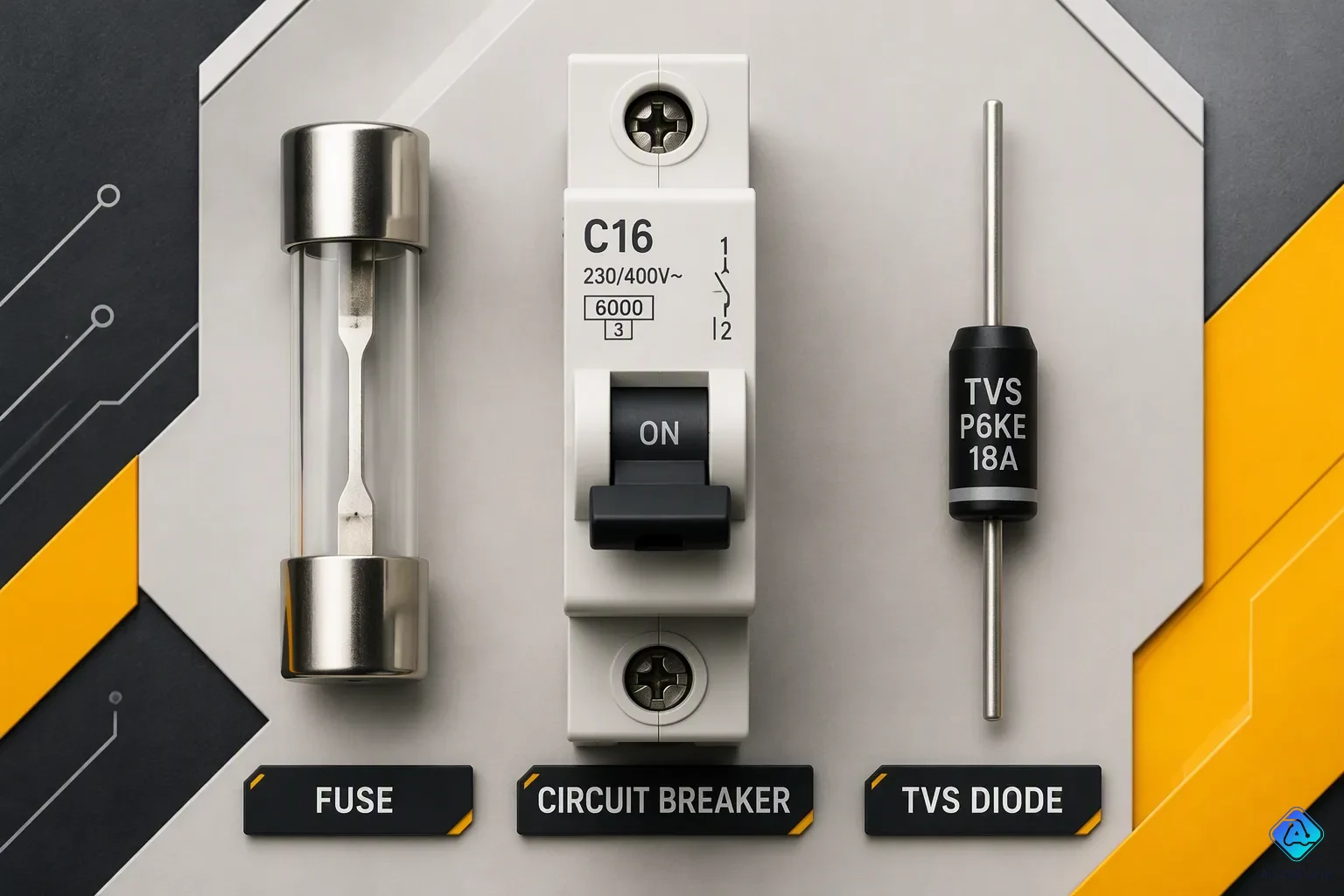
In the debate of Fuses vs Circuit Breakers vs TVS Diodes, each serves a distinct role in circuit protection. A fuse is a one-time overcurrent device that protects against overloads and short circuits. A circuit breaker is a resettable overcurrent device that handles both overloads and short circuits. A TVS diode is a semiconductor overvoltage protector that clamps voltage spikes in nanoseconds. Think of a fuse as a one-time wire that burns out, a breaker as a switch you flip back, and a TVS diode as a surge absorber. This blog compares their working principles, response times, and resettability. You will learn which protection device fits your needs. Understanding these differences helps you design reliable circuit protection. A zener diode regulates steady voltage, while a TVS diode handles fast transients. You need both overcurrent and overvoltage strategies for complete safety.
Key Takeaways
-
Fuses only protect against overloads, and you must replace them after one use.
-
Circuit breakers deal with overloads and short circuits and can be reset.
-
TVS diodes stop sudden voltage spikes in just a few billionths of a second, keeping delicate electronics safe.
-
Use a fuse or breaker to stop too much current, and a TVS diode to stop too much voltage, for full protection.
Overcurrent Protection: Fuses and Circuit Breakers
When too much current flows through a circuit, you need devices that can stop the flow before damage happens. Fuses and circuit breakers do this job, but they work in different ways and give different levels of protection.
Fuses: Overcurrent Protection
A fuse has a metal link that melts when current goes above its rated level. This melting vaporizes the link material, which fully breaks the circuit. After the fuse works, you must replace it. This one-time use makes fuses simple and cheap for basic overcurrent protection.
Fuses react to overloads based on their time-current curves. Manufacturers draw these curves on log-log paper, showing average melting times at different current levels. Different fuse types react differently. Fast-acting fuses open quickly, while time-delay fuses allow brief surges. Type RK-5 fuses, often used in motor disconnects, have interrupting ratings from 50 kA AC to 200 kA AC. Ultra-fast semiconductor fuses handle fault currents over 100 kA for special uses.
You should know that fuses protect against both overloads and short circuits. Each fuse has an interrupting rating, which is the maximum fault current it can safely clear. For example, Type RK-5 fuses have interrupting ratings up to 200 kA AC. Ultrafast semiconductor fuses can handle fault currents over 100 kA. If the fault current exceeds the fuse's interrupting rating, the fuse may not safely clear the fault.
Circuit Breakers: Overload and Short Circuit Protection
Circuit breakers give wider protection. They handle both overloads and short circuits using two mechanisms. A thermal part uses a bimetallic strip that bends with heat, releasing a latch during overloads. A magnetic part uses an electromagnet that trips the breaker instantly during short circuits.
You can reset a circuit breaker after it trips. This reset feature makes breakers handy for places where you expect repeated faults. Thermal-magnetic breakers come with different trip curves. B-curve breakers trip at 3-5 times rated current for resistive loads. C-curve breakers trip at 6-10 times for transformer loads. D-curve breakers trip at 10-15 times for motor loads with high starting inrush.
For example, a 10 A B-curve breaker handles a 20 A overload by tripping between 10 and 100 seconds. A 70 A short circuit trips the same breaker between 0.001 and 0.01 seconds. This inverse-time thermal response plus instant magnetic response gives you full overcurrent protection in one device.
TVS Diodes for Overvoltage Protection
Fuses and circuit breakers handle too much current, but they cannot protect your circuit from voltage spikes. A tvs diode works differently. This semiconductor device sits quietly in your circuit during normal operation. It only activates when voltage rises above a safe threshold. You can think of it as a pressure relief valve for electrical energy.
Clamping Voltage Spikes
A tvs diode detects overvoltage events in nanoseconds. When voltage exceeds the predetermined threshold, the diode senses the difference almost instantly. It then clamps the voltage to a safe level, diverting excess energy away from your sensitive components. This clamping action happens so fast that your equipment never sees the full force of the spike.
You might wonder how a tvs diode differs from a zener diode. Both devices regulate voltage, but they serve different purposes. A zener diode maintains a steady reference voltage for continuous operation. A tvs diode remains inactive until a transient strikes. While a zener diode handles constant small variations, a tvs diode absorbs sudden, high-energy pulses. This makes the tvs diode ideal for transient voltage suppression in sensitive electronics.
The table below shows the operational limits for repetitive pulses:
| Parameter | Specification |
|---|---|
| Maximum duty cycle for repetitive pulses | 0.01% (ratio of pulse duration to interval between pulses) |
| Consequence of exceeding duty cycle | Cumulative heating leading to device failure |
| Reliability after thousands of non-repetitive high-energy pulses | Maximum power rating remains above 80% of original value |
You must respect this duty cycle limit. Exceeding it causes cumulative heating that destroys the device. For occasional spikes, however, the tvs diode proves remarkably durable.
TVS Diodes vs Fuses and Breakers
The differences between a tvs diode and overcurrent devices come down to speed and function:
-
A tvs diode responds in picoseconds to nanoseconds, clamping voltage to a safe level, dissipating surge energy as heat, and returning to standby state — unlike fuses or circuit breakers which interrupt the circuit.
-
A tvs diode cannot carry sustained fault current. You should pair it with an appropriately rated fuse or circuit breaker upstream to handle sustained overcurrent protection while the tvs diode handles short-duration transients.
Fuses and breakers react in milliseconds. A tvs diode reacts thousands of times faster. This speed matters because voltage spikes can destroy components in microseconds. Your fuse might eventually blow, but the damage happens first. The tvs diode stops the spike before it reaches your components.
Remember that a tvs diode provides overvoltage protection, not overcurrent protection. You need both strategies for complete circuit safety. Use a fuse or breaker for sustained faults. Use a tvs diode for transient protection against lightning, switching surges, and electrostatic discharge. Together, these devices give you comprehensive surge protection for your design.
Comparison of Circuit Protection Components
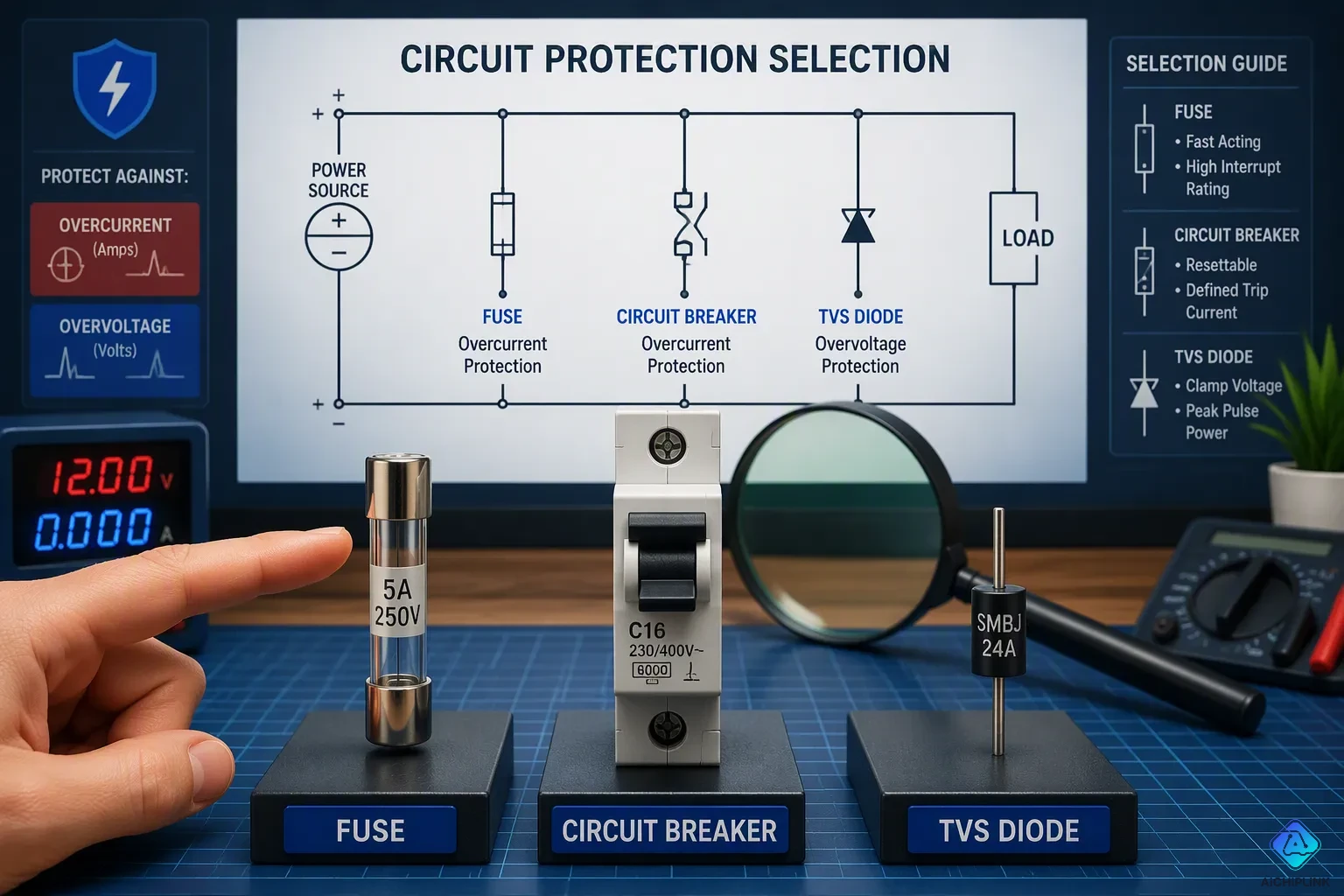
You now know how each device works on its own. But how do they compare when you put them next to each other? Fuses and circuit breakers both protect against too much current. A TVS diode protects against too much voltage. These two types handle different problems. Yet you often need both in one design. The table below shows if each part can be reset after it works.
| Component | Resettability | Replacement Requirement |
|---|---|---|
| Fuse (one-time) | Not resettable | Must be replaced after a fault |
| Circuit breaker | Resettable | Can be toggled back to 'on' after fault is cleared |
| PTC resettable fuse | Resettable | No replacement needed; designed for temporary overcurrent |
Response Time and Resettability
Response time sets these devices apart more than any other thing. A TVS diode reacts in nanoseconds. It clamps voltage spikes before they reach your sensitive parts. Fuses and circuit breakers respond in milliseconds. That feels like forever in electronics. When lightning strikes or a switching surge happens, the TVS diode absorbs the energy right away. Your fuse might blow later. But the spike would have already destroyed your parts without the TVS diode.
Resettability also differs a lot among these circuit protection parts. A fuse works once and then you must replace it. You need to carry spare fuses and swap them after each fault. A circuit breaker trips and you just flip it back to "on." This ease makes breakers great for places where you expect many faults. A TVS diode resets on its own after clamping a spike. But only if you do not go over its duty cycle rating. It goes back to standby mode and waits for the next spike. This self-resetting feature makes the TVS diode almost maintenance-free.
You should also think about the zener diode in this comparison. A zener diode controls steady voltage all the time. A TVS diode stays off until a spike hits. Both use similar semiconductor physics. But they serve different jobs. A zener diode handles constant small changes in voltage. A TVS diode absorbs sudden, high-energy pulses. You would not use a zener diode for voltage spike protection. It cannot handle the power of large surges. You would not use a TVS diode for voltage control either. It stays off during normal operation.
When to Use Each Device
Your project decides which protection part works best. For simple, low-cost overcurrent protection, pick a fuse. For circuits that need reset ability, choose a circuit breaker. For sensitive electronics that face spikes, install a TVS diode. Many designs mix these methods for full surge protection.
Car electronic control units show this mix clearly. A TVS diode gives DC power protection against voltage spikes. It also offers ESD protection for sensitive electronic circuits. You will find TVS diodes guarding sensors linked to the ECU. They protect entertainment systems built into car electronics. They also guard the electronic control units themselves. These uses need protection against load dump events and other fast voltage spikes. A fuse alone cannot handle these quick, high-energy events. The TVS diode clamps the spike. A fuse or breaker upstream handles longer overcurrent faults.
Think about the trade-offs carefully. Fuses cost less but need replacement. Circuit breakers cost more but are easy to use. A TVS diode costs little and protects against overvoltage. But it cannot carry a long fault current. You need overcurrent protection from a fuse or breaker. You also need overvoltage protection from a TVS diode. Together, these circuit protection parts create a full defense for your design. Check your circuit's dangers and pick the right protection part. Or use a mix of them to make sure it works well.
Selecting the Right Circuit Protection
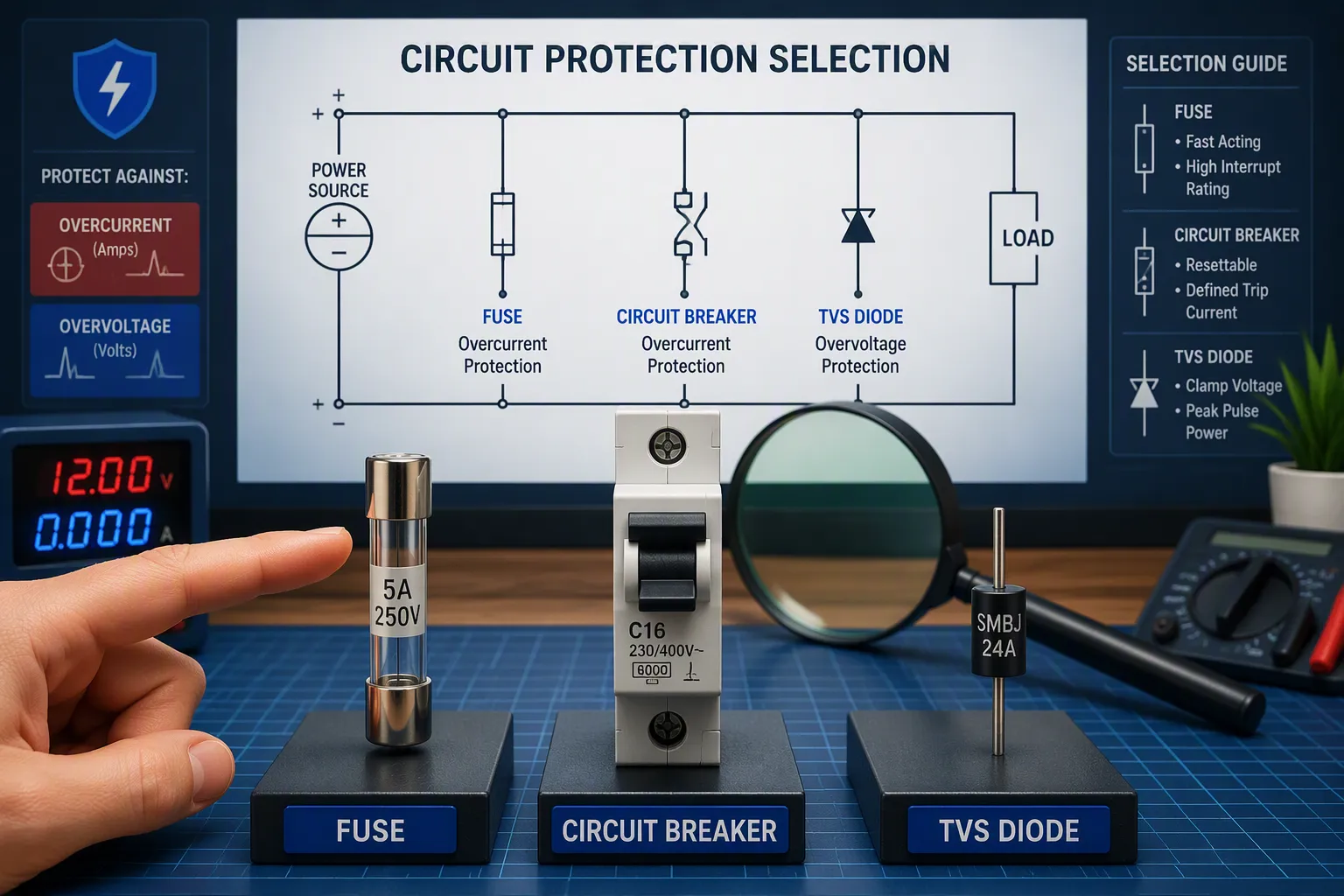
Choosing the right protection part depends on the danger you face. You need to know if your circuit has too much current, too much voltage, or both. Each case needs a different fix. The table below shows the key points for picking each part.
| Criterion | Fuse | Circuit Breaker | TVS Diode |
|---|---|---|---|
| Threat type | Too much current | Too much current | Too much voltage / Surge |
| Action | Breaks the circuit (opens) | Breaks the circuit (opens) | Holds voltage down (shunts) |
| Recovery | One-time use (replace) | Can be reset (by hand) | Fixes itself (holds, can be used again) |
| Speed | Slow (heat-based) | Slow (heat-based) | Very fast (billionths of a second) |
| Typical location | On a board, at the line | In a panel, at equipment input | On a board near sensitive chips |
| Key parameters | Rated current, time-current, interrupting capacity | Trip curve, interrupting rating | Standoff voltage, clamping voltage, peak pulse power, response time |
Choosing Based on Use
Start with the type of danger. A fuse works well for simple, low-cost protection against too much current. You might protect a motor circuit or a lighting branch. The fuse sits at the board level or line input. It breaks the circuit when current goes over its rating. You replace it after each fault.
A circuit breaker works for places where you want to reset it. Panel boards and equipment inputs often use breakers. You flip the breaker back to "on" after clearing the fault. This saves time in factories. You also get resettable short-circuit protection.
A tvs diode protects sensitive electronics from voltage spikes. Put it near chips that face surges. The tvs diode holds down high voltage in billionths of a second. It moves extra energy away from your parts. You might pair it with a fuse or breaker upstream for full coverage.
Think about how to size a fuse carefully. You must pick the right fuse for your load. Follow these steps:
-
Find the steady load: Measure the highest steady current.
-
Apply a derating factor: Select a fuse rating that is larger than the continuous load current to avoid nuisance tripping.
-
Adjust for ambient temperature: Use a derating factor from the manufacturer's datasheet if the operating temperature is high.
-
Pick the next standard size: Choose the next standard fuse rating.
-
Check wire size: Ensure the wire gauge is rated for the fuse current.
Motor circuits need extra care. Size time-delay fuses to accommodate starting inrush without nuisance tripping.
Main Trade-offs
Every protection part has trade-offs. Cost matters for production budgets. Fuses cost the least but need replacement. Circuit breakers cost more but are easy to reset. A tvs diode costs little and protects against too much voltage. You must weigh these against your needs.
Space also affects your choice. A tvs diode takes up very little board space near sensitive chips. A circuit breaker takes up panel space. A fuse is somewhere in between. Your layout decides which works best.
Speed is another trade-off. A tvs diode reacts in billionths of a second. Fuses and breakers respond in thousandths of a second. For quick spikes, speed saves your parts. For long faults, slower response is fine. You need both speeds for full protection.
Think about whether the part can handle long faults. A tvs diode cannot carry a steady fault current. It holds down a spike and goes back to standby. Going over its duty cycle causes heat buildup and failure. A fuse or breaker handles long overcurrent conditions. The zener diode controls steady voltage but cannot take large surges. The tvs diode absorbs big energy pulses but stays off during normal use. You need the right part for each job.
Your final choice depends on your circuit's specific dangers. Check the threats. Pick the right protection part or combine them. A fuse for too much current and a tvs diode for quick spikes makes a strong defense. This layered approach helps your design survive real-world conditions.
Comparing fuses, circuit breakers, and TVS diodes shows they each have different jobs. A TVS diode clamps overvoltage spikes, while a zener diode regulates steady voltage. A zener diode cannot handle surges, but a TVS diode handles sudden energy spikes. A zener diode manages small, constant voltage changes, and a TVS diode stays off until a spike hits. A zener diode works all the time to regulate steady voltage, while a TVS diode handles transient spikes. Fuses and circuit breakers protect against overcurrent, and breakers are resettable. Use a fuse for overcurrent and a TVS diode for surge protection. Choose a TVS diode for spike immunity. A zener diode serves voltage regulation, and a TVS diode absorbs high-energy pulses. A zener diode keeps a reference voltage, and a TVS diode resets after a spike. A zener diode operates continuously. The question of fuses vs circuit breakers vs TVS diodes helps you pick the right protection device. Evaluate your circuit's dangers and combine devices for full protection.

Written by Jack Elliott from AIChipLink.
AIChipLink, one of the fastest-growing global independent electronic components distributors in the world, offers millions of products from thousands of manufacturers, and many of our in-stock parts is available to ship same day.
We mainly source and distribute integrated circuit (IC) products of brands such as Broadcom, Microchip, Texas Instruments, Infineon, NXP, Analog Devices, Qualcomm, Intel, etc., which are widely used in communication & network, telecom, industrial control, new energy and automotive electronics.
Empowered by AI, Linked to the Future. Get started on AIChipLink and submit your RFQ online today!
Frequently Asked Questions
What is the difference between a TVS diode and a zener diode?
A zener diode keeps voltage steady during normal operation. A TVS diode stays inactive until a voltage spike happens. It clamps the spike in nanoseconds and then resets. A zener diode cannot handle large surge energy.
Can a fuse protect against short circuits?
Yes, a fuse can protect against short circuits, but it is a one-time device. It must be replaced after a fault. A circuit breaker handles both overloads and short circuits and is resettable. A zener diode does not protect against overcurrent. Use a zener diode for voltage regulation instead.
How fast does a TVS diode respond compared to a fuse or breaker?
A TVS diode responds in nanoseconds. Fuses and circuit breakers respond in milliseconds. This speed difference matters because voltage spikes can destroy components in microseconds. A zener diode also reacts quickly but cannot handle surge power.
Do I need both a fuse and a TVS diode in my circuit?
Yes, you need both for full protection. A fuse or breaker handles overcurrent. Overvoltage spikes require a separate device. A zener diode provides steady voltage regulation but not surge protection. Use a zener diode for constant voltage control.
Can a circuit breaker replace a fuse?
A circuit breaker can replace a fuse for overcurrent protection. It offers resettability and short circuit protection. However, a zener diode provides voltage regulation. A zener diode cannot handle surge energy. Use a zener diode for steady voltage control.