MAC vs PHY in Automotive Ethernet What Sets Them Apart
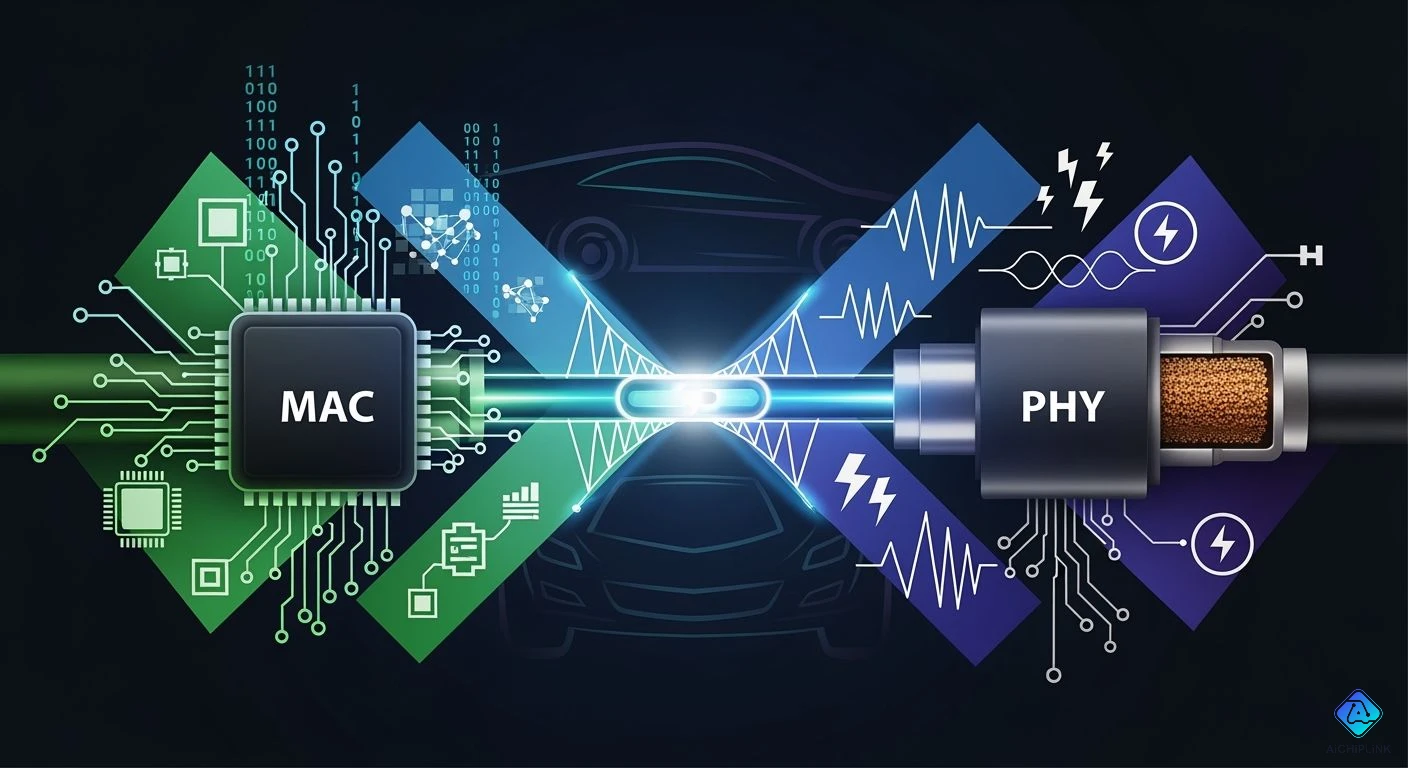
You can see a big difference between the mac and phy layers in automotive ethernet. The mac works with data frames, addresses, and controls who can use the network. The phy changes these digital frames into electrical signals to send them. Knowing about MAC vs PHY in Automotive Ethernet helps you build strong car networks. Look at this table for a fast comparison:
| Feature | Ethernet MAC | Ethernet PHY |
|---|---|---|
| OSI Layer | Data Link (Layer 2) | Physical (Layer 1) |
| Main Role | Frame management, addressing | Signal conversion, transmission |
Key Takeaways
-
The MAC layer handles data frames and controls who uses the network. It makes sure communication in car networks is organized.
-
The PHY layer changes digital data into signals for sending. This lets devices talk to each other using things like cables.
-
Knowing how MAC and PHY are different helps people design good car Ethernet systems. These systems need to be reliable and work well.
-
Picking the right PHY transceiver is very important. It helps cars get fast data and keeps them working well.
-
Putting MAC and PHY layers together the right way helps car systems talk to each other. This makes cars safer and work better.
What Is the MAC Layer in Ethernet?
Ethernet MAC Layer Overview
You use the mac layer when you send or get data over ethernet. The mac layer means media access control. It is part of the data link layer in the OSI model. IEEE 802.3 standards say the ethernet mac layer sets rules for building, addressing, sending, and checking frames. Every ethernet frame has source and destination mac addresses, payload data, and a frame check sequence. In full-duplex ethernet, the mac layer lets devices send and get data at the same time. Devices do not worry about collisions.
Tip: The mac layer connects right to the physical layer. This helps your data move from digital frames to signals easily.
Here’s a simple table with the formal definition:
| Aspect | Description |
|---|---|
| Standard | IEEE 802.3 |
| MAC Sublayer Definition | Sets rules for how ethernet frames are made, addressed, sent, and checked. |
| Frame Components | Has source and destination mac addresses, payload data, and a Frame Check Sequence (FCS). |
| Operation | In full-duplex ethernet, the mac works without contention. Devices can send and get data at the same time without collisions. |
Main Functions of MAC
The ethernet mac layer does many important jobs. It puts together and takes apart frames. It controls how devices use the network. It checks for errors. The mac layer adds special mac addresses to each frame. This helps devices know each other. It uses CRC to find errors and keeps the network working well.
-
The mac layer works with hardware like a Network Interface Card (NIC).
-
It handles data encapsulation and media access control.
-
You see mac addresses in every frame header.
-
The mac layer puts frames on ethernet cables and takes them off when received.
-
It does framing, physical addressing, and error control.
Here’s a table of main responsibilities:
| Responsibility/Function | Description |
|---|---|
| Frame encapsulation and decapsulation | The mac layer puts together and takes apart frames. |
| Media access arbitration | It controls how devices use the media. It supports half and full duplex. |
| Error detection via CRC | Checks for errors using Cyclic Redundancy Check (CRC). |
| Addressing using mac addresses | Adds special mac addresses to frame headers for identification. |
The mac layer listens to the channel and decides when a device can send data. It uses CSMA/CD to stop collisions. Only one device sends data at a time. This keeps your ethernet network safe and makes sure data stays correct.
MAC in Automotive Ethernet
In automotive ethernet, the mac layer changes to meet strict needs. You need fast and reliable communication between car systems. The ethernet mac layer wraps data with source and destination mac addresses. It controls access and finds errors using FCS. It also helps stop congestion with flow control. The mac layer connects with the network layer. It handles protocol identification, error checking, and flow control.
| Function | Description |
|---|---|
| Framing | Wraps data with source and destination mac addresses. |
| Access Control | Controls how devices share the physical transmission medium. |
| Error Detection | Finds transmission errors using frame check sequence (FCS). |
| Flow Control | Helps stop network congestion. |
| LLC Sublayer | Connects with the network layer. Handles protocol identification, error checking, and flow control. |
| MAC Sublayer | Wraps frames, manages addressing, and enforces media access rules. |
You count on the ethernet mac layer to keep car networks safe and working well. It makes sure every message gets where it needs to go without errors or delays.
What Is the PHY Layer in Ethernet?
Ethernet PHY Layer Overview
You use the ethernet phy when you connect devices to a network. The ethernet phy layer is at the lowest part of the OSI model. IEEE standards say the phy layer is an electronic circuit. It is often a chip that links your device to the physical medium. You use the ethernet phy to connect to copper cables or optical fibers. The ethernet phy has the physical coding sublayer and the physical medium dependent layer. You count on the ethernet phy to change digital data into signals. These signals travel across wires or fiber.
Note: The ethernet phy layer helps your data move from your device to the cable or fiber. It makes sure your information does not get lost.
Main Functions of PHY
You need the ethernet phy for many important jobs. The ethernet phy layer sends raw bits over cables or fiber. It encodes signals and keeps them in sync. The ethernet phy decides how devices connect and use the medium.
-
The ethernet phy changes digital bits into electrical, radio, or optical signals.
-
It sets voltage levels and timing for sending data.
-
It controls the bit rate and chooses simplex, half duplex, or full duplex modes.
-
The ethernet phy decides the physical layout and how devices share the network.
You see the ethernet phy working when you plug in a cable and send data. It keeps your signals clear and helps them reach their destination.
PHY in Automotive Ethernet
You face special problems when you use ethernet phy in cars. The ethernet phy must work in tough places. You need the ethernet phy to handle temperatures from -40°C to +125°C. It must fight electromagnetic interference and keep signals strong during vibration or humidity.
Here is a table showing how the ethernet phy manages signal encoding and transmission in automotive ethernet:
| Sublayer | Function |
|---|---|
| Physical Signaling (PLS) | Handles Manchester encoding and decoding. |
| Medium Attachment Unit (MAU) | Manages the physical connection, isolation, link test pulses, and TP_IDL signals. |
| Attachment Unit Interface (AUI) | Connects the PLS and MAU sublayers. |
| Twisted Pair Wiring | Sends signals over CAT-3 or CAT-5 cables using two pairs for transmit and receive. |
| Differential Signal | Uses two voltage levels for each pair: high (+2.2V to +2.8V) and low (-2.2V to -2.8V). |
You depend on the ethernet phy to keep your car’s network safe. It protects your data from interference. It keeps communication steady even when conditions change.
MAC vs PHY in Automotive Ethernet: Key Differences
Interface and Communication
When you compare mac and phy in automotive ethernet, how they connect matters a lot. The mac layer works with data frames and controls network access. The phy layer sends signals over cables. You link the mac and phy with special interfaces. These interfaces help your data move from digital frames to physical signals.
Some common interface standards are:
-
MII (Media Independent Interface): Used for 10/100 Mbps ethernet.
-
GMII (Gigabit Media Independent Interface): Supports gigabit ethernet speeds.
-
RGMII (Reduced Gigabit Media Independent Interface): Uses fewer pins for gigabit ethernet.
-
SGMII (Serial Gigabit Media Independent Interface): Uses serial communication for faster speeds and simpler wiring.
Automotive ethernet often uses the 10BASE-T1x MAC-PHY Serial Interface Specification. This standard gives better connections between the mac and phy layers. The IEEE Standard for Ethernet Amendment updates how these layers work together. It supports single and multi-port setups. These standards help you build strong and fast networks in cars.
| Specification | Description |
|---|---|
| 10BASE-T1x MAC-PHY Serial Interface Specification | Shows the interface between MAC and PHY layers. It gives better connections for Automotive Ethernet. |
| IEEE Standard for Ethernet Amendment | Changes IEEE Std 802.3 for new interfaces between MAC and PHY. It supports single and multi-port setups. |
Comparison Table: MAC vs PHY
You need to know the main differences between mac and phy layers when designing automotive ethernet systems. The table below shows how their jobs and roles compare.
| Parameter | MAC Layer (Media Access Control) | PHY Layer (Physical Layer) |
|---|---|---|
| OSI Layer | Data Link (Layer 2) | Physical (Layer 1) |
| Main Role | Frame management, addressing, access control | Signal conversion, transmission, reception |
| Error Detection | Uses CRC, parity checking, checksum | Checks signal quality, not frame errors |
| Data Framing | Groups bits into frames for sending | Sends raw bits |
| Physical Signaling | Not involved | Changes digital data to electrical or optical signals |
| Collision Avoidance | Controls channel access, stops collisions | Supports bus communication, lets devices send beacons |
| Topology Support | Works with different network shapes | Supports mixing segments and multidrop connections |
| Compliance Testing | Checks frame structure | Tests signal quality and strength |
The mac layer organizes and protects your data. The phy layer makes sure signals travel safely across cables or fiber.
Summary of Differences
You find many differences when you compare mac and phy in automotive ethernet. The mac layer works at the data link level. It manages frames, addresses, and checks for errors. The phy layer works at the physical level. It changes digital data into signals and sends them over wires or fiber.
-
The mac layer gives framing, error checking, and access control. It keeps your data neat and safe.
-
The phy layer handles signal encoding, voltage levels, and timing. It moves your data through tough car environments.
-
In automotive ethernet, mac and phy layers must work together. You need both for fast and reliable communication in cars.
Tip: When you design car networks, always check the interface standards between mac and phy. This helps you avoid problems and makes sure your network meets industry rules.
You also need to think about signaling methods and collision avoidance. For example, 10BASE-T1S uses DME signaling. This is cheap and allows quick clock recovery. The topology supports mixing segments, so you can connect many devices on one channel. Bus communication in multidrop mode lets devices send beacons to stop collisions. Compliance testing means you must copy these conditions in the lab.
When you know the differences between mac and phy in automotive ethernet, you can make better choices for your car networks. You make sure your systems are strong, reliable, and ready for the road.
How MAC and PHY Work Together in Ethernet
Data Flow and Signal Conversion
You see the real power of ethernet when the mac and phy layers work together. The mac layer starts by building a data frame. It adds addresses and checks for errors. After the frame is ready, the mac sends it to the phy. The phy takes this digital data and changes it into signals that can travel through wires. This process is called signal conversion.
Here is a simple table that shows how data moves from the mac to the phy and back:
| Step | Description |
|---|---|
| 1 | The mac layer prepares the data frame. |
| 2 | The phy converts it into the appropriate analog waveform and transmits it over the medium. |
| 3 | On the receiving side, the phy decodes the signal and passes the data bits back to the mac for reassembly. |
You use the MII, or Media Independent Interface, to connect the mac and phy. This interface makes sure that different chips from different companies can work together. You get reliable data flow because the mac and phy follow the same rules.
Importance in Automotive Networks
You depend on mac/phy integration to keep your car’s network strong and safe. In automotive ethernet, you need fast and steady communication between many devices. The mac manages who can send data and when. The phy makes sure the signals stay clear, even with noise or vibration.
Here are some ways the mac and phy work together for reliable data transmission:
-
The phy converts digital signals from the mac into physical signals for sending and receiving.
-
The mac manages access to the network and stops conflicts when many devices want to send data.
-
The MII gives a standard way for the mac and phy to connect, so you can use parts from different makers.
You see mac/phy integration in every part of your car’s ethernet network. This teamwork lets you trust that messages from sensors, cameras, and controllers reach their destination without errors. When you design automotive networks, you make sure the mac and phy work together for the best performance.
Practical Implications for Automotive Design
Reliability and Performance
When you build a car network, your mac and phy choices matter. They decide how well the system works. You want every message to arrive fast and without mistakes. The right phy transceiver gives you enough speed for smart car features. It helps with things like driver-assistance and entertainment. Modern cars use data rates like 100 Mbps or even 1000 Mbps. High-performance phy transceivers help ECUs, sensors, and actuators talk without stopping. As cars get more connected, you depend on these layers for strong and steady communication.
-
Picking phy transceivers affects speed and efficiency.
-
Data rates of 100 Mbps and 1000 Mbps support new car features.
-
High-performance phy transceivers keep links between ECUs, sensors, and actuators reliable.
Integration Considerations
You need to think about more than speed when choosing mac and phy parts. Start by focusing on electromagnetic compatibility (EMC) to avoid noise problems. Learn about both differential and common-mode noise. Pre-compliance testing helps you find issues early and saves money. Using the right passive parts, like chokes and ferrites, helps you follow EMI rules.
-
Focus on EMC early, including different noise types.
-
Use pre-compliance testing to catch problems before they grow.
-
Pick passive parts like chokes and ferrites for EMI compliance.
Signal integrity testing is also important. Test during design to spot issues before they get worse. When you put everything in the car, test again to choose the best cables and routes. Always check how ECUs work when there is electromagnetic noise.
-
Do signal integrity testing during design and integration.
-
Choose cables and routes for the best results.
-
Check ECU performance in noisy places.
You see these steps in real car projects. Engineers test mac and phy setups in electric cars to make sure cameras and sensors work in tough conditions. Careful planning and testing help you build networks that last.
You can see that mac and phy do different jobs in your car’s network. Mac takes care of frames and who can use the network. Phy changes data into signals and sends them. If you know these differences, you can pick the best parts for safety and good performance.
-
New protocols like TSN and AVB help cameras and sensors send real-time data.
-
Standards like IEEE 802.1AS and MACsec make time sync better and keep data safe.
-
Following AEC-Q200 means connectors work well and block noise.
When you know how mac and phy work, you can make smarter choices for your car’s network in the future.

Written by Jack Elliott from AIChipLink.
AIChipLink, one of the fastest-growing global independent electronic components distributors in the world, offers millions of products from thousands of manufacturers, and many of our in-stock parts is available to ship same day.
We mainly source and distribute integrated circuit (IC) products of brands such as Broadcom, Microchip, Texas Instruments, Infineon, NXP, Analog Devices, Qualcomm, Intel, etc., which are widely used in communication & network, telecom, industrial control, new energy and automotive electronics.
Empowered by AI, Linked to the Future. Get started on AIChipLink and submit your RFQ online today!
Frequently Asked Questions
What is the main job of the MAC layer in automotive networks?
You use the MAC layer to manage data frames. It controls who can send data and checks for errors. This layer helps your car’s network stay organized and safe.
Why do you need a physical layer transceiver in cars?
You need a physical layer transceiver to change digital data into signals that travel through wires. It helps your car’s devices talk to each other, even in tough conditions.
How do MAC and PHY layers connect in automotive systems?
You connect the MAC and PHY layers using special interfaces like MII or RGMII. These interfaces let data move smoothly from digital frames to physical signals.
Can you use the same MAC and PHY chips in every car model?
You cannot always use the same chips. Each car may need different speeds, features, or levels of protection. You must pick the right parts for your design.
What happens if the PHY layer fails in a vehicle?
If the PHY layer fails, your car’s devices cannot send or receive data. This can stop important systems from working. You should always test the physical layer transceiver for reliability.