Commonly Used Circuit Protection Components in Electronics
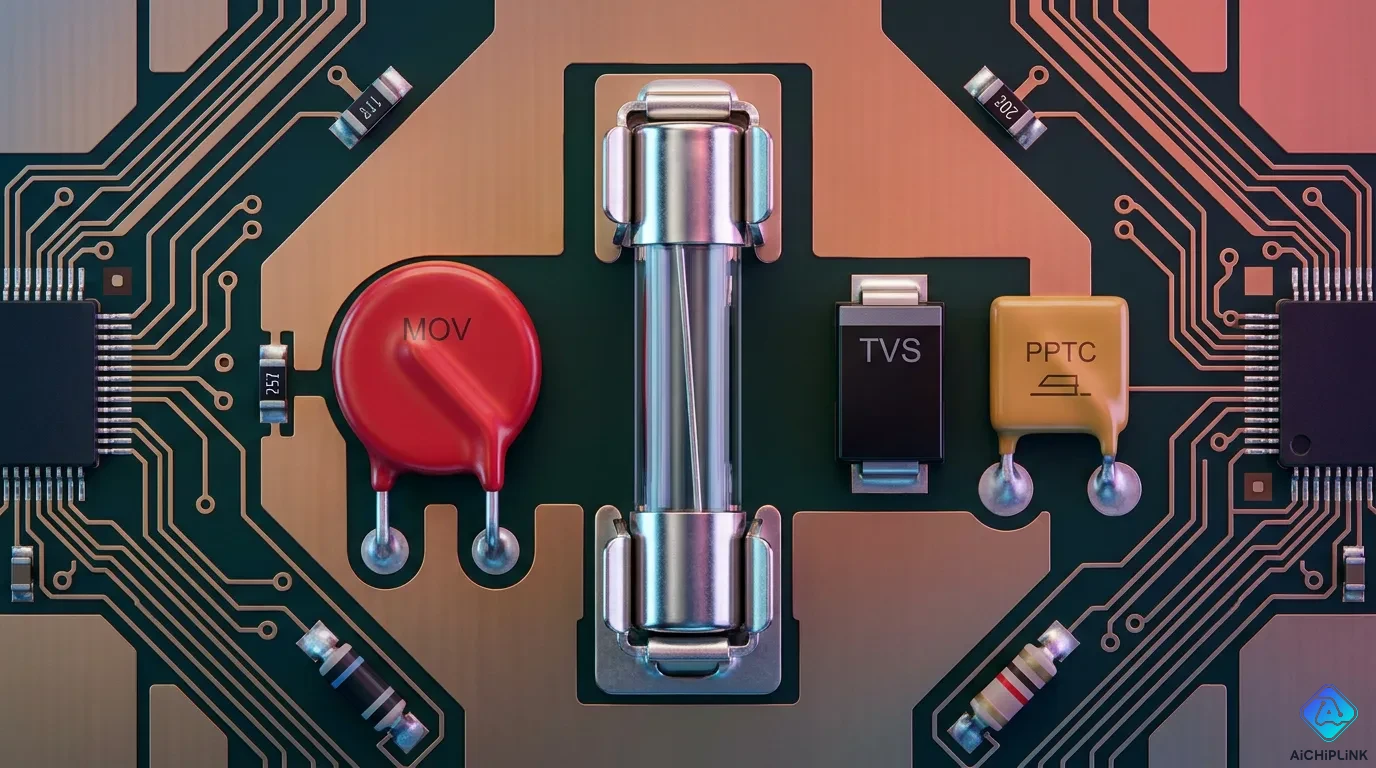
Circuit protection safeguards electronic devices against power surges, excessive heat, and overcurrent conditions. Without adequate defenses, sudden power spikes can destroy delicate hardware permanently. Modern designs rely on distinct functional categories to stop electrical hazards: transient overvoltage suppression, current limiting, thermal protection, and EMC filtering. You must choose Commonly Used Circuit Protection Components carefully to isolate sensitive integrated circuits from catastrophic field failure.
As many as 75% of integrated circuit failures can be attributed to voltage transient events.
Proper component selection prevents thermal runaway and catastrophic board failure. You also ensure your final design complies with all global electrical safety standards.
Key Takeaways
-
Circuit protection devices save delicate microchips from dangerous power surges and extra heat.
-
TVS diodes and varistors quickly block sudden voltage spikes from destroying electronic parts.
-
Resettable PTC devices block too much current and go back to normal after they cool down.
-
Engineers multiply normal current by 1.25 to choose the right breaker size.
Overview of Commonly Used Circuit Protection Components
You can protect electronic parts by putting safety devices right into circuit pathways. Engineers use standard groups of parts to manage electrical dangers safely. These groups include fuses, TVS diodes, metal oxide varistors (MOVs), polymer PTC devices, thermal cutoffs, and circuit breakers. Each part reacts to specific electrical threats to keep your overall system running safely.
Categorizing Protection by Fault Types
You can group safety parts by the exact electrical problems they fix. Overcurrent events threaten your hardware when electricity goes past safe limits. Fuses, circuit breakers, and protective relays quickly block these high currents. Overvoltage events need fast suppressors like surge protective devices (SPDs), MOVs, and lightning arresters. TVS diodes react in nanoseconds to stop sudden voltage spikes. Continuous overcurrent protection devices take a few milliseconds to clear steady overloads.
Thermal faults happen when inside heat builds up to dangerous levels. Thermal cutoffs cut off electric power during overheating to stop fires in home appliances. Thermal-magnetic circuit breakers work along the heat section of time-current curves to manage long overloads. Ground Fault Circuit Interrupters (GFCIs) find escaping current to shield people from shocks in wet areas. You connect each part to one specific fault type to protect delicate electronics easily.
Primary versus Secondary Protection Devices
Circuit plans split parts into primary and secondary protection roles. Primary devices give direct protection by physically stopping bad fault currents. Molded Case Circuit Breakers (MCCBs) follow UL 489 rules to guard power circuits safely. Simple fuses offer low prices and high short-circuit power limits from 10kA to 100kA. Fuses work as single-use parts that you must swap out after they blow. MCCBs give resettable protection with strong power limits from 22kA to 65kA.
Secondary protection devices offer indirect help to back up your main equipment. Parts like current transformers (CTs) and potential transformers (PTs) read current and voltage levels clearly. These extra tools send their measurement numbers right to protective relays. The relays then signal primary circuit breakers to pop open during bad fault events. Using Commonly Used Circuit Protection Components in primary and secondary steps provides strong safety for your whole system.
Overvoltage Protection Devices
TVS Diodes and ESD Suppressors
You protect delicate microchips from static power by putting transient voltage suppression (TVS) diodes alongside your parts. These safety tools keep resistance high during normal power levels. Quick electrostatic discharge (ESD) spikes force the TVS diode over its active trip point. Part resistance falls right away, and the tool safely directs bad current into the ground line. When the power drops back down, the TVS diode turns off by itself. Place the protector close to the edge plug. This clever circuit board setup keeps wire interference tiny and blocks bad power before hitting your chips.
You must pick between one-way and two-way TVS diodes depending on your exact wire needs. One-way diodes protect simple single-direction power lines. Two-way diodes defend back-and-forth data lines and system networks.
| Aspect | Unidirectional TVS | Bidirectional TVS |
|---|---|---|
| Circuit Type | Single-pole | Bipolar, differential, CAN, AC |
| Polarity Protection | Protects one polarity | Protects positive and negative |
| Fault Protection | Less robust | More robust protection |
Varistors and Gas Discharge Tubes
Metal Oxide Varistors (MOVs) and Gas Discharge Tubes (GDTs) save your setup from large voltage jumps. MOVs act in tiny fractions of a second to cap power spikes, but GDTs use ionized gas to bleed off massive lightning strikes. Pick MOVs if your board needs fast speeds, low power limits, and steady heat soaking.
Engineers pick MOVs instead of GDTs for many regular uses:
-
Consumer electronics: Cell phones, computers, and smart TVs get quick shelter from sudden power jumps.
-
Automotive systems: Screen units, computer brains, and battery setups handle sudden alternator spikes and static shocks.
-
Telecom base stations: Cellular network towers avoid real harm from heavy lightning strikes.
-
Smart home tools: Connected house gear gets small-sized surge safety.
-
Industrial automation: Factory power boxes easily control big current shifts in normal power systems.
Overcurrent and Thermal Protection Components
Good heat safety blocks hot current surges before they ruin your power paths. Strong current spikes quickly melt tiny board parts and burn thin copper lines. Using correct parts stops sudden short circuits from causing permanent system damage.
Fuses and Resettable PTC Devices
Standard fuses offer single-use safety by melting an inner wire during heavy electrical faults. Polymer PTC tools give your modern hardware designs a simple, self-resetting alternative.
| Feature | Polymer PTC Thermistor | Traditional Fuse |
|---|---|---|
| Response to overcurrent | Dramatically increases resistance, limiting current flow | Melts and permanently breaks the circuit |
| Resetting capability | Self-resets after fault removal and cooling | Requires replacement after one trip |
| Maintenance | Low – resettable, reduces downtime | High – one-time use, needs manual replacement |
| Protection scope | Overcurrent and overtemperature protection | Overcurrent protection only |
| Size | Compact, space-saving | Typically larger |
You check two key numbers called hold current and trip current when picking PTC parts.
| Parameter | Value |
|---|---|
| Hold current | 2A |
| Trip current | 4A |
A part built with a 2A hold current safely carries normal power without stopping. An electrical fault pushing power to the 4A trip mark forces the PTC high.
Standard fuses also react at different speeds based on your total system power needs.
| Characteristic | Fast-Acting Fuse | Time-Delay Fuse |
|---|---|---|
| Response Time | Immediate | Delayed |
| Inrush Tolerance | Low | High |
| Typical Applications | Electronics, controls, instrumentation | Motors, transformers, lighting |
| Nuisance Tripping Risk | Higher | Lower |
The short-circuit limit shows the largest electrical surge a fuse stops without catching fire. You pick a rating higher than the highest surge current available at that point. Weak fuses might burst into flame during massive short-circuit events. Power-limiting fuses block extra heat to protect nearby Commonly Used Circuit Protection Components inside big electrical systems.
Circuit Breakers and Thermal Cutoffs
Heavy-duty breakers and thermal cutouts save high-power systems from long overloads. Engineers select thermal-magnetic or fluid-magnetic types based on working room conditions.
| Feature | Thermal Breaker | Hydraulic-Magnetic Breaker |
|---|---|---|
| Temperature influence | High | Very low |
| Trip curve stability | Variable | Stable |
| Inrush current tolerance | Limited | Excellent |
Thermal breakers use two-metal strips that bend when hot. Fluid-magnetic breakers rely on magnetic wire coils and thick liquids.
| Feature | Thermal-Magnetic | Hydraulic-Magnetic |
|---|---|---|
| Trip Time | Slower for moderate overloads due to bimetallic strip heating | Faster response to faults |
| Environment Sensitivity | More sensitive to ambient temperature | Less susceptible to environmental conditions |
Thermal cutoffs permanently shut down big heaters whenever inside heat crosses safe working limits.
Secondary Protection and EMC Components
Safety Capacitors and EMI Filters
Safety capacitors protect AC lines from high-frequency electromagnetic interference. These components create a low-impedance path for unwanted noise while keeping electrical lines isolated. Combined with inductors, safety capacitors form low-pass filters. These filters block high-frequency noise and allow low-frequency power to pass smoothly.
| Noise Mode | Inductor Role | Capacitor Role | Combined Attenuation |
|---|---|---|---|
| Common-mode | Common-mode choke provides high impedance | Capacitors shunt noise to chassis ground | Blocks and diverts common-mode noise |
| Differential-mode | Series inductors create high impedance | Capacitors form LC low-pass filter | Attenuates differential-mode noise |
You must select safety capacitors based on their class ratings and failure modes:
-
X1 capacitors handle peak pulses from 2.5 kV to 4 kV and fail shorted to open fuses.
-
X2 capacitors handle peak pulses under 2.5 kV for common consumer electronics.
-
Y1 capacitors handle up to 500 V with an 8 kV peak test and fail open to prevent shocks.
-
Y2 capacitors manage 150 V to 300 V with a 5 kV peak test for 250 VAC lines.
Ferrite Beads and Signal Isolation
Ferrite beads suppress high-frequency noise on signal lines. High-frequency current passes through the bead and creates a changing magnetic field. This field induces a back EMF and transforms electrical noise into harmless heat. Manufacturers rate these components by their total impedance value at 100 MHz.
| Region | Frequency Range | Behavior |
|---|---|---|
| Inductive | Below 10–30 MHz | Reactance dominates; low energy loss |
| Resistive | Near self-resonant frequency | Resistance dominates; noise turns to heat |
| Capacitive | Above self-resonant frequency | Capacitance dominates; impedance drops |
Optocouplers provide galvanic signal isolation to break ground loops. Light transmits signals across an internal gap to block unwanted currents. A thick insulation layer gives optocouplers strong dielectric strength. These parts withstand voltage surges over 20 kV and block fast transients up to 45 kV/µs.
Component Selection and Comparison Guidelines
Energy Absorption and Response Time
You pick parts by looking at how fast they react and how much power they absorb. Quick devices stop harmful voltage spikes before they hit your fragile microchips. TVS diodes react faster than any other common protection tool available today. Because they act so fast, TVS diodes work best to block static shocks and sudden electrical surges. Metal Oxide Varistors react slower than TVS diodes, but they absorb medium-sized power spikes very well. Gas Discharge Tubes take longer to act, but they safely handle huge power surges from lightning strikes.
-
TVS diodes quickly clamp static electricity and fast voltage spikes.
-
Metal Oxide Varistors act with medium speed to block average power surges.
-
Gas Discharge Tubes react slowly but absorb very large surge voltages.
How fast a part reacts directly controls the extra voltage left on your power lines. A slow tool leaves high voltage behind, which damages parts further down the circuit. Yet, fast reaction speed alone does not make a system completely safe. You need to review clamping voltage, surge limits, and energy capacity at the same time. Fast tools with high leftover voltage still ruin delicate processors and main data centers. Fast protection keeps data center circuits safe from hidden harm, corrupted files, and logic bugs. Also, long wire leads add 150 to 200 extra volts for every foot of length. Long wires cancel out the useful perks of fast reaction speeds during sudden voltage surges.
Regulatory Standards and Selection Framework
Engineers follow simple setup rules to pick the best safety parts for strong systems. You easily find the right rating with a simple math rule: Breaker Size = Normal Current × Safety Factor. That safety factor is almost always set at 1.25. A home circuit using 3000W at 230V pulls a 13.04A current stream. Doing the math shows you need a standard 16A circuit breaker for safe use. An industrial factory motor using 10kW at 415V pulls an 18.22A current stream. That calculation leads you to pick a 25A breaker to handle heavy starting surges safely.
You must match your board setup with real room conditions and official safety rules. Pick your final parts by measuring Commonly Used Circuit Protection Components against exact build needs.
| System Parameter | Parameter Detail or Requirement | Example Selection Choice |
|---|---|---|
| System Voltage | Maximum 980V DC | 1000V rated breaker (2% margin) |
| Continuous Current | 36A × 1.25 safety factor = 45A | 50A breaker (derated to 40A at 50°C) |
| Interrupting Capacity | Calculated 8kA fault current | 10kA rated breaker (25% margin) |
| Operating Temperature | -20°C to +60°C range | -40°C to +70°C rated breaker |
| Certification Standard | Required safety approval | UL 489B certified |
Outside conditions change how your electrical safety tools work every single day. Outdoor gear needs IP65 sealed boxes to keep damp air and water out. Using gear higher than 2000m up requires lower power settings because thin air cools hot arcs poorly. High room heat cuts down how much current your parts can safely carry. A breaker placed inside a hot 60°C box needs a 20 to 30 percent power drop. Always test breaking limits for short circuits and pick strong trip styles like Type C. Last, check safety stickers like UL 489B to follow every legal building rule. Following these standard steps helps Commonly Used Circuit Protection Components keep your projects safe.
Mixing current, voltage, and heat safety parts keeps whole systems working well. Factory motor setups use breakers, heat sensors, and TVS diodes to block bad electrical faults. Standard USB ports pair a resettable PTC with an ESD tool to stop lost data. Tiny mini-sized diodes protect basic switches from static shocks up to 30kV.
You must match main electrical numbers right to your real circuit needs. Always check clamping limits, shutoff power, and reaction speed before building final circuit boards. Picking Commonly Used Circuit Protection Components correctly saves your delicate microchips from sudden failure and keeps your design following official safety laws. Modern electronics count on this total balance.

Written by Jack Elliott from AIChipLink.
AIChipLink, one of the fastest-growing global independent electronic components distributors in the world, offers millions of products from thousands of manufacturers, and many of our in-stock parts is available to ship same day.
We mainly source and distribute integrated circuit (IC) products of brands such as Broadcom, Microchip, Texas Instruments, Infineon, NXP, Analog Devices, Qualcomm, Intel, etc., which are widely used in communication & network, telecom, industrial control, new energy and automotive electronics.
Empowered by AI, Linked to the Future. Get started on AIChipLink and submit your RFQ online today!
Frequently Asked Questions
What is the main difference between a TVS diode and an MOV?
TVS diodes react in nanoseconds to guard fragile chips against low-energy static spikes. Metal Oxide Varistors (MOVs) respond a little slower. However, MOVs soak up much bigger power surges than TVS diodes. Engineers often group these parts to build multi-layered system protection.
Why should you choose a polymer PTC over a traditional fuse?
Standard fuses melt and permanently snap open during big current spikes. You must swap out a blown fuse by hand. Polymer PTC thermistors raise their resistance during overcurrent faults to block heavy power flow. PTC tools reset on their own after the problem stops and the part cools off.
How do you calculate the right breaker size for a circuit?
Multiply your normal steady current by a basic safety factor of 1.25. For instance, a 36A steady load times 1.25 equals 45A. You will then pick the next standard rating, like a 50A circuit breaker, to avoid unwanted tripping.
What function do safety capacitors serve in AC power lines?
Safety capacitors clean out high-frequency electrical noise on AC power lines. X capacitors guard your lines against line-to-line noise. Y capacitors send common-mode noise safely into the ground line. These parts block signal interference and stop shock risks if a part breaks.