Comparing RGB and XYZ Color Sensors for Different Applications
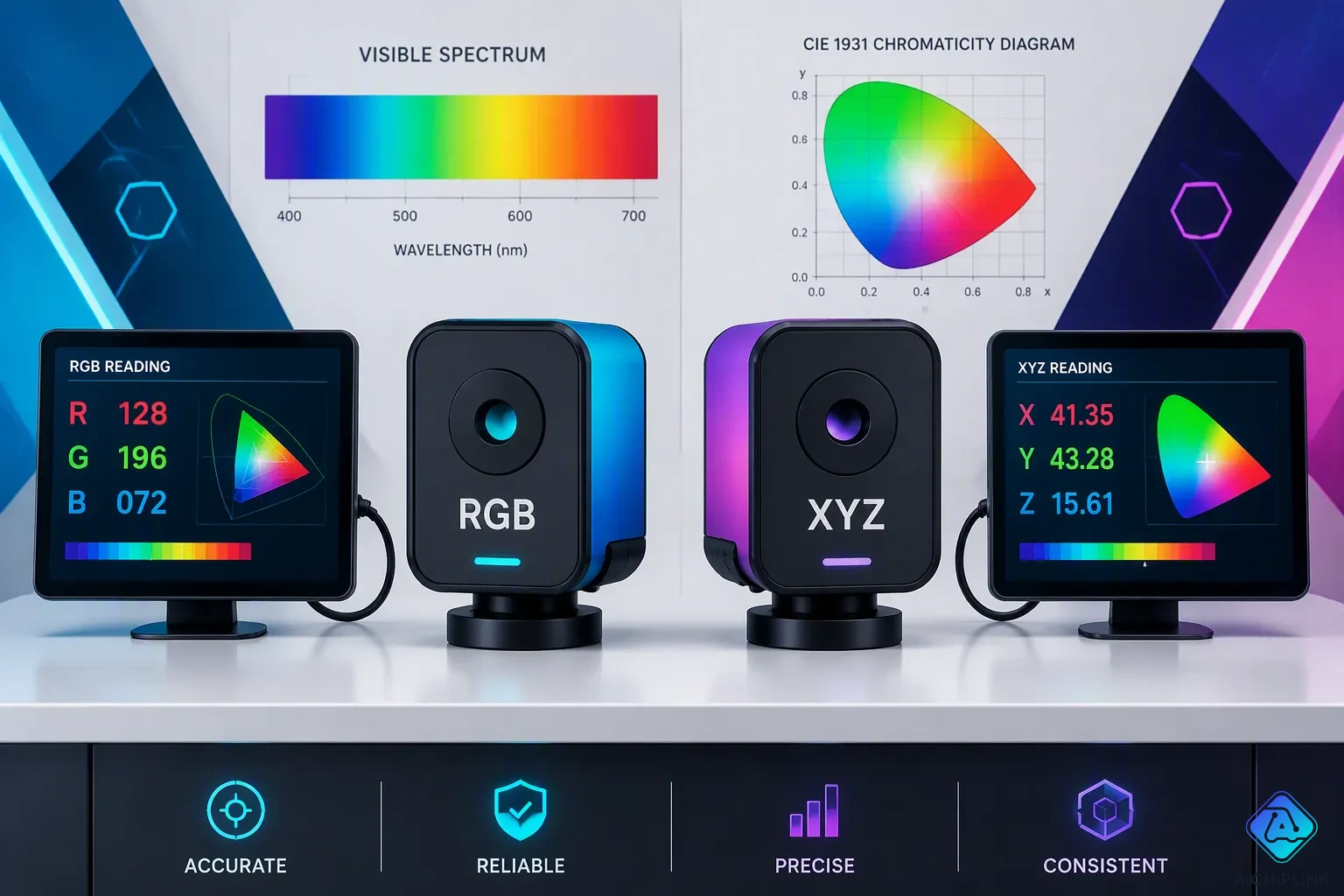
When Comparing RGB and XYZ Color Sensors, the decision often comes down to precision versus practicality. XYZ sensors measure a full, standard color space defined by CIE 1931, ensuring consistent, device-independent results. In contrast, RGB color sensors capture a less standardized portion of the spectrum, making their output highly dependent on the specific hardware. This leads to a critical question: how do you choose between them for your unique applications? The answer impacts accuracy, cost, and processing speed for your project. A color sensor that delivers exact, repeatable readings is ideal for laboratory research, while a simpler, faster RGB option works well for high-volume sorting tasks on factory floors. This comparison offers data-driven guidance for engineers and product developers who need dependable performance without overspending on unnecessary features. By understanding these core differences, you can confidently select the right sensor for your workflow. Ultimately, the choice between these two technologies shapes the entire color measurement process, from initial data capture to final output.
Key Takeaways
-
XYZ sensors are very accurate because they use the standard CIE 1931 color space, making them great for lab work and display calibration.
-
RGB sensors are cheap and process data quickly, making them good for color jobs that compare shades, like sorting items in factories.
-
RGB sensors need tricky calibration and depend on the device, but XYZ sensors give direct, trustworthy readings.
-
Use XYZ when you need to measure exact colors. Use RGB when you want to detect color changes without spending much money.
-
XYZ sensors handle temperature changes better, so they work steadily in different conditions.
Comparing RGB and XYZ Color Sensors: Core Differences
When you evaluate a color sensor for your project, the first major distinction lies in how each type handles color space. XYZ sensors align with the CIE 1931 standard, providing a complete, device-independent framework. RGB sensors capture only a subset of visible colors. This fundamental difference affects every measurement you take.
Standardized vs. Subset Color Spaces
The CIE 1931 XYZ color space uses imaginary primaries. This design ensures all visible colors have positive coordinates, making it a universal reference. Consider this key fact:
You cannot display the range of human color perception on an RGB monitor – the gamut of normal human vision covers the entire CIE diagram while the gamut of an RGB monitor can be displayed as a triangular region within the CIE diagram.
Real-world RGB color spaces, like sRGB and Adobe RGB, each define their own three primary colors. You can plot these as triangles inside the CIE diagram. Here are the important points:
-
The CIE 1931 XYZ color space uses imaginary primaries, ensuring all visible colors have positive coordinates, making it a universal reference.
-
Real-world RGB color spaces (e.g., sRGB, Adobe RGB) are defined by their own three primary colors, plotted as triangles within the CIE diagram.
-
Neither sRGB nor Adobe RGB can express the entire gamut of human color perception; colors outside a space's triangle get clipped to the closest expressible color.
-
XYZ serves as a common language: any device color space can be converted to and from XYZ, enabling accurate color reproduction across devices.
This limitation directly affects your measurements. Consider a chemical reaction producing a saturated blue solution:
During approximately the first 21 minutes of reaction, the saturated blue color of the solution produces chromaticity coordinates that lie outside the representable range of the sRGB color space. When converting spectrophotometric data to sRGB or when capturing these colors directly with a smartphone camera, these out-of-gamut colors are clipped (or mapped) to the nearest representable color within the sRGB gamut boundary. This gamut clipping creates an artificial attenuation of the trajectory of sRGB values during the initial reaction phase. This phenomenon affects both spectra-derived RGB values and direct camera measurements, demonstrating a fundamental limitation of RGB-based colorimetry when monitoring reactions involving saturated colors that exceed the gamut limitations of standard digital color spaces.
Device Dependence and Calibration Needs
RGB sensors are filter-based and device-dependent. Their output varies with hardware filters, lighting conditions, and sensor electronics. This device dependence reduces measurement accuracy compared to direct XYZ sensing. You need extensive color calibration to achieve reliable results.
The calibration process for an RGB sensor involves characterizing each LED channel. You gather three types of data: spectra of each channel sampled at 3.33nm granularity between 360nm and 740nm, color measurements in CIE xyY space derived by integrating CIE color matching functions with the spectrum, and overall light intensity in Lux. You take measurements using a spectrophotometer, like a Colormunki device, controlled via open-source Argyll color management software using the 'spotread' program. You perform the measurements at a fixed drive current of 500mA and a fixed distance, controlling intensity with PWM. This empirical data allows you to achieve correspondence with defined white points and other relative color spaces like sRGB.
The calibration follows a specific procedure:
-
White point calibration: Define a target color point (e.g., Illuminant D65 with RGB values set to 1.0). Program the LEDs to output the desired RGB code. Measure the spectrum using a spectrometer to obtain a relative SPD. Compute CIE XYZ values from the SPD, then derive CIE xyY coordinates and RGB values. Calculate compensation factors (Cr, Cg, Cb) for each channel to correct the actual output to match the target chromaticity.
-
Color gamut calibration: Define target color values for each corner of the gamut triangle (pure red, green, blue). Measure the spectrum of each LED channel individually to obtain three RGB vectors. Set up a system of nine equations with nine unknowns to solve for the calibration matrix.
-
Application: Apply the white point compensation factors and the calibration matrix to transform every RGB input value before sending it to the LEDs.
Without this calibration, RGB sensors cannot achieve reliable color measurements. Several factors contribute to this limitation:
- RGB sensors are not truly linear to light emissions, which undermines the reliability of standard RGB-to-XYZ 3×3 matrix conversions, further reducing measurement accuracy compared to direct XYZ sensing.
RGB cameras, even at their best, cannot perform very accurate optical measurements. The mosaic pattern causes pixel averaging, compromising measurement accuracy, and color calibration is often impossible without a camera-specific matrix generated against a known target.
The table below summarizes the key differences:
| Sensor Type | Measurement Accuracy | Key Limitation |
|---|---|---|
| RGB | Lower | Device-dependent; requires calibration; lacks standardized color space |
| XYZ | Higher | None identified; uses internationally standardized colorimetry |
Understanding these core differences helps you choose the right sensor. XYZ sensors offer superior performance for absolute colorimetry. RGB sensors provide a cost-effective solution for relative color tasks, but only after proper calibration.
Color Science Basics: CIE 1931 and Human Vision
Before you pick a sensor type, you need to learn how we see color. The CIE 1931 standard says how human eyes react to light. This standard is the base for every color sensor you look at.
The Standard Observer and Tristimulus Values
The CIE 1931 XYZ color space came from a simple idea: show all colors people can see with only positive numbers. The older RGB space needed negative numbers for some colors. That made math harder. The XYZ space fixed this by changing the math.
The XYZ tristimulus values come from mixing a light source's spectrum with three color matching functions:
X = ∫ S(λ) * x̄(λ) dλ, Y = ∫ S(λ) * ȳ(λ) dλ, Z = ∫ S(λ) * z̄(λ) dλ
These formulas show how a color sensor must weigh incoming light to get the right tristimulus response. The CIE set five rules for this system:
-
All color matching functions must be zero or positive everywhere.
-
The y-bar function must match the eye's brightness sensitivity V(λ).
-
The white point with equal energy needs x = y = z = 1/3.
-
Every color must fit inside the triangle [1, 0], [0, 0], [0, 1].
-
The z-bar function can be zero above 650 nm.
The Y part carries brightness info. It matches the CIE 1924 brightness function. So Y tells you how bright a color looks. The X part mixes the three CIE RGB curves. Z is close to blue. Together these three values describe any color fully.
You can turn XYZ values into chromaticity coordinates for easier viewing:
| Concept | Description |
|---|---|
| Chromaticity coordinates | x = X/(X+Y+Z), y = Y/(X+Y+Z), z = Z/(X+Y+Z); since x+y+z=1, only x and y matter |
| xyY representation | Y carries brightness, xy carries color info |
| Spectrum locus | Plotting pure wavelengths gives a horseshoe shape; all visible colors lie inside it |
Why Device-Independent Measurement Matters
Device-independent color measurement turns personal sight into clear numbers. This lets ICC profiles work. They act like translation guides between each device's own color space and the standard reference. When colors go from a screen to a printer, the profile makes sure numbers keep the same look.
Without device-independent measurement, each device reads color values using its own limits. This causes random color shifts as images move through work steps. With good calibration, description, and conversion, you build a shared language for all systems.
This science base directly affects your sensor choice. A true XYZ color sensor copies the standard observer's response through careful filters. An RGB sensor only catches part of the spectrum. It needs complex math to guess XYZ values. For jobs that need exact accuracy, the XYZ method gives better results. For relative tasks where consistency matters more than exact values, an RGB color sensor may work. Knowing this difference helps you match the sensor to your color measurement needs.
Sensor Types and Their Characteristics
True Color (XYZ) Sensors: Design and Response
A true color sensor uses special filters to match how the CIE 1931 standard says our eyes see color. These filters give each channel a specific sensitivity for each wavelength. This design lets the sensor take exact color measurements. You get XYZ numbers directly from the hardware without hard math.
The AS7261 is a good example. This true color sensor gives XYZ coordinates that tell you the color numbers. It copies how the human eye sees light. You can use this data for precise color measurement in labs. The sensor's response follows international standards. This means your results are the same on different devices and in different places.
You will find true color sensors in jobs where accuracy matters most. Display calibration, paint matching, and medical tests all use this design. The sensor gives steady readings no matter the light. You can trust the output for important choices.
RGB Sensors: Filter-Based Approach and Limitations
An RGB color sensor uses three filters to catch light. These filters split incoming light into red, green, and blue channels. The TCS3400 is a common example. Where its peaks fall depends on the design and cost. This method does not match any standard or model of human vision.
You can use an RGB color sensor for relative color tasks. Industrial sorting, quality checks, and process control work well with this hardware. The sensor spots differences between items quickly. You get fast color detection without expensive parts. This makes RGB sensors popular for high-volume production lines.
But you face limits with exact accuracy. The three filters restrict what you can measure. Even with calibration, you cannot get the precision of a true color sensor. The output depends on the specific hardware and light. You need complex math to guess XYZ values from RGB data.
For multi-spectral tasks, you might need more than three channels. Some systems use multiple RGB sensors or add extra filters. This improves spectral measurements but raises cost and complexity. You must weigh these factors against your accuracy needs.
The table below shows the key design differences:
| Feature | RGB Sensor (e.g., TCS3400) | True Color Sensor (e.g., AS7261) |
|---|---|---|
| Filter type | Three band-pass filters | Interference filters |
| Spectral peak placement | Not uniform; set by design/cost | Specific sensitivity per wavelength per channel |
| Alignment to human eye | Not aligned to any standard or model | Based on CIE 1931 Standard Observer (XYZ) |
| Measurement capability | Limited to 3 band-passes; accuracy limited even with calibration | Absolute-value color measurements; calibrated to give XYZ coordinates |
| Use case | Color tasks with less accuracy | Describing colors as human eye would see them |
Your choice between these sensor types depends on what you need. A true color sensor gives better color measurement for demanding jobs. An RGB color sensor offers speed and low cost for color detection when relative differences are enough. Knowing these trade-offs helps you pick the right tool for your work.
Performance Metrics: ΔE00 and Test Results
Test Setup for Comparative Analysis
To measure color sensor performance, you need a controlled test setup. The setup includes these key parts:
-
Sensor and filter assembly
-
Electronics for signal processing
-
Controlled lighting conditions
-
A calibration target
ams set up tests using LED lights or display backlights for their comparison. They set a color difference threshold of Δu'v' ≤0.005, which the average human eye can see. Both sensor systems were calibrated at 40°C. Then they changed the LED temperature to cause color drift, and the feedback control loop tried to fix it.
The results showed a clear difference between the two sensor types. The RGB sensor system had a control accuracy above 0.007 at 20°C. The True Color sensor kept a deviation of only 0.0011, which the human eye cannot see. This test shows how temperature changes affect each color sensor differently. For industrial uses where temperature changes, this difference matters a lot.
Accuracy Benchmarks: RGB vs. XYZ
The ΔE00 metric measures color difference between two samples. Lower values mean better accuracy. A ΔE00 below 1 is usually not seen by human eyes. This metric helps you check color detection quality across different hardware.
A study of 37 cameras reported ΔE00 values for XYZ sensors. The table below shows the results:
| Metric | Least-Squares ΔE00 | Spherical Sampling ΔE00 |
|---|---|---|
| Min | 1.1178 | 1.1178 |
| Max | 7.3300 | 7.1277 |
| Mean | 1.8784 | 1.8245 |
| Median | 1.5049 | 1.4950 |
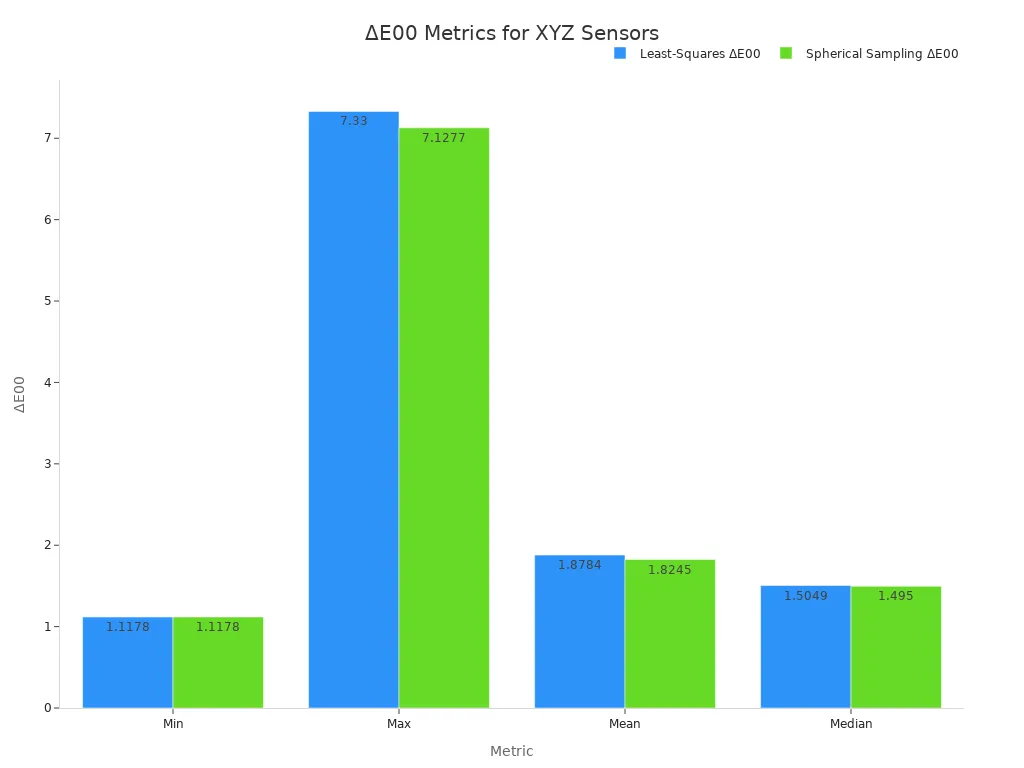
The study reports a mean improvement of 2.87% in ΔE00 when using spherical sampling compared to least-squares for camera characterization. This means the reported ΔE00 values can be reduced by nearly 3% with a better sampling method.
These numbers show that XYZ sensors usually get ΔE00 values around 1.5 to 1.9 on average. RGB color sensors often range from 2 to 5, depending on calibration quality. This gap matters for color detection tasks where precision affects final product quality. For multi-spectral applications, you need the best accuracy possible. The spherical sampling method improves results a little. This optimization helps you get closer to true color measurement standards. When comparing RGB and XYZ color sensors, this performance data guides your choice. Multi-spectral systems benefit from the improved sampling approach. Multi-spectral imaging needs consistent results across many wavelengths. Multi-spectral analysis in lab settings requires reliable spectral measurements. Your final decision depends on balancing accuracy needs against budget limits for your specific uses.
Display Management Applications
Display calibration needs exact color measurement. You must know precisely what your screen shows. The choice between XYZ and RGB sensors changes your calibration quality and how fast you can produce units.
Calibration and White Point Correction
XYZ sensors are great for display calibration because they measure true color values. You get XYZ numbers straight from the hardware. This data matches the CIE 1931 standard observer. Your calibration software works with accurate tristimulus values without guessing. The sensor reads the display's white point exactly. You can fix color drift quickly and dependably.
RGB color sensors work differently. They grab relative color data through three filters. You must change this data to XYZ values using complex math. The conversion matrix depends on your exact hardware. Each display type may need its own calibration matrix. This process can add errors at every step. You might get good results, but you will put in more effort.
The temperature test from ams shows this difference clearly. When LED temperature shifted, the RGB sensor system showed control accuracy above 0.007 at 20°C. The True Color sensor kept a deviation of only 0.0011. That gap falls below what human eyes can detect. For display calibration, this accuracy difference matters a lot. You need steady white points across every production unit.
Production Line Consistency
Making displays requires the same color output on every unit. You cannot ship screens that look different from each other. XYZ sensors give you the measurement stability you need. They provide repeatable readings no matter the environment. Your production line can hold tight tolerances unit after unit.
RGB sensors can handle relative adjustments in production. You can compare one display to another using RGB values. This method works when you only need to match colors between units. But you face limits with absolute accuracy. The sensor's output changes with temperature and light. You need frequent recalibration to stay consistent. Complex correction algorithms become necessary for good performance.
The practical results are clear. For high-end display manufacturing, XYZ sensors are worth their higher cost. You get reliable absolute measurements that protect your brand image. For budget-focused operations, RGB sensors give you a starting point. You can set up basic color calibration with careful planning. Just know the trade-offs before you decide. Your choice between these sensor types shapes your whole quality control process.
Printing and Colorimetry Applications
Mixing ink needs exact color readings that only a true color sensor can give. You must get the same results in every batch you make. Picking between XYZ and RGB technology changes how your whole process works.
Ink Formulation and Proofing
Spectrophotometers read the full color spectrum from ink samples. This data turns into XYZ tristimulus values. You get precise ink mixing by looking at how colors behave under different lights and surfaces. An XYZ color sensor can spot metamerism—when two colors look the same under one light but different under another. This helps you avoid color mistakes in proofing and final production.
ISO 13655 measurement conditions (M0–M3) keep your XYZ values correct on surfaces with optical brighteners. These brighteners glow under UV light. Without the right measurement conditions, they mess up your readings. You must follow these standards for dependable results.
Good habits make your color sensor more reliable. Calibrate often to keep readings steady. Control the environment to stop drift from temperature and humidity changes. Use the same sample position every time to cut down on measurement differences. These habits reduce errors in formulation and proofing work.
Quality Control in Lab Settings
Lab quality control needs exact color measurement. You need numbers that match global standards. An XYZ color sensor gives you device-independent readings straight from the hardware. You can trust these values for big decisions about product acceptance.
An RGB color sensor might work for tasks that don't need high accuracy. You can use it to compare samples to each other. But you hit limits when you need exact values. The sensor's output depends on hardware filters and lighting. You must use complex math to guess XYZ data.
For general colorimetry, XYZ is still the best choice. You get repeatable measurements across different tools and places. This consistency matters when many labs share the same specs. Your color checks stay in line with what customers expect.
The table below shows the key differences:
| Application | RGB Sensor | XYZ Sensor |
|---|---|---|
| Ink formulation | Limited; needs complex calibration | Full spectral analysis; spots metamerism |
| Proofing | Relative matching only | Exact values under ISO 13655 |
| Lab QC | Fine for low-accuracy tasks | Best choice for color measurement |
Your choice depends on your quality needs. For printing jobs where color consistency drives customer happiness, spend on XYZ technology. For basic sorting tasks, an RGB color sensor gives you a low-cost starting point. Match your sensor choice to what you really need.
Choosing the Right Color Sensor
You now know how these sensor types differ. The next step is to match that knowledge to your own needs. Your choice affects your budget, how fast you can produce items, and the quality of your final product. This section gives you a simple way to make that decision.
Cost, Speed, and Integration Trade-offs
Cost drives many buying choices. RGB color sensors cost less than XYZ sensors. You can buy them from many suppliers. Their simple design uses common manufacturing steps. This keeps the price low for large production runs.
XYZ sensors need special interference filters. These filters match the CIE 1931 color matching functions exactly. Making them requires tighter control. This raises your part costs. You also need more complex electronics to handle the signals. The total system cost can be much higher than RGB solutions.
Speed matters for production lines. RGB sensors read three channels quickly. They process data fast with simple math. You can sort items at high speeds. This makes them great for industrial sorting where speed drives profit.
XYZ sensors need more processing time. The math changes raw readings into standard color coordinates. This adds a few milliseconds to each measurement. For most display calibration tasks, this delay does not matter. For high-speed sorting lines, it could slow you down.
Integration complexity also differs. RGB sensors offer simple connections. You can hook them up to standard microcontrollers easily. Their output maps directly to familiar color values. Your firmware team can set up basic color detection quickly.
XYZ sensors need more careful setup. You must think about lighting conditions. You need proper calibration routines. Your software must handle the full tristimulus conversion. This adds development time to your project.
Matching Sensor Type to Application Needs
Your application decides which trade-offs make sense. Start by defining your accuracy needs. Ask yourself if you need absolute color measurement or just relative color detection. This one question guides your whole decision.
For lab color work, choose XYZ sensors. You need results that match global standards. Your measurements must stay the same across different tools and places. The higher cost pays off with data you can trust.
Display calibration also needs XYZ technology. You need exact white point correction. Your production line must deliver the same color on every unit. The temperature stability of XYZ sensors keeps your calibration accurate even when factory conditions change.
Industrial sorting works well with RGB sensors. You compare items against a reference sample. The exact color value matters less than the difference between items. A low-cost RGB color sensor handles this task well. You save money without losing sorting performance.
Printing and ink mixing need XYZ accuracy. You must match colors across batches and surfaces. Metamerism detection needs full spectral data. RGB sensors cannot give this level of detail. Spend on XYZ technology for these demanding jobs.
The table below shows the key differences:
| Characteristic | RGB Sensor | XYZ Sensor |
|---|---|---|
| Accuracy | Moderate (ΔE00 2-5) | High (ΔE00 < 2) |
| Cost | Low | High |
| Speed | Fast | Moderate |
| Calibration | Complex, device-dependent | Simple, standardized |
| Best for | Relative color detection, sorting | Absolute color measurement, lab work |
| Multi-spectral capability | Limited | Good foundation |
Your final choice balances these factors against your own limits. For multi-spectral uses, think about future needs. Multi-spectral systems benefit from XYZ's standard output. Multi-spectral analysis needs steady measurements across wavelengths. Multi-spectral imaging projects demand reliable spectral data. The XYZ approach gives a stronger base for these advanced uses.
Remember that comparing RGB and XYZ color sensors comes down to your application needs. This comparison helps you match sensor features to your performance needs. Choose XYZ for absolute color measurement accuracy. Choose RGB for low-cost relative color detection tasks. Your project's success depends on making this choice right.
Your choice of color sensor depends on your needs. An XYZ color sensor delivers high precision for absolute measurement. An RGB color sensor offers a low-cost solution for relative tasks. This comparison shows the trade-offs. A color sensor for lab work needs XYZ technology. A color sensor for sorting works with RGB hardware. The best color sensor matches your application requirements. Accuracy and cost guide your color sensor decision. The comparison table helps you pick the right color sensor. RGB color sensors remain useful for many applications. Performance varies between types. New technology may bridge the gap between cost and accuracy. Comparing RGB and XYZ color sensors helps you choose wisely.

Written by Jack Elliott from AIChipLink.
AIChipLink, one of the fastest-growing global independent electronic components distributors in the world, offers millions of products from thousands of manufacturers, and many of our in-stock parts is available to ship same day.
We mainly source and distribute integrated circuit (IC) products of brands such as Broadcom, Microchip, Texas Instruments, Infineon, NXP, Analog Devices, Qualcomm, Intel, etc., which are widely used in communication & network, telecom, industrial control, new energy and automotive electronics.
Empowered by AI, Linked to the Future. Get started on AIChipLink and submit your RFQ online today!
Frequently Asked Questions
What makes an XYZ color sensor more accurate than an RGB sensor?
An XYZ color sensor uses filters that match the CIE 1931 standard. This sensor gives direct tristimulus values for accurate color measurement. An RGB sensor captures only a subset of visible colors. You need a sensor that matches your application needs. The output depends on hardware filters and lighting conditions.
When should you choose rgb color sensors for your application?
Choose rgb color sensors for relative color tasks like industrial sorting. This sensor costs less and processes data faster. You need frequent calibration. This color sensor works well for color detection when exact color values matter less than identifying sample differences. This sensor suits industrial applications with lower accuracy needs.
What is a typical ΔE00 value for each sensor type?
An XYZ color sensor often achieves ΔE00 values below 2. Some reach below 1, which human eyes cannot see. An RGB sensor typically ranges from 2 to 5. This sensor depends on calibration quality for accurate color measurement. Choose your color sensor based on your color accuracy needs.
Do temperature changes affect sensor performance?
Yes. Tests show an RGB color sensor system deviates above 0.007 at 20°C. A True Color sensor maintains a deviation of only 0.0011. Temperature stability matters for industrial applications. This comparison helps you choose the right sensor for your environment. Consistent color measurement depends on the right hardware.
Can you use an RGB sensor for printing applications?
An RGB sensor works for basic color matching in printing. This color sensor cannot detect metamerism or provide full spectral analysis. For ink formulation and proofing, you need the standardized measurement that an XYZ color sensor delivers for accurate color management. This approach suits applications with strict quality standards.