Wire Wound Resistors vs Other Types Which One Should You Choose
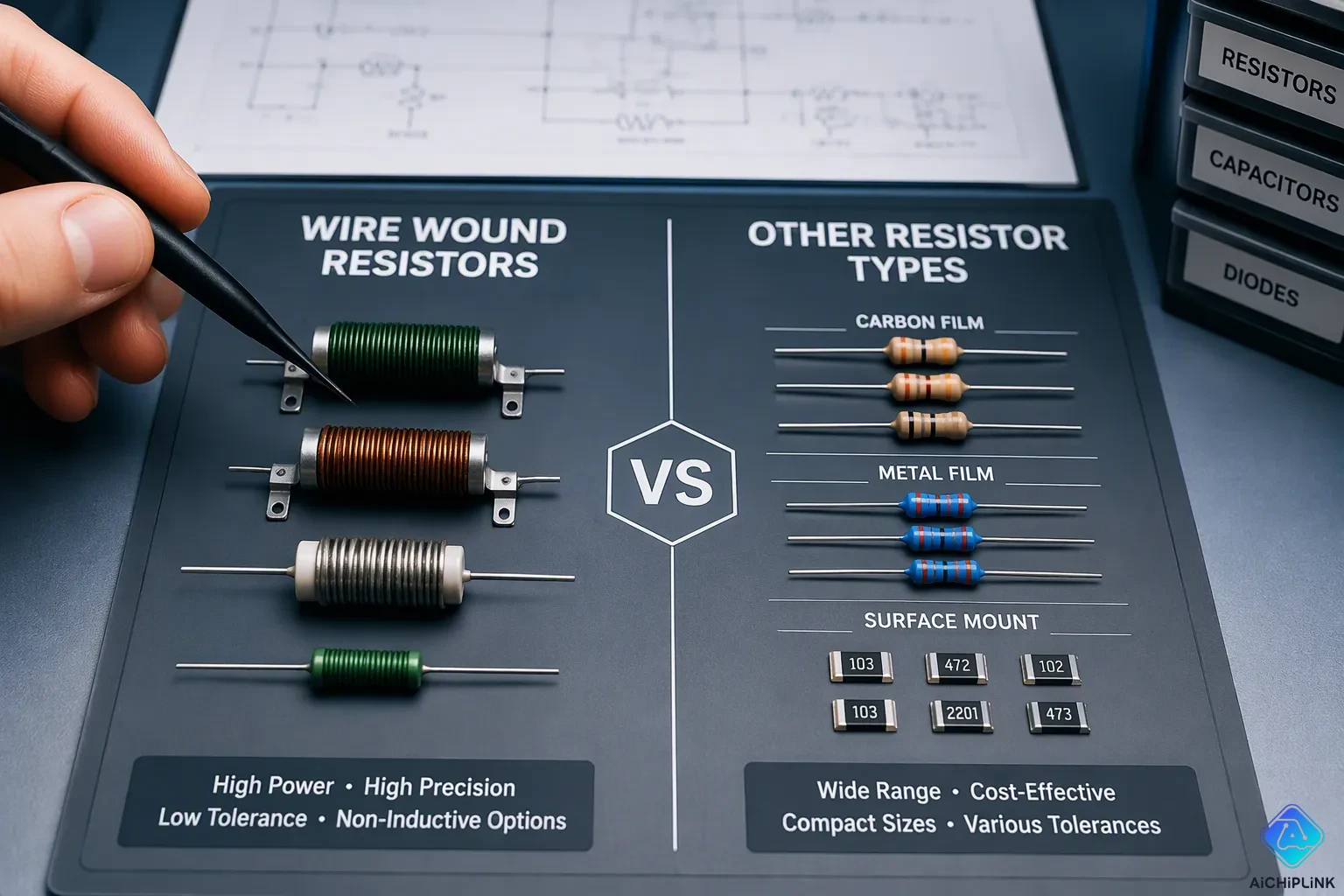
When you need a part that handles high power at low frequencies, wire wound resistors perform better than any other type. For high-frequency precision circuits, however, film resistors often win the race. This article looks at the key differences in how they are built, how to use them, and the pros and cons of each type. You will also find a simple guide to help you choose. Keep in mind that non-inductive versions of the wirewound resistor exist, which work for some high-frequency tasks. Still, many engineers prefer film types for those jobs. Your choice of resistor depends on what your circuit needs. Check power, frequency, tolerance, and cost before you decide. The right resistor for your project balances these factors.
Key Takeaways
-
Wire wound resistors handle high power and surge energy well. They work best for power supplies and industrial circuits.
-
Film resistors are more accurate and work better at high frequencies. They are great for sensitive measuring tools and radio frequency circuits.
-
Non-inductive wire wound resistors lower inductance. But they still have downsides, such as parasitic capacitance.
-
Choose a resistor by looking at power, frequency, tolerance, and cost. Pick the part that fits your circuit's most important needs.
Wirewound Resistor Construction and Performance
Construction and Inductance of Wirewound Resistor
Manufacturers create wire wound resistors by wrapping a resistive wire around a ceramic or fiberglass core. These core materials support the winding and help keep it stable. The resistive wire uses Nichrome or Constantan. These alloys give exact resistance values and can handle high power.
You will find three main types: chassis mount, axial lead, and surface mount. Each type fits different mounting needs. The way it is built directly affects inductance. A standard wirewound resistor acts like an inductor at high frequencies. This limits its use in high-speed circuits.
To lower inductance, manufacturers use non-inductive winding methods. The table below shows these methods.
| Winding Method | Mechanism for Reducing Inductance | Key Trade-off |
|---|---|---|
| Bifilar | Wire folds double before winding; adjacent wires carry current in opposite directions, cancelling magnetic fields | Large parasitic capacitance due to voltage differences between adjacent wires |
| Ayrton-Perry | Two parallel wires wind in opposite directions with insulation; opposing currents cancel magnetic fields | Minimized parasitic capacitance because parallel wires have the same voltage |
These methods help wirewound resistors work in some high-frequency tasks. But you must think about the trade-offs for your circuit when picking a resistor.
Resistor Power Rating, Tolerance, and TCR
The power rating of a resistor depends on how it is built. Larger cores and thicker wire handle more power. Standard power ratings range from 0.4W up to 1000W. The WW series offers 0.4 to 10W. The MHL series delivers up to 1000W. This range suits many power applications.
Tolerance also varies widely. You can find tolerances from 0.1% to 10%. Common values include 0.1%, 0.5%, 1%, 2%, 5%, and 10%. The WRC series offers 1 to 5.5W at 5% tolerance. The WW series provides 0.4 to 10W with tolerances from 0.1% to 5%. The MHL series delivers up to 1000W with tolerances of 1%, 5%, and 10%.
The temperature coefficient of resistance (TCR) shows how much resistance changes with temperature. Wirewound resistors generally offer good TCR performance. This stability comes from the materials. Nichrome and Constantan have low TCR values.
The construction method affects all these parameters. Tight windings and good core materials improve power handling. Non-inductive windings may slightly reduce power capacity. You must balance these factors when choosing a resistor.
Wirewound Resistor Application Guidance
When to Use Wirewound Resistor (High Power, Low Frequency)
You should pick wire wound resistors when your circuit needs to handle a lot of power. These parts work great in power supplies, motor controls, and industrial machines. They can take high current loads without any trouble. The thick wire inside each part soaks up energy that would destroy thinner film resistors.
Surge protection is one of the best reasons to use them. A wirewound resistor can take up to 200 J of surge energy for a 10W part. Compare that to thick film resistors, which usually handle only 0.01 J to 3 J. This matters when your circuit faces sudden voltage spikes or inrush currents.
The inrush resistor must handle a very large short-term overload, so a chunky wire-wound type is the right choice, and it is crucial to make sure it can survive this overload many times over the life of the amplifier.
This advice applies directly to power supply designs. When your equipment turns on, capacitors charge very fast. That initial current spike can break weaker parts. A wirewound resistor takes this punishment again and again without wearing out.
The build explains why it is so tough. The resistive wire has more mass than the film in thick or thin film technology. More material means more heat capacity. Wirewound resistors also avoid damage from voltage stress. Their metal resistance wire carries electricity evenly. Film resistors can suffer from voltage stress that creates paths through non-conductive materials.
For high power jobs, you also get a wide resistance range. Standard parts offer tolerances from 0.1% to 10%. The MHL series handles up to 1000W. This flexibility lets you match the resistor to your exact needs.
When to Choose Other Resistor Types (High Frequency, Precision)
High-frequency circuits need a different approach. Standard wirewound resistors act like inductors at high frequencies. Their coiled wire creates magnetic fields that block signal flow. This self-inductance becomes the main problem in RF applications.
You can fix this with bifilar winding. This method arranges wire turns to create opposing magnetic fields. One field spins clockwise, the other counterclockwise. They cancel each other out. This cuts inductance by about 90%. Only a little inductance from terminations and leads remains.
However, film resistors still win for precision measurements. Look at the tolerance and temperature stability you can get:
| Specification | Standard | Special / Ultra-Precision |
|---|---|---|
| Tolerance | ±1% to ±0.005% | as tight as ±0.005% |
| TCR | 0±5 ppm/°C | 0±1 ppm/°C |
These specs fit instrumentation and measurement gear. When your circuit needs exact resistance values that stay steady across temperature changes, film technology gives better results.
Cost also plays a role in your choice. Carbon resistors offer a cheap option for general-purpose circuits. They lack the precision of film types but work fine for basic jobs. Metal oxide resistors sit in the middle with good stability at a fair price.
Your choice really depends on what your circuit cares about most. A resistor that handles huge power surges suits industrial equipment. A precision film part serves sensitive measurement circuits. Match the part to the job, and your design will work well.
Wirewound Resistor vs Other Types: Pros and Cons
Wirewound Resistor Advantages and Disadvantages
Wire wound resistors are great for high power jobs. Their thick wire can absorb energy that would break thinner film parts. They handle surges very well, with a 10W part surviving up to 200 J of surge energy. This makes them perfect for power supplies, motor controls, and factory machines. They also stay stable over time. The metal alloy wire does not drift much, so your circuit keeps working well for years.
The build also gives you many tolerance choices. You can pick parts from 0.1% to 10% tolerance. The MHL series handles up to 1000W, giving you options for tough designs.
But wirewound resistor downsides matter in some circuits. The coiled wire makes a magnetic field, and more coils mean more inductance. This changes the effective resistance with frequency. Even non-inductive winding patterns keep some parasitic inductance. You also deal with size and cost issues. Getting high resistance with enough power needs a longer wire and core. This makes the part bigger and pricier than film types.
Safety risks also exist. High voltages can cause arcing between close windings, especially if the coating has gaps. Under a big overload, the part can overheat and maybe catch fire. You must think about these risks in power circuit designs.
Other Resistor Types: Pros and Cons
Film resistors shine for precision work. They offer tight tolerances and low temperature coefficients. You get steady performance as temperature changes. Their build also lowers noise and capacitance, which helps signal quality.
Film resistors are the top pick for high-frequency uses because their low noise and low capacitance keep things accurate and stable, which is vital for signal quality at high frequencies.
Carbon resistors give you a cheap option. They work fine for basic circuits but lack precision. Their resistance shifts more with temperature and age. Metal oxide resistors fall in the middle, giving good stability at a fair price.
Your pick depends on what your circuit needs most. A wirewound resistor handles heavy power demands. A film resistor gives precision and frequency response. Match the part to the job, and your design works well.
Choosing the Right Resistor: Wirewound or Not?
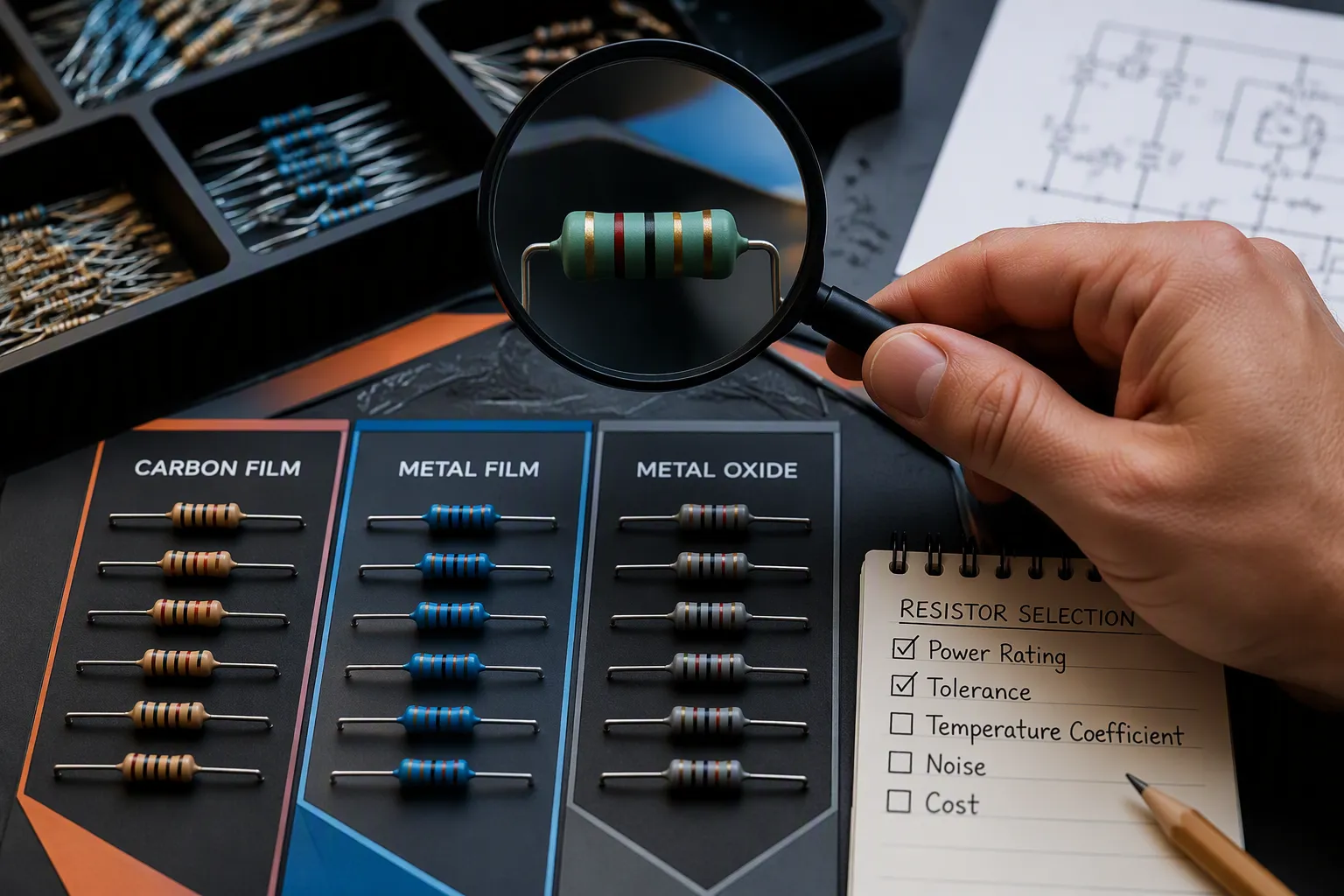
Decision Checklist for Resistor Selection
You need a clear plan to pick the right part for your circuit. Follow these steps to check your needs against what each component offers.
First, figure out the power rating you need. Use the formula P = I²R, where I is the current through the resistor and R is its resistance. Always choose a resistor with a power rating higher than this number. This stops overheating and breakage. A common error is picking a part too close to its max rating. Parts that run near their limits wear out and fail over time.
Next, look at the temperature coefficient. The TCR tells you how much resistance shifts with heat. If your circuit sees big temperature changes, a low TCR is very important. Wirewound parts with special alloys like Manganin can reach TCR below 10 ppm/°C. Metal film types also stay stable with heat. Carbon film ones work only in a narrow temperature range.
Then pick the right material type. Carbon film parts fit general-purpose, low-cost designs. They are cheap for common circuits with medium resistance and loose tolerance. Metal film resistors work well for low-power signal jobs that need exact tolerance. They give better heat stability and low noise. Metal oxide resistors handle higher heat, up to 450°C, with a lower temperature coefficient around 300 ppm. They also resist pulses well and are flame-proof. Wirewound resistors shine in high-power uses with great heat release. They manage high current and surge conditions well.
Finally, think about size and shape. Surface-mount parts fit small devices. Through-hole parts work better for prototyping or hobby projects where you want easy handling.
Check the voltage rating as well. The applied voltage must not go over the working voltage or the value from the power rating and resistance. Both limits matter. For example, a 10-ohm 0402 chip resistor at its max working voltage of 50 volts would give off 250 watts, far above its power rating. The point where both limits meet is the critical resistance value.
Common errors include ignoring load impedance, not thinking about frequency effects, and skipping the datasheet check. Always account for capacitance and switching speed in your circuit.
Flowchart Overview for Choosing a Resistor
The choice starts with your circuit's power needs. If you need high power above 1-2 watts, wirewound types are the best pick. They handle steady high power and surge conditions better than any other type. A 10-watt wirewound part can survive up to 200 joules of surge energy.
For low-power circuits below 0.5 watts, you have more choices. Check the frequency needs next. For high-frequency or RF circuits, thin-film or metal film types work best. They offer near-zero inductance and great frequency response. Wirewound types are naturally inductive. Even bifilar winding cuts but cannot remove inductance. They do not work for megahertz frequencies.
For precision jobs, look at tolerance and TCR. Thin-film types reach tolerances as tight as 0.01 percent. Wirewound precision types can hit 0.005 percent but cost more. Metal film types give good tolerance for a fair price.
Think about cost as the last filter. Carbon film types cost the least for general-purpose circuits. Thick-film types are cheap and lead low-power uses. Thin-film and MELF types cost more but perform better. Wirewound types are less appealing at low power ranges due to their higher cost.
The table below sums up the key trade-offs across types.
| Type | Power Handling | Frequency Response | Tolerance | Cost |
|---|---|---|---|---|
| Wirewound (precision) | High | Poor (inductive) | Excellent (0.005%) | High |
| Carbon Composition | Excellent surge | Good (non-inductive) | Poor (1% best) | High |
| Thick-film | Moderate | Good (low inductance) | Poor (>0.1%) | Low |
| Thin-film / MELF | High | Excellent | Good (0.01%) | Moderate to High |
Use this flowchart method to narrow your options. Start with power, then frequency, then precision, then cost. Match the part to your exact circuit needs.
You now see the core trade-offs clearly. Wire wound resistors deliver unmatched power handling and surge capability. Their coiled design adds inductance, though non-inductive versions reduce this effect. Film resistors offer better precision and frequency response for sensitive circuits. Carbon resistors cost less but drift more with temperature and age.
Your decision hinges on your circuit's demands. Review the decision checklist before you buy. It guides you through power, frequency, tolerance, and cost considerations. Every resistor type serves a purpose. Match the component to your specific application.
Evaluate your specific power, frequency, tolerance, and cost requirements to make the best choice for your circuit. A wirewound resistor handles heavy loads. A film resistor excels in precision work. Choose wisely.

Written by Jack Elliott from AIChipLink.
AIChipLink, one of the fastest-growing global independent electronic components distributors in the world, offers millions of products from thousands of manufacturers, and many of our in-stock parts is available to ship same day.
We mainly source and distribute integrated circuit (IC) products of brands such as Broadcom, Microchip, Texas Instruments, Infineon, NXP, Analog Devices, Qualcomm, Intel, etc., which are widely used in communication & network, telecom, industrial control, new energy and automotive electronics.
Empowered by AI, Linked to the Future. Get started on AIChipLink and submit your RFQ online today!
Frequently Asked Questions
Can a wirewound resistor work in high-frequency circuits?
Standard wirewound resistors have high inductance. Non-inductive versions reduce this problem. However, film resistors still perform better for most high-frequency tasks. Choose the right resistor for your frequency needs.
What makes wirewound resistors ideal for power supplies?
Their thick wire construction handles high current and surge energy. A 10W wirewound resistor can survive up to 200 joules of surge. This makes them perfect for power supply inrush protection.
How do wirewound and film resistors compare for precision?
Film resistors offer tighter tolerances down to 0.005% and lower TCR. Wirewound precision types can reach 0.005% but cost more. For sensitive measurement circuits, film resistors often win.
What is the main disadvantage of standard wirewound resistors?
Their coiled wire creates inductance. This changes their behavior at high frequencies. Non-inductive winding methods help, but they add parasitic capacitance you must consider.