What is an Interface IC and Its Key Functions in Electronics
An interface integrated circuit connects parts together. You use an interface ic for simple device talk. Devices often use different hardware protocols and signal levels. An interface changes these input and output settings easily. It manages hardware communication for safe data moves. This links your electronic systems together well.
| Metric | Details |
|---|---|
| Valuation (2024) | USD 3.05 Billion |
| Forecast Valuation (2032) | USD 4.16 Billion |
| Compound Annual Growth Rate (CAGR) | 4.04% (2025–2032) |
Key Takeaways
-
Interface ICs link different electronic parts. They help separate devices talk easily.
-
Voltage level translators match power levels. They safely protect tiny chips from damage.
-
Protocol converters change data formats fast. Devices share data without hard code.
-
Signal buffers make weak signals strong. They push data through long wires.
-
Digital isolators block dangerous power surges. They protect sensitive chips and systems.
Core Functions of an Interface IC
An interface ic does key jobs in tech. It translates raw data for parts. You use it for odd settings. Without it, your circuits lose data.
Voltage Level Shifting
New chips run on low power. Old tech uses higher power. You cannot link them safely directly.
A translator fixes input and output settings. The chip boosts low power up. It also drops high power down. This protects sensitive parts from harm. It lets new chips run old tech.
Protocol Conversion
Different systems talk in unique ways. A chip might use simple speech. A sensor wants a special code. An interface ic fixes this gap easily.
Interface chips change rules for systems. They flip data formats for new spots.
This helps send data across big setups. You send commands without writing hard code. Smart tools use this to link parts.
Signal Buffering
Long wires weaken digital signals fast. A buffer chip makes signals strong. This keeps your data moving fast.
Clock buffers send clear timing signals. They boost output without adding bad noise.
| Capability Category | Feature Details |
|---|---|
| Output Capacity | Scales from 2 up to 20 outputs |
| Supported Formats | LVCMOS, LVDS, LVPECL, HCSL, and LP-HCSL |
| Protocol Compliance | Fully compliant with PCIe specifications (PCIe 1.0 through 6.0) |
| Signal Integrity | Minimal additive jitter, low channel-to-channel skew, and reduced noise floor |
| System Support | Built-in voltage level-translation and JESD204 synchronization up to 12.8 GHz |
These buffers move fast data well. Special chip types give great output choices:
-
Output Scalability: Supports configurations catering to 6, 10, or 12 LVPECL outputs via specific IC family variants.
-
Additive Jitter: Delivers ultra-low signal degradation with additive jitter measured down to 75 fs rms.
Circuit Protection and Isolation
Power spikes can break delicate digital paths. You must shield parts from surges.
Isolators split circuits to protect parts. They use smart barriers to keep chips safe:
-
Isolation Barrier Construction: Employs capacitive, inductive, or optical coupling mechanisms to pass signals without physical contact, blocking dangerous currents and transient voltages from reaching sensitive low-voltage processors.
-
Ground Loop Mitigation: Intercepts and breaks continuous ground paths, suppressing unwanted current flows and eliminating primary sources of circuit noise.
These parts help smart tools move data. You can place chips near big motors.
Common Types of Interface ICs
You can pick a special interface ic for projects. Engineers group these interface chips by their main jobs. Picking the right chip helps systems link up well. It keeps tiny delicate parts very safe too.
Communication Transceivers
Transceivers move data back and forth over wires. You need them to connect far away devices. Industrial machines use RS-232 and RS-485 interfaces to talk. They send quick serial commands through very long cables.
Cars use Controller Area Network transceivers every day. These chips handle car parts and control internal sensors. Modern CAN tools offer great data transmission speed capabilities.
| Transceiver / Technology Type | Maximum Data Transfer Speed | Compliance / Operating Condition |
|---|---|---|
| CAN Signal Improvement Capability (SiC) Transceiver | 5 to 8 Mbit/s | Compatible with Classical CAN and CAN FD architectures |
| Standard CAN FD Data Phase | 5 to 8 Mbps | Requires restricted bus lengths (typically 20–50 meters or less) |
| NXP TJA1145A High-Speed Transceiver | Up to 5 Mbit/s | Fully compliant with ISO 11898-2 (2016) |
Bus Interface Controllers
Bus interface controllers help chips talk to many parts. You find these controllers in small smart tools. Popular circuit board setups include I2C, SPI, and USB.
Shared I2C buses need careful management to avoid problems:
-
Bus Monitoring: Controllers watch the line for START or STOP signals. They wait if the line stays busy.
-
Deterministic Arbitration Mechanism: Chips compare data bits during simultaneous messages. They resolve conflicts without random delays.
-
Signal Level Verification: Each chip checks the line state while sending data. It stops sending if another chip takes over.
-
Address and Data Stage Resolution: The chip sending the lowest address number wins control. Data checks continue if addresses match.
-
Dynamic Role Switching: A losing chip changes to target mode fast. It listens to the winning chip right away.
Level Translators
Level translators help chips talk across different voltages. New gadgets run on very low power levels. Older parts need much higher voltage levels to work.
Translator designs change high-speed data transfer capabilities:
| Configuration | Transistor Setup | High State Requirement |
|---|---|---|
| Open-Drain | Utilizes a single transistor tied to ground/low | Demands an external or internal pull-up resistor to reach a high logic level |
| Push-Pull | Uses two complementary transistors (one tied to high, one tied to low) | Actively drives the line high using the high-side transistor (only one active at a time) |
Push-pull translators support high-speed data transfer up to 24 Mbps. Open-drain translators usually stop near 2 Mbps speed. Auto-direction sensing translator chips offer even better options:
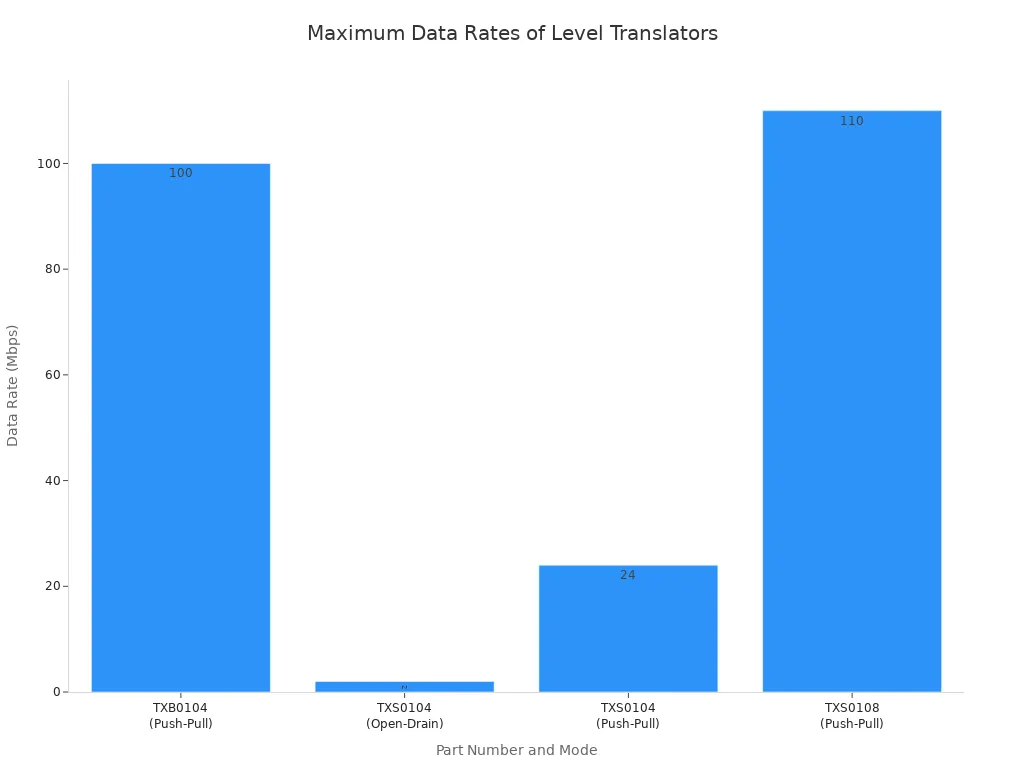
Choose push-pull translators for high-speed data transfer across boards.
Digital Isolators
Digital isolators give great safety to main processors. You use these interface chips to stop power spikes. They keep data paths working without any trouble.
Medical tools and factory systems use safety barriers. They stop short circuits and block bad electric noise.
Why Interface ICs Matter in Electronics
Modern tech connects many parts. You need smooth links. They join distinct subsystems.
Resolving Signal Incompatibility
Main chips talk daily. External devices mix up protocols. They use mismatched voltages. An interface ic fixes conflicts. It translates signals fast. Smart devices stay connected.
Good designs turn raw data into action.
Smart iot tools need data. An interface chip manages it. You get fast data transfer. Separate units lose zero data.
Improving System Reliability
Noise disrupts digital devices fast. Strong lines protect your hardware. Sudden power surges cause damage. Industrial jobs need secure setups. They protect low-voltage tools.
| System Need | Interface Solution |
|---|---|
| Voltage Differences | Level translation moves data safely |
| High Electrical Noise | Isolation shielding clears communication |
Tiny iot devices need clean paths. Proper circuits enable fast transfers. They run in harsh conditions. Safe transfers prevent system crashes.
Simplifying PCB Design
Custom circuits waste board space. Choose built-in interface chips instead. They save valuable space easily. These parts streamline all communication.
-
Standard protocols ease hardware setup.
-
Universal parts cut total costs.
-
Smart devices gain strong links.
Engineers build modern systems fast. Connected hardware relies on standards. Assembly becomes very easy now. Special parts move data smoothly. This setup connects devices well.
An interface ic bridges modern electronics setups well. These chips convert signals nicely. They link distinct devices easily. You transfer data fast and cleanly. They protect processing units in sensitive devices.
Interface designs combine protocols onto single chips. This consolidation saves 20% circuit space. It cuts power draw by 14%.
These parts handle hardware communication very smoothly. You get simple connectivity. Data transfers move fast. Your electronic devices stay compact. ⚡

Written by Jack Elliott from AIChipLink.
AIChipLink, one of the fastest-growing global independent electronic components distributors in the world, offers millions of products from thousands of manufacturers, and many of our in-stock parts is available to ship same day.
We mainly source and distribute integrated circuit (IC) products of brands such as Broadcom, Microchip, Texas Instruments, Infineon, NXP, Analog Devices, Qualcomm, Intel, etc., which are widely used in communication & network, telecom, industrial control, new energy and automotive electronics.
Empowered by AI, Linked to the Future. Get started on AIChipLink and submit your RFQ online today!
Frequently Asked Questions
What is the main function of an interface IC?
You use interface ICs for your devices. They join separate tech parts together. They fix mixed hardware speech rules fast. They balance uneven power levels for data. Your gear shares key facts safely now.
Why do smart devices require high-speed data transfer?
Smart tools handle big data right away. Fast speeds stop bad video lag. They keep smart sensors running smoothly. Special interface chips boost these data paths. They push signals safely between parts.
How do interface chips improve board layout?
Interface chips tidy up complex boards nicely. They squeeze many data lines together. This neat design boosts total connections easily. It drops overall power use down too. Tiny tools run hard jobs well. They follow normal tech rules every day.
How do these components manage data exchange in iot devices?
These parts control data inside your gear. You place controllers to guide signals well. They use real circuit paths every time. These smart tools keep connections steady. Your signals avoid bad noise easily.