What Is a Variable Frequency Drive? Meaning, Uses, and Energy Savings
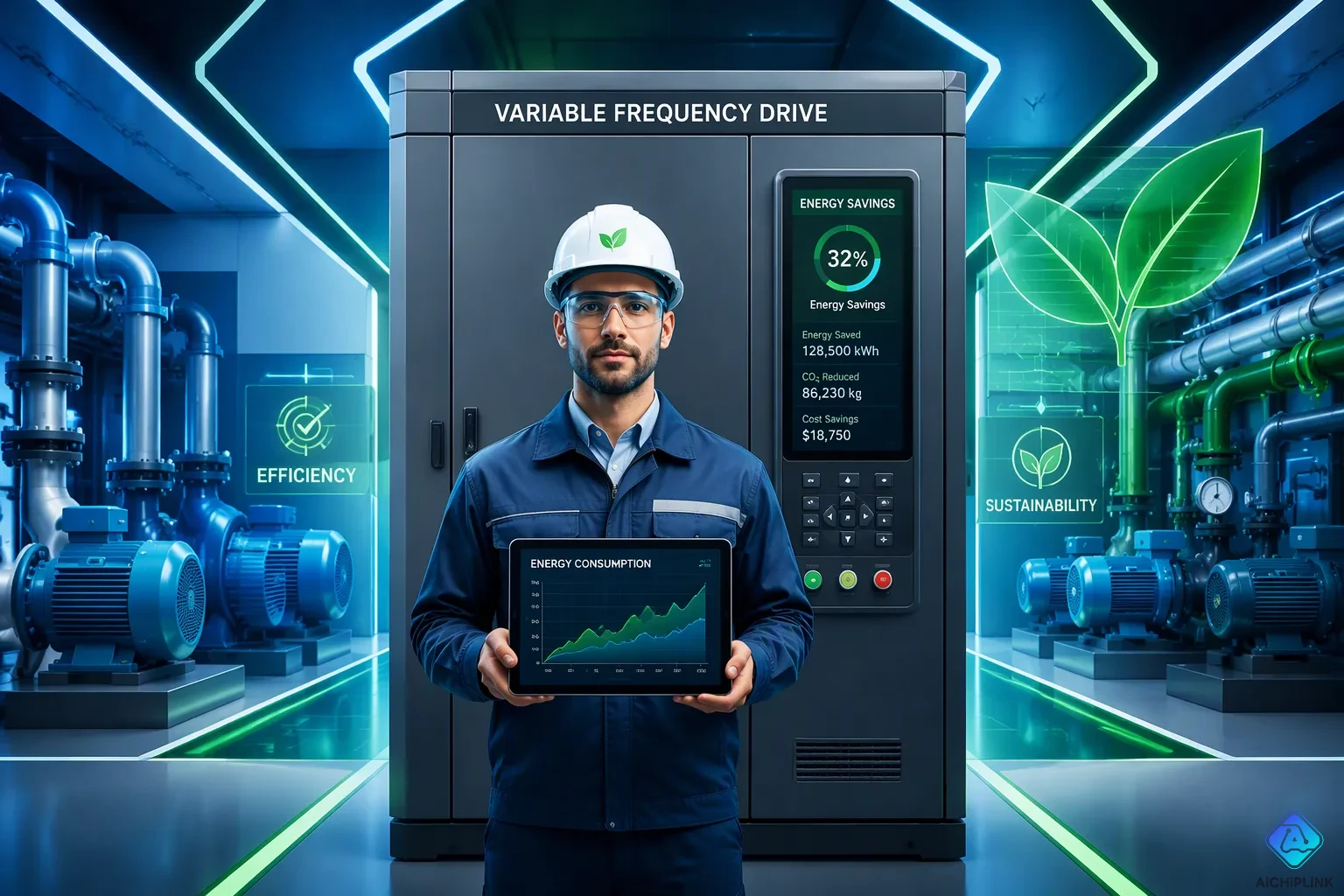
A Variable Frequency Driver is a device that controls the speed of an electric motor by adjusting the power it gets. Instead of just turning a motor on or off, a Variable Frequency Driver lets you control motor speed with precision. This small change gives big results: smoother operation, less mechanical wear, and lower energy bills. You will find Variable Frequency Drivers in factories, office buildings, and water plants. The idea matters because motor-driven systems use about 65% of industry's electricity, according to CLASP. That scale explains the growing demand for Variable Frequency Drivers worldwide.
| Metric | Value |
|---|---|
| Global Variable Frequency Driver Market Size (2024) | USD 23.5 Billion |
Key Takeaways
-
A variable frequency drive (VFD) changes how fast a motor runs by adjusting the power’s frequency and voltage.
-
Variable frequency drives can lower energy use by 20% to 50% in industrial settings.
-
You can find VFDs in factories, HVAC systems, and home appliances such as washing machines.
-
VFDs cut down on mechanical wear and make equipment last longer.
-
VFDs often pay for themselves in less than 3 years, so they are a smart investment.
What Is a Variable Frequency Drive?
A Simple Definition
A variable frequency drive, or VFD, is a motor controller. It changes the speed of an electric motor by adjusting the power's frequency and voltage. You use a VFD to control a common AC induction motor.
The International Electrotechnical Commission (IEC) gives a clear definition:
The IEC says a VFD is a device that electronically controls motor speed and torque. It does this by changing fixed-frequency input power into variable-frequency output power.
The IEC gives standards for several types of drives. It sees VFDs as one kind of VSD, with its own standards and guidelines. This definition points out the motor control job of these devices. The drive changes both frequency and voltage. That keeps the motor running well at any speed.
The VFD system has three main parts. The rectifier uses diodes. They let current flow only one way. This changes AC into rough DC. The DC bus filter uses capacitors. They smooth out the voltage ripples, like a reservoir. The inverter section has IGBTs. They switch on and off thousands of times each second to make AC again at the right frequency. By controlling this switching speed, the VFD adjusts the speed exactly. These three parts work together to make the variable frequency drive.
To make it easier to understand, think of a plumbing system:
The converter is like check valves where voltage acts as water pressure that forces the valve open. A capacitor works like a reservoir or accumulator that smooths the flow.
Just as adjusting a valve controls water flow, the VFD controls speed by adjusting the frequency and voltage.
Before VFDs, older methods ran pumps at full speed or turned them off. They used mechanical valves to slow flow. That caused mechanical stress and wasted energy. With a VFD, the system can just pump less when less is needed instead of running full speed and blocking output. This control method saves a lot of energy. The AC induction motor is the most common motor in industry. The VFD is made to work with it. Electronic control of speed and torque allows smooth acceleration and deceleration. That reduces mechanical stress on the system.
The technology behind VFDs grew over time:
-
1960s – People started Pulse-width modulation (PWM) VFD projects at Strömberg in Finland.
-
1973 – Strömberg sold the idea of a PWM drive to Helsinki Metro.
-
1982 – The first PWM drive, called SAMI10, began working.
-
1983 – The insulated-gate bipolar transistor (IGBT) came out. Later it became the main inverter switching device in VFDs.
Today VFDs are common in many industrial and business uses. In North America, power usually runs at 60 Hz. So adjusting the frequency directly changes how fast the motor shaft spins.
Other Common Names
You may hear a VFD called by many different names. These are:
-
Inverter
-
Adjustable speed drive
-
Variable speed drive
-
Adjustable frequency drives
-
AC drives
-
Drive
-
Frequency inverter
-
Variable frequency driver
Engineers sometimes say variable voltage variable frequency drives. This shows the dual control of voltage and frequency. In some places, the term frequency inverter is still common. VFD control lets you match motor speed exactly to what your load needs. The VFD is made to run an AC induction motor well. These drives control AC induction motors in many uses. By adjusting the frequency, you get exact motor speed control. VFDs are one kind of the bigger group called variable speed drives. Variable frequency drives are used in fan and pump uses. In the HVAC industry, people prefer the term adjustable speed drives. In water treatment, you often hear variable speed drives. The world market for VFDs keeps growing as industries want better energy efficiency. The many names show that VFDs are used widely across different industries.
How Does a VFD Work?
The Three Basic Stages
A VFD changes incoming AC power into DC power, stores it, and then rebuilds it as AC at the frequency you need. You connect it between the power supply and your electric motor. The process happens in three stages:
-
Rectifier: This stage converts incoming AC voltage into DC voltage using diodes. The diodes allow current to flow in only one direction, so the AC becomes unrefined DC.
-
DC Bus: This stage uses capacitors and inductors to smooth out ripples in the rectified DC voltage. The DC link capacitor buffers energy between the rectifier and inverter, stabilizes the DC bus voltage, and provides a low-impedance path for ripple currents. It acts as a short-term energy buffer when motor demand changes faster than the input stage can respond.
-
Inverter: This stage converts the filtered DC voltage back into AC. It uses IGBT switches controlled by pulse width modulation (PWM) to generate an adjustable AC output. The inverter controls the voltage and frequency supplied to the motor.
A user interface lets you configure the drive through keypads, buttons, or touchscreens. Control logic interprets your settings and manages internal operations from start to stop.
Frequency and Voltage Control
Changing the frequency and voltage is how a VFD achieves motor speed control. Motor speed depends on the applied frequency. For a 4-pole AC induction motor, 60 Hz produces a synchronous speed of 1800 RPM, while 30 Hz produces 900 RPM. The governing relationship is synchronous RPM = (120 × frequency) / number of poles. Since the pole count is fixed by motor construction, the VFD controls speed by varying the applied frequency.
Changing frequency alone is not enough. Lower frequency strengthens the magnetic field and can cause overheating. Higher frequency weakens the field and reduces torque. To prevent this, the VFD maintains a constant volts-per-hertz ratio. This keeps magnetic flux constant and allows torque production to remain stable as speed varies.
| Motor Condition | Frequency (Hz) | Voltage (V) | V/Hz Ratio | Effect |
|---|---|---|---|---|
| Rated/base speed | 60 | 460 | 7.67 | Maintains constant magnetic field and rated torque |
| Half speed | 30 | 230 | 7.67 | VFD lowers voltage proportionally to keep flux and torque stable |
PWM makes this possible. The inverter switches IGBTs on and off thousands of times per second. A longer on-time produces higher RMS voltage. A shorter on-time produces lower RMS voltage. By adjusting pulse width and period, the VFD delivers precise speed control.
VFDs often work with programmable logic controllers (PLCs) for precise motor control. The PLC sends signals to the drive, and the drive adjusts output accordingly. This combination gives you accurate control over complex systems. A frequency inverter without PLC integration still works well for simple tasks. For advanced automation, the PLC adds a layer of intelligence that improves coordination across multiple motors.
Common Uses of VFDs
Everyday and Industrial Applications
You can find a variable frequency driver in factories and in home appliances. In factories, vfds run pumps, fans, and compressors. They control flow in water systems and stop water hammer. They change fan speed in ventilation systems. They give cranes, lifts, and conveyor belts a smooth start and stop. For crushers and mixers, they provide torque boost and handle jams.
According to Advanced Energy, variable frequency drives work very well with centrifugal loads like pumps and fans. Common uses include air compressors with changing loads, boiler and chiller feedwater pump motors, cooling tower fans, and air handler fans. In HVAC, these variable frequency drives use signals such as duct static pressure to control variable speed.
You also see them at home. In a washing machine, the drive controls drum speed during wash cycles. This cleans better and causes less wear. In an inverter air conditioner, the frequency inverter allows variable-speed compressors. This saves more energy and keeps the temperature steady.
Benefits Beyond Speed Control
Besides motor speed control, you get several good things. The soft-start feature stands out. According to Machine Design, a vfd lowers inrush currents when the motor starts. It reduces mechanical stress on motors, belts, and gears. This cuts down wear and can make the motor and machinery last longer.
A variable frequency drive also makes the power factor better. The DC bus capacitors supply reactive current for the motor's magnetic field. The AC supply line only sends real power. Voltage and current stay almost in phase. The power factor can get close to unity. But vfds create harmonic current distortion. Harmonic currents do not do useful work. They cancel out some power factor benefits. Adding impedance with a line reactor lowers total harmonic distortion. Modern vfds have harmonic filters that keep sensitive equipment safe.
A variable frequency drive gives you exact speed control through its vfd control system. It holds pressure or temperature steady. Controlled acceleration reduces shock. Good motor control makes your whole system last longer. These benefits make the ac induction motor more reliable.
How VFDs Save Energy
Speed and Power Relationship
A VFD saves energy because motor speed and power use do not change at the same rate. For centrifugal loads like pumps and fans, the affinity laws control this link. Flow changes in a straight line with speed. Pressure changes with the square of speed. Power changes with the cube of speed. This cubic link is the reason behind the savings.
If flow in a pipe or duct system is cut by 50%, the fan or pump will only use 12.5% of the power required at full flow.
A simple example makes this clear. Slow a fan from 100% to 80% speed, and the motor pulls about 51% of full-load power. That is almost 49% energy savings from a small 20% speed drop. Go down to 50% speed, and power falls to 12.5% of the original — an 87.5% saving. The table below shows this pattern across common operating points.
| Speed (%) | Flow (%) | Power (%) | Energy Saved |
|---|---|---|---|
| 100% | 100% | 100% | 0% |
| 80% | 80% | 51.2% | 48.8% |
| 60% | 60% | 21.6% | 78.4% |
| 50% | 50% | 12.5% | 87.5% |
The affinity laws work best for speed changes under 25%. Past that range, efficiency shifts and predictions become less reliable. You should check major changes with manufacturer curves or field testing.
Real-World Savings
The U.S. Department of Energy reports that VFDs can cut energy use in industrial applications by 20% to 50%. The same agency notes savings of 30% or more in specific applications. Every 1% drop in energy usage means $10 billion in savings for the U.S. manufacturing sector.
Documented case studies confirm these figures. A 2024 study of two SME manufacturing facilities found energy use dropped by 900,000 kWh and 1,300,000 kWh. Ivaco Rolling Mills projected nearly $1.5 million in yearly cost savings after upgrading multiple industrial systems. These results show why vfds for energy efficiency attract so much attention.
Payback periods make the investment case stronger. Fans and pumps usually pay back in 1 to 2 years. HVAC drives range from 1 to 5 years, with most projects landing between 1.5 and 3 years. At 50% operating speed, one analysis showed a payback of just 2.5 months. A payback under 3 years usually justifies immediate implementation. A payback beyond 5 years suggests the application may not suit a VFD.
A variable frequency driver is a motor controller that changes the frequency and voltage of the power it sends. This lets it adjust motor speed. This control makes motors, belts, and gears work better and wear out less. You will find vfds running pumps, fans, compressors, and HVAC systems in factories and buildings all over. When motors run slower, they use much less energy, often 20% to 50% less. If a variable frequency drive pays for itself in under 3 years, it is usually worth looking at for your pump, fan, or HVAC use. With vfds, you get exact control, equipment that lasts longer, and lower bills.

Written by Jack Elliott from AIChipLink.
AIChipLink, one of the fastest-growing global independent electronic components distributors in the world, offers millions of products from thousands of manufacturers, and many of our in-stock parts is available to ship same day.
We mainly source and distribute integrated circuit (IC) products of brands such as Broadcom, Microchip, Texas Instruments, Infineon, NXP, Analog Devices, Qualcomm, Intel, etc., which are widely used in communication & network, telecom, industrial control, new energy and automotive electronics.
Empowered by AI, Linked to the Future. Get started on AIChipLink and submit your RFQ online today!
Frequently Asked Questions
What does a variable frequency drive do?
A variable frequency drive controls the speed and torque of an AC motor. It changes the frequency and voltage of the power going to the motor. This lets you run the motor at the exact speed your system needs.
Can I install a VFD on any motor?
A VFD works best with a standard AC induction motor. You should check the motor's ratings and the drive's power range first. Most industrial motors work well with a properly sized drive.
How much energy can a VFD save?
The U.S. Department of Energy reports savings of 20% to 50% in industrial uses. Fans and pumps often save the most. A small speed drop creates a large power drop for centrifugal loads.
How long does a VFD take to pay for itself?
Fans and pumps usually pay back in 1 to 2 years. HVAC drives range from 1 to 5 years. A payback under 3 years usually justifies the investment. A payback beyond 5 years may not suit your application.
Do VFDs need regular maintenance?
Yes. You should check cooling fans, filters, and connections on a regular schedule. Heat and dust shorten drive life. Keep the enclosure clean and the airflow clear. Follow the manufacturer's maintenance guide for your specific model.