In the modern era of 1.2V FPGAs and 0.8V processors, finding a chip that speaks the language of the 1980s and 90s—5 Volts—is becoming a superpower.
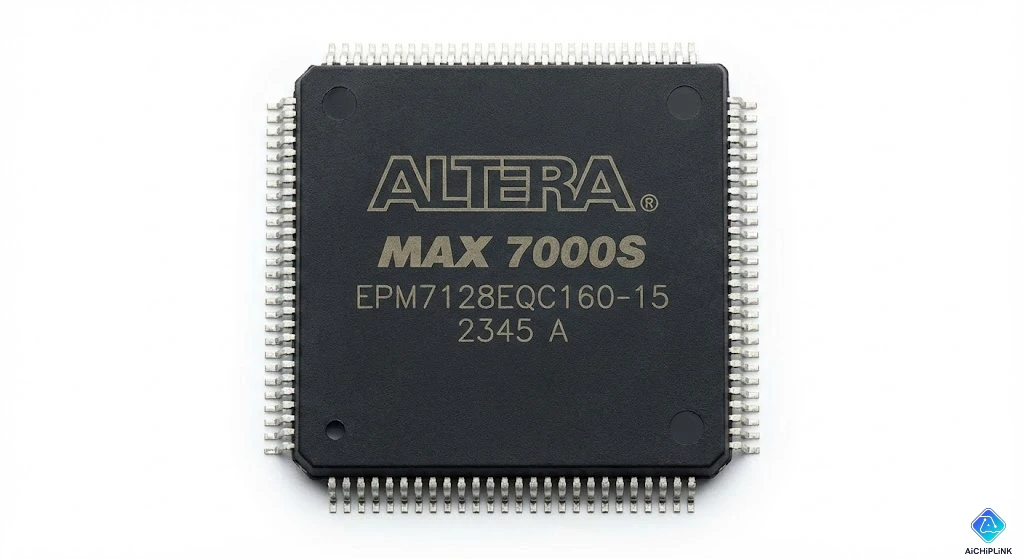
The Intel (Altera) EPM7128EQC160-15 is that superhero.
Part of the legendary MAX® 7000 family, this CPLD (Complex Programmable Logic Device) is the heart of countless industrial controllers, arcade machines, and retro-computing projects. Unlike modern FPGAs, it is Non-Volatile (remembers its code) and natively supports 5V TTL logic.
This guide covers everything you need to know to keep this silicon legend alive.
Table of Contents
- 1. Decoding the Part Number
- 2. Technical Specifications: Why 5V Matters
- 3. Software Compatibility: The Time Machine
- 4. Hardware Considerations: PQFP-160
- 5. Conclusion
1. Decoding the Part Number
Altera part numbers tell a story. Here is the breakdown for EPM7128EQC160-15:
| Segment | Code | Meaning |
|---|---|---|
| EPM | Device Type | Erasable Programmable Logic Device. |
| 7 | Family | MAX 7000. The 5V EEPROM-based family. |
| 128 | Density | 128 Macrocells. (Approx. 2,500 usable gates). |
| E | Feature | Enhanced. Supports ISP (In-System Programming) and extra routing features. |
| QC | Package | PQFP (Plastic Quad Flat Pack). |
| 160 | Pins | 160 Pins. A high pin-count version for maximum I/O. |
| -15 | Speed | 15 nanoseconds (Propagation Delay, $t_{PD}$). |
2. Technical Specifications: Why 5V Matters
The primary reason engineers hunt for this specific chip is Voltage Compatibility.
- Native 5V Operation: Both the Core ($V_{CCINT}$) and I/O ($V_{CCIO}$) run on 5.0V.
- Why this is critical: If you are repairing a board with a 68000 CPU, an ISA bus, or 74-series TTL logic, you cannot use a modern 3.3V FPGA without messy level shifters. The EPM7128 connects directly.
- Non-Volatile: It uses EEPROM technology. You program it once via JTAG, and it retains the configuration forever. It is "Instant-On," meaning it works the moment power is applied (no boot time).
- 128 Macrocells: While small by FPGA standards, 128 macrocells are plenty for:
- Address Decoding (Selecting memory banks).
- State Machines (Traffic lights, motor sequencers).
- Glue Logic (Replacing 20+ individual 74xx logic chips).
3. Software Compatibility: The Time Machine
Warning: Do NOT install the latest Quartus Prime Pro. It will not recognize this chip.
Because the MAX 7000 architecture is legacy, Intel stopped supporting it in newer tools.
- Required Software: Quartus II Web Edition v9.1 (Service Pack 2 is best).
- OS: Windows 7 is preferred, but it runs on Windows 10 with compatibility settings.
- Programmer: You can use a standard USB Blaster clone. Connect it to the 10-pin JTAG header on your board.
4. Hardware Considerations: PQFP-160
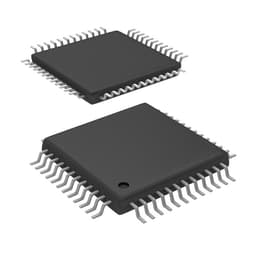
The QC160 package is a beast compared to modern chips.
- Size: 28mm x 28mm body.
- Pitch: 0.65mm.
- Pinout: With 160 pins, you get over 100 User I/O pins. This is fantastic for bus-heavy applications (like 32-bit data buses).
- Soldering: Unlike BGAs (Ball Grid Arrays), the leads are on the outside. This means you can inspect solder joints visually and touch them up with a standard soldering iron. It is very repair-friendly.
5. Conclusion
The EPM7128EQC160-15 is a bridge to the past that enables the future of legacy systems. Whether you are keeping a 1990s CNC machine running or designing a new accelerator card for a vintage computer, its robust 5V logic and non-volatile nature make it irreplaceable.
Sourcing Legacy Altera CPLDs Finding reliable stock of obsolete MAX 7000 chips can be difficult. Visit Aichiplink.com to search for verified inventory of EPM7128EQC160-15.

Written by Jack Elliott from AIChipLink.
AIChipLink, one of the fastest-growing global independent electronic components distributors in the world, offers millions of products from thousands of manufacturers, and many of our in-stock parts is available to ship same day.
We mainly source and distribute integrated circuit (IC) products of brands such as Broadcom, Microchip, Texas Instruments, Infineon, NXP, Analog Devices, Qualcomm, Intel, etc., which are widely used in communication & network, telecom, industrial control, new energy and automotive electronics.
Empowered by AI, Linked to the Future. Get started on AIChipLink.com and submit your RFQ online today!
Frequently Asked Questions
1. What is EPM7128EQC160-15?
It is a 5V MAX 7000 series CPLD from Altera (Intel) with 128 macrocells.
2. Does EPM7128EQC160-15 support 5V TTL logic?
Yes, it operates natively at 5.0V for both core and I/O.
3. Is EPM7128EQC160-15 non-volatile?
Yes, it uses EEPROM technology and retains configuration without power.
4. Which software is required to program this CPLD?
It requires Quartus II v9.1 (or earlier); newer Quartus versions do not support it.
5. What package does EPM7128EQC160-15 use?
It comes in a PQFP-160 package with a 0.65 mm pin pitch.
.png&w=256&q=75)