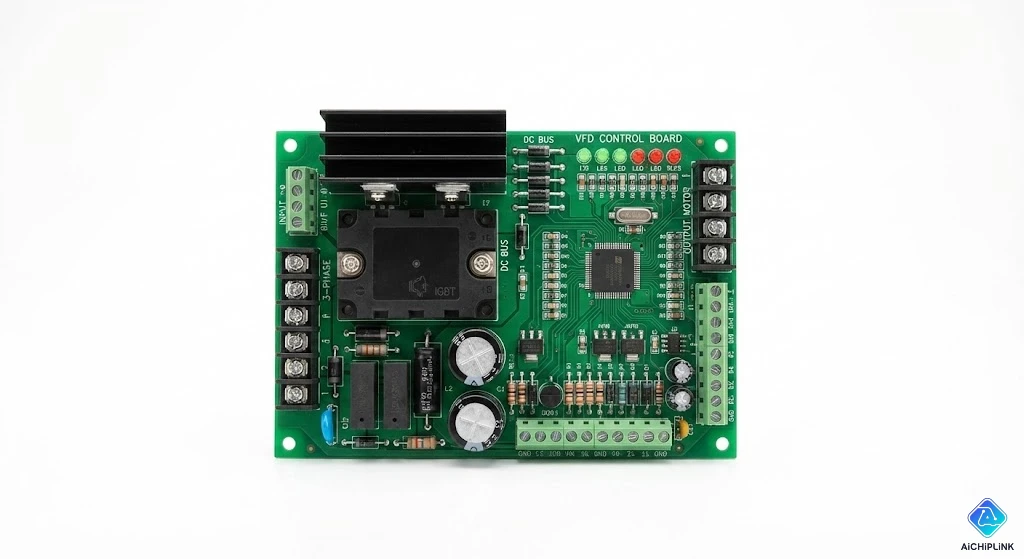
In modern industry, electric motors consume nearly 70% of all industrial electricity. Controlling them efficiently is the job of the Variable Frequency Drive (VFD).
But what exactly happens inside that box? How does it take the fixed 50Hz or 60Hz power from the wall and turn it into a precise, variable speed output for a motor?
The answer lies in the VFD Drive Circuit. It is a power electronics journey that involves converting AC to DC, smoothing it out, and then chopping it up back into AC.
This guide breaks down the anatomy of a VFD, explaining the three critical stages: the Rectifier, the DC Bus, and the Inverter.
1. The Core Concept: Speed via Frequency
To understand the circuit, you must understand the goal. The speed ($N$) of an AC induction motor is determined by the frequency ($f$) of the power supply and the number of poles ($P$):
$$N = \frac{120 \times f}{P}$$
Since we cannot change the number of poles inside a built motor, the only way to change its speed is to change the Frequency ($f$).
The utility grid gives us a fixed frequency (e.g., 60Hz). The VFD's job is to create a new frequency.
2. The Anatomy: The Three Main Circuit Stages
A VFD circuit is often called an AC-DC-AC Converter. Here is the step-by-step flow:
Stage 1: The Converter (Rectifier)
"The Check Valves" The first stage connects directly to the incoming AC power supply (L1, L2, L3).
- Components: A bridge of Diodes.
- Function: Diodes act like check valves—they only allow electricity to flow in one direction. As the AC sine wave goes positive and negative, the diodes steer the positive voltage to the top rail and negative to the bottom rail.
- Output: A rough, pulsating DC voltage.
Stage 2: The Intermediate Circuit (DC Bus)
"The Reservoir" The raw DC from the rectifier is bumpy (full of "ripple"). It needs to be smoothed out before it can be used.
- Components: A bank of large Capacitors (and sometimes Inductors/Chokes).
- Function: The capacitors act like a battery or a water reservoir. They absorb the energy peaks and fill in the valleys.
- Output: A smooth, stable DC voltage (typically ~650V DC for a 480V AC drive).
Stage 3: The Inverter
"The Switch Master" This is where the magic happens. We now have stable DC, but the motor needs AC.
- Components: IGBTs (Insulated Gate Bipolar Transistors). These are high-speed electronic switches.
- Function: The VFD's brain (microcontroller) triggers these switches to open and close thousands of times per second. By firing the positive and negative switches in a specific sequence, they synthesize an AC waveform.
3. The "Magic": Pulse Width Modulation (PWM)
You might wonder: How do simple On/Off switches create a sine wave?
The answer is Pulse Width Modulation (PWM).
Instead of outputting a smooth analog curve, the VFD outputs a series of rectangular DC pulses.
- To simulate high voltage: The pulses are wide (On for a long time).
- To simulate low voltage: The pulses are narrow (On for a short time).
Because the motor is a large inductor (a coil of wire), it doesn't "see" the choppy switching. It smooths out these pulses into a current waveform that looks and acts like a pure sine wave.
4. Key Components Summary
| Component | Location | Analogy | Function |
|---|---|---|---|
| Diode | Rectifier | One-way Check Valve | Converts AC to DC. |
| Capacitor | DC Bus | Water Tank / Battery | Stores energy and smooths ripples. |
| IGBT | Inverter | Light Switch | Switches DC On/Off rapidly to create AC. |
| Control Board | Logic | The Brain | Tells the IGBTs when to fire. |
5. Why Use a VFD?
Understanding the circuit highlights why VFDs are so powerful:
- Energy Efficiency: By reducing the frequency (speed), you reduce power consumption. For fans and pumps, reducing speed by 20% can save 50% energy.
- Soft Starting: The VFD ramps up the frequency slowly (0Hz -> 60Hz). This eliminates the massive "Inrush Current" (6x rated current) seen in Across-the-Line starters, protecting your mechanical belts and gears.
- Process Control: You can set the motor to run at exactly 43.5Hz if that is what your conveyor belt needs, rather than being stuck at 60Hz.
6. Conclusion
The VFD Drive Circuit is a masterpiece of power electronics. By taking the brute force of the AC grid, rectifying it into a DC pool, and then elegantly inverting it back into a variable frequency output, it gives us total control over our machinery.
Need VFD Components? Whether you are building a custom drive or repairing a blown inverter stage, sourcing high-quality power semiconductors is key. Visit Aichiplink.com to search for IGBT Modules, Rectifier Bridges, and DC Bus Capacitors.

Written by Jack Elliott from AIChipLink.
AIChipLink, one of the fastest-growing global independent electronic components distributors in the world, offers millions of products from thousands of manufacturers, and many of our in-stock parts is available to ship same day.
We mainly source and distribute integrated circuit (IC) products of brands such as Broadcom, Microchip, Texas Instruments, Infineon, NXP, Analog Devices, Qualcomm, Intel, etc., which are widely used in communication & network, telecom, industrial control, new energy and automotive electronics.
Empowered by AI, Linked to the Future. Get started on AIChipLink.com and submit your RFQ online today!
Frequently Asked Questions
What does a VFD drive circuit do?
It converts fixed-frequency AC power into variable-frequency AC to control motor speed and torque.
Why is a VFD called an AC-DC-AC converter?
Because it first rectifies AC to DC, smooths it in the DC bus, then inverts DC back to AC.
What is the role of the DC bus in a VFD?
The DC bus stores and stabilizes energy, providing smooth DC power for the inverter stage.
How does a VFD create variable-frequency AC output?
By using IGBTs and PWM (Pulse Width Modulation) to synthesize an AC waveform at the desired frequency.
Does a VFD change voltage or frequency to control speed?
Primarily frequency controls speed, while voltage is adjusted proportionally to maintain motor torque.