Rail-to-Rail vs Standard Op-Amps: Key Differences and Applications
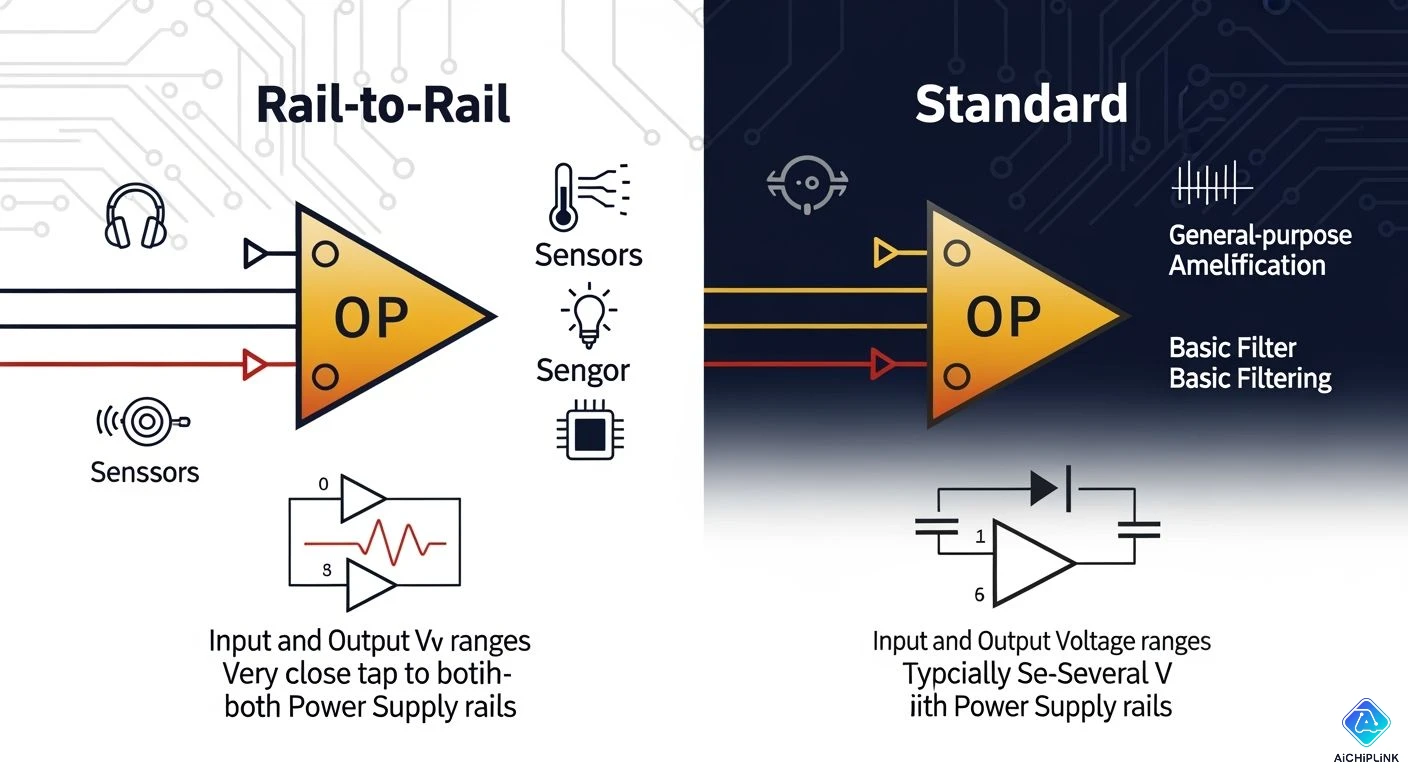
You see the main difference in Rail-to-Rail vs Standard Op-Amps when you look at how much voltage each can handle. Rail-to-rail op-amps let you use almost the full voltage range, from the lowest to the highest supply. Standard op-amps cannot reach both ends, so they lose some output. For example, the MCP6022 gives you a full swing, while the OPA134 and LM358 fall short at the rails.
| Op-Amp Model | Output Voltage Range | Notes |
|---|---|---|
| MCP6022 | Rail-to-Rail | Can output up to positive and down to negative rail |
| OPA134 | Within 1V of rails | Clips at the top and bottom, cannot reach rails |
| LM358 | Single Supply | Can reach negative rail but not positive rail |
Maximizing voltage range helps you get more signal and better performance. You need to choose the right op-amp for your project to match your voltage needs.
Key Takeaways
-
Rail-to-rail op-amps use almost all the voltage. This makes them good for low-voltage uses.
-
Standard op-amps work well in circuits with more voltage. They are used when full voltage swing is not needed.
-
Picking the right op-amp depends on your circuit’s voltage and how well it must work.
-
Rail-to-rail op-amps are best for battery devices. They help get better signals and save power.
-
Always look at the op-amp’s datasheet for details. Check things like offset, noise, and voltage limits. This helps you get the best performance.
Rail-to-Rail vs Standard Op-Amps: Definitions
Rail-to-Rail Op-Amp Overview
Rail-to-rail op-amps are common in today’s electronics. They let you use almost all the voltage between the power rails. You can work with signals that get very close to the lowest and highest voltages. This helps your circuit work better, especially if you have a low supply voltage.
Tip: Rail-to-rail op-amps are great for battery-powered devices. They help you get the biggest signal swing and more dynamic range.
You can see what top semiconductor companies say in the table below:
| Feature | Description |
|---|---|
| Rail-to-Rail Input/Output | Can handle signals very close to the power rails. |
| Output Voltage Range | Can get within millivolts of the rails at low output currents. |
Rail-to-rail op-amps are best for low-power uses. They still work well even if the voltage supply is small. This means you get the biggest signal swing and better dynamic range. This is important when you need every bit of voltage.
Standard Op-Amp Overview
Standard op-amps have been used for many years. You find them in lots of circuits, but they cannot use the full voltage range. The input and output signals stay away from the rails. You lose some voltage at both ends, so you cannot use all the dynamic range.
You might pick a standard op-amp if your circuit does not need the biggest voltage swing. These op-amps are good when the supply voltage is high and the signal does not need to reach the rails. You often see standard op-amps in audio amps, analog filters, and other old designs.
When you look at rail-to-rail and standard op-amps, you see rail-to-rail types give you more voltage options. You should choose the op-amp that fits how much voltage swing your project needs.
Electrical Differences
Input Voltage Range
When you look at rail-to-rail and standard op-amps, you see a big difference in input voltage range. Rail-to-rail op-amps let you use signals that go almost from the lowest to the highest supply voltage. This helps your amplifier work well, even if the supply voltage is low. You can make circuits that still work great with small voltages.
Standard op-amps have a smaller input voltage range. Their input signals cannot reach the supply rails. If you try to use input voltages too close to the rails, you might get errors or weird behavior. This can make your amplifier work worse, especially in sensitive or low-voltage circuits.
Here is a table that shows what can happen if you use a standard op-amp outside its input range:
| Implication | Description |
|---|---|
| Errors and Distortion | Input bias currents can cause errors and distortion of the input signal, especially when the common-mode voltage range is passed. |
| Output Behavior | Limits can cause bad output like clipping and phase reversal. |
| Selection of Op-Amps | You need to pick op-amps carefully, and CMOS op-amps are better for low-voltage circuits. |
If you want the best results in low-voltage or high-precision circuits, you should pick a rail-to-rail op-amp. This helps you avoid errors and get the biggest signal swing.
Output Voltage Swing
Output voltage swing means how close the output can get to the supply rails. Rail-to-rail op-amps can make their output go almost all the way to both the positive and negative supply voltages. This lets you use the full voltage range for your signal. It is important for getting the best dynamic range and amplifier performance.
Standard op-amps cannot do this. They usually stop a few volts away from the rails. For example:
-
The LM358, which is a standard op-amp, cannot output voltages close to its supply rails. It usually does not get closer than 4 volts to the positive rail.
-
Many people want outputs that reach the full supply voltage, but standard op-amps like the LM358 cannot do this.
-
Rail-to-rail op-amps fix this by letting the output swing almost the whole voltage range.
If you need every bit of voltage for your signal, you should use a rail-to-rail op-amp. This gives you more options and better amplifier performance.
Offset and Noise
Offset and noise change how accurate your amplifier is. Rail-to-rail and standard op-amps can be different here, but it depends on the design. Rail-to-rail op-amps often use special circuits to reach the rails. Sometimes this adds a little more offset or noise. But many new rail-to-rail op-amps have very low offset and noise. You can use them in high-precision circuits.
Standard op-amps might have lower offset and noise sometimes, but they do not give you the full voltage swing. If you want high accuracy and full voltage range, pick a rail-to-rail op-amp with low offset and noise. This will help your amplifier work its best.
Frequency and Slew Rate
Frequency response and slew rate tell you how fast your op-amp can react to changes in the input signal. Rail-to-rail and standard op-amps can have similar frequency and slew rate, but you should always check the datasheet. Some rail-to-rail op-amps may have a little lower slew rate because of extra circuits needed to reach the rails.
If you need high-speed performance, compare both types of op-amp. Look for the one that gives you the speed and voltage range you want. Many new rail-to-rail op-amps have both high frequency and wide voltage swing. This makes them good for tough jobs.
Note: Always match the op-amp’s frequency and slew rate to your circuit’s needs. This helps you avoid signal distortion and get the best performance.
When you compare rail-to-rail and standard op-amps, you see that rail-to-rail types give you more usable voltage and better flexibility. You can get better amplifier performance, especially in low-voltage and high-precision designs.
Performance
Dynamic Range
You want your amplifier to work with many signal strengths. Rail-to-rail and standard op-amps are different here. Rail-to-rail op-amps let you use almost all the voltage between the rails. This means your amplifier can handle weak and strong signals well. Standard op-amps cannot reach the supply rails. You lose some voltage at both ends. Your amplifier cannot use the whole signal range. If you want the biggest dynamic range, rail-to-rail op-amps are better.
Tip: Use rail-to-rail op-amps when every bit of voltage is important, like in sensors or battery-powered gadgets.
Power Supply Impact
The supply voltage changes how your op-amp works. Rail-to-rail op-amps work well even with low supply voltage. You can build amplifiers for portable or low-power devices. Standard op-amps need higher supply voltage to work well. If you use them with low supply voltage, they do not perform as well. The output swing is also limited.
Here is a table that shows how supply voltage affects both types:
| Op-Amp Type | Output Swing Capability | Supply Voltage Requirement | Performance at Low Voltage |
|---|---|---|---|
| Rail-to-Rail | Closer to supply rails | Lower supply voltages | Better performance |
| Standard Op-Amp | Away from supply rails | Higher supply voltages | Degradation at low voltage |
You can see rail-to-rail op-amps work better in new electronics where supply voltage is lower.
Precision and Accuracy
You want your amplifier to be accurate. Rail-to-rail op-amps use special designs to reach the rails. Sometimes this adds a little offset or noise. Many new rail-to-rail op-amps still keep high precision. Standard op-amps may have less offset and noise. But they cannot use the full voltage range. If you want both accuracy and the biggest voltage swing, pick a rail-to-rail op-amp with low offset and noise. This helps your amplifier work better in sensitive circuits.
Note: Always look at the datasheet for offset, noise, and supply voltage limits before picking your op-amp.
Rail-to-rail and standard op-amps have different strengths. Rail-to-rail op-amps give you more voltage range, better low-voltage performance, and high accuracy in new designs.
Rail-to-Rail vs Standard Op-Amps: Applications
Rail-to-Rail Use Cases
Rail-to-rail op-amps are needed when circuits use low voltage. They help you get almost all the voltage for your signal. This is important for new devices where every bit of voltage matters.
-
Battery-powered devices use rail-to-rail op-amps. These devices run on small batteries, so voltage is low. Rail-to-rail op-amps, like the MCP6V0X series, work well at 1.8V. They use little current, so batteries last longer.
-
Medical equipment uses rail-to-rail op-amps for sensor calibration. Devices like defibrillators and CT scanners need high precision. They must handle signals close to the supply rails.
-
Industrial systems use rail-to-rail op-amps for accurate readings. Temperature sensors and DC offset correction circuits need amplifiers that work with signals near the rails.
Rail-to-rail op-amps are also found in many electronics. Here are some common uses:
-
Analog signal conditioning helps amplify weak signals from sensors.
-
Audio circuits use rail-to-rail op-amps for sound amplification.
-
Active filters shape signals for better sound or data quality.
-
Data acquisition systems boost signals before digital conversion.
-
Battery management systems monitor and control battery voltage.
-
Comparator circuits compare voltages and give a digital output.
Tip: Pick rail-to-rail op-amps if you need the biggest dynamic range or your device uses a small battery. These op-amps help your amplifier work best in low-voltage designs.
Standard Op-Amp Use Cases
Standard op-amps are good when circuits do not need the full voltage range. They are used in older designs or when supply voltage is high. These op-amps still give good performance for many jobs.
| Op-Amp Model | Common Applications | Example Use Case |
|---|---|---|
| LM358 | Filtering, buffering, amplification | Used in temperature monitoring systems to amplify weak sensor signals |
| TL081 | Audio preamplifiers, active filters, waveform generation | Used in audio preamplifiers for amplifying sound signals with good frequency response |
Standard op-amps are used in:
-
Audio preamplifiers boost sound signals before sending them to speakers.
-
Active filters help shape and clean up signals in radios and music players.
-
General amplification tasks make weak signals stronger in temperature monitoring systems.
-
Buffering circuits protect sensitive parts from changes in voltage.
Note: Standard op-amps are good if your circuit has enough voltage and does not need the full supply range. They often cost less and work well for classic amplifier designs.
Comparing Applications and Selection Criteria
Rail-to-rail and standard op-amps fit different needs. Rail-to-rail op-amps are important in low-voltage circuits, battery-powered devices, and high-precision jobs. They help you get the most signal swing and dynamic range. Standard op-amps work best in circuits with higher voltage supplies or where you do not need to reach the rails.
Ask yourself these questions when picking an op-amp:
-
Does your circuit use low voltage?
-
Do you need the full voltage range for your signal?
-
Is high precision or dynamic range important for your amplifier?
-
Are you building a battery-powered or portable device?
If you say yes to any, rail-to-rail op-amps will likely work better. If your circuit has higher voltage and does not need to reach the rails, a standard op-amp may be right for you.
Choosing the Right Op-Amp
Selection Factors
You need to look at several important factors when you choose an op-amp for your circuit. Each factor helps you match the op-amp to your project’s needs. The table below shows the main things you should check:
| Factor | Description |
|---|---|
| Power Supply Parameters | Check the supply voltage range, power use, and how well the op-amp rejects noise from the power supply (PSRR). |
| Input Characteristics | Look for low input offset voltage, low bias current, and high common-mode rejection ratio (CMRR). |
| Output Requirements | Make sure the op-amp can give enough output current and swing close to the supply rails. |
| Noise Performance | Pick an op-amp with low noise if your circuit needs clean signals. |
You should also think about how the op-amp will work in your amplifier. For example, if you need the output to get close to the supply rails, a rail-to-rail op-amp is a better choice. If your circuit works with higher voltages and does not need the full swing, a standard op-amp can work well.
Mistakes can happen if you do not match the op-amp to your needs. Some rail-to-rail op-amps can have crossover distortion. Standard op-amps may not swing as close to the rails, especially under heavy load. Always check how the op-amp works with your load and signal range.
You can spot big differences between rail-to-rail and standard op-amps in how much voltage they use and how dependable they are. Rail-to-rail op-amps give steady output and work better in circuits with low voltage. Standard op-amps might make your signal bigger, but they can’t always use the whole voltage range. The table below shows how using more or less voltage can change how well your circuit works:
| Op-Amp Type | Output Behavior | Voltage Range Impact |
|---|---|---|
| Rail-to-Rail | Predictable within supply voltage | Reliable |
| Standard | May exceed supply voltage | Less reliable |
If you want to pick the right op-amp for your project, try these steps: 1. Choose precision amplifiers when you need things to be very accurate. 2. Use ADA4528-2 if your system is slow and you want almost no offset drift. 3. Pick ADA4522-2 if you have sensors that need low noise and high resistance.
Make sure the op-amp you pick fits what your circuit needs so it works its best.

Written by Jack Elliott from AIChipLink.
AIChipLink, one of the fastest-growing global independent electronic components distributors in the world, offers millions of products from thousands of manufacturers, and many of our in-stock parts is available to ship same day.
We mainly source and distribute integrated circuit (IC) products of brands such as Broadcom, Microchip, Texas Instruments, Infineon, NXP, Analog Devices, Qualcomm, Intel, etc., which are widely used in communication & network, telecom, industrial control, new energy and automotive electronics.
Empowered by AI, Linked to the Future. Get started on AIChipLink and submit your RFQ online today!
Frequently Asked Questions
What does "rail-to-rail" mean in op-amps?
"Rail-to-rail" means the op-amp can handle signals that go very close to both the lowest and highest supply voltages. You get almost the full voltage range for your input and output signals.
Can I replace a standard op-amp with a rail-to-rail op-amp?
You can often swap them, but you should check the datasheet for pin compatibility, supply voltage, and performance. Rail-to-rail op-amps usually work in more situations, especially in low-voltage circuits.
Why do some circuits not need rail-to-rail op-amps?
Some circuits use higher supply voltages or do not need the full voltage swing. Standard op-amps work well in these cases. You might also choose them for lower cost or specific performance features.
Do rail-to-rail op-amps have any drawbacks?
Note: Some rail-to-rail op-amps may have higher offset voltage or more noise than standard types. Always check the datasheet to make sure the op-amp meets your accuracy needs.