Capacitor Types Explained and Their Key Functions
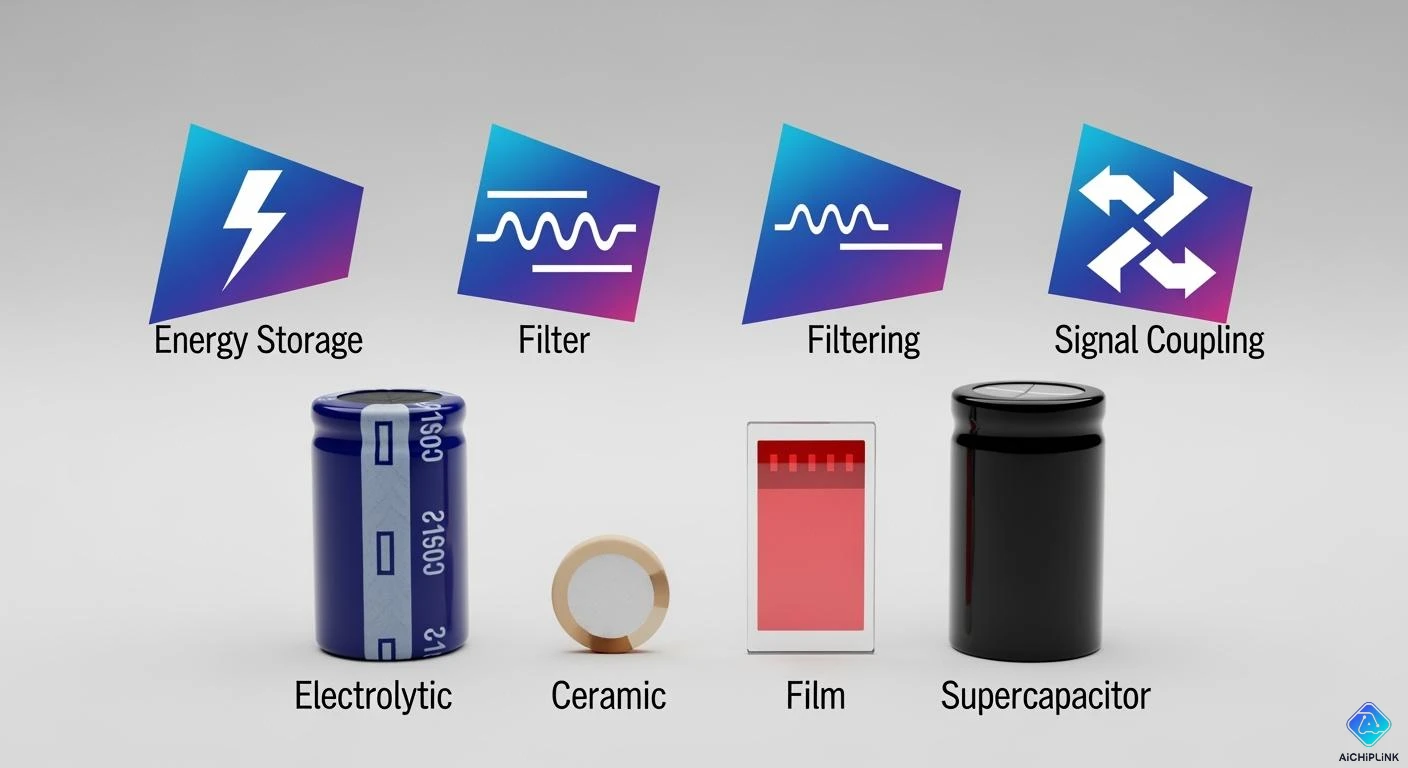
You find capacitors in almost all electronic devices. A capacitor holds energy and gives it out when needed. Picking the right type can make your circuit work better and more stable. There are many kinds of capacitors. Some need to be connected a certain way, but others work no matter how you put them in. Polarized capacitors are used in power supplies. Non-polarized ones are used in AC circuits. Fixed capacitors have one value. Variable types let you change the value if you need to.
| Type of Capacitor | Description | Common Applications |
|---|---|---|
| Polarized Capacitors | Correct polarity needed | Power supply circuits |
| Non-Polarized Capacitors | Any direction possible | AC circuits, coupling, decoupling |
| Fixed Capacitors | Set capacitance value | Most circuits |
| Variable Capacitors | Adjustable capacitance | Tuning radios, filters |
| Ceramic | Compact, for high-frequency | General electronics |
| Film | Stable, reliable | Audio, timing circuits |
| Electrolytic | High capacitance | Power supply smoothing |
| Tantalum | Compact, stable | Mobile, medical devices |
| Mica, Paper, Polymer, Glass | Specialized use | High-performance circuits |
You should think about more than just capacitance or voltage. Temperature, tolerance, and size are important too. Capacitor Types Explained shows that knowing these things helps your projects work well. Always check polarity, capacitance, and what your circuit needs before you choose a capacitor.
Key Takeaways
- Capacitors keep and give out electrical energy. They are very important in electronic devices. - Pick the right capacitor type for your circuit. Think about things like polarity and capacitance. - Polarized capacitors need to be put in the right way. Non-polarized ones can go in any direction. - Variable capacitors let you change the capacitance. This makes them good for tuning things. - Check and change capacitors often. This helps your circuit work well and stops problems.
Capacitor Basics and Functions
What Is a Capacitor?
Capacitors are in almost every electronic device. A capacitor is a simple part that stores and gives out electrical energy. You can think of it like a tiny battery that works very fast. It has two metal plates with a dielectric between them. This setup lets the capacitor hold electric charges until needed.
How Capacitors Work
When you connect a capacitor to power, charges build up on the plates. The dielectric stops the charges from moving between the plates. An electric field forms, and the capacitor stores energy. The energy depends on plate size, distance, and the dielectric type. Capacitance is how much charge it can store, measured in farads.
-
A capacitor keeps energy as charges on two plates with a dielectric between.
-
Capacitance changes with plate size, distance, and dielectric.
-
When voltage is added, charges gather on the plates and make an electric field.
-
The capacitor charges and discharges, but current does not cross the dielectric.
Core Functions in Circuits
Capacitors do many important things in circuits. They store energy, filter, and smooth out voltage changes. They also help with signal coupling, timing, and changing frequencies. The table below lists the main jobs of capacitors and how they are used:
| Function | Description |
|---|---|
| Energy storage | Takes in extra energy when power changes |
| Filtering and smoothing | Makes DC power supplies less bumpy |
| Signal coupling | Lets AC signals go through but blocks DC |
| Timing and frequency | Used for delays and making oscillators |
| Capacitance | Shows how much charge it can hold |
| Voltage rating | Highest voltage the capacitor can take |
| ESR (Series Resistance) | Inside resistance, matters for high-frequency use |
| Leakage current | Small current that leaks through the dielectric |
There are two main types of capacitors: polarized and non-polarized. Polarized capacitors have a positive and negative side. You must connect them the right way or they might break. These are best for DC circuits and have higher capacitance. Non-polarized capacitors can go in any direction and are used in AC circuits. Fixed capacitors have one value. Variable capacitors let you change the value for tuning radios or filters.
Tip: Always check the type and polarity before you add a capacitor to your circuit. This helps stop damage and keeps your project safe.
Capacitor Types Explained
When you start working with electronics, you will see many capacitor types. Each type is built differently and has special uses. This section helps you understand the main capacitor types. You will find out how each one works and where to use it.
Ceramic Capacitors
Ceramic capacitors are very common in electronics. They use ceramic or porcelain as the inside part. These capacitors are small and work well at high frequencies. You can find them in radios and computers.
| Construction Material | Typical Capacitance Range |
|---|---|
| Ceramic/Porcelain | A few picofarads to several microfarads (μF) |
People use ceramic capacitors for bypassing, coupling, and filtering signals. They do not have polarity, so you can put them in any way. Their small size fits well in tiny circuits.
Electrolytic Capacitors
Electrolytic capacitors have high capacitance values. You see them in power supplies and audio gear. These capacitors are polarized, so you must connect them the right way.
-
Electrolytic capacitors are polarized and have high capacitance.
-
They store energy, filter signals, and smooth voltage.
-
The voltage rating should be 1.5 to 2 times higher than the circuit’s voltage.
-
They are made from Aluminum, Tantalum, or Niobium, which changes how they work.
-
They have higher leakage currents and a wide tolerance (±20%).
-
They have higher ESR and do not last long in heat.
-
ESR, ESL, and leakage resistance are not ideal.
Electrolytic capacitors are important for storing energy and filtering in power supplies. They help keep circuits working well.
Aluminum electrolytic capacitors last from 2,000 to 10,000 hours. High heat, ripple current, and too much voltage can make them wear out faster. Always check the voltage rating and connect them the right way.
Film Capacitors
Film capacitors use thin plastic films inside. You find them in many electronics at home and in factories. These capacitors are stable and last a long time.
| Material Type | Impact on Performance and Reliability |
|---|---|
| PET (Mylar) | Used for stability and reliability |
| Polypropylene (PP) | Better for new designs |
| Polystyrene | Not used much now |
The kind of film, like PET or PP, changes how stable and strong the capacitor is. Film capacitors are good for tough jobs because they handle voltage well and last long.
-
Polyester film capacitors are used in timing circuits.
-
Polypropylene film capacitors are best for high-performance jobs like audio.
-
You find them in radios, TVs, and computers.
-
They are also in power supplies, motor starters, cars, and factory machines.
Tantalum Capacitors
Tantalum capacitors are small and stable. They have high capacitance for their size. You see them in phones and medical tools. These capacitors are polarized and need to be connected the right way.
| Advantages | Disadvantages |
|---|---|
| Good frequency performance | Not as common as aluminum or ceramic |
| Last longer than aluminum and ceramic | Tantalum metal can be hard to get and expensive |
| Lower resistance lets more current flow | Polarized, only for DC |
| Highest capacitance for their size | Can fail badly if voltage is too high |
Tantalum capacitors can break in a special way called field crystallization. This can cause shorts or leaks. If you connect them backwards, they can break or catch fire. To stay safe, use a voltage rating at least 50% higher than your circuit. Adding a resistor or soft-start circuit can help prevent problems.
Supercapacitors
Supercapacitors can store much more energy than regular capacitors. You use them when you need to store and release a lot of energy fast.
-
Supercapacitors have very high capacitance for big energy storage.
-
They can give out energy quickly, which helps start motors or with braking.
-
Regular capacitors cannot store as much energy as supercapacitors.
-
Supercapacitors are made to hold a lot of charge, measured in farads.
-
They release energy faster than batteries but do not store as much as batteries.
You find supercapacitors in solar power, electric cars, and backup circuits. They help save energy, smooth power, and make systems more efficient.
Silver Mica Capacitors
Silver mica capacitors use mica inside and silver for the plates. These capacitors are very stable and accurate. You see them in radio circuits and special filters. They are not as common as other types, but they are important for low loss and high reliability.
Variable Capacitors
Variable capacitors let you change the capacitance by moving the plates. You can turn a knob to set the value. This is great for tuning radios and filters.
Variable capacitors work by changing the space or overlap between plates. This is done by turning a set of metal plates between fixed plates. These capacitors are used in tuning circuits, especially in radios and microwaves, where you need to adjust the value for best results.
You use variable capacitors in radio transmitters, receivers, and circuits that need tuning.
Paper Capacitors
Paper capacitors use waxed or oil-soaked paper inside. They were used a lot in old high-voltage circuits.
-
Paper capacitors use waxed or oil-soaked paper as the inside part.
-
They were common in high-voltage jobs in the past.
-
Now, they are sometimes used in:
-
Old equipment
-
Vintage audio gear
-
Special high-voltage circuits.
-
You may still see paper capacitors in old electronics or when fixing vintage devices.
Polarized vs. Nonpolar Capacitors
When you look at capacitor types, you see two main groups: polarized and nonpolar.
| Feature | Polarized Capacitors | Nonpolar Capacitors |
|---|---|---|
| Polarity Characteristics | Must be connected the right way | Can go in any direction |
| Structural Differences | Has an electrolyte inside | Uses inorganic material inside |
| Advantages | High capacitance, low cost | Good for high frequencies, lasts long |
| Disadvantages | Not good for high frequencies, shorter life | Lower capacitance, bigger size |
Polarized capacitors are needed in audio circuits to pass signals and block DC. In power supplies, they help lower ripple and filter noise. Nonpolar capacitors are good for AC circuits and high-frequency jobs.
Fixed vs. Variable Capacitors
Fixed capacitors have one value you cannot change. Variable capacitors let you change the value.
-
Fixed capacitors have one value, which can limit your design.
-
Variable capacitors let you adjust the value for tuning.
-
One variable capacitor can take the place of many fixed ones.
-
Variable capacitors are important for tuning antennas and filtering.
-
They help get the best performance in tunable circuits like radios.
-
Variable capacitors help tune frequency and match impedance.
-
They let you change circuits for different needs.
When you pick between fixed and variable, think about how much you need to change your circuit. Variable capacitors are important in radios, while fixed ones are best for steady, everyday circuits.
Tip: Knowing about these capacitor types will help you choose the right one. Always match the capacitor to your circuit for the best results.
Comparison and Selection Guide
Capacitor Comparison Table
You can look at important features to compare capacitors. The table below shows the main differences in a simple way:
| Type | ESR (Low/High) | Voltage Rating | Lifespan | Polarity | Size |
|---|---|---|---|---|---|
| Ceramic | Low | Medium | Long | Nonpolar | Small |
| Electrolytic | High | High | Medium | Polarized | Medium |
| Film | Low | High | Long | Nonpolar | Medium |
| Tantalum | Medium | Medium | Long | Polarized | Small |
| Supercapacitor | Low | Low | Medium | Polarized | Large |
| Silver Mica | Very Low | High | Very Long | Nonpolar | Small |
| Paper | High | High | Short | Nonpolar | Large |
-
ESR means how much resistance is inside the capacitor. It matters most when using high frequencies.
-
Voltage rating is the highest voltage the capacitor can take.
-
Lifespan means how long the capacitor will work before it stops.
Choosing the Right Capacitor
To pick a good capacitor, first check what value your circuit needs. The voltage rating should be more than the highest voltage in your circuit. The dielectric material changes how well the capacitor works in heat and how long it lasts. Tolerance tells you if the real value is close to the number on the label. Some capacitors work well in hot places, but others can break if they get too hot.
-
High ESR can make the capacitor heat up and not work well.
-
Make sure the size and shape fit your circuit board.
-
Pick a long-lasting capacitor for important jobs.
-
For special uses, like in medical or space tools, use capacitors that follow strict rules.
Tip: Always choose a capacitor that matches what your circuit needs. This helps your project work better and last longer.
Common Mistakes
People sometimes make mistakes when picking capacitors. You might choose one with the wrong voltage rating or forget about ESR. Using old or wrong parts from a list can cause trouble. If you put capacitors far from power pins, they do not work as well. High heat or ripple current can make electrolytic capacitors wear out faster. If you put a polarized capacitor in backwards, it can break or even explode.
-
Do not forget about ESR, voltage rating, or tolerance.
-
Do not use old or wrong capacitors.
-
Plan ahead for changes in parts supply.
-
Put capacitors close to where they are needed on the board.
-
For special circuits, always use the right kind of capacitor.
Note: Taking time to pick the right capacitor helps you avoid problems and keeps your circuits safe.
Capacitors in Real Circuits
Applications and Examples
Capacitors are in almost every electronic device you use. They help power supplies work smoothly. Capacitors store energy and give it out fast when needed. In power supplies, they smooth voltage changes and protect devices. You see capacitors in amplifiers. They block DC and let AC signals go through. This makes music sound clear and strong.
Capacitors are important in radio frequency circuits. They help tune radios and filter signals. You find them in high-power RF gear like cell phones and telecom equipment. Medical devices use capacitors for precise control. MRI coils and lasers need them to work right. Industrial electronics, like plasma generators, use capacitors for steady operation. Military electronics need capacitors for top performance and reliability.
Capacitors are used for energy storage too. Supercapacitors can hold lots of energy and release it quickly. This helps electric cars and backup power systems. In these cases, capacitors give fast bursts of power when needed most.
Troubleshooting and Best Practices
When you use capacitors, you must keep circuits safe and reliable. Electrical testing helps find weak capacitors before they cause trouble. Replace electrolytic capacitors before they fail, especially in old boards. Always pick high-quality capacitors with the right ratings for your project. This helps avoid problems and keeps devices running longer.
You can ask experts to check or replace old capacitors. They know how to test and choose the best parts. Put capacitors close to where they are needed on the board. This improves performance and lowers noise. Keep capacitors away from heat and high ripple currents. This helps them last longer and work better.
Tip: Check your capacitors often. Good care and smart choices help your circuits stay strong and safe.
You now know how different capacitors work. Each type is important for your projects. Capacitors like ceramic, film, electrolytic, tantalum, and supercapacitors have special jobs. Picking the right capacitor makes your circuit more reliable and better. Use this table to help your circuit work well:
| Factor | Description |
|---|---|
| Capacitance | Find out what capacitance your circuit needs. |
| Voltage rating | Pick a capacitor with a voltage rating higher than your circuit’s highest voltage. |
| Dielectric material | Think about temperature stability and losses when choosing a dielectric. |
| Tolerance | Choose a tolerance that matches your circuit, usually +5% or +10%. |
| Size and package | Make sure the capacitor fits your circuit, like through-hole or surface-mount. |
| Lifetime and reliability | Look at how long the capacitor lasts and how reliable it is, especially for important uses. |
Capacitors help you stop mistakes and keep circuits safe. If you know how capacitors get old and how DC bias changes capacitance, you can plan for circuits that last longer. Capacitors also help you use new technology and make your designs better.
-
Your system works better when you know how capacitors change over time.
-
You get the best performance by picking the right capacitor for high-frequency or hot jobs.
-
You can design faster and smarter by using simulation tools to test capacitors before building.
Keep using what you know about capacitors to build good circuits. Stay curious and learn about new capacitor technology.

Written by Jack Elliott from AIChipLink.
AIChipLink, one of the fastest-growing global independent electronic components distributors in the world, offers millions of products from thousands of manufacturers, and many of our in-stock parts is available to ship same day.
We mainly source and distribute integrated circuit (IC) products of brands such as Broadcom, Microchip, Texas Instruments, Infineon, NXP, Analog Devices, Qualcomm, Intel, etc., which are widely used in communication & network, telecom, industrial control, new energy and automotive electronics.
Empowered by AI, Linked to the Future. Get started on AIChipLink and submit your RFQ online today!
Frequently Asked Questions
What is the main job of a capacitor?
A capacitor stores energy and gives it out fast. This keeps your circuit steady. It stops DC signals but lets AC signals go through.
How do you know which capacitor to pick?
You look at voltage rating, capacitance, and size. You also check the dielectric type. Make sure the capacitor fits what your circuit needs.
Why do some capacitors have polarity?
Some capacitors, like electrolytic ones, have polarity because of how they are made inside. You must connect them the right way. If you do not, the capacitor can break or even explode.
Where do you find capacitors in real life?
Capacitors are in power supplies, radios, computers, and cars. They help smooth voltage, filter signals, and store energy for quick use.