What Is the Difference Between MLCC and Electrolytic Capacitors?
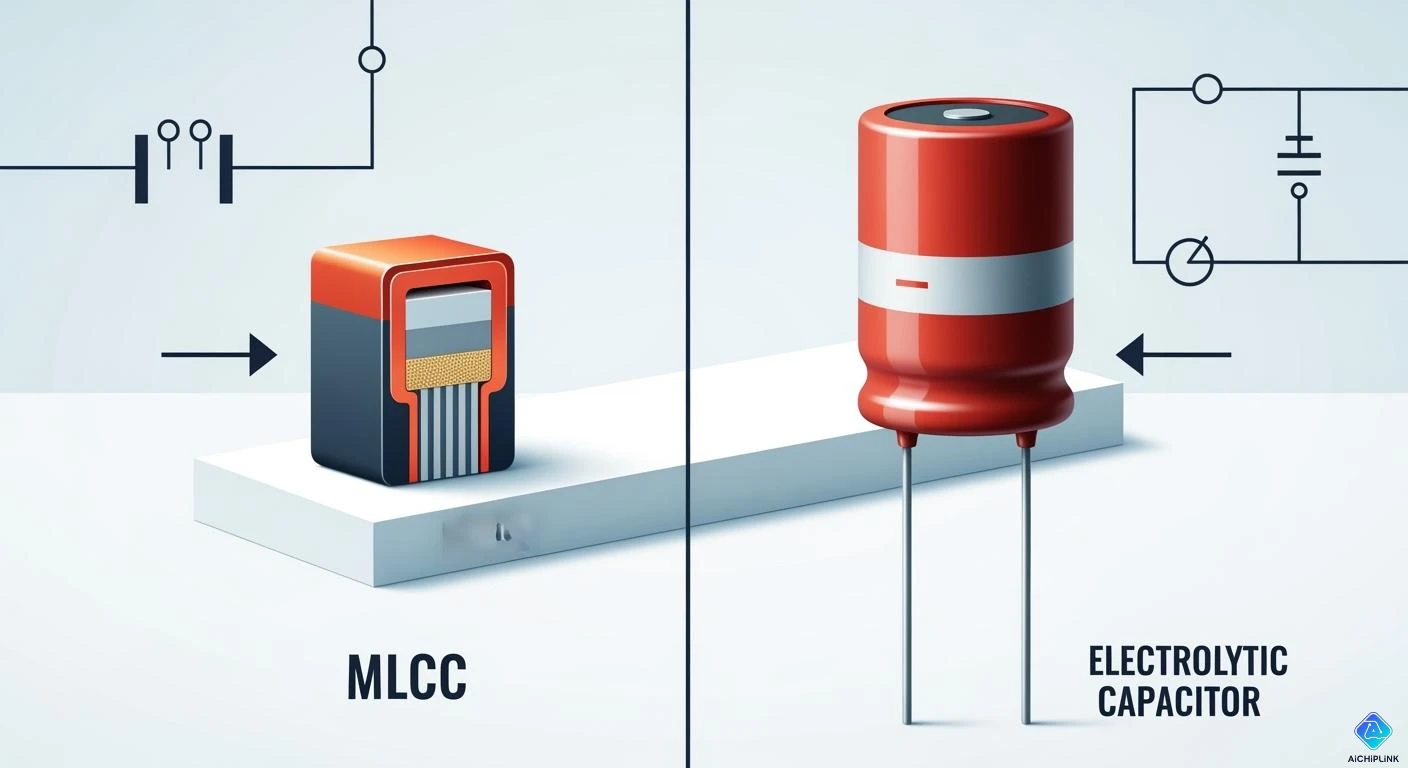
You can see the Difference Between MLCC and electrolytic capacitors by looking at how they are made and used. MLCCs have layers of ceramic material. Electrolytic capacitors use aluminum oxide and an electrolyte. It is important to know these differences. Each type works best in different devices. MLCCs are used a lot in smartphones and laptops. Electrolytic capacitors are good when you need high capacitance. The table below shows how their features are different:
| Feature | MLCC (Multilayer Ceramic Capacitors) | Electrolytic Capacitors |
|---|---|---|
| Polarity | Non-polarized | Polarized |
| Construction Method | Uses many layers of ceramic dielectric | Uses a thin layer of aluminum oxide on the anode with an electrolyte as the cathode |
| Capacitance Characteristics | High capacitance-to-volume ratio | High capacitance, but bigger size |
Key Takeaways
- MLCCs are smaller than electrolytic capacitors. They also last longer. This makes them great for small devices. Electrolytic capacitors can hold more energy. But they need the right polarity to work safely. Pick MLCCs for high-frequency uses. They have low ESR and are very stable. Always look at the voltage rating and capacitance. This helps you pick the right capacitor for your project. Using both MLCC and electrolytic capacitors together is smart. It makes circuits work better by using their strengths.
Difference Between MLCC and Electrolytic Capacitors
Comparison Overview
It is important to know the main difference between MLCC and electrolytic capacitors before picking one for your project. The table below helps you compare these two types in key ways. You can use this table to see how electrolytic capacitors and MLCCs are not the same.
| Parameter | Electrolytic Capacitors | MLCC (Multilayer Ceramic Capacitors) |
|---|---|---|
| ESR (Equivalent Series Resistance) | Higher, increases with age | Lower, stays stable over time |
| Lifetime | 2,000 to 12,000 hours, longer at low temperature | Much longer, often over 10,000 years |
| Size | Larger for the same capacitance | Smaller for the same capacitance |
| Capacitance Change Over Frequency | 18% to 80% | 8% to 12% |
| Polarity | Polarized, must connect the right way | Non-polar, can connect either way |
| Frequency Response | Gets worse at low temperatures | Stays stable across temperatures |
| Mechanical Stress | More likely to get damaged | More robust and strong |
| Dielectric Absorption | Higher (10-15%) | Lower (0.01-0.05%) |
| Acoustic Noise Suppression | No | Yes, with special materials |
| Reliability | Less reliable, electrolyte can dry out | More reliable, no liquid inside |
Tip: Always check the polarity when using electrolytic capacitors. If you connect them wrong, they can break or even explode.
Key Distinctions
You can see the difference between MLCC and electrolytic capacitors when you use them in real circuits. Here are the main things to remember:
-
MLCCs have lower ESR. They waste less energy as heat and work well at high frequencies. Electrolytic capacitors have higher ESR, and it gets worse as they get older.
-
MLCCs last much longer. You can use them in places where you want your circuit to work for many years. Electrolytic capacitors do not last as long because the liquid inside dries out.
-
MLCCs are smaller. You can fit more on a circuit board. Electrolytic capacitors take up more space for the same capacitance.
-
MLCCs do not have polarity. You can connect them any way you want. Electrolytic capacitors are polarized. You must connect the positive and negative sides correctly.
-
MLCCs handle high frequencies better. You can use them in circuits that need to work fast or switch a lot. Electrolytic capacitors do not work as well at high frequencies.
-
MLCCs are stronger. They can handle more shaking and stress. Electrolytic capacitors can break more easily if you bend or shake the board.
-
MLCCs have lower dielectric absorption. They hold less leftover charge after you discharge them. Electrolytic capacitors hold more leftover charge, which can affect sensitive circuits.
You will see these differences when you build or fix electronic devices. For example, in power supplies, you often use both types together. MLCCs give fast response and low ESR. Electrolytic capacitors provide high capacitance to smooth out voltage. If you use only electrolytic capacitors, you may see more heat and a shorter life. If you use only MLCCs, you might need more space and deal with noise.
You should know that new kinds of electrolytic capacitors, like polymer and hybrid types, last longer and work better at high temperatures. These new capacitors can be more reliable than older ones. Still, MLCCs usually last longer and stay stable over time.
Note: Some circuits, like LDO regulators and op-amps, need a certain ESR range to work right. If you use a capacitor with ESR that is too low or too high, the circuit may not work well.
When you pick between MLCC and electrolytic capacitors, think about size, life, frequency, and how much energy you need to store. The difference between MLCC and electrolytic capacitors will change how your circuit works and how long it lasts.
Construction
MLCC Structure
MLCCs are in many new electronic devices. These capacitors have many thin ceramic layers. Metal electrodes are between each layer. Each layer works like a tiny capacitor. Some MLCCs have over 1000 layers in one chip. The number of layers and the size of the electrodes decide how much charge the MLCC can hold. Nickel is often used for the electrodes. Nickel is good at carrying electricity and works well in factories.
Ceramic materials in MLCCs are in two groups. Class I ceramics stay stable when the temperature changes. Class II ceramics can hold more charge but are less stable. When MLCCs are made, they are heated to form crystals in the ceramic. These crystals change how the capacitor works in different situations. Thicker ceramic layers let the MLCC handle more voltage. But, thick layers mean you cannot fit as many layers in one chip.
MLCCs do not have polarity. You can connect them any way you want. This makes them simple to use in circuits.
-
MLCCs are made with:
-
Many thin ceramic dielectric layers
-
Metal electrodes between the layers
-
Nickel for the inside electrodes
-
Class I or Class II ceramic materials
-
Electrolytic Capacitors Structure
Electrolytic capacitors are built in a different way. They have a few main parts inside:
-
Anode: This is made from pure aluminum foil or tantalum foil. The foil is made rough to give it more surface area. More area means the capacitor can hold more charge.
-
Dielectric layer: The anode gets a thin oxide layer. This layer is made by a special process. The oxide layer holds the charge.
-
Electrolyte: A liquid sits next to the oxide layer. The liquid helps store and move charges.
-
Cathode: The cathode foil touches the electrolyte and closes the circuit.
-
Electrolytic paper: This paper keeps the anode and cathode apart. It also helps spread the liquid.
-
Lead wires: These wires let you connect the capacitor to your circuit.
-
The rough anode surface helps the capacitor hold more charge.
-
The thickness of the oxide layer depends on the voltage.
-
The amount of ions in the liquid changes how well the capacitor works.
Electrolytic capacitors can hold more charge than other types. The kind of liquid used changes how steady and good the capacitor is. You must connect electrolytic capacitors the right way. If you connect them wrong, they can stop working.
Always look at the markings before you put in electrolytic capacitors. This helps stop damage and keeps your circuit safe.
Performance
Capacitance and Stability
It is important to know how capacitors act over time. MLCC and electrolytic capacitors are not the same in stability. MLCC capacitors use ceramic materials. These materials can change how much charge they hold. This happens when temperature or voltage goes up or down. Electrolytic capacitors have a liquid or gel inside. This makes them less steady as they get older or get hot.
Here is a table that shows how MLCC and tantalum capacitors compare in stability:
| Capacitor Type | Capacitance Stability | Temperature Effects | Voltage Effects |
|---|---|---|---|
| MLCC | +/- 15% shift | Decreases at extremes | Significant change in effective capacitance |
| Tantalum | More linear | Increases at higher temperatures | Much more stable with voltage performance |
You can see MLCC capacitors can lose or gain up to 15% charge. This happens when temperature or voltage changes a lot. Electrolytic capacitors can also change, but they lose more stability as they age. You should always check the datasheet before using a capacitor.
Tip: Pick capacitors with low drift and high reliability if you want your circuit to stay stable for many years.
Voltage and Frequency Response
MLCC and electrolytic capacitors react differently to voltage and frequency. MLCC capacitors can lose capacitance with high voltage. This is called voltage coefficient. Electrolytic capacitors do not lose as much capacitance with voltage. But they can dry out or leak if used near their voltage limit.
MLCC capacitors work better in high-frequency circuits. They keep their performance steady even when signals change fast. Electrolytic capacitors have higher losses at high frequencies. This is because of their internal resistance and the way the liquid moves inside. You may see more heat and less efficiency with electrolytic capacitors in these cases.
-
MLCC capacitors are good for fast signals and steady performance.
-
Electrolytic capacitors are better for holding lots of charge at lower frequencies.
If you want your circuit to work well at high speed, use MLCC capacitors. If you need to store a lot of energy, use electrolytic capacitors. Always pick the right capacitor for your circuit’s needs.
Reliability
Lifetime and Failure Modes
You should think about how long capacitors last. Electrolytic capacitors can last 10 to 20 years if they stay at normal temperatures, like 40 to 60 degrees Celsius. If you use them somewhere hot, over 50 degrees Celsius, they might only last 3 to 7 years. In a cool room, they can last more than 25 years. MLCCs last longer because they do not have any liquid inside.
It is important to know how capacitors can fail. Here are some common ways they stop working:
-
Silver ion migration can hurt MLCCs, especially in wet places. This can make the capacitor fail.
-
MLCCs can crack if you bend or drop the board. This is called fracture.
-
Electrolytic capacitors can dry out. The liquid inside can leak out. This makes them lose capacitance and stop working.
-
Dielectric breakdown and surface arcing can happen in both types. MLCCs can have these problems more in wet places.
You should always read the datasheet to see how long a capacitor should last and how it might fail before you pick one for your project.
Environmental Tolerance
Capacitors can have problems in tough places. MLCCs can break if you put too much stress on them. The thin ceramic layers can crack easily. If you use them where there is a lot of shaking or bumping, you need to be careful. Electrolytic capacitors can lose weight and capacitance if it gets too hot. Polymer or hybrid types can keep their capacitance in heat and wet places, but their resistance can go up.
You should know about the rules for capacitors. The table below shows some important ones:
| Standard | Application Description |
|---|---|
| AEC-Q200 | Used in cars. Tests for temperature changes, shaking, and wetness. |
| IEC 60384-1 | Used all over the world. Sets rules for capacitance and voltage. |
| UL 94 V-0 | Fire safety rule. Makes sure MLCCs do not burn easily. Used in home and medical devices. |
| ISO 10993 | Used in medical devices. Makes sure parts are safe and not toxic. |
You should always choose capacitors that meet the right rules for your project. This helps your design stay safe and last longer, even in hard places.
Mechanical Strength
Robustness and Stress Resistance
When you pick capacitors, think about how strong they are. MLCCs are made with ceramic. This gives them a solid design. MLCCs can handle shaking and bumps well. They work in places with lots of movement. The solid build helps them not break from bending or shaking. You often find MLCCs in things that move or get stressed.
But, ceramic can crack if you push too hard. If you drop or bend the board a lot, MLCCs might break. Cracks can make the circuit stop working or short out. You need to be careful with MLCCs when you put them in or use them.
Electrolytic capacitors, like polymer aluminum ones, use metal and resin. These parts make them stronger. They are good for places where things get rough. Polymer electrolytic capacitors handle stress better than MLCCs. They do not crack as easily. You can use them in things that might get hit or dropped.
Tip: Always look at what your project needs. Pick MLCCs for solid strength. Pick electrolytic capacitors if you need more crack resistance.
Acoustic Noise
Sometimes, you can hear noise from circuits with capacitors. MLCCs can make sound. When you put voltage on them, they can shake. This shaking comes from the ceramic layers moving. The shaking goes to the board and makes noise you can hear. You hear this more in fast circuits.
Electrolytic capacitors do not make this kind of noise. Their inside parts do not move when voltage is on them. Polymer types also stay quiet. You can use electrolytic capacitors in places where you want no noise.
Here is a table that shows the difference:
| Capacitor Type | Acoustic Noise Generation |
|---|---|
| MLCC | Makes noise because the ceramic moves when voltage is on, causing shaking that goes to the board. |
| Electrolytic | Does not make noise because the inside does not move when voltage is on. |
-
MLCCs can shake and make noise you can hear when voltage is used.
-
Electrolytic capacitors, especially polymer types, do not shake, so they stay quiet.
Note: If you want a quiet circuit, use electrolytic capacitors or special MLCCs that stop noise.
ESR and Capacitance Behavior
ESR Comparison
ESR stands for Equivalent Series Resistance. It is important when picking capacitors. ESR decides how much heat a capacitor makes. It also affects how well your circuit works. Electrolytic capacitors usually have higher ESR than MLCCs. This means they lose more energy as heat. Their ESR gets worse as they get older. MLCCs keep their ESR low and steady. This helps them work well at high frequencies.
Here is a table that shows ESR values for different capacitor types:
| Capacitor Type | Typical ESR Range | Common Use |
|---|---|---|
| Aluminum Electrolytic (low-ESR) | 0.02 - 0.20 ohm | SMPS secondary/output filtering |
| Aluminum Electrolytic (general purpose) | 0.20 - 3.00 ohm | Bulk filtering and general circuits |
| Polymer Electrolytic | 0.005 - 0.08 ohm | Very low ESR, high ripple capability |
| Film (polypropylene/polyester) | 0.001 - 0.10 ohm | AC, pulse, and snubber applications |
| Ceramic MLCC | Very low, frequency-dependent | Excellent HF bypass; value shifts with DC bias |
| Tantalum | 0.05 - 2.00 ohm | Stable capacitance; derating is critical |
MLCCs have very low ESR. This makes them good for high-frequency jobs. Electrolytic capacitors, especially general purpose ones, have higher ESR. Polymer electrolytic capacitors have lower ESR. You can use them when you need to handle lots of ripple current.
Tip: If you want less heat and better performance at high frequencies, pick MLCCs or polymer electrolytic capacitors.
Effective Capacitance
You should also check how capacitance changes in real circuits. MLCCs can lose a lot of capacitance when voltage is applied. This happens mostly in Class II ceramics like X7R and X5R. Sometimes, the capacitance drops by half or more compared to what is printed. Electrolytic capacitors do not lose as much capacitance under DC bias. Polymer types stay steady even when voltage changes.
-
MLCCs can lose up to 70% of their capacitance under DC voltage.
-
Electrolytic capacitors keep their capacitance steady with applied voltage.
-
Polymer electrolytic capacitors do not change much with voltage.
-
At high frequencies, MLCCs keep low ESR, but electrolytic capacitors can become more inductive.
-
Designers often need to overspecify MLCCs to make sure the circuit works as planned.
You must check how much capacitance you really get in your circuit. If you use MLCCs, you may need to pick a higher value than you think. Electrolytic capacitors give you more stable capacitance. You can trust their ratings more.
Note: Always check the datasheet for real capacitance values, especially if you use MLCCs in power or signal circuits.
Applications
MLCC Uses
MLCCs are in many new electronic devices. They work well when you need small parts that stay stable. In phones, MLCCs help keep the power steady and signals clear. Fitness trackers use them to help the device run without problems. Smart home gadgets use MLCCs to stop power changes and keep working right. Portable game consoles use MLCCs for fast circuits, which helps them work better. Home appliances use MLCCs to handle power spikes and make them last longer.
Cars also use MLCCs a lot. They are in engine control units to help the engine run well. Advanced driver-assistance systems need MLCCs to work safely. Car radios and screens use MLCCs to make sound and pictures better. Electric cars use MLCCs in power circuits to save energy. Car MLCCs are tough. They work from -55°C to +150°C and up to 500V. This makes them good for rough places.
Factories use MLCCs too. Telecom gear uses them to filter high-frequency signals. 5G equipment needs MLCCs to match signal levels. Machines in factories use MLCCs to keep running even when things get rough.
Tip: Pick MLCCs if you want small, strong, and steady capacitors for fast or tough jobs.
Electrolytic Capacitors Uses
Electrolytic capacitors do many important jobs in electronics. You see them a lot in power supplies. They help store and filter energy in switched-mode power supplies. One big job is to smooth out voltage and remove noise in DC power supplies.
Electrolytic capacitors can act like small batteries. They give quick bursts of power in things like camera flashes and motors. In audio amps, they let AC signals pass but block DC. This helps keep the sound clear and the voltage steady. Timing circuits use these capacitors to set how long pulses last in timers and oscillators. By-pass jobs use electrolytic capacitors to send high-frequency noise to ground, which helps the circuit work better. Motor starters use them to help start AC motors by shifting the phase.
You find electrolytic capacitors in many things. TVs, computers, and speakers all use them to work well.
Note: Always check the voltage and which way you connect electrolytic capacitors. This helps stop damage and keeps things safe.
Choosing the Right Capacitor
Selection Criteria
You should think about a few things before picking a capacitor. Each type is good for different jobs. MLCC capacitors are great for decoupling and noise filtering. They also work well in high-frequency circuits. Electrolytic capacitors can store more energy. They are used in power circuits. The table below helps you match the right capacitor to your project:
| Capacitor Type | Key Characteristics | Ideal Applications |
|---|---|---|
| Ceramic (MLCC) | Low ESR, stable, high-frequency performance | Decoupling, noise filtering |
| Aluminum Electrolytic | Bulk energy storage, polarized, high capacitance values | Low-frequency filtering, power circuits |
Check the minimum capacitance, voltage rating, and ESR for your circuit. MLCC capacitors are good if you need fast response and low noise. Electrolytic capacitors are better for smoothing power or storing energy. Always read the datasheet to make sure the capacitor fits your circuit.
Tip: MLCC capacitance can drop when you use DC voltage. Check your circuit voltage and pick a higher rating if needed.
Practical Tips
Follow these steps to help your project work well:
-
Find the lowest capacitance, voltage rating, and ESR your circuit needs.
-
Pick a capacitor that meets these specs but is not too high.
-
Use parallel or series capacitors to adjust values instead of one big part.
-
Compare costs and quality from suppliers. Balance price, lifespan, and how easy it is to get the part.
Always pick a capacitor with a voltage rating higher than your circuit voltage. A safety margin of 20–50% helps stop failure.
Avoid common mistakes. Ignoring ESR can cause bad filtering and make your circuit unstable. Picking the wrong voltage rating can make the capacitor fail. Poor thermal management makes the capacitor last less time. Improper polarity damages electrolytic capacitors right away. If you use MLCC, choose X5R or X7R types for better performance.
In big production, MLCC capacitors often cost less per unit than electrolytic capacitors. Supply shortages can change prices and how easy it is to get parts. Matching the capacitor to your circuit needs saves money and keeps your project reliable.
You can find the main differences between MLCC and electrolytic capacitors in this table. Each type has its own build, size, speed, and how long it lasts. MLCCs are best for small devices that need to work fast. Electrolytic capacitors are better for things that use a lot of power.
| Feature | MLCC Capacitors | Electrolytic Capacitors |
|---|---|---|
| Structure | Multi-layered ceramic | Metal can with electrolyte |
| Size & Capacity | Tiny, moderate capacitance | Bulkier, high capacitance |
| Speed | Fast charge/discharge | Slow charge/discharge |
| Lifespan | Long, no wear-out | Shorter, electrolyte degrades |
| Best For | Compact devices | Power systems |
You should choose a capacitor that fits what your project needs. MLCCs can handle high frequencies and stay steady. Electrolytic capacitors hold more energy and are good for power circuits. Always look at what you need and how reliable the part is before picking a capacitor.

Written by Jack Elliott from AIChipLink.
AIChipLink, one of the fastest-growing global independent electronic components distributors in the world, offers millions of products from thousands of manufacturers, and many of our in-stock parts is available to ship same day.
We mainly source and distribute integrated circuit (IC) products of brands such as Broadcom, Microchip, Texas Instruments, Infineon, NXP, Analog Devices, Qualcomm, Intel, etc., which are widely used in communication & network, telecom, industrial control, new energy and automotive electronics.
Empowered by AI, Linked to the Future. Get started on AIChipLink and submit your RFQ online today!
Frequently Asked Questions
What does MLCC stand for?
MLCC means Multilayer Ceramic Capacitor. You find these in lots of electronics. MLCCs have layers of ceramic and metal. These layers help store electric charge.
Can you use MLCC and electrolytic capacitors together?
Yes, you can use both in one circuit. MLCCs are good for high frequencies. Electrolytic capacitors store more energy. Using both gives your circuit better performance.
Why do electrolytic capacitors have polarity?
Electrolytic capacitors use a chemical inside. You must connect them the correct way. If you switch the sides, the capacitor can break or even explode.
How do you choose the right capacitor for your project?
You should check voltage, capacitance, and ESR. MLCCs are good for fast signals. Electrolytic capacitors are better for storing power. Always read the datasheet before you pick one.
Are MLCCs better for high-frequency circuits?
Yes, MLCCs work well at high frequencies. They have low ESR and stay steady. You should use MLCCs for noise filtering and fast circuits.