Top 7 Capacitor Types for Industrial Automation in 2026
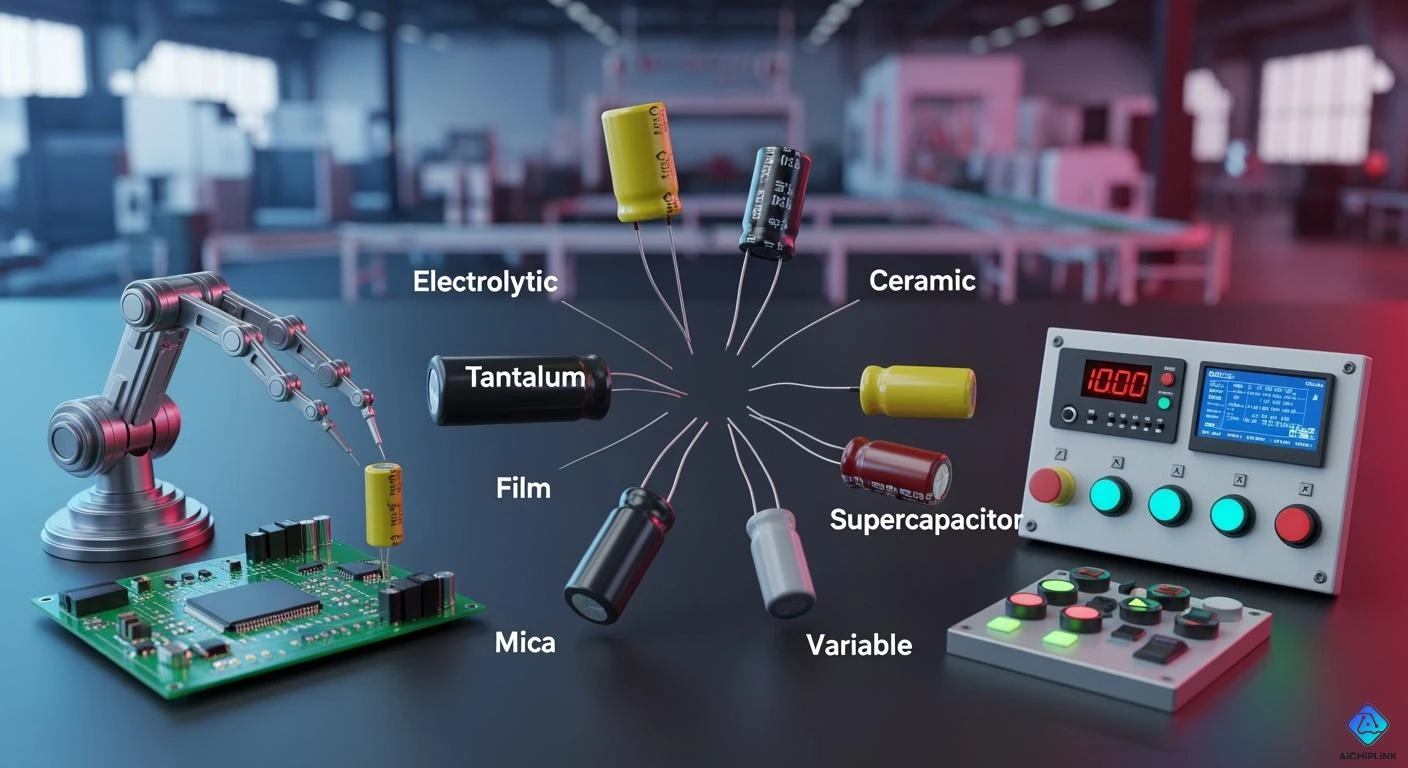
Choosing the right capacitors in industrial automation is very important. Here are the top 7 capacitor types you should think about for 2026:
-
Ceramic Capacitors
-
Film Capacitors
-
Electrolytic Capacitors
-
Tantalum Capacitors
-
Supercapacitors
-
Aluminum Polymer Capacitors
-
Mica Capacitors
These capacitors in industrial automation are very reliable. They can handle high and low temperatures well. Each one works best for certain jobs. Many industries like to use plastic film capacitors for power factor correction. High-voltage ceramic capacitors are used more in tough places. It is important to pick the right capacitors in industrial automation for each job. This helps your machines work well for a long time and not break down often.
Key Takeaways
- Pick the right capacitor for your automation job. This helps your system last longer and work well. Ceramic and film capacitors block noise. They also handle high voltage. This makes them useful for many jobs. Electrolytic capacitors hold a lot of charge. They help keep voltage steady in power supplies and motors. Supercapacitors store energy fast. They give backup power quickly. They also charge and discharge very fast. Always think about heat and humidity when you pick capacitors. This helps your system work better and last longer.
Capacitors in Industrial Automation: Top Types
Ceramic Capacitors
Ceramic capacitors help block noise and keep signals steady. You can use them in motor drives, RF circuits, and power supplies. These capacitors have high capacitance but are small. There are two main types: Class 1 and Class 2.
Class 1 ceramic capacitors keep their capacitance very steady. They lose very little energy. You can use them in high-frequency and timing circuits.
Class 2 ceramic capacitors have more capacitance but are less steady. They work well for general decoupling and power supply jobs.
| Class Type | Characteristics | Applications |
|---|---|---|
| Class 1 (NP0/C0G) | Capacitance stays steady, low losses, no aging | High-frequency RF, timing, and precision analog circuits |
| Class 2 (X7R, X5R) | More capacitance, less steady, some trade-offs | General decoupling, power supply uses |
Ceramic capacitors are cheap and work well. You can trust them to keep signals clear and block noise. Their small size fits in tight spaces. They are good for many automation needs.
Film Capacitors
Film capacitors last a long time and are very reliable. You can use them in power factor correction, motor drives, and inverter circuits. These capacitors handle ripple currents and high voltages.
| Benefit | Description |
|---|---|
| Fewer Failures | Plastic film means fewer failures than other capacitors. |
| Excellent Voltage Resistance | Film capacitors work at higher voltages than aluminum electrolytic capacitors. |
| Anti-Ripple Current Operation | They handle ripple currents well, which helps power supplies. |
| High Voltage Withstand Capability | Film capacitors can take voltages up to almost 4000 V. |
| Excellent Frequency Characteristics | They block high-frequency harmonics and cut down interference. |
| Stability in High-Temperature | They stay steady even when it is hot. |
| Long Service Life | They last over 100,000 hours, so they are good for long use. |
| Energy Efficiency | Using film capacitors can save 15% to 20% of energy. |
You can use film capacitors in motor control circuits. They help keep voltage steady and block noise in power supplies. Better encapsulation makes them last longer. You get solutions that can last for many years.
Electrolytic Capacitors
Electrolytic capacitors give you high capacitance. You can use them in power supplies, motor starters, and machines. These capacitors keep voltage steady and help motors start.
-
Power supplies use electrolytic capacitors to keep voltage even.
-
Motor drives and robots need them to work well.
-
You find them where high capacitance is needed.
Temperature changes how long electrolytic capacitors last. If you lower the temperature by 10°C, they last twice as long. High heat makes them age faster and not last as long. You can make them last longer by keeping them cool. These capacitors are good for many automation jobs.
Tantalum Capacitors
Tantalum capacitors are small and very reliable. You can use them in military, aerospace, and medical devices. They can fix small problems by themselves. This helps them last longer and work better.
-
Tantalum capacitors are good for important equipment.
-
They are great when you do not have much space.
But there are some problems. Direct current leakage can drain batteries in important devices. High heat and defects can make leakage worse. Their resistance is higher than some other types. You should think about these things before using tantalum capacitors.
Supercapacitors
Supercapacitors store a lot of energy. You can use them for backup power, energy storage, and AGVs. These capacitors charge very fast and give quick energy.
| Use Case | Description |
|---|---|
| Zero-Interruption Backup Power | Supercapacitors give fast energy to protect important systems. |
| Automated Guided Vehicles (AGVs) | AGVs use supercapacitors for quick charging and steady work. |
| Energy Storage Systems | Supercapacitors keep voltage steady during sudden changes. |
Supercapacitors can be used many times without losing much power. You get solutions that last longer than regular capacitors. They are great for jobs that need lots of charging and discharging.
Aluminum Polymer Capacitors
Aluminum polymer capacitors have low resistance and are very reliable. You can use them for filtering in switch-mode power supplies. These capacitors give clean DC output and steady performance.
| Specification | Value |
|---|---|
| Temperature Range | -55°C to +105°C |
| Equivalent Series Resistance | 4.5mΩ to 70mΩ |
| Voltage Range | 2 V to 16 V |
| Capacitance | μF to hundreds of μF |
| Recommended Derating | ≤ 80% of VR |
Heat, humidity, and higher resistance can make them work less well. You should check these things to keep them working right. Aluminum polymer capacitors wear out slowly, but they are still good for tough jobs.
Mica Capacitors
Mica capacitors give steady and exact capacitance. You can use them in electronics, telecommunications, aerospace, motors, appliances, defense, and new industries.
| Industrial Sector | Application of Mica Capacitors |
|---|---|
| Electronics | Insulating material |
| Telecommunications | Insulating material |
| Aerospace | Insulating material |
| Motors | Insulating material |
| Electrical Appliances | Insulating material |
| Defense | Insulating material |
| Cutting-edge Industries | Insulating material |
-
Mica capacitors can take high voltages and heat.
-
They lose little energy and have a high quality factor.
-
Their small inductance is good for radio frequency circuits.
-
Silver mica capacitors are tightly sealed and last a long time.
You get good solutions for high-frequency and high-voltage jobs. Mica capacitors cost more, but they work very well in important systems.
Tip: Pick the right capacitor for your job in automation. This will help your system last longer and work better.
Selection Guide for Industrial Automation Capacitors
Application Matching
You need to pick the right capacitor for each job. Aluminum electrolytic capacitors are good for input filtering and storing energy in power supplies. Film capacitors are best for DC link jobs because they last long and handle ripple current well. Polymer aluminum capacitors have low resistance and give clean output filtering. Ceramic capacitors help with high-frequency filtering and decoupling on control boards.
| Capacitor Type | Application Description |
|---|---|
| Aluminum Electrolytic | Used for input filtering and energy storage in power supplies, ideal for bulk energy storage. |
| Film (Polypropylene) | Preferred for DC link applications due to superior ripple current handling and long service life. |
| Polymer Aluminum | Combines efficiency of electrolytics with low-ESR performance, excellent for output filtering. |
| Ceramic (MLCC) | Utilized for high-frequency filtering and decoupling on control boards, with attention to DC bias derating. |
Think about what the capacitor does in your system. Capacitors help the DC bus and lower ripple. They make voltage more stable. They help the inverter stage work better. In energy storage systems, you need capacitors that can charge and discharge fast.
Reliability and Lifespan
You want capacitors that last long and keep machines running. The quality of a capacitor decides how long it works. High-quality electrolytic capacitors can last up to 20,000 hours. Tantalum capacitors have different reliability levels. Commercial tantalum capacitors can fail 1% of the time every 1,000 hours. High-reliability types can fail as little as 0.001% of the time.
| Capacitor Type | Reliability Level (% per 1,000 hours) | Confidence Level |
|---|---|---|
| Commercial Tantalum | 1% | N/A |
| High-Reliability Tantalum | 0.1% - 0.001% | 90% |
| Capacitor Type | Typical Lifespan (Hours) | Notes on Quality and Conditions |
|---|---|---|
| Electrolytic Capacitor | 1,000 - 10,000 | Lifespan depends on operating conditions and quality. |
| High-Quality Electrolytic Capacitor | Up to 20,000+ | Used in industrial applications for extended durability. |
Look for capacitors that meet standards like AEC-Q200, UL 810, or CSA C22.2. These tests check if the capacitor is safe and works well in tough places.
Temperature and Environmental Considerations
You need to see how heat, humidity, and vibration affect your capacitor. High humidity can lower insulation resistance and cause more leakage. Water vapor can make the capacitor rust and lose capacitance. Vibration can break the leads and change how the capacitor works. When heat and humidity change, water vapor can get inside and make the capacitor worse.
Tip: Always pick capacitors with high quality and the right certification for your environment. This helps your energy storage systems and automation work longer and better.
You make your automation system better by picking the right capacitor. First, check the noise frequency. Look at the insertion loss curve too. Make sure the capacitor fits your job. Always check how you will install it.
-
Put each capacitor close to the IC for best results.
-
Pick the right value so all noise is blocked.
-
Keep the ground plane strong. Run tests to stop problems.
Focus on getting good quality. Good capacitors last longer and handle ripple current. They give you solutions you can trust. Good quality also means better voltage safety and surge protection. Hot places can make quality worse. So, choose capacitors that work well in your area.
You get the best results when you match quality to your needs. Check your automation system. Talk to experts to find the best solutions.

Written by Jack Elliott from AIChipLink.
AIChipLink, one of the fastest-growing global independent electronic components distributors in the world, offers millions of products from thousands of manufacturers, and many of our in-stock parts is available to ship same day.
We mainly source and distribute integrated circuit (IC) products of brands such as Broadcom, Microchip, Texas Instruments, Infineon, NXP, Analog Devices, Qualcomm, Intel, etc., which are widely used in communication & network, telecom, industrial control, new energy and automotive electronics.
Empowered by AI, Linked to the Future. Get started on AIChipLink and submit your RFQ online today!
Frequently Asked Questions
What is the main role of a capacitor in automation systems?
A capacitor stores energy and lets it go when needed. It keeps voltage steady in the system. It also blocks noise that can cause problems. This helps the automation system work better and safer.
How do you choose the right capacitor for industrial and commercial use?
First, think about what your system needs to do. Pick a capacitor that fits the voltage and temperature needed. Make sure it will last as long as you need. Always check if it has safety and quality certificates.
Why do some capacitors fail in harsh environments?
Capacitors can break if it is too hot or wet. Shaking or vibration can also hurt them. Water vapor can make them rusty and not work well. You can protect your system by using good quality capacitors.
Can you use the same capacitor for every automation application?
You cannot use just one kind for all jobs. Each task in automation needs a special type. You must pick the right capacitor for each job and place.
How often should you check or replace capacitors in your automation system?
Check your capacitors often to see if they are worn out. Change them if you see leaks or swelling. If they do not work well, replace them. This helps your automation system keep working well.