What makes High-Speed CAN different from Low-Speed CAN
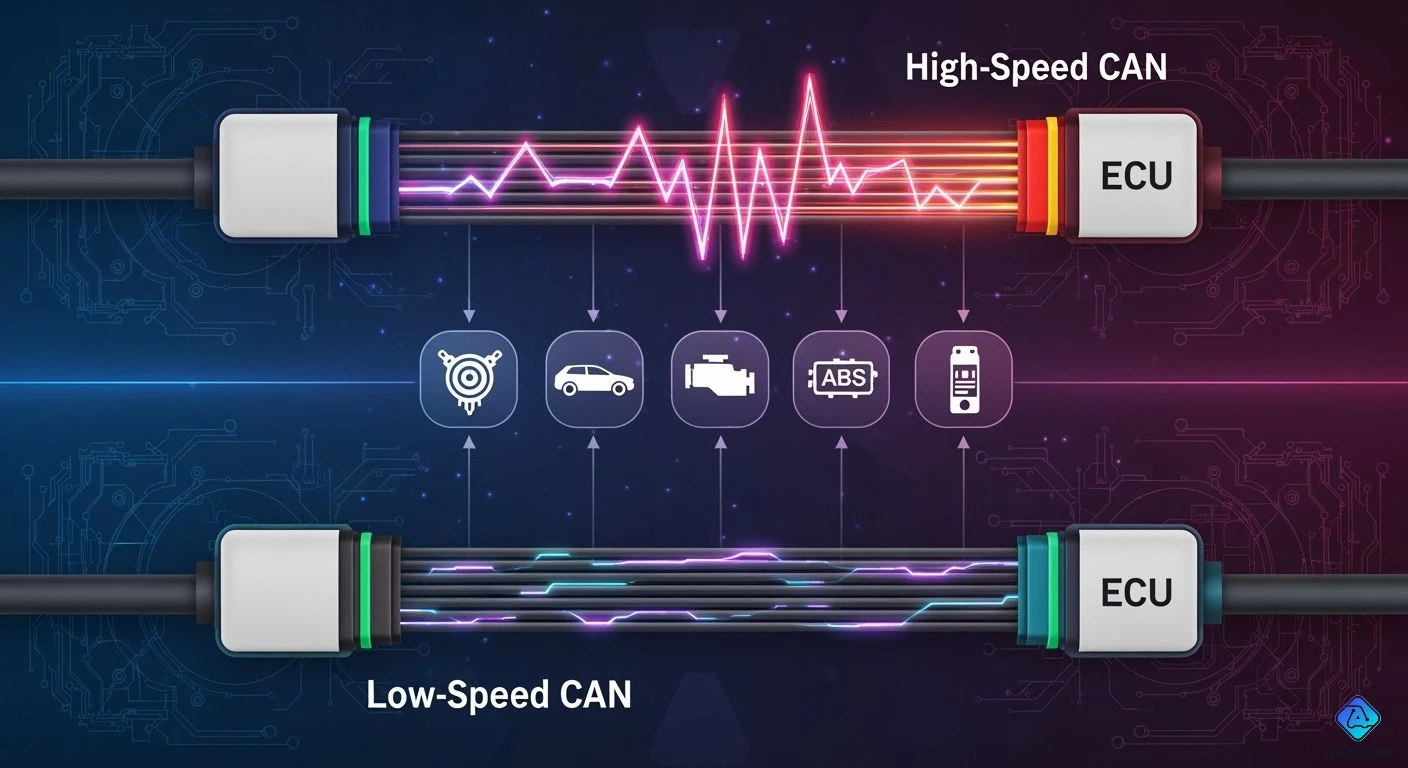
You notice clear differences when you compare high-speed CAN and low-speed CAN. High-speed CAN moves data much faster and works best in systems where speed matters, like engine control. Low-speed CAN focuses on fault tolerance, so it keeps running even if part of the wiring fails. You also see differences in voltage levels and how each type fits certain uses. Here is a quick look at how these features compare:
| Feature | High-Speed CAN | Low-Speed CAN (Fault-Tolerant) |
|---|---|---|
| Baud Rate | 5k - 1M | 5K - 125K |
| Voltage (Idle) | CAN-H: ~2.5V, CAN-L: ~2.5V | CAN-H: ~0V, CAN-L: ~5V |
| Voltage (Valid) | CAN-H: ~3.6V, CAN-L: ~1.4V | CAN-H: ~4V, CAN-L: ~1V |
High-Speed CAN vs Low-Speed CAN matters because these features help you choose the right system for your project.
Key Takeaways
- High-Speed CAN works well when you need fast data. It is used for things like engine control and safety systems. Low-Speed CAN can keep working even if wires break. This means it is good when you need things to be reliable. Pick High-Speed CAN if you need data right away. Choose Low-Speed CAN if you need it to work in tough places. High-Speed CAN can send data up to 1 Mbps. Low-Speed CAN can only send data up to 125 kbps. Think about what your project needs before you pick which CAN type to use.
High-Speed CAN Basics
What is High-Speed CAN
High-speed CAN lets devices talk to each other fast. It follows strict rules so everything works together. These rules are called standards. Some main standards are ISO-11898-1 and ISO-11898-2. These standards tell how high-speed CAN should work in different places. You can find high-speed CAN in cars and factories. It helps devices share information quickly and safely.
| Standard | Description |
|---|---|
| ISO-11898-1 | High-Speed CAN specifications |
| ISO-11898-2 | High-Speed CAN physical layer |
| ISO-11898-5 | High-Speed CAN with fault confinement |
| ISO-11783-2 | Agricultural equipment communication |
| MilCAN | Military CAN protocol |
| CANopen | Application layer for embedded networks |
| DeviceNet | Industrial automation network |
| SAE J1939 | Heavy-duty vehicle communication protocol |
| SAE J2284-1, -2, -3 | Standards for automotive applications |
Key Features and Specs
High-speed CAN is special because it sends data fast. The usual speed is 500K bits per second. This lets devices send messages quickly. The voltage changes with the signal. When nothing is sent, CAN High and CAN Low are both at 2.5 volts. When sending data, CAN High goes up to 3.5 volts. CAN Low drops to 1.5 volts. You need 120 Ω resistors at both ends of the CAN bus. These resistors stop signals from bouncing back. They help keep communication clear. Twisted-pair cables and good grounding protect the system from noise.
| State | CAN High voltage | CAN Low voltage |
|---|---|---|
| Recessive | 2.5 volts | 2.5 volts |
| Dominant | 3.5 volts | 1.5 volts |
-
You must put termination at both ends of the CAN bus.
-
Only the devices at the ends need resistors.
-
Termination resistors stop signal reflection and help block noise.
-
Twisted-pair cables give better protection.
-
Good grounding keeps the system steady.
Common Applications
High-speed CAN is used in many safety systems. It is found in antilock brakes, engine control, and emissions systems. These systems need fast and reliable communication to keep people safe. High-speed CAN is also used in factories, farms, and military vehicles. It works best where quick response and clear data are needed. High-speed CAN is better than low-speed CAN when speed and accuracy matter.
-
Automotive safety systems (ABS, ECMs)
-
Industrial automation networks
-
Agricultural equipment
-
Military vehicles
Tip: Always test your CAN bus setup. This makes sure every device works right. Testing helps you find problems early and keeps your system running well.
Low-Speed CAN Features
What is Low-Speed CAN
Low-speed CAN is used when you need a network that keeps working if something goes wrong. It is also called fault-tolerant CAN. It sends data slower, up to 125 kbps. You find low-speed CAN where safety and reliability are more important than speed. The system uses special wires and connectors. These help it keep running if one wire breaks or gets damaged. You can trust low-speed CAN to send messages even in tough places.
Fault Tolerance and Specs
Low-speed CAN is special because it can handle problems. If a wire fails, the network still sends messages. You do not lose communication. The protocol uses extra circuits and smart wiring to fix issues. Data rates go up to 125 kbps, which is slower than high-speed CAN. Voltage levels change with the signal. When the bus is idle, CAN High is about 0 volts and CAN Low is about 5 volts. When sending data, CAN High goes up to 4 volts and CAN Low drops to 1 volt. The cables use twisted pairs to fight interference. This gives strong resistance to electrical disturbances. The system works well in tough environments. CAN bus cables can handle high heat and dust. You see fewer errors, even when connectors face humidity or dirt.
| Feature | Low-Speed CAN (Fault-Tolerant) |
|---|---|
| Baud Rate | Up to 125 kbps |
| Fault Tolerance | Yes |
| Voltage (Idle) | CAN-H: ~0V, CAN-L: ~5V |
| Voltage (Valid) | CAN-H: ~4V, CAN-L: ~1V |
| Environmental Robustness | High resistance to interference, temperature, dust |
Note: Low-speed CAN keeps your system working when wires fail. You get reliable communication in harsh conditions.
Use Cases
Low-speed CAN is used in many vehicle functions that are not critical. These jobs do not need fast data but must work all the time. You find low-speed CAN in window controls, seat adjustments, climate control, and lighting. Industrial machines use low-speed CAN for tasks that need to last and be reliable. The protocol works well in places with high heat, dust, or electrical noise. You pick low-speed CAN when you want your system to keep working, even if the environment gets rough.
-
Window controls in vehicles
-
Seat adjustments
-
Climate control systems
-
Lighting functions
-
Industrial machines in harsh environments
High-Speed CAN vs Low-Speed CAN Comparison
Speed and Bandwidth
When you compare high-speed can vs low-speed can, speed stands out as the biggest difference. High-speed can supports data rates from 40 kbit/s up to 1 Mbit/s. This means you can send messages much faster. Low-speed can works at speeds from 40 kbit/s to 125 kbit/s. If you need to move lots of data quickly, high-speed can is the better choice.
| CAN Type | Maximum Speed |
|---|---|
| High-Speed CAN | 40 kbit/s to 1 Mbit/s |
| Low-Speed CAN | 40 kbit/s to 125 kbit/s |
You see high-speed can in places where real-time data matters, like engine control or safety systems. Low-speed can fits best in comfort features, such as window controls or dashboard displays. In modern vehicles, high-speed can vs low-speed can often comes down to how much data you need to move and how fast you need it.
-
High-speed can supports speeds up to 1 Mbps.
-
CAN FD, a newer version, can reach up to 15 Mbps.
-
Low-speed can usually runs at about 20 kbps.
-
High-speed can is best for real-time communication.
-
Low-speed can is not good for high-demand data tasks.
Voltage and Physical Layer
The physical layer of each network also shows clear differences. High-speed can uses 120 Ohm termination resistors at both ends of the bus. This setup keeps signals clear and reduces noise. Low-speed can needs termination at every node, which makes the wiring more complex.
| Feature | High-Speed CAN | Low-Speed CAN |
|---|---|---|
| Data Rate | Up to 1 Mbps | 40 Kbps to 125 Kbps |
| Termination | 120 Ohm at both ends | Termination at every node |
| Voltage Levels | 3.5V (CAN_H), 1.5V (CAN_L) | 0.2V and 3.6V (CAN_H), 1.8V and 4.8V (CAN_L) |
| Maximum Stub Length | 30 cm for 500 bits/sec | N/A |
High-speed can uses a simple wiring setup. You only need to add resistors at the ends. Low-speed can needs more careful wiring and more parts. The voltage levels also change between the two. High-speed can uses 3.5V for CAN_H and 1.5V for CAN_L when sending data. Low-speed can uses a wider range, which helps it keep working even if the wires get damaged.
Fault Tolerance
Fault tolerance is where low-speed can shines. If a wire breaks or shorts, low-speed can keeps working. High-speed can will stop if there is a wiring problem. This makes low-speed can a better choice for systems that must keep running, even when something goes wrong.
| Fault Condition | Low-Speed CAN Capability | High-Speed CAN Capability |
|---|---|---|
| Interruption of CAN_H and CAN_L | Operates | Fails |
| Shortcut between CAN_H or CAN_L and battery voltage | Operates | Fails |
| Shortcut between CAN_H or CAN_L and ground | Operates | Fails |
| Shortcut between CAN_H and CAN_L | Operates | Fails |
You should pick low-speed can if you need your system to survive wiring faults. High-speed can works well when you want speed, but it does not handle faults as well.
Tip: For harsh environments or places where wiring might get damaged, low-speed can gives you more reliability.
Application Differences
You see high-speed can vs low-speed can in many real-world applications. High-speed can is common in engine control, anti-lock braking systems, and other real-time systems. These jobs need fast and accurate data. Low-speed can is used for comfort features, like power windows, dashboard controls, and entertainment systems. These do not need fast data, but they must keep working all the time.
| Feature | High-Speed CAN | Low-Speed CAN |
|---|---|---|
| Data Rate | 500 kbps | 100 kbps |
| Transmission Distance | Up to 40 meters | Up to 100 meters |
| Application Scope | Engine control, ABS, real-time systems | Comfort systems, entertainment |
| Usage Scenarios | High data exchange subsystems | Less critical control systems |
You also need to think about cost. High-speed can has a lower cost per node and does not need extra switches. Low-speed can costs more per node and needs more parts. For simple functions, high-speed can is more cost-effective. For high-value features that must always work, low-speed can is worth the extra cost.
In the end, high-speed can vs low-speed can is about what your system needs. If you want speed and real-time data, choose high-speed can. If you need fault tolerance and reliability, low-speed can is the better fit.
You can see that High-Speed CAN and Low-Speed CAN serve different needs. High-Speed CAN gives you faster data rates and supports more devices. Low-Speed CAN offers better fault tolerance and longer cable runs. The table below shows the main differences:
| Feature | High-Speed CAN | Low-Speed CAN |
|---|---|---|
| Maximum Speed | 1 Mbit/s | 125 kbit/s |
| Fault Tolerance | Limited | Enhanced |
| Max Length | 40 meters | 500 meters |
Choose High-Speed CAN for speed and real-time tasks. Pick Low-Speed CAN for reliability and tough environments.

Written by Jack Elliott from AIChipLink.
AIChipLink, one of the fastest-growing global independent electronic components distributors in the world, offers millions of products from thousands of manufacturers, and many of our in-stock parts is available to ship same day.
We mainly source and distribute integrated circuit (IC) products of brands such as Broadcom, Microchip, Texas Instruments, Infineon, NXP, Analog Devices, Qualcomm, Intel, etc., which are widely used in communication & network, telecom, industrial control, new energy and automotive electronics.
Empowered by AI, Linked to the Future. Get started on AIChipLink and submit your RFQ online today!
Frequently Asked Questions
What is the main reason to use High-Speed CAN in the automotive industry?
You use High-Speed CAN when you need fast data transfer. The automotive industry relies on it for safety systems like airbags and engine control. Quick communication helps keep vehicles safe and efficient.
Can Low-Speed CAN handle critical systems in the automotive industry?
You should not use Low-Speed CAN for critical systems. The automotive industry uses it for non-essential features like window controls. It works best where reliability matters more than speed.
How do you know which CAN type to choose for your project?
You look at your needs. If you work in the automotive industry and need speed, pick High-Speed CAN. For long-lasting, fault-tolerant systems, choose Low-Speed CAN. Always match the CAN type to your system’s demands.
Do both CAN types use the same wiring?
You see differences in wiring. High-Speed CAN uses simple wiring with resistors at each end. Low-Speed CAN needs more complex wiring for fault tolerance. Each type fits different needs in vehicles and machines.