Will FPGA be replaced by AI?
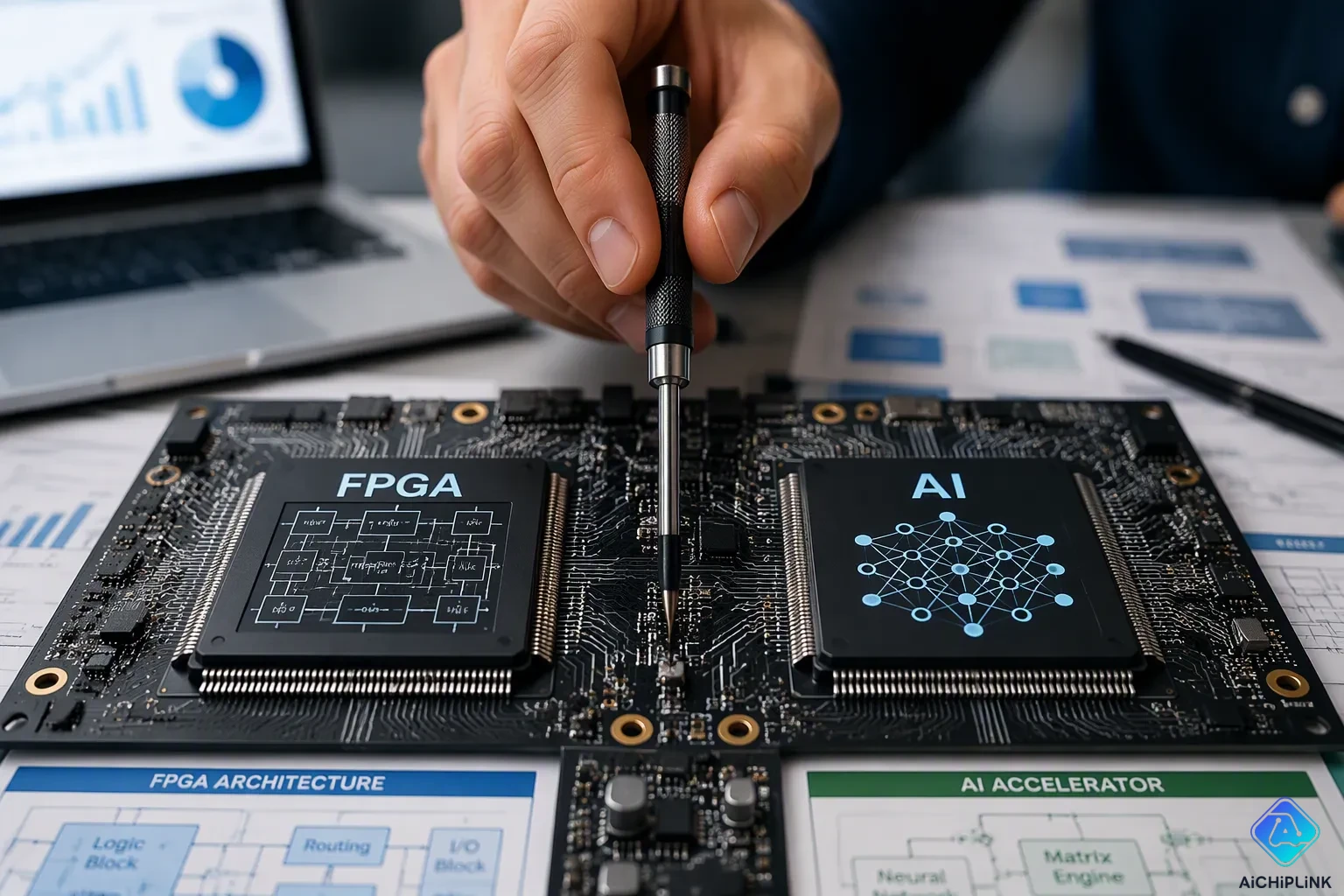
The question "Will FPGA be replaced?" often arises because AI hype makes it seem like every tool faces disruption. But no, AI will not replace FPGAs—these two technologies work together, not against each other. Industry analysts predict the overall FPGA market will grow from USD 8.9 billion in 2026 to USD 18.5 billion by 2036, a 7.60% compound annual growth rate, with AI named as one of the key accelerants. Recent industry views show FPGA hardware gaining importance inside AI systems, not losing ground.
Key Takeaways
-
AI and FPGAs work together, not against each other, to make systems faster and smarter.
-
FPGAs have a special flexibility that AI can't replace, because they can be updated even after they are put into use.
-
AI raises the need for FPGA engineers who can build fast, low-latency hardware that works well for AI tasks.
-
AI tools help automate FPGA design, but people still need to check the hard parts.
-
Learning AI and FPGA design together can lead to great jobs in the growing tech world.
Will FPGA Be Replaced? The Short Answer
The question "Will FPGA be replaced?" misses how these technologies really relate. AI does not replace FPGAs. Instead, AI works as a strong tool that grows FPGA abilities. The special hardware flexibility of FPGAs is still beyond what pure AI software can copy. FPGAs offer reconfigurability in seconds, letting updates and new features happen even after deployment. This clear advantage means the fear of replacement has no basis. AI and FPGAs exist together and strengthen each other in modern systems.
Complementary Roles of AI and FPGA
Many real-world uses show how AI and FPGAs work together as complementary technologies. The table below shows several areas where this teamwork appears:
| Application area | AI + FPGA complementary role | Named example |
|---|---|---|
| Neural network acceleration | Parallel processing of neural-network layers allows real-time inference with lower latency than CPU/GPU solutions. | Microsoft Project Brainwave |
| Large-scale data analytics | FPGA instances speed up parallel analytics workloads in cloud infrastructure. | AWS F1 instances |
| Edge computing / video analytics | Low-power AI processing at the edge supports real-time video analytics and decision-making. | NVIDIA DRIVE platform for sensor fusion |
| Industrial inspection | FPGAs add custom hardware parallelism to AI-based inspection systems. | Intel Altera FPGAs in semiconductor inspection |
Groups that join AI with FPGAs gain from low-latency processing and hardware acceleration. The FPGA architecture handles deterministic timing while AI provides smart decision-making. This partnership proves that AI does not remove FPGAs but instead grows their usefulness. The debate over will fpga be replaced is settled by clear industry trends: FPGAs are doing well alongside AI.
Why FPGA Programming Remains Safe from Automation
Several parts of hardware description language programming resist full AI automation. Today's large language models hit specific limits:
-
Lengthy inputs with long dependencies: LLMs struggle to understand lengthy HDL inputs that show long dependency chains.
-
Scarcity of HDL in pretraining data: Domain-specific languages like HDLs and TCL scripts are underrepresented in LLM pretraining corpora, especially for closed-source commercial models.
-
Limitations on complex hardware designs: LLMs show performance limits on complex designs (e.g., >64 states), needing a mix with structural approaches like GNNs.
-
Scalability with modern complex designs: Ensuring scalability for modern, complex hardware designs remains a big hurdle.
-
Irreplaceable human oversight in verification: Human intervention, especially in verification stages, remains necessary; the nuanced understanding and decision-making of human designers cannot be replaced.
Beyond programming challenges, the hardware itself offers unmatched adaptability. Users can download new bitstreams to change FPGA functionality even after deployment, supporting new protocols, bug fixes, or added features without replacing hardware. The adaptive FPGA architecture supports dynamic partial reconfiguration, enabling multitasking and runtime adaptation to different workloads.
An automobile containing an adaptive SoC FPGA may remain in service for a decade or more. Reconfigurable FPGA hardware lets automakers deliver over-the-air (OTA) updates to comply with evolving federal regulations and to patch potential security vulnerabilities.
Partial reconfiguration allows updating a portion of the FPGA while the rest of the system keeps operating, minimizing downtime. Adaptive SoCs support dynamic partial reconfiguration, where parts of the FPGA are reprogrammed while other logic keeps running. The answer to will fpga be replaced is clear: FPGAs remain essential due to these unique attributes that AI cannot duplicate.
How AI Boosts Demand for FPGA Engineers
Edge AI and Low-Latency Requirements
Edge AI systems need fast responses. Cloud-based AI takes 100 to 500 ms to respond because of network travel time. Today's edge AI systems get below 10 ms for many vision tasks. Self-driving cars must decide in under 1 ms for safety. Augmented reality needs below 20 ms to keep frames smooth. These tight time limits push developers toward hardware acceleration.
FPGAs give predictable low latency with fixed timing. Custom hardware paths remove extra steps. No global scheduler means less delay for task handling compared to GPUs. Microsoft's Project Brainwave built neural cores on FPGAs for edge AI. This shows how FPGAs speed up tasks with custom hardware paths. So, AI use creates more need for engineers who build these special systems.
The Rising Need for FPGA Engineers
The shortage of hardware talent is a real and growing problem. Every year, one out of three engineering jobs stays unfilled. Open jobs often sit empty for over 60 days. FPGA design engineers have seen a 15% pay increase since 2024, partly from CHIPS Act projects. AI accelerator architects earn $150 to $275 per hour, with the biggest raises in the last 18 months. Every big cloud company—Google, Amazon, Microsoft, Meta—makes its own chips and competes for the same workers as traditional chipmakers.
Memory on the chip is still the main bottleneck for large AI models on FPGAs. The LUT-LLM project from Microsoft and UCLA replaces math with pre‑computed lookup tables stored on the chip. This removes the need to move data around. It let an AMD V80 FPGA handle billion‑parameter models and run 1.66 times faster than an AMD MI210 GPU. FPGA hardware engineers must change how memory is accessed and stored for these large models. The Kelly Services report lists FPGA Engineers as a key job with talent shortages, estimating about 6,000 FPGA Engineers in North America. Demand for semiconductor engineers could outrun supply by nearly 50% in the next few years.
FPGA Advantages for AI Acceleration
Reconfigurability and Low Latency
FPGA reconfigurability gives cost benefits over ASICs for AI acceleration. ASICs need costly custom manufacturing, so they only make sense for high-volume production. FPGAs skip this upfront cost completely. Teams can test and change hardware designs quickly without being locked into a fixed chip. This flexibility allows faster iteration during AI model development, where algorithms change often. Being able to reconfigure hardware after deployment helps adapt to new standards or requirements. These features make the fpga architecture perfect for proof-of-concept projects and low-volume deployments. The same hardware can serve multiple generations of a product.
Low latency strengthens this advantage. AI workloads at the edge need response times under 10 milliseconds. FPGAs give deterministic timing because they use dedicated hardware paths instead of shared processing units. They remove the scheduling overhead found in GPUs and CPUs. The fpga architecture supports custom dataflows that match each AI model exactly. Logic can be optimized to cut delay at every stage. This mix of reconfigurability and predictable timing makes FPGAs a strong choice for edge AI systems.
Handling On-Chip Memory Challenges
Transformer-based AI models often go beyond the on-chip memory capacity of current FPGAs. The table below sums up the key limitations.
| Memory Limitation Aspect | Specific Value / Description |
|---|---|
| Relative memory consumption | Transformer models can exceed FPGA on-chip memory by more than 5× |
| Compression feasibility | Ideal memory reduction with 4‑bit training is limited to 8× (often unattainable in practice) |
| Specific FPGA (Alveo U50) capacity | SRAM budget: ≈28.5 MB ( <6 MB BRAM + 22.5 MB URAM ) |
| Achievable model size after tensor compression | End‑to‑end training possible for models up to 93.5 MB within the 28.5 MB budget |
Storing large models directly on-chip is impossible without careful compression. The fpga design must include techniques like tensor decomposition and weight sharing to fit within the memory budget. Engineers also use hierarchical memory structures that move data between on-chip and off-chip storage as needed. This approach requires knowledge of both the ai algorithm and the hardware capabilities. Skilled fpga design teams can reach model sizes near 93.5 MB through end-to-end compression strategies. The challenge drives demand for fpga implementation experts who understand memory optimization.
By combining reconfigurable hardware with memory-efficient designs, FPGAs continue to work as effective accelerators for AI tasks. Their unique strengths of reconfigurability and custom memory handling keep them relevant as AI models grow more complex.
The Future: AI as a Tool for FPGA Development
AI-Driven Design Automation
AI now helps engineers at every step of FPGA design. Companies have made tools that use machine learning to solve hard optimization problems. The table below shows some examples.
| Vendor | Tool | AI-Driven Capability |
|---|---|---|
| AMD | Vitis AI | Provides libraries and pre-trained models to accelerate AI inference on SoCs and FPGAs |
| AMD | Vivado Design Suite | Uses machine learning to improve quality of results, achieve timing goals, and estimate power |
| NVIDIA | AutoDMP | Automates macro placement using multi-objective Bayesian optimization with a GPU-accelerated placer |
More toolchain partnerships happened in 2024. In January, Lattice Semiconductor worked with Synopsys to combine Lattice FPGA design flows with the Fusion Design Platform. In April, Achronix teamed up with Synopsys to improve design flows and reuse IP for Speedster FPGAs. In July, Intel released a big update for Quartus Prime for Agilex FPGAs, making compile times faster and adding better HLS support.
Machine learning also helps with placement and routing. Researchers see placement as a decision process for deep reinforcement learning. The system uses a graph and board status as a four-channel image. Possible actions are valid placement spots. A learning method finds the best policy for those spots. Studies show these methods make placement and routing faster and give results as good or better than simulated annealing.
FPGA Remains Central to Embedded AI
These automation advances do not take FPGAs out of embedded AI systems. They just remove boring manual steps. The FPGA still gives the reconfigurable hardware that edge AI needs. You can change an FPGA design after it is deployed with new bitstreams. No AI model can copy that hardware-level flexibility.
AI is a tool for FPGA development, not a replacement for the hardware. Engineers who know both AI and FPGA design will shape the next generation of smart hardware.
The answer to will fpga be replaced is a clear no. AI helps these chips instead of taking them out. AI creates new chances, and the need for FPGA skills keeps growing. This technology cannot be replaced for fast, changeable systems.
Engineers who learn both AI and FPGA design will be at the front of the next wave of smart hardware. They will create systems that are faster, smarter, and more flexible. The future is for people who use both of these strong fields.

Written by Jack Elliott from AIChipLink.
AIChipLink, one of the fastest-growing global independent electronic components distributors in the world, offers millions of products from thousands of manufacturers, and many of our in-stock parts is available to ship same day.
We mainly source and distribute integrated circuit (IC) products of brands such as Broadcom, Microchip, Texas Instruments, Infineon, NXP, Analog Devices, Qualcomm, Intel, etc., which are widely used in communication & network, telecom, industrial control, new energy and automotive electronics.
Empowered by AI, Linked to the Future. Get started on AIChipLink and submit your RFQ online today!
Frequently Asked Questions
Does AI make FPGA engineers obsolete?
No. AI tools handle routine placement and routing work, but they cannot take the place of human judgment in verification and complex design choices. The article points out that people still need to check the work, especially during verification. FPGA design engineers have earned 15% more pay since 2024, which shows rising demand instead of a drop.
Can AI tools design an FPGA without human help?
Not fully. Large language models have trouble with long HDL inputs, long dependency chains, and complex designs above 64 states. They also do not have enough HDL data in their pretraining. Engineers still need to guide memory optimization, compression strategies, and verification. AI works as a design helper, not a designer that runs on its own.
Why do edge AI systems need FPGAs instead of GPUs?
Edge AI needs response times under 10 milliseconds for vision tasks and under 1 millisecond for self-driving safety decisions. FPGAs give steady timing through dedicated hardware paths. They skip the scheduling overhead found in GPUs.
What memory limits affect AI models on FPGAs?
Transformer models can go beyond FPGA on-chip memory by more than 5 times. The Alveo U50 offers about 28.5 MB of SRAM. Engineers use tensor decomposition and weight sharing to fit models up to 93.5 MB. This challenge drives demand for FPGA implementation experts who understand both algorithms and hardware.
Will FPGA be replaced by AI in the future?
No. AI improves FPGA development through tools like AMD Vitis AI and Vivado, which use machine learning for timing and power estimation. The hardware still provides reconfigurable logic that no software can copy. Engineers who learn both AI and FPGA design will lead the next wave of intelligent hardware.