AI Chips: A Comprehensive Guide to 15 Frequently Asked Questions

An ai chip is a special processor. It helps you do artificial intelligence tasks quickly and easily. You use these chips for hard ai jobs, like machine learning and deep learning. Ai chips help with fast inference and big models. Knowing about ai chips helps you pick the right ones for your devices or software. Ai technology is part of many things you use every day, like smart phones and cars.
Key Takeaways
-
AI chips are special processors. They help artificial intelligence work faster and better. These chips are important for things like smartphones and self-driving cars.
-
There are different kinds of AI chips. Some examples are GPUs, TPUs, FPGAs, and ASICs. Each chip has its own job. People can pick the best chip for their AI needs.
-
The AI chip market is growing very fast. Experts think it could be worth $604 billion by 2033. This is because technology is getting better and more people want AI.
-
Buying AI chips can help people make money. You can invest in big companies or new startups. Each choice has its own risks and rewards.
-
Security and privacy matter a lot in AI chip design. These chips often use private data. So, they need strong ways to keep information safe.
What Are AI Chips?
Definition
You use ai chips to handle complex ai tasks. An ai chip is a special processor that helps computers think and learn. These chips work much faster than regular chips when you run ai models. You find ai chips in many devices, such as smartphones, smart speakers, and even cars. They help you with deep learning, which lets machines recognize images, understand speech, and make decisions. Ai chips make it possible for you to use ai in your daily life. When you use voice assistants or play games with smart graphics, you rely on ai chips. These chips are built to run artificial intelligence workloads that need a lot of power and speed.
Core Functions
Ai chips perform many important jobs. You use them to process huge amounts of data quickly. They help you train and run ai models for deep learning. Ai chips let you finish artificial intelligence workloads faster and with less energy. In data centers, ai chips boost performance and keep energy use low. You also see ai chips in edge devices, where they bring ai closer to you by running tasks on your phone or camera. Ai chips support deep learning by handling many calculations at once. This makes them perfect for ai models that need to learn from lots of data. Ai chips also help in cars, where they power smart features like self-driving and safety systems. You depend on ai chips to make ai smarter and more useful in many areas of your life.
Tip: When you choose a device for ai tasks, check if it uses a dedicated ai chip. This can make your experience faster and more efficient.
AI Chip Design
Parallel Processing
You need ai chip design that can handle many tasks at once. Parallel processing lets you split big jobs into smaller parts. This helps you train large ai models faster and run them more smoothly. You can use different types of parallel processing in ai chip design:
-
Data parallelism lets you train ai models on large datasets by splitting the data across many chips. This works well for big tasks, but you may see limits if the network cannot keep up with the data flow.
-
Model parallelism spreads the ai model itself across several chips. This helps you work with very large models and makes the most of each chip’s power.
-
Pipeline parallelism breaks the ai model into stages. Each stage runs on a different chip, which lowers memory use and boosts speed.
With these methods, ai chip design gives you better performance and helps you finish ai tasks faster.
Design and Fabrication Steps
You follow a careful process in ai chip manufacturing to make sure your chips work well. Here are the main steps:
| Step | Description |
|---|---|
| Design | You set the requirements, build a detailed model, and use special software to draw the chip’s circuits. |
| Fabrication | You create the chip on a silicon wafer. This step needs high precision and clean materials to avoid mistakes. |
| Packaging | You cut, test, and cover the chip to protect it. Then you test it again before it goes into devices. |
Each step in ai chip manufacturing affects how well your ai chip works and how much it costs. Good ai chip design can boost energy efficiency, speed, and lower latency. If you use advanced integration, you can add more features and save money. New materials and eco-friendly choices can also help you get better performance and keep costs down. When you match hardware and software in ai chip design, you make your ai systems run smoother and cheaper. Reconfigurable chips let you use them for many tasks, which adds value and saves money.
Note: Smart ai chip design helps you get the best mix of speed, cost, and energy use for your ai projects.
Types of AI Chips
There are many types of ai chips. These chips help you do ai work faster and better. Each type has special features for different jobs. The table below lists the main types of ai accelerators and what makes them special:
| AI Chip Type | Description | Key Features |
|---|---|---|
| GPUs | Made for graphics, now used for ai model training. | Can do many things at once, and you can use more than one together. |
| TPUs | Made for deep learning and neural networks. | Very fast with data, made for ai work. |
| FPGAs | Chips you can program for different uses. | You can change them for your needs, and they are very flexible. |
| ASICs | Built for one ai job, not changeable. | Very good at their job and use less power. |
GPUs
You use GPUs to speed up ai work. GPUs can do many jobs at the same time. This helps you train ai models quickly. When you use GPUs, you get better speed and save energy. You can use one GPU or many together for big jobs. GPUs are good for both large and small ai projects. If you want your ai models to work better, GPUs are a smart choice.
Tip: GPUs are great for deep learning and tough computer jobs. You can use more GPUs together to get even more power.
TPUs
TPUs are special chips for deep learning. You use TPUs to run neural networks fast. TPUs finish ai jobs quicker than normal chips. You find TPUs in big data centers and cloud places. When you need to train big ai models, TPUs give you the speed you need.
FPGAs
FPGAs are chips you can program for many jobs. You use FPGAs when you want to change how the chip works. FPGAs let you do many things at once and use smart math. With FPGAs, you get good speed and save energy. You can make FPGAs fit your ai project.
-
Can do lots of logic
-
Work on many data pieces at once
-
Save energy
ASICs
ASICs are chips made for one ai job. You use ai asic when you want the fastest speed. Ai asic is best for things like mining coins and ai inference. Ai asic gives you more work for each watt of power. You see ai asic in things that need quick and smart ai chips. Ai asic cannot be changed, but it is great for special jobs. Ai asic helps you run ai tasks fast and saves power.
Note: Ai asic is best when you need top speed and low power use.
Leading AI Chip Companies
Major Manufacturers
Many companies are important in the ai chip market. These companies make chips for your favorite ai tools. The table below shows the top companies and their market share around the world. This helps you see who leads in ai chips.
| Company | Market Share |
|---|---|
| Nvidia | 80-95% |
| ASML | 100% |
| TSMC | 90% |
| Amazon Web Services | 32% |
Nvidia has the biggest part of the ai chip market. You find Nvidia chips in data centers, games, and research labs. ASML makes machines that help build ai chips for many companies. TSMC makes chips for lots of brands, including ai chips for phones and servers. Amazon Web Services gives cloud ai chips for big data jobs. You use ai chips from these companies in many devices for artificial intelligence.
Note: You might also hear about amd and intel. These companies make ai chips for computers and servers. People use amd for games and ai work. Intel makes ai chips for laptops, desktops, and data centers.
Startups
New startups bring new ideas to the ai chip world. These companies try new designs to make ai faster and smarter. The table below lists some important startups and what they do.
| Startup | Innovation Description |
|---|---|
| Groq | Developing new ways to get better performance for some AI jobs. |
| Cerebras Systems | Made very large chips, a new way to design AI chips. |
| Graphcore | Tries different designs to fix GPU problems. |
| SambaNova Systems | Works on new ideas for AI processing. |
| Tenstorrent | Looks for new designs to make AI chips work better. |
-
Groq got $640 million to make better ai chip technology. Groq works on Language Processing Units for things like chatbots.
-
Cerebras Systems builds huge ai chips for deep learning.
-
Graphcore tries new ways to run ai models faster.
-
SambaNova Systems makes chips for ai research and business.
-
Tenstorrent tests new designs for better ai speed.
You can watch these startups to learn about the future of ai chips. They help you get more from ai in your devices and services.
AI Chip Market Trends
Market Growth
You see the ai chip market growing very fast. The market for ai chips is expected to reach $604 billion by 2033. In 2024, the market stands at $116 billion. This shows you how quickly the market is expanding. You notice that different types of ai chips grow at different rates. Hyperscaler ai ASICs are set to grow at 44.6% in 2026. GPUs will grow at 16.1%. Custom ai ASICs could reach $118 billion by 2033, with a compound annual growth rate of 27%.
Here is a quick look at the numbers:
| AI Chip Type | Projected Market Size (2033) | Growth Rate |
|---|---|---|
| AI Accelerator Market | $604 billion | - |
| Custom AI ASICs | $118 billion | 27% CAGR |
| Hyperscaler AI ASICs | - | 44.6% (2026) |
| GPUs | - | 16.1% (2026) |
You can see that the ai chip market offers many chances for growth. Companies invest in new ai technology to keep up with the market demand. You benefit from faster and smarter devices as the market grows.
Tip: Watch for new ai chip releases each year. These new chips can change the market and give you better performance.
Regional Trends
You find the fastest ai chip market growth in the Asia-Pacific region. This region is expected to have a compound annual growth rate of about 34% until 2040. Rapid digitalization and better cloud infrastructure help drive this growth. Many countries in Asia invest in ai and smart city projects. These investments increase the need for high-performance ai chips.
Key drivers in the Asia-Pacific market include:
-
Government support for ai innovation
-
Growth in semiconductor manufacturing
-
More smart city projects
You see China leading with companies like Huawei and Cambricon. India invests $1.24 billion in its AI Mission. South Korea and Taiwan have strong foundry companies, such as Samsung and TSMC. These countries help the ai chip market grow faster.
You notice that the market in North America and Europe also grows, but not as quickly as in Asia-Pacific. You can expect more ai chip factories and research centers in these regions soon.
Note: If you want to follow the latest ai chip market trends, watch what happens in Asia-Pacific. This region shapes the future of ai technology.
AI Chip Applications
AI chips help many things you use every day. You see them in data centers, edge devices, electronics, and cars. Each place uses ai chips in its own way. This makes artificial intelligence work better and faster.
Data Centers
AI chips are very important in data centers. They help train big language models and deep learning. These chips use parallel processing to make ai faster. Here are some ways ai chips help data centers:
-
They make training ai algorithms much quicker. This is important for big models.
-
They make neural networks work better in generative ai tools.
-
They use less energy by using low-precision math.
-
They share work between chips to save power and lower pollution.
-
They let you make special chips for different ai jobs.
Tip: Data centers with ai chips can do more work and use less energy. This is good for the planet.
Edge Devices
You find ai chips in edge devices like cameras and smart gadgets. These chips let your device process data right where it is made. The table below shows the main benefits:
| Benefit | Description |
|---|---|
| Ultra-Low Latency | You get results in real time, in just milliseconds. |
| Enhanced Privacy | Your data stays on your device, so it is safer. |
| Bandwidth Optimization | Only important data goes to the cloud, saving network space. |
| Operational Reliability | AI keeps working even if you lose your network or are far away. |
| Cost Efficiency | You save money because you use less cloud and data for big jobs. |
These features make your ai apps faster and safer on your devices.
Consumer Electronics
AI chips change how you use your electronics. You get smarter and more helpful devices with ai. Here are some ways ai chips make things better:
-
Devices understand you with voice recognition and smart helpers.
-
You can control your home from anywhere with smart home tools.
-
Security gets better because ai can spot dangers.
AI and deep learning help your devices learn what you like. For example, smart TVs and music apps suggest shows or songs for you. This makes using your devices more fun and personal.
Automotive
You see ai chips in cars, especially self-driving ones. These chips do many things to keep you safe and help you drive. Here is how ai chips help cars:
-
They use data from cameras, LiDAR, and sensors.
-
They make fast choices so cars move safely in traffic.
-
They make self-driving cars smarter and safer.
For example, when your car stops at a light, ai chips help it see the color and watch other cars. This helps your car make good choices on the road.
Note: AI chips help with many things in cars, like parking and self-driving.
Performance Metrics
When you look at ai chip performance, you need to check several important metrics. These metrics help you see how well an ai chip works for artificial intelligence tasks like deep learning and inference. You want your ai chip to be fast, efficient, and use less power.
| Metric | What It Means |
|---|---|
| Performance, Power, Area (PPA) | Shows how fast, efficient, and compact your ai chip is. |
| Worst Negative Slack (WNS) | Finds the biggest timing problem in your ai chip. |
| Total Negative Slack (TNS) | Adds up all timing problems to show overall timing health. |
| Number of Violating Paths (NVP) | Counts how many paths in your ai chip miss timing targets. |
| Congestion | Checks if too many wires are packed in one area, which can slow down your ai chip. |
| Wire Length (WL) | Measures the total length of wires, which affects speed and power. |
Speed
You want your ai chip to process data quickly. Speed matters most when you run deep learning models or need high-performance inference. Fast ai chips let you finish inference tasks in less time. You get better results in real time, which is important for things like voice assistants or self-driving cars. High-throughput inference means your ai chip can handle many tasks at once without slowing down.
Tip: If you need quick answers from your ai, look for chips with high speed and low latency.
Efficiency
Efficiency tells you how well your ai chip uses its resources. You want your chip to do more work with less waste. Efficient ai chips help you save energy and keep your device cool. When you use efficient chips, you can run deep learning and inference for longer without draining your battery. Good efficiency also means your ai chip can fit into smaller devices.
-
Efficient ai chips help you get more out of your artificial intelligence projects.
-
You can use them in phones, cameras, and other edge devices.
Power Consumption
Power consumption shows how much energy your ai chip uses. Lower power use means your device lasts longer and stays cooler. You want ai chips that use less power but still give you strong ai chip performance. This is important for mobile devices and data centers. If your ai chip uses too much power, it can overheat or cost more to run.
Note: Always check the power rating of your ai chip before you choose it for your next inference project.
AI Chips vs CPUs/GPUs
Differences
You might ask how ai chips are not like CPUs and GPUs. Ai chips are made for artificial intelligence jobs. They use lots of tiny, quick transistors. This helps them handle more data and use less energy. Ai chips can do many math problems at once. This is called parallel processing. You need parallel processing for ai inference and neural network inference. CPUs are good for simple jobs done one at a time. They do basic work well but have trouble with big ai tasks. GPUs are better than CPUs for ai because they do thousands of jobs at once. But ai chips are even better.
Some main points are:
-
Ai chips are faster than CPUs and GPUs for ai inference.
-
They use less power, so your device stays cool.
-
Ai chips have special memory designs. These keep important data close to where it is needed, which helps with fast inference.
-
Ai chips can change how they work to fit different ai models.
Tip: If you want the best speed for ai inference, pick ai chips instead of CPUs or GPUs.
Use Cases
You see many times when ai chips are better than CPUs and GPUs. Ai chips are great for deep learning, neural network inference, and other hard ai jobs. They help you finish inference jobs quickly and save energy.
The table below shows how GPUs and CPUs compare for ai jobs:
| Feature | GPUs | CPUs |
|---|---|---|
| Processing Type | Parallel processing | Sequential processing |
| Performance in AI | Superior for AI training and inference | Less efficient for AI tasks |
| Energy Efficiency | Higher energy efficiency | Lower energy efficiency |
| Task Handling | Complex tasks like deep learning | Basic tasks |
You use ai chips in data centers for fast ai inference. They also power edge devices, like cameras and phones, where quick inference matters. Ai chips help with neural network inference in self-driving cars and smart home devices. You find more ways to use ai chips as ai grows in your daily life.
-
Ai chips give high throughput for inference jobs.
-
They cut down memory calls, making inference faster.
-
Ai chips work well for real-time ai inference in many devices.
Note: You get the most from artificial intelligence when you use ai chips for your inference needs.
Custom AI Chips
Why Custom Chips
You may wonder why some companies build custom ai chips instead of using regular ones. Custom chips give you special benefits for ai training and other tasks. When you use a chip made just for your needs, you can make your ai training faster and cheaper. Here are some reasons why you might choose a custom ai chip:
-
You can lower costs by matching the chip’s hardware to your software. This helps you save money during ai training.
-
Custom chips boost performance. They cut down on delays and let you finish ai training jobs much quicker.
-
You help the planet by using less energy and fewer materials. Some companies, like IBM, design custom chips to reduce their environmental impact.
Tip: If you want the best results for ai training or special artificial intelligence projects, a custom chip can give you a big advantage.
Examples
You see many types of custom ai chips in use today. Each one helps with different ai training and inference jobs. The table below shows some popular custom ai chips, what they do, and their limits:
| Chip Type | Application | Limitation |
|---|---|---|
| TPU (Tensor Processing Unit) | Speeds up TensorFlow tasks and matrix math for neural networks. | Works best with certain software and only in Google Cloud. |
| NPU (Neural Processing Unit) | Handles deep learning on phones and edge devices. | Not good for cloud-based tasks. |
| FPGA (Field-Programmable Gate Array) | Lets you change the chip for special ai training jobs. | Slower and harder to program than other chips. |
| LPU (Language Processing Unit) | Made for language ai tasks and large models. | Too big for most on-site uses. |
| WSE (Wafer Scale Engine) | Gives huge power for ai and science simulations. | Very large and costly for most places. |
You use custom ai chips for many things. They help with large language models, edge ai, self-driving cars, and robotics. These chips make ai training and inference faster and more efficient. You get better results in less time, whether you work with smart devices or advanced robots.
Design Challenges
Technical Hurdles
You face many technical hurdles when you design ai chips. Each step brings its own set of problems. You must solve these to make sure your ai chip works well and stays reliable. Here are some of the biggest challenges:
-
You need to balance compute, memory, and interconnect resources. This helps your ai chip meet the needs of new ai models.
-
You must develop silicon, packaging, and software at the same time. This lets you find system-level problems early.
-
You use silicon-proven IP blocks to speed up development and lower risk. This makes your ai chip more adaptable.
-
You try advanced packaging like 2.5D and 3D integration. These boost performance but make power delivery and heat control harder.
-
You start software development early. This helps you get better performance and power use when your ai chip is ready.
-
You check your ai chip with strong verification and validation. This finds bugs and makes sure everything works right.
-
You add multi-layered security. This protects your ai chip from threats that target artificial intelligence workloads.
-
You plan for manufacturing and testing from the start. This improves yield and reliability.
-
You work closely with other teams. Good teamwork helps you solve problems faster.
Tip: If you want your ai chip to succeed, you must focus on both hardware and software from the beginning.
Cost Factors
You also need to think about cost when you design ai chips. New ai chips can cost much more than older ones, but they give you better performance. You want to get the most compute for your money. The table below shows how cost and performance have changed for popular ai chip models:
| Chip Model | Year | Cost (relative) | Performance (relative) | Compute per Dollar (relative) |
|---|---|---|---|---|
| P100 | 2016 | 1 | 1 | 1 |
| H100 | 2022 | 6 | 17 | 17 |
| A100 | 2020 | 3 | 3 | 3 |
| B100 | 2024 | 9 | 27 | 27 |
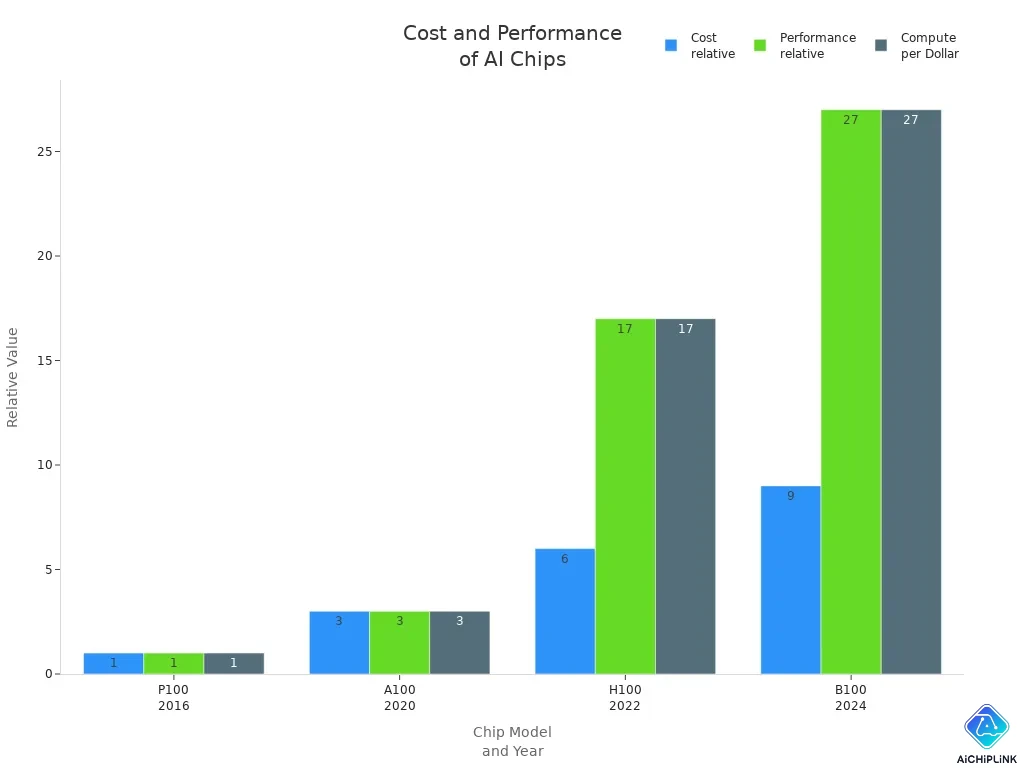
You see that newer ai chips like the B100 cost more, but they give you much more compute per dollar. This means you get better value as technology improves. You must balance your budget with your need for high performance. If you plan to use ai for big projects, you should look for chips that give you the best compute per dollar.
Note: Smart choices in ai chip design help you save money and get the best results for your artificial intelligence needs.
Security & Privacy
Security Features
You need good security in ai chips to keep your data safe. Many ai chips use special hardware and software to stop attacks. These features help keep your information private. You find these security tools in many devices, from phones to big data centers. The table below lists the main security features you see in ai chips:
| Security Feature | Description |
|---|---|
| Security modules | Special processors that make sure the chip uses safe firmware and let you update from far away. |
| Trusted execution environments (TEEs) | Safe places that protect your data while it is being used and stop fake actions. |
| Tamper-resistant enclosures | Strong cases that block and find attacks, keeping your chip safe from being changed. |
| Other hardware security measures | Confidential computing keeps your ideas safe and fights attacks on the chip and its data. |
You count on these features to keep your ai chip safe from hackers. Security modules let you fix problems fast with updates from far away. TEEs keep your data private when you use ai for important things. Tamper-resistant enclosures protect your chip if someone tries to steal or break it. Other hardware security tools help keep your ai chip safe from new dangers.
Note: Always check if your ai chip has strong security before you use it for artificial intelligence jobs.
Privacy Issues
You have privacy problems when you use ai chips in many places. These chips work with private data, so you must keep your info safe. Here are some main privacy worries:
-
There are risks when ai chips handle private data in healthcare, money, or government. Data leaks can cause big trouble.
-
Federated learning lets you train ai models on data that stays in different places. This helps keep user privacy because you do not move all the data to one spot.
-
Differential privacy lets ai chips share group results without showing anyone’s personal data. This is important in places with strict rules.
You need to think about privacy every time you use ai chips. You keep your data safe by using smart ways like federated learning and differential privacy. These tools help you use ai safely in artificial intelligence projects.
Tip: Always ask how your ai chip protects privacy before you use it for private jobs.
Open-Source AI Chips
Projects
You can find many open-source projects that focus on ai chips. These projects let you study, use, or even help build hardware for ai tasks. Some popular open-source ai chip projects include:
-
RISC-V AI: You can use this project to explore ai hardware based on the RISC-V instruction set. Many developers use it to create custom ai accelerators.
-
Open Neural Network Exchange (ONNX) Hardware: This project helps you run ai models on different open-source chips. You can test ai models on many devices.
-
OpenAI Hardware: You may see some groups working on open-source hardware for artificial intelligence. These projects aim to make ai chips more available to everyone.
-
TinyML: You can use TinyML projects to run ai on small, low-power chips. These projects help you bring ai to edge devices.
You can join these projects to learn how ai chips work. You can also help improve the hardware and software for ai.
Pros & Cons
You should know the benefits and drawbacks of open-source ai chips. The table below shows the main pros and cons:
| Pros | Cons |
|---|---|
| Lower cost for development | May have less support |
| More control and flexibility | Can be slower than commercial chips |
| Easier to customize | Security may be weaker |
| Community-driven innovation | Harder to get updates or bug fixes |
You get more freedom with open-source ai chips. You can change the design to fit your needs. You also save money because you do not pay for expensive licenses. Many people work together to make these chips better.
You may face some problems. Open-source ai chips might not run as fast as commercial ones. You may not get as much help if you have trouble. Security can be weaker if fewer people check the code. You might wait longer for updates or bug fixes.
Tip: If you want to learn about ai hardware or build your own artificial intelligence projects, open-source ai chips give you a good place to start.
Investing in AI Chips
You can find many ways to invest in ai chips. The ai chip market grows fast, and you see new chances every year. If you want to join this market, you can look at public companies or startups. Each choice gives you different risks and rewards.
Public Companies
You can buy shares in public companies that lead the ai chips market. These companies shape the future of ai and artificial intelligence. When you invest in these companies, you join a large part of the market. Here are some top public companies you can watch:
| Company | Focus Area | Market Impact |
|---|---|---|
| Nvidia | Data center ai chips | Largest market share |
| AMD | GPUs and ai accelerators | Growing fast |
| Intel | CPUs and ai chips | Broad market reach |
| TSMC | Chip manufacturing | Key to ai chip supply |
| Qualcomm | Mobile ai chips | Strong in devices |
You can track these companies in the stock market. They often lead in new ai chip designs and set trends for the whole market.
Tip: Always check the latest news and financial reports before you invest in any ai chip company.
Startups
You may want to invest in startups if you like new ideas and higher risk. Startups in the ai chips market often bring fresh designs and new ways to use ai. Many startups focus on edge ai, low-power chips, or special uses for artificial intelligence. Some well-known startups include Groq, Cerebras Systems, and Graphcore.
You can invest in these startups through venture capital, crowdfunding, or private equity. Startups can grow fast if they find a good spot in the market. You may see big gains, but you also face more risk than with public companies.
-
Startups often move faster than big companies.
-
They can change the ai chips market with new tech.
-
You need to study each startup’s team, product, and market plan.
Note: Investing in startups can be exciting, but always do your research before you decide.
Future of AI Chips
Emerging Technologies
New technology is changing how ai chips work. These changes help you get answers faster and keep your data safe. The table below shows some new technologies and what they do.
| Technology Type | Key Benefits | Market Trends |
|---|---|---|
| Edge Artificial Intelligence Chips | Faster processing, improved data privacy, localized intelligence | Rapid expansion driven by IoT, demand for on-device intelligence, and autonomous processing |
| Analog AI Chips | High-performance AI ASICs and NPUs, less reliance on foreign suppliers | Growth in cloud computing, edge AI, and domestic semiconductor manufacturing in China |
| Privacy-Preserving AI Chips | Secure AI solutions, real-time inference on resource-constrained devices | Increasing demand for privacy-centric solutions in smart healthcare, autonomous vehicles, and automation |
Edge ai chips let you process data right where you need it. This means you get answers quickly and your information stays private. Analog ai chips help you do hard jobs and support many businesses. Privacy-preserving ai chips keep your data safe in places like hospitals and self-driving cars.
-
Edge ai chips make your devices faster and safer.
-
Analog ai chips help with big jobs and new ideas.
-
Privacy-preserving ai chips protect your data all the time.
Note: These new technologies make artificial intelligence smarter and safer for you.
Industry Predictions
Big changes are coming for ai chips. Companies spend more money to make chips faster and use less power. You will see ai chips get smaller and work better. Experts think edge ai chips will be the most popular. Your devices will get smarter and work without sending data to the cloud.
In the future, you will use ai chips in homes, cars, and hospitals. These chips help you make quick choices and keep you safe. The industry is making chips that protect your privacy and give you answers right away. Ai chips will be a bigger part of your life every day.
You can expect ai chips to focus on speed, safety, and saving energy. Companies will make chips that fit what you need. Artificial intelligence will be everywhere because of these chips. The future of ai chips will bring smarter and safer technology to the world.
Tip: Watch for new ai chip news. You will find more chances as the industry grows.
You learned how ai chips help you run ai tasks faster and smarter. You saw how design choices affect performance and cost. You explored where ai chips work best, from data centers to cars. You noticed the market for ai grows quickly. You can follow new trends in artificial intelligence and find ways to invest or learn more.
Stay curious and keep watching for new ai chip technology. You can join the future of ai by reading, testing, or investing.

Written by Jack Elliott from AIChipLink.
AIChipLink, one of the fastest-growing global independent electronic components distributors in the world, offers millions of products from thousands of manufacturers, and many of our in-stock parts is available to ship same day.
We mainly source and distribute integrated circuit (IC) products of brands such as Broadcom, Microchip, Texas Instruments, Infineon, NXP, Analog Devices, Qualcomm, Intel, etc., which are widely used in communication & network, telecom, industrial control, new energy and automotive electronics.
Empowered by AI, Linked to the Future. Get started on AIChipLink and submit your RFQ online today!
Frequently Asked Questions
What makes ai chips different from regular chips?
You use ai chips for tasks that need fast math and smart learning. These chips help you run ai models better than normal chips. They give you more speed and use less energy for artificial intelligence work.
Can you use ai chips in your phone?
Yes, you can use ai chips in your phone. These chips help your phone understand speech, take better photos, and run smart apps. You get faster results and save battery life with ai on your device.
How do ai chips help with ai in cars?
You see ai chips in cars for safety and smart driving. These chips process data from cameras and sensors. They help your car make quick choices, like stopping for people or staying in the lane.
Do ai chips make gaming better?
Yes, ai chips can make your games look and feel smarter. They help with real-time graphics, voice commands, and smart enemies. You get a better gaming experience with ai working in the background.
What is the future of ai chips?
You will see ai chips in more places soon. They will help with health, smart homes, and learning. As ai grows, these chips will make artificial intelligence faster and safer for everyone.