What Is the Difference Between Ethernet and InfiniBand
You can see big differences when you look at Ethernet vs InfiniBand. The main things to compare are speed, latency, scalability, cost, and management. InfiniBand has very low latency and works well for high-performance computing. Ethernet costs less and is good for many types of jobs. Many companies are now upgrading their systems for AI, so Ethernet is used a lot for big groups of computers. InfiniBand’s RDMA helps it work better when there is a lot of traffic. Lately, companies like Cisco and NVIDIA are working together for hybrid solutions. Look at the table below to see a quick comparison of Ethernet vs InfiniBand:
| Attribute | InfiniBand | Ethernet |
|---|---|---|
| Speed | Similar top speeds (like 400 Gbps) | Similar top speeds (like 400 Gbps) |
| Latency | Less than one microsecond delay | About 1-2 microseconds delay |
| Scalability | Works well in big groups | Grows well but may need extra setup |
| Cost | Costs more at first | Switches and NICs cost less |
Key Takeaways
- Ethernet does not cost a lot and is easy to use. It works well for most networks and AI jobs. InfiniBand is very fast and can move a lot of data. It is best for big computers and training AI. Ethernet can get bigger easily with what you already have. InfiniBand is better when computers need to work very closely together. Ethernet is easier to manage because there are many good tools. InfiniBand needs people who know special skills to set it up and take care of it. Pick Ethernet for normal jobs. Pick InfiniBand when you need things to be very fast and not slow.
What Is Ethernet vs InfiniBand
Ethernet Overview
Ethernet is used in homes, schools, and offices. It connects computers, printers, and servers. Ethernet works for many kinds of networks. Speeds have grown from 10 Mbps to 800 Gbps. Terabit ethernet will be available soon. Ethernet uses layers, often with TCP/IP. This makes it simple to set up and manage. Ethernet is everywhere because it costs less and is flexible. Many devices use ethernet, so you can build networks with different hardware.
Ethernet has features like Priority Flow Control and Enhanced Transmission Selection. These help manage traffic and keep data moving well. Data Center Bridging Exchange lets you set up features for better performance. RoCE gives memory access abilities. Ethernet has mature management tools. These tools help you watch and fix networks. You can split networks for multi-tenancy, which helps big organizations. Ethernet works in enterprise data centers and cloud providers. People use ethernet for general networking.
Tip: You can grow ethernet networks easily. Add switches and cables as your needs change.
InfiniBand Overview
You pick InfiniBand for high performance. InfiniBand supports speeds up to 400 Gbit/s. It has very low latency, often 3 to 5 microseconds. This is faster than ethernet in many cases. InfiniBand uses a switched fabric design. This helps build tightly connected networks. You can expand without losing speed.
InfiniBand gives strong quality of service and hardware congestion control. Remote Direct Memory Access lowers CPU work. This makes data transfer more efficient. InfiniBand works best in high-performance computing, AI, and big data analytics. You see it in data centers where speed and reliability are important. InfiniBand is great for distributed training of AI models. You get easy scaling and strong reliability.
InfiniBand is used where every microsecond matters. It is needed for fast communication between servers. InfiniBand is not as common as ethernet, but it is the best for special jobs.
| Feature | InfiniBand | Ethernet |
|---|---|---|
| Architecture | Switched fabric architecture | Layered architecture (e.g., TCP/IP) |
| Latency | Low latency | Higher latency for some applications |
| Bandwidth | High bandwidth | Versatile but potentially lower bandwidth |
| Use Case | High-performance computing (HPC), AI | General-purpose networking |
| Scalability | Better suited for tightly coupled networks | Excels in heterogeneous environments |
| Performance in AI | Superior performance for distributed training | May struggle with AI model synchronization |
| Common Deployments | Data centers for AI, HPC, big data analytics | Enterprise data centers, cloud providers |
Ethernet vs InfiniBand: Key Differences
Speed and Bandwidth
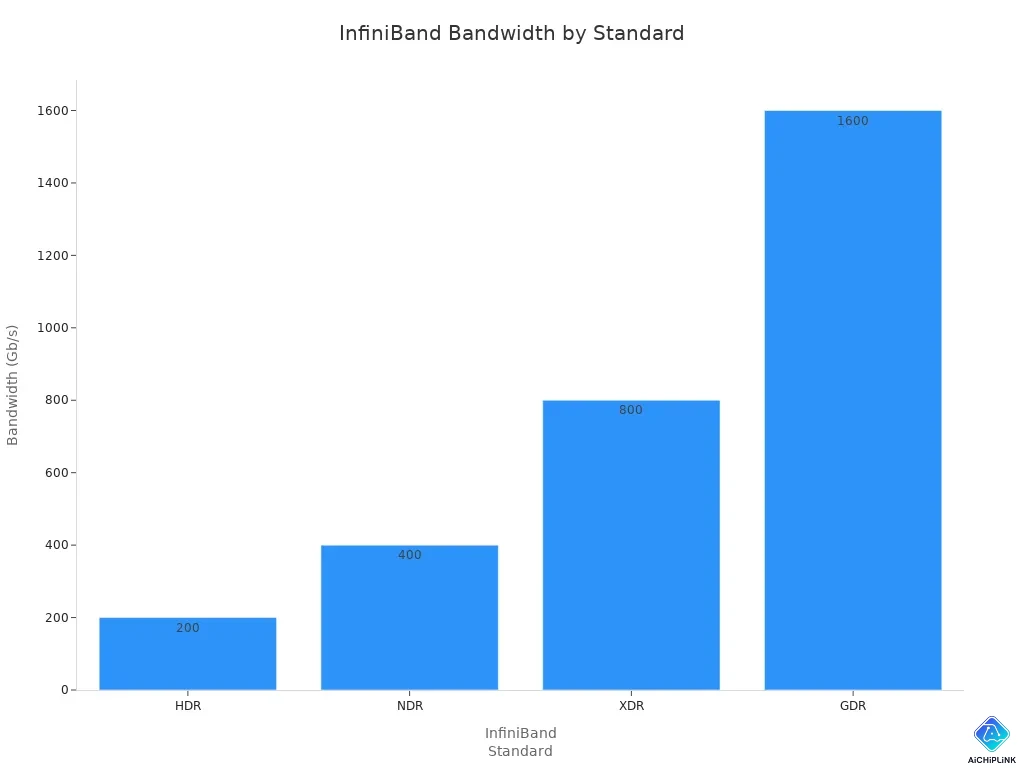
Ethernet and InfiniBand are different in speed and bandwidth. InfiniBand gives much higher bandwidth and faster speed. You can use InfiniBand standards like HDR, NDR, XDR, and GDR. These standards reach up to 1600Gb/s. Ethernet has gotten better, but most networks use 10Gb/s to 400Gb/s. InfiniBand is made for high performance and big data jobs.
| InfiniBand Standard | Bandwidth |
|---|---|
| HDR | 200Gb/s |
| NDR | 400Gb/s |
| XDR | 800Gb/s |
| GDR | 1600Gb/s |
InfiniBand works well in supercomputers and hpc clusters. You get better scaling with InfiniBand for tight networks. Ethernet is good for general networking and big AI clusters. You can grow ethernet networks easily, but you may need extra setup to match InfiniBand's efficiency.
Latency
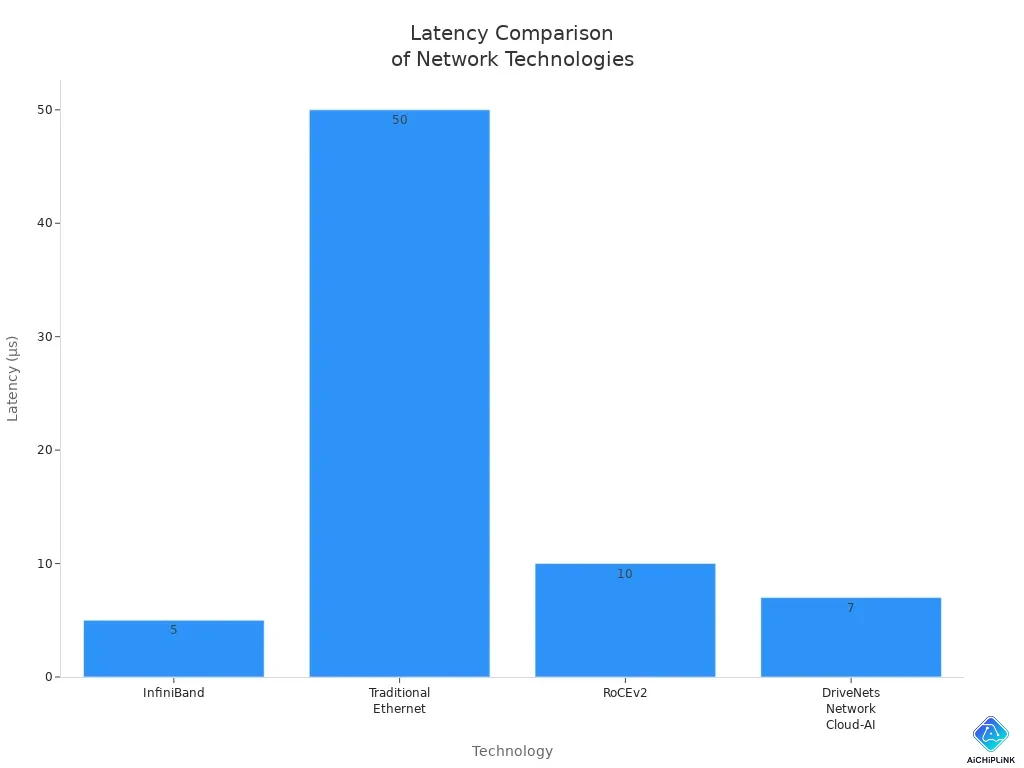
Latency means how long data takes to travel. InfiniBand gives low latency, often as low as 5 microseconds. Ethernet latency is higher, usually around 50 microseconds. New ethernet solutions like RoCEv2 and DriveNets Network Cloud-AI can lower latency to 7-10 microseconds. InfiniBand is best for high performance and low latency.
| Technology | Latency (microseconds) | Notes |
|---|---|---|
| InfiniBand | 5 | Good for fast data delivery |
| Traditional Ethernet | 50 | Higher latency than InfiniBand |
| RoCEv2 | 10 | Lower latency with new technology |
| DriveNets Network Cloud-AI | 7 | Latency almost as low as InfiniBand |
You need low latency for hpc, AI training, and real-time jobs. InfiniBand has less protocol overhead and zero-packet loss. Ethernet is getting better, but InfiniBand still leads in high performance and low latency.
Scalability
Networks should grow as your needs change. InfiniBand is made for big clusters and supports hundreds or thousands of nodes. You get good communication and high performance in hpc and data centers. Ethernet is more flexible and costs less. You can scale ethernet networks for enterprise and AI jobs. You may need advanced tuning to match InfiniBand's performance.
| Network Type | Scalability Features | Limitations |
|---|---|---|
| InfiniBand | Made for big clusters, supports many nodes, keeps communication efficient | Costs more, vendor lock-in, harder to scale |
| Ethernet | Very scalable, flexible, widely used | Higher latency in big networks, needs tuning to match InfiniBand |
Tip: If you want easier scaling for mixed jobs, ethernet is simpler to manage and expand.
Reliability and Performance
InfiniBand gives high performance and reliability. You get fast data transfer, low latency, and strong Quality of Service. InfiniBand uses advanced fault-finding, Forward Error Correction, and packet retransmission. You can prioritize important data and reduce packet drop. Ethernet has strong error detection and correction. You keep data safe in enterprise networks.
-
InfiniBand works well in hpc and supercomputers.
-
InfiniBand is more consistent under heavy load than ethernet.
-
Ethernet can reach high performance with RDMA and RoCEv2, but InfiniBand is better for small packets and steady performance.
| Metric | Ethernet | InfiniBand |
|---|---|---|
| Latency | 20-80 microseconds | 3-5 microseconds |
| Throughput | Varies, usually lower | Up to 400 Gbps |
| RDMA Support | RoCEv2 lowers latency | Native RDMA support |
| Deterministic Performance | Less steady under load | More steady under load |
| Efficient Small Packet Handling | Less optimized | Highly optimized |
Note: InfiniBand needs hot spare nodes for quick recovery. You must plan for maintenance to avoid downtime.
Cost and Complexity
Ethernet and InfiniBand are different in cost and complexity. InfiniBand costs more for adapters, switches, and cables. You pay $2,000-$3,000 per port for InfiniBand adapters. Ethernet adapters cost $800-$1,500 per port. A 40-port InfiniBand switch costs $50,000. Ethernet switches cost $25,000. You spend $15 million for a 1,000 GPU InfiniBand cluster. Ethernet costs $7 million for the same size.
| Item | InfiniBand Cost | Ethernet Cost |
|---|---|---|
| Adapter per port | $2,000 - $3,000 | $800 - $1,500 |
| 40-port switch | $50,000 | $25,000 |
| DAC cables | $500 - $800 | $200 - $400 |
| Total for 1,000 GPU cluster | $15 million | $7 million |
| Annual labor savings | $500,000 | N/A |
| Annual power savings | $200,000 | N/A |
| Software licensing | Higher for Ethernet | N/A |
InfiniBand's management is centralized with a Subnet Manager. You get global visibility and automated routing. Ethernet uses distributed protocols. You must set up ethernet by hand, which makes it harder. InfiniBand is easier to manage in hpc clusters, but ethernet is simpler for big AI clusters.
Security and Management
Ethernet has mature security and management tools. You use tools for monitoring, troubleshooting, and multi-tenancy. InfiniBand needs special skills for setup and maintenance. You face challenges with deployment, compatibility, and tuning. You must check costs against performance gains.
| Challenge Type | Description |
|---|---|
| Deployment Complexity | InfiniBand needs careful planning for topology, routing, and backup, which can be hard for teams needing standard connectivity. |
| Interoperability | Connecting InfiniBand with other networks adds design and management challenges. |
| Specialized Skill Requirements | Setting up and maintaining InfiniBand needs special skills that may not be easy to find. |
| Cost Considerations | The costs of adapters, switches, and design must be checked against performance gains. |
| Tuning Needs | Getting the best performance needs careful tuning, which adds to management complexity. |
Alert: You need proactive maintenance and hot spare nodes for InfiniBand to keep high performance and reliability.
Compatibility and Ecosystem
Ethernet is widely supported and works with many devices. You can use ethernet in enterprise networks, cloud providers, and AI clusters. InfiniBand is common in hpc, supercomputers, and data centers. You get high performance and low latency, but you face vendor lock-in and limited compatibility. Ethernet gives you a broad ecosystem and easier integration.
-
InfiniBand is best for high performance and big data jobs.
-
Ethernet is best for general networking and large AI jobs.
-
You choose ethernet or InfiniBand based on your needs for speed, latency, scalability, and management.
When to Use Ethernet vs InfiniBand
Best Use Cases for Ethernet
Ethernet is in almost every data center today. It works for many jobs because it is easy to use. You can set it up fast. If you run AI jobs or have small AI clusters, ethernet saves money. It is good for inference tasks. These tasks need quick and steady model processing. Ethernet helps teams share resources and work together. Cloud AI services use ethernet a lot. It grows with your needs and uses what you already have.
Here is a table that shows where ethernet works best in data centers:
| Use Case | Description |
|---|---|
| General-purpose AI workloads | Ethernet is good for many AI jobs. It is flexible and saves money. |
| Smaller AI clusters | Best for small AI clusters. It is easy to set up. |
| Inference tasks | Great for inference tasks. It helps process models fast. |
| Distributed AI applications | Helps teams work together and share resources. |
| Cloud-based AI services | Works well for cloud AI. It uses what you already have and can grow. |
Ethernet gives you fast and steady connections for daily work. It is good for gaming, video calls, and moving big files. Ethernet is reliable because it does not get interference like Wi-Fi. This makes ethernet a smart pick for data centers that want steady growth and stable networks.
Best Use Cases for InfiniBand
Pick InfiniBand when you need high performance in your data center. InfiniBand is best when you need very low delay and fast data. If you use AI or machine learning, InfiniBand helps move data between many GPUs. This makes training faster and more efficient. InfiniBand is important for science jobs like genomics, climate studies, and space research. It stops data slowdowns and keeps simulations running well.
InfiniBand is used in high-frequency trading. Here, every microsecond matters. InfiniBand uses a switched fabric design. It supports remote direct memory access. This means data moves quickly and does not slow your CPU. InfiniBand is great for parallel computing and machine learning in data centers that need fast connections.
Note: If you mix InfiniBand with other networks, you must plan ahead. You may need gateways, special skills, and extra tuning for top performance. InfiniBand adapters and switches cost more, so check your budget before you use it.
Ethernet vs InfiniBand: Comparison Table
You might want to know the main differences fast. This table shows both side by side. It helps you pick what works best for you.
| Metric | Ethernet | InfiniBand |
|---|---|---|
| Speed | Up to 800 Gbps (common: 10–400 Gbps) | Up to 1,600 Gbps (common: 200–400 Gbps) |
| Latency | 20–80 microseconds (RoCEv2: 7–10 μs) | 3–5 microseconds |
| Lossless Performance | Needs careful tuning (RoCEv2) | Native lossless (credit-based design) |
| Scalability | Grows easily, almost unlimited with IP | Up to ~48,000 nodes per subnet |
| Reliability | High, with mature error correction | Very high, with advanced congestion control |
| Total Cost of Ownership | Lower hardware and operational costs | Higher hardware and specialized overhead |
| Management | Mature tools, easy for large networks | Centralized, needs special skills |
| Compatibility | Works with most devices and vendors | Limited ecosystem, vendor lock-in possible |
| Best Use Cases | Enterprise, cloud, large AI clusters | HPC, supercomputing, low-latency AI training |
💡 Tip: If you want a network that is simple to grow, Ethernet is flexible and costs less. If you need the fastest speed and lowest delay, InfiniBand is best.
-
Ethernet is good for most regular networking jobs.
-
InfiniBand is great for science and high-performance computing.
-
Think about your budget, your team’s skills, and what you need before you pick.
📝 Note: InfiniBand gives you lossless data transfer right away. Ethernet can do this too, but you must set it up carefully.
This table lets you compare both quickly. Use it when you plan your next data center or AI project.
You should pick your network based on what you need. Infiniband is best for big AI clusters and fast computing. It gives you great speed and low delay. Ethernet is good for most jobs in companies and the cloud. Look at this table to help you choose:
| Criteria | Infiniband | Ethernet |
|---|---|---|
| Performance | Ultra-low latency | Good for general workloads |
| Cost | Higher | Lower, easy to scale |
| Management | Needs special skills | Simple, familiar tools |
Knowing these differences helps you make the right choice for your network.

Written by Jack Elliott from AIChipLink.
AIChipLink, one of the fastest-growing global independent electronic components distributors in the world, offers millions of products from thousands of manufacturers, and many of our in-stock parts is available to ship same day.
We mainly source and distribute integrated circuit (IC) products of brands such as Broadcom, Microchip, Texas Instruments, Infineon, NXP, Analog Devices, Qualcomm, Intel, etc., which are widely used in communication & network, telecom, industrial control, new energy and automotive electronics.
Empowered by AI, Linked to the Future. Get started on AIChipLink and submit your RFQ online today!
Frequently Asked Questions
What is the main reason to choose InfiniBand over Ethernet?
Pick InfiniBand if you need very fast data and low delay. InfiniBand is best for science, big AI jobs, and fast computers.
Can you use Ethernet and InfiniBand together in one network?
Yes, you can use both in one network. Many data centers use Ethernet for normal jobs and InfiniBand for fast ones. You might need special adapters or gateways to connect them.
Does InfiniBand require special skills to manage?
Yes, you need special skills to run InfiniBand. The tools and commands are not the same as Ethernet. Training helps you set it up right and avoid problems.
Is Ethernet fast enough for AI workloads?
Ethernet can be very fast, up to 800 Gbps. For most AI jobs, Ethernet works well. If you need the lowest delay for big groups, InfiniBand might be better.
Which technology costs less to deploy?
Ethernet costs less to buy and manage. InfiniBand costs more but gives better speed for some jobs.