In the world of electric motors, there is a distinct divide. On one side, you have the workhorse Induction Motor, which runs slightly slower than the power grid driving it. On the other side, you have the perfectionist: the Synchronous Motor.
As the name suggests, a Synchronous Motor runs in perfect harmony with the frequency of the electricity powering it. If the grid cycles 60 times a second, the motor turns exactly in step. No lag. No slip.
While they used to be reserved for giant industrial pumps or tiny wall clocks, the rise of Electric Vehicles (EVs) has thrust the Synchronous Motor (specifically the PMSM) back into the spotlight.
This guide explores how they work, why they are unique, and why they are the engine of choice for precision and efficiency.
1. The Definition: Locking in Step
A Synchronous Motor is an AC motor where the rotation of the shaft is synchronized with the frequency of the supply current.
- Induction Motor: Speed drops slightly as load increases (Slip).
- Synchronous Motor: Speed remains absolute constant from No Load to Full Load.
The speed is governed by this rigid formula: $$N_s = \frac{120 \times f}{P}$$
- $N_s$: Synchronous Speed (RPM)
- $f$: Frequency (Hz)
- $P$: Number of Poles
If you overload it beyond its "Pull-Out Torque," it doesn't just slow down—it stalls completely (loses synchronism).
2. How It Works: The Magnetic Lock
The secret to synchronous operation is Magnetic Locking.
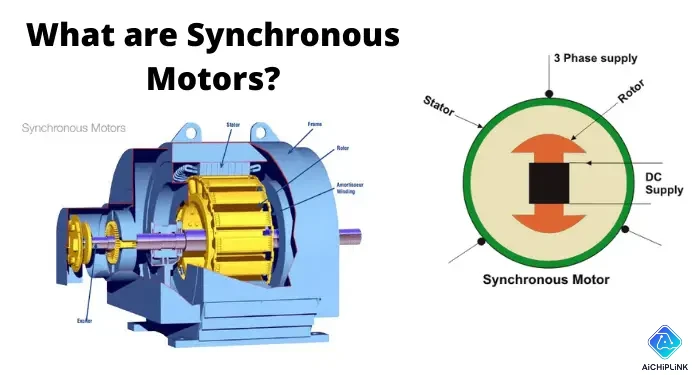
- The Stator (The Driver): Similar to an induction motor, 3-phase AC is applied to the stator windings, creating a Rotating Magnetic Field (RMF) that spins at synchronous speed.
- The Rotor (The Follower): Unlike an induction motor (which relies on induced current), the synchronous rotor has its own magnetic field. This is created either by:
- DC Excitation: Sending DC current into coils on the rotor via slip rings.
- Permanent Magnets: Embedding strong magnets (Neodymium) in the rotor.
- The Lock: The North pole of the Stator RMF grabs the South pole of the Rotor. They magnetically "lock" together. As the RMF spins, it drags the rotor along with it at the exact same speed.
3. Types of Synchronous Motors
Not all synchronous motors are the same. They are defined by how they create that rotor magnetic field.
1. Wound Field Synchronous Motor
- Construction: The rotor has coils of wire. DC current is fed to them through Slip Rings and Brushes (or a brushless exciter).
- Superpower: Power Factor Correction. By adjusting the DC current (Excitation), you can make the motor look like a Capacitor to the grid, fixing voltage dips caused by other machines.
- Use Case: Giant industrial compressors, ship propulsion, and grid stabilizers (Synchronous Condensers).
2. Permanent Magnet Synchronous Motor (PMSM)
- Construction: The rotor uses high-strength magnets (Rare Earth). No slip rings, no brushes.
- Superpower: Efficiency & Power Density. Without the energy loss of rotor coils, these motors are incredibly efficient and small for their power.
- Use Case: Electric Vehicles (Tesla Model 3, BYD), robotics, servo drives.
3. Synchronous Reluctance Motor (SynRM)
- Construction: The rotor has no magnets and no coils. It is just shaped iron with "flux barriers."
- Superpower: Cheap & Rugged. No expensive magnets to overheat, no windings to fail.
- Use Case: Pumps and fans where efficiency > cost.
4. Synchronous vs. Induction Motor: The Showdown
| Feature | Synchronous Motor | Induction (Asynchronous) Motor |
|---|---|---|
| Speed | Constant (Synchronous) | Variable (Always less than Synch) |
| Slip | Zero | Typically 1-5% |
| Efficiency | High (especially PMSM) | Lower (Rotor $I^2R$ losses) |
| Power Factor | Adjustable (Leading/Lagging) | Always Lagging (Poor) |
| Starting | Needs Assist (Damper/VFD) | Self-Starting |
| Cost | Higher (Magnets/Exciter) | Lower (Simple Cage Rotor) |
5. Starting Methods: The "Not Self-Starting" Problem
Here is the catch: A synchronous motor cannot start itself.
If you connect a stationary synchronous rotor to a 60Hz grid, the magnetic poles rush past it 60 times a second. The rotor tries to move forward, then backward, resulting in vibration but no rotation.
How do we fix this?
- Damper Windings (Amortisseur Windings): We hide a small "squirrel cage" induction winding inside the rotor poles. The motor starts as an Induction Motor. Once it gets near top speed, the DC field is turned on, and it snaps into synchronization.
- VFD (Variable Frequency Drive): The modern way. The drive starts at 0.5 Hz and slowly ramps up the frequency, allowing the rotor to stay locked the entire time. This is how all EVs start.
- Pony Motor: A small external motor spins the large motor up to speed before connecting it to the grid (Old school method).
6. Conclusion
The Synchronous Motor is the precision instrument of the motor world. While the Induction motor powers the mundane tasks of industry, the Synchronous motor handles the critical ones—whether it's correcting the power factor of a factory (Wound Field) or squeezing every mile of range out of a battery (PMSM).
Understanding this motor is essential for modern engineers, as the world transitions away from fossil fuels toward high-efficiency electric drivetrains.
Sourcing Motor Components? Building a motor drive or repairing industrial machinery? Visit Aichiplink.com to search for IGBT Modules, Gate Drivers, and Motor Controllers.

Written by Jack Elliott from AIChipLink.
AIChipLink, one of the fastest-growing global independent electronic components distributors in the world, offers millions of products from thousands of manufacturers, and many of our in-stock parts is available to ship same day.
We mainly source and distribute integrated circuit (IC) products of brands such as Broadcom, Microchip, Texas Instruments, Infineon, NXP, Analog Devices, Qualcomm, Intel, etc., which are widely used in communication & network, telecom, industrial control, new energy and automotive electronics.
Empowered by AI, Linked to the Future. Get started on AIChipLink.com and submit your RFQ online today!
Frequently Asked Questions
What is a synchronous motor?
A synchronous motor is an AC motor that runs at a constant speed exactly synchronized with the supply frequency.
Why does a synchronous motor have zero slip?
Because the rotor magnetic field locks directly with the stator’s rotating magnetic field, eliminating speed difference.
Are synchronous motors self-starting?
No. They require a starting method such as a VFD, damper windings, or an external motor.
Why are PMSMs widely used in electric vehicles?
PMSMs offer high efficiency, high torque density, and precise speed control, making them ideal for EVs.
How does a synchronous motor differ from an induction motor?
A synchronous motor runs at constant speed with higher efficiency, while an induction motor always runs slightly slower than synchronous speed.