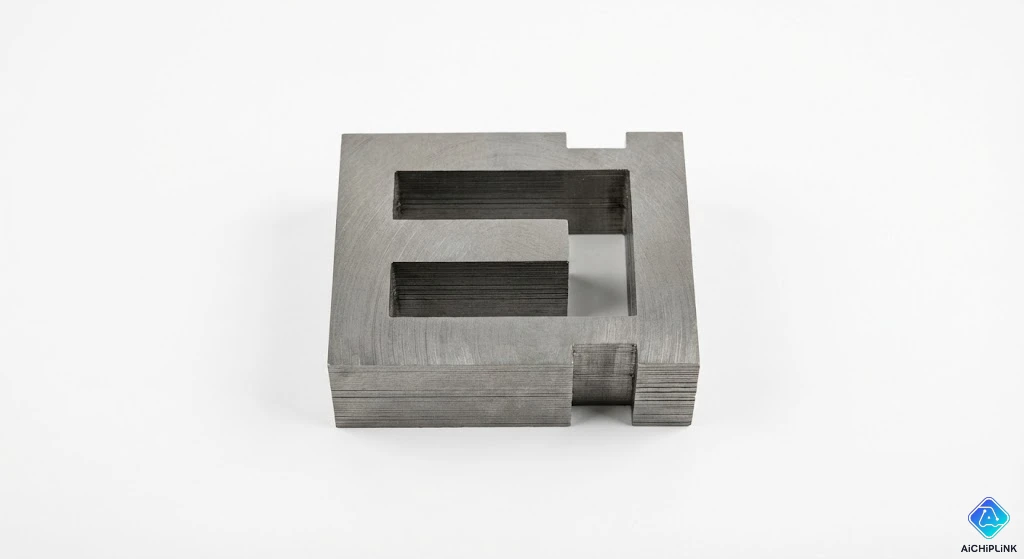
The Transformer Core is the silent engine of electrical conversion. While the copper windings carry the current, it is the core that carries the magnetic flux, acting as the bridge between input and output.
Choosing the wrong core material or geometry can lead to a transformer that overheats, hums loudly, or fails to regulate voltage efficiently.
Whether you are designing a massive distribution transformer or a tiny high-frequency Switch Mode Power Supply (SMPS), understanding the physics of the core is essential. This guide explores the materials, shapes, and loss mechanisms that define modern transformer design.
Table of Contents
- 1. What is a Transformer Core?
- 2. The Battle of Materials: CRGO vs. Ferrite vs. Amorphous
- 3. Core Construction: EI vs. Toroidal
- 4. Why Lamination Matters (Killing Eddy Currents)
- 5. Selection Guide
1. What is a Transformer Core?
A transformer works on the principle of Induction. A changing current in the Primary Coil creates a magnetic field. This field must link to the Secondary Coil to induce a voltage.
Air is a terrible conductor of magnetic flux (it has high Reluctance). Iron is an excellent conductor of magnetic flux (low Reluctance).
The Function: The Core provides a "Magnetic Highway" for flux ($\Phi$). A good core concentrates the magnetic field, ensuring that nearly 100% of the energy from the primary reaches the secondary.
2. The Battle of Materials: CRGO vs. Ferrite vs. Amorphous
The frequency of your application dictates your material choice.
| Material | Best For | Frequency Range | Characteristics |
|---|---|---|---|
| Silicon Steel (CRGO) | Mains Power | 50Hz - 400Hz | Cold Rolled Grain Oriented. High Flux Density (~1.7 Tesla). Cheap and robust. The standard for grid power. |
| Ferrite | SMPS / RF | 10kHz - 100MHz | Ceramic Iron Oxide. Non-conductive. Low Saturation (~0.3 Tesla) but virtually zero Eddy Current loss at high frequencies. |
| Amorphous Metal | Green Energy | 50Hz - 1kHz | Disordered atomic structure. Extremely low Hysteresis loss. More expensive, but pays for itself in energy savings over 20 years. |
| Powdered Iron | Chokes/Inductors | 100kHz+ | Lower permeability, handles DC bias well without saturating. |
Key Takeaway: Never use Silicon Steel for a high-frequency switching supply (it will overheat instantly). Never use Ferrite for a 50Hz mains transformer (it will saturate and fail to transfer power).
3. Core Construction: EI vs. Toroidal
The shape of the core affects noise, cost, and efficiency.
A. Laminated EI Core
Named because it is built from stacks of "E" and "I" shaped steel sheets.
- Pros: Cheapest to manufacture. Easy to wind coils on a bobbin separately.
- Cons: Air Gaps. Where the E and I meet, there is a tiny gap. This causes "Flux Leakage" (efficiency loss) and mechanical vibration (the famous 60Hz hum).
B. Toroidal Core (Ring)
A donut-shaped core made from a continuously wound strip of steel.
- Pros: No Air Gaps. The magnetic path is continuous. Ultra-low electromagnetic interference (EMI). Very quiet (low hum).
- Cons: Expensive to wind (requires special machines that thread wire through the donut).
- Best Use: High-end Audio Amplifiers, Medical Equipment.
4. Why Lamination Matters (Killing Eddy Currents)
If you made a transformer core out of a solid block of steel, it would turn into a heater.
The Villain: Eddy Currents Since the core is metal, the changing magnetic field induces voltage inside the core material itself. This causes loops of current to circulate within the iron, generating massive heat ($I^2R$ loss).
The Hero: Lamination Engineers slice the core into thin sheets (0.23mm to 0.35mm thick) and coat each sheet with a microscopic layer of insulating varnish.
- This insulation breaks the circuit for the Eddy Currents.
- Current cannot flow across the insulation, keeping the core cool.
Formula for Eddy Current Loss ($P_e$): $$P_e \propto f^2 \times B^2 \times t^2$$
- $f$: Frequency
- $B$: Flux Density
- $t$: Thickness of lamination
Notice that $t$ is squared. Making the lamination half as thick reduces the loss by a factor of four!
5. Selection Guide
How do you choose the right core for your project?
- Standard 120V/220V Power Supply:
- Low Budget: EI Core (CRGO).
- Low Noise (Audio): Toroidal Core (CRGO).
- Solar Inverter / High Efficiency Grid:
- Amorphous Core (To minimize standby losses).
- Phone Charger / PC Power Supply (SMPS):
- Ferrite Core (E-Core or PQ shape). Operating at 50kHz+.
- RF Filter / Antenna:
- Powdered Iron or Ferrite Toroid.
Sourcing Magnetic Components Whether you need high-grade CRGO laminations or precision Ferrite cores for a flyback converter, quality materials are key to efficiency. Visit Aichiplink.com to search for magnetic core suppliers and transformer kits.

Written by Jack Elliott from AIChipLink.
AIChipLink, one of the fastest-growing global independent electronic components distributors in the world, offers millions of products from thousands of manufacturers, and many of our in-stock parts is available to ship same day.
We mainly source and distribute integrated circuit (IC) products of brands such as Broadcom, Microchip, Texas Instruments, Infineon, NXP, Analog Devices, Qualcomm, Intel, etc., which are widely used in communication & network, telecom, industrial control, new energy and automotive electronics.
Empowered by AI, Linked to the Future. Get started on AIChipLink.com and submit your RFQ online today!
Frequently Asked Questions
Q1: What is the main function of a transformer core?
The core provides a low-reluctance path for magnetic flux, ensuring efficient energy transfer between windings.
Q2: Which core material is best for 50Hz power transformers?
CRGO silicon steel is best for 50Hz–60Hz applications due to its high flux density and low cost.
Q3: Why are ferrite cores used in SMPS transformers?
Ferrite cores have very low eddy current loss at high frequencies, making them ideal for SMPS designs.
Q4: What is the advantage of a toroidal core over an EI core?
Toroidal cores have lower flux leakage, less noise, and higher efficiency, but cost more to manufacture.
Q5: How do laminations reduce transformer losses?
Thin insulated laminations interrupt eddy current paths, significantly reducing heat and power loss.