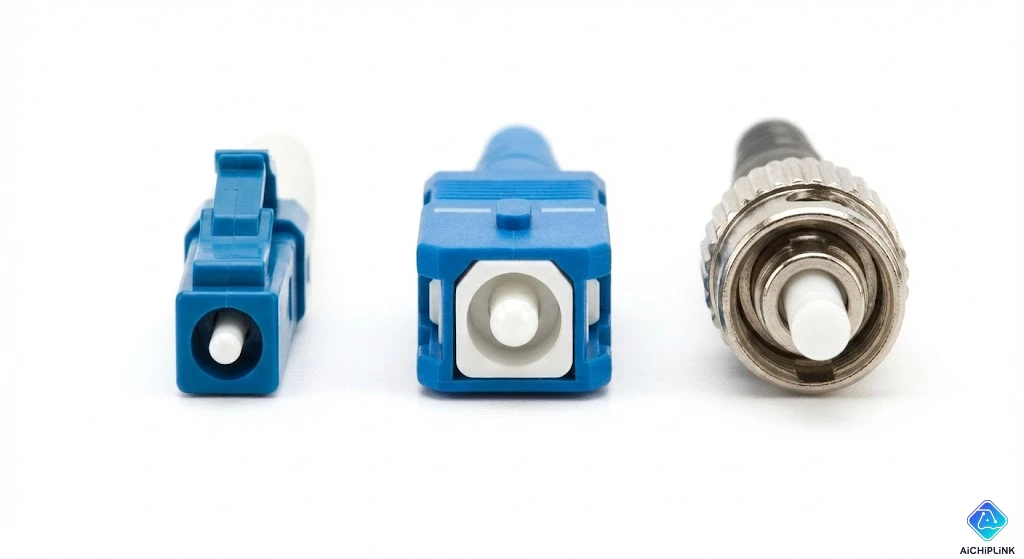
Fiber optic cabling is the backbone of modern networking, but walking into a server room can feel like looking at a bowl of alphabet soup. LC, SC, ST, FC, MPO...
If you buy the wrong patch cord, it simply won't fit into your switch or transceiver.
While there are many types, 90% of the confusion comes down to the "Big Three": LC, SC, and ST. This guide explains the physical and functional differences between them so you never order the wrong cable again.
Table of Contents
- 1. The Quick Comparison Table
- 2. SC Connector (The "Square" Standard)
- 3. LC Connector (The "Little" Standard)
- 4. ST Connector (The "Stab & Twist")
- 5. Key Differences Summary
- 6. Which One Should I Choose?
1. The Quick Comparison Table
If you are in a rush, here is the cheat sheet:
| Feature | SC (Subscriber Connector) | LC (Lucent Connector) | ST (Straight Tip) |
|---|---|---|---|
| Shape | Square (Large) | Square (Small) | Round (Metal) |
| Size | Standard | Small Form Factor (SFF) | Standard |
| Ferrule Size | 2.5mm | 1.25mm | 2.5mm |
| Mechanism | Push-Pull | Latch (RJ45 style) | Bayonet (Twist) |
| Primary Use | Datacom, GPON, Telecom | High-Density, SFP Modules | Legacy, Industrial |
| Mnemonic | "Square Connector" | "Little Connector" | "Stab and Twist" |
2. SC Connector (The "Square" Standard)
Full Name: Subscriber Connector (or Standard Connector).
The SC was the industry standard for Gigabit Ethernet for a long time. It features a square plastic housing.
- Mechanism: Push-Pull. You simply grab the plastic housing, push it in until it clicks, and pull the housing back to release it.
- Ferrule: Uses a 2.5mm ceramic ferrule.
- Where you'll see it:
- ISPs: The fiber box (ONT) on your wall at home usually uses an SC connector (often Green SC/APC).
- Media Converters: Older boxes that convert copper to fiber often use SC.
3. LC Connector (The "Little" Standard)
Full Name: Lucent Connector.
The LC is the modern king of the data center. As network speeds increased, switches needed to pack more ports into the same space. The SC was too big, so the LC was invented.
- Mechanism: Latch. It looks and acts like a tiny version of the ethernet (RJ45) jack. You press the small clip on top to release it.
- Ferrule: Uses a 1.25mm ceramic ferrule (Half the size of SC/ST).
- Where you'll see it:
- SFP/SFP+ Modules: If you are plugging fiber into a Cisco/Ubiquiti/Mikrotik switch via a transceiver module, it is almost 100% guaranteed to be LC.
- High-Density Patch Panels: Where space is money.
4. ST Connector (The "Stab & Twist")
Full Name: Straight Tip.
The ST is the "Grandfather" of connectors. Developed by AT&T, it was dominant in the 90s. It looks remarkably like a BNC connector used for coaxial cables.
- Mechanism: Bayonet (Twist-Lock). You insert the plug, push, and twist it to lock it onto the pin.
- Ferrule: Uses a 2.5mm ceramic ferrule (Same as SC).
- Where you'll see it:
- Legacy Networks: Old corporate campuses and schools wired in the early 2000s.
- Industrial Environments: The metal twist-lock is extremely vibration resistant.
5. Key Differences Summary
1. Size (Density)
LC is a "Small Form Factor" (SFF) connector. You can fit two LC connectors in the exact same space as one SC connector. This is why LC is used for "Duplex" (Tx/Rx) communication in SFP modules.
2. Handling
- SC is the easiest to handle. Just push and pull.
- ST is the hardest. You need room for your fingers to twist the barrel. It is annoying to use in tight racks.
- LC can be fiddly because it is tiny, but the latch ensures it never falls out.
3. Ferrule
- SC and ST share the same 2.5mm ferrule. (You can actually connect them together easily with a hybrid adapter).
- LC uses a unique 1.25mm ferrule.
6. Which One Should I Choose?
-
Building a new Data Center or LAN? Go with LC. It is the standard for 10G, 40G, and 100G hardware. It fits all modern SFP transceivers.
-
Connecting to ISP equipment or generic Media Converters? Check the device, but it is likely SC. (Look for the square port).
-
Extending an existing Multi-mode fiber run from 1999? Check the patch panel. It might be ST.
Need Fiber Patch Cords? Whether you need LC-LC, SC-LC, or a legacy ST-SC hybrid cable, quality matters to prevent signal loss. Visit Aichiplink.com to search for Fiber Optic Connectors and Patch Cords.

Written by Jack Elliott from AIChipLink.
AIChipLink, one of the fastest-growing global independent electronic components distributors in the world, offers millions of products from thousands of manufacturers, and many of our in-stock parts is available to ship same day.
We mainly source and distribute integrated circuit (IC) products of brands such as Broadcom, Microchip, Texas Instruments, Infineon, NXP, Analog Devices, Qualcomm, Intel, etc., which are widely used in communication & network, telecom, industrial control, new energy and automotive electronics.
Empowered by AI, Linked to the Future. Get started on AIChipLink.com and submit your RFQ online today!
Frequently Asked Questions
Q1: What is the main difference between LC and SC connectors?
LC connectors are smaller and support higher port density, while SC connectors are larger and easier to handle.
Q2: Which fiber connector is commonly used with SFP modules?
LC connectors are the standard choice for SFP, SFP+, and SFP28 transceivers.
Q3: Are ST connectors still used today?
ST connectors are mostly found in legacy or industrial networks but are rarely used in new installations.
Q4: Can LC, SC, and ST connectors be used interchangeably?
No, they are not directly interchangeable and require matching ports or hybrid adapters.
Q5: Which fiber connector is best for a new network deployment?
LC connectors are recommended for new networks due to their compatibility with modern high-speed equipment.