What are Laser Diodes?
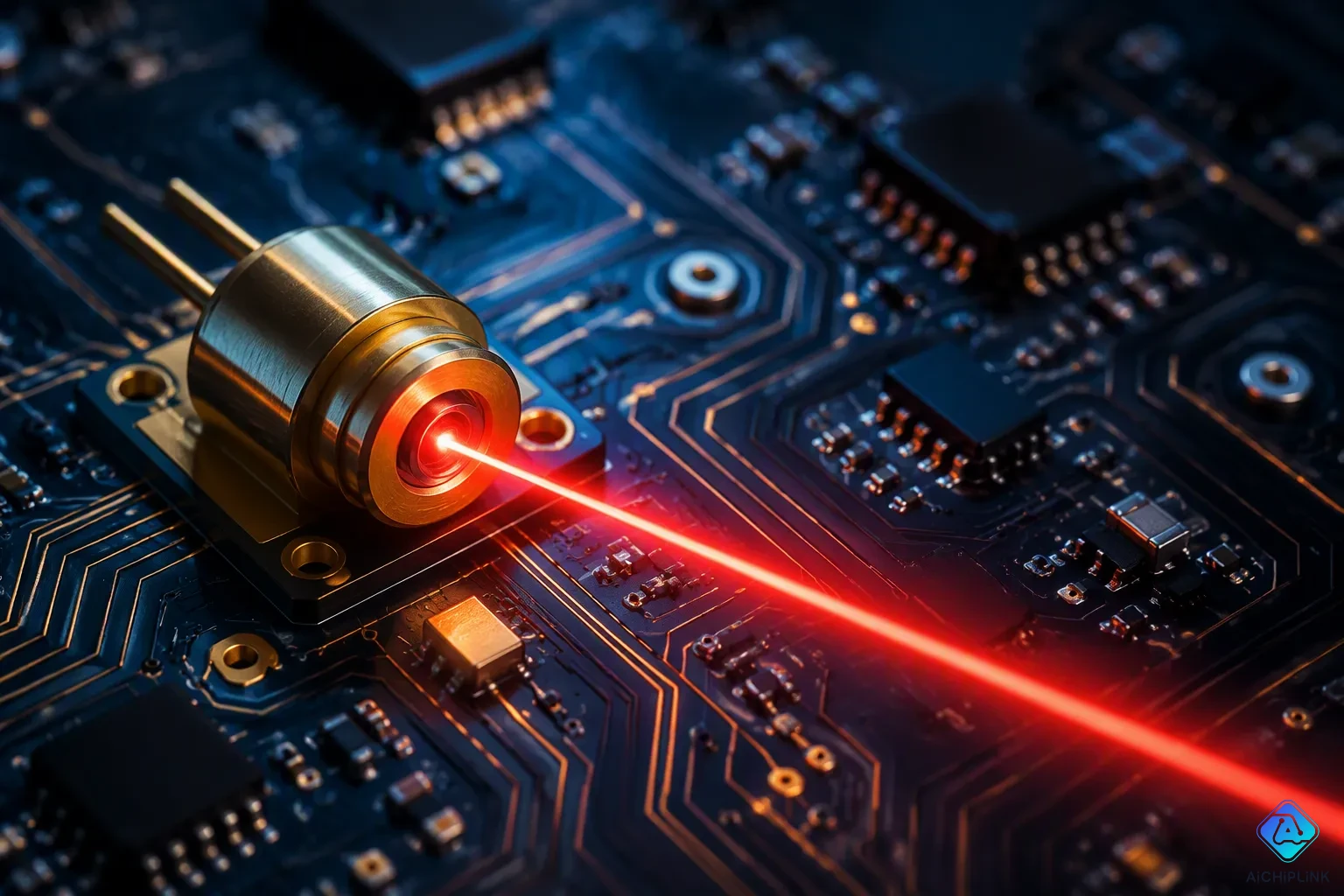
You see a red dot from a presentation remote or the scanner at a grocery store checkout. A diode laser makes that possible. A laser diode is a small semiconductor chip that turns electrical current directly into a focused, steady beam of light. Inside the chip, electrons and holes join together to give off energy as light, making a very exact and strong beam. These devices are the most common type of laser in the world. You find laser diodes in everything from DVD players to internet cables. You will learn the simple science behind them, the different kinds available, and why they are incredibly useful.
Key Takeaways
-
Laser diodes change electricity into a narrow light beam through a process called stimulated emission.
-
Different types like Fabry-Perot, DFB, and VCSEL lasers do different jobs, from CD players to internet cables.
-
You use laser diodes every day in barcode scanners, presentation remotes, and fiber-optic internet.
-
Laser diodes work well and last a long time, but heat and static electricity can hurt them quickly.
How Laser Diodes Work
The P-N Junction
Every laser diode starts with a tiny semiconductor chip built around a p-n junction. This junction forms where two types of material meet: one with extra electrons (n-type) and one with missing electrons, called holes (p-type). When you apply a forward voltage, electrons rush toward the junction and fall into those holes. This process is the "gain medium" — the heart of the device where light gets born.
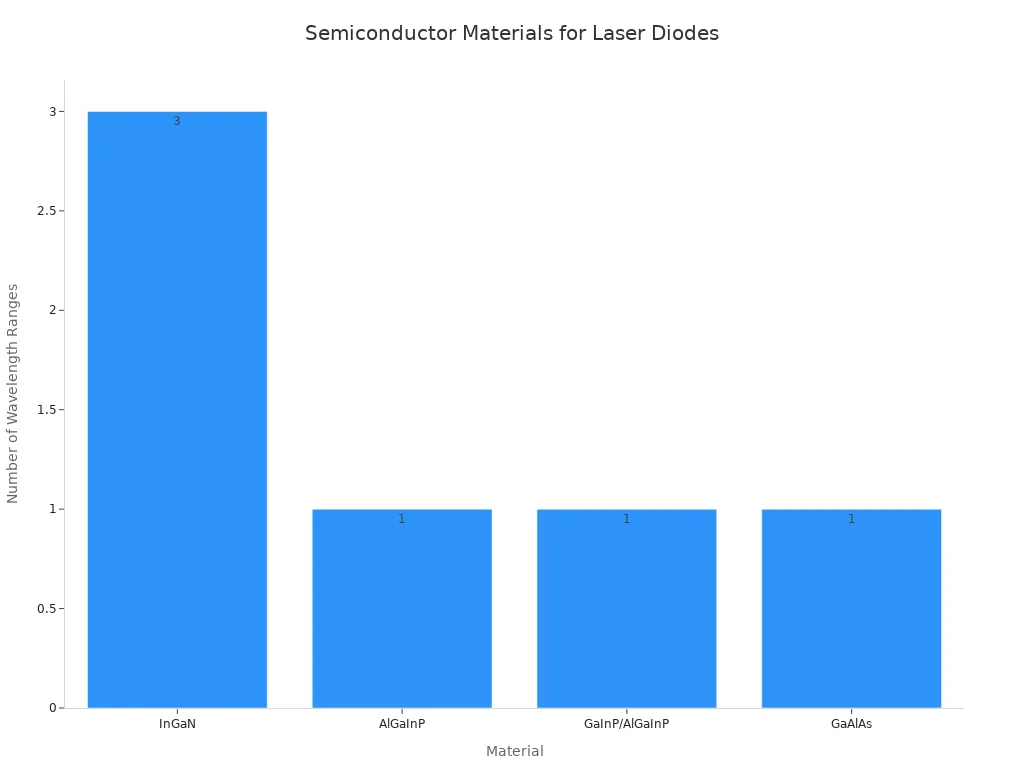
Think of it like a light traffic jam. Electrons pile up at the junction, unable to move forward. When one electron finally drops into a hole, it releases its extra energy as a photon — a particle of light. This spontaneous emission happens randomly at first. The semiconductor material determines the photon's wavelength. For instance, gallium arsenide (GaAs) has a direct bandgap of 1.42 eV, producing light near 890 nm in the infrared range. Different materials produce different colors, as you can see below.
| Wavelength (nm) | Material |
|---|---|
| 405 | InGaN |
| 445–465 | InGaN |
| 488–525 | InGaN |
| 635–670 | AlGaInP |
| 650–660 | GaInP/AlGaInP |
| 785–808 | GaAlAs |
The doping concentration also matters. Higher doping narrows the depletion region where recombination occurs, which affects how efficiently the device operates. A lower threshold current — the minimum current needed to start lasing — means less wasted energy and better performance.
Stimulated Emission and the Optical Cavity
Spontaneous emission alone produces weak, scattered light. The magic of a laser diode comes from stimulated emission. Here is how it works: when a passing photon encounters an excited electron, it triggers that electron to drop into a hole and release a second photon. Crucially, this new photon matches the first one exactly — same wavelength, same direction, same phase. One photon becomes two, then four, then eight. This chain reaction amplifies the light rapidly.
To sustain this process, the chip has an optical cavity. Two mirrored ends sandwich the gain medium. The mirrors reflect photons back and forth, forcing them to pass through the junction repeatedly and trigger more emissions. One mirror is only partially reflective — typically above 99.8% reflectivity at a 0° angle of incidence, with optimized mirrors exceeding 99.99% — so a small fraction of light escapes. That escaping light forms your laser beam.
The cavity length controls the beam's properties. Longer cavities produce more longitudinal modes with smaller frequency spacing, while shorter cavities spread modes further apart. Engineers tune this spacing for specific applications.
Above the threshold current, the device transitions from spontaneous to stimulated emission. The slope efficiency then measures how effectively additional current converts into light output. Typical wall-plug efficiency — the ratio of optical power to electrical input — reaches about 30% at high powers, with the best commercial laser diodes exceeding 50%. This efficiency, combined with precise wavelength control, makes laser diodes the workhorse of modern photonics. Your laser power depends entirely on these carefully engineered internal processes.
Common Types of Laser Diodes
Fabry-Perot (FP) Lasers
The Fabry-Perot design is the simplest kind of diode laser. You see these in everyday items like CD players and basic sensors. They cost little and are easy to make, so they work well when you do not need extreme precision. The FP cavity uses two cleaved crystal facets. These facets act as mirrors. This simple setup keeps manufacturing costs low.
Inside a CD player, an FP diode laser gives a maximum output power of 5 mW. The power that actually reaches the objective lens is usually between 0.3 and 1 mW. That is enough to read the disc's data reliably. For communication, FP devices work at wavelengths of 1310 nm or 1550 nm.
These types give off a wide spectral width. They produce multi-longitudinal mode coherent light. The beam has several closely spaced wavelengths instead of a single pure color. This wide spectrum limits the transmission distance to usually within 20 km. For short-range, low-rate tasks, the FP laser works perfectly. Dispersion in the fiber makes the different wavelengths spread out over distance. This effect limits how far the signal can travel before it becomes unclear.
DFB and VCSEL Lasers
Distributed Feedback devices fix the wavelength precision problem. A built-in grating inside the cavity picks out a single wavelength. This design gives a narrow spectral width and single-longitudinal mode emission. DFB devices operate at 1310 nm and 1550 nm.
The side-mode suppression ratio (SMSR) shows how well the main mode dominates. A typical DFB device has an SMSR above 30 dB. That means the main mode is at least 1000 times stronger than the most significant side mode. Some manufacturers get even better results. They reach SMSR values above 35 dB for certain wavelength ranges. These features make DFB devices ideal for high-speed fiber-optic communications over distances above 40 km. The single wavelength nature prevents dispersion issues that trouble FP types.
Vertical-Cavity Surface-Emitting devices, or VCSELs, take a different approach. They emit light from their top surface rather than from the edge. This design makes them easy to test and arrange into arrays. A VCSEL typically operates at 850 nm. Because you can test them on the wafer before cutting, manufacturing costs stay low.
In data centers, VCSELs play a crucial role. The industry targets 100 G per lane as the standard for VCSEL-based links. A high-speed VCSEL can send error-free digital data over optical fiber for short reaches of 30 to 100 meters. It runs at no less than 100 gigabits per second. This makes them perfect for high-speed data center interconnects and 3D sensing applications.
The table below shows the typical wavelength ranges for each type of these laser diodes.
| Laser Diode Type | Typical Wavelength Range |
|---|---|
| VCSEL | 850 nm |
| FP | 1310 nm or 1550 nm |
| DFB | 1310 nm and 1550 nm |
| EML | 1470–1610 nm (typically around 1550 nm) |
Key Applications of Laser Diodes
In Consumer Electronics and Communication
You come across laser diodes many times every day without even realizing it. The barcode scanner at the grocery store checkout uses a red laser diode to read the stripes on your items. Your presentation remote shines that familiar red dot onto a screen. These everyday tools all depend on the same small semiconductor technology.
Fiber-optic communication forms the backbone of the internet, and laser diodes make it possible. Data centers use DFB lasers to send information through glass fibers at amazing speeds. Each light pulse stands for a bit of data traveling across continents. Without these tiny light sources, streaming video, cloud computing, and global phone calls would not exist.
Optical data storage also relies on laser diodes. Blu-ray players use a blue-violet laser diode that works at 405 nm. This shorter wavelength reads smaller pits on the disc surface, so you can store more data than with older DVD or CD formats. The laser power in these devices stays low — usually just a few milliwatts — because the reader only needs to detect reflected light, not burn anything.
Laser pointers are the simplest diode laser applications. A small battery powers the diode, and a lens shapes the beam. You get a bright, focused spot that travels hundreds of meters. The whole device fits in your pocket and costs only a few dollars to make.
In Medical and Industrial Tools
Medical professionals use laser diodes for precise procedures that would be impossible with traditional tools. Laser eye surgery, for example, reshapes your cornea using ultraviolet laser diodes. The surgeon controls the beam with computer precision, removing microscopic layers of tissue. Patients regain clear vision without blades or stitches. Laser diodes also seal blood vessels during surgery, reducing bleeding and speeding recovery. Dermatologists use them to remove tattoos, hair, and age spots by targeting specific pigments beneath your skin.
Industrial applications need higher laser power. Cutting and welding metal requires beams that create intense heat at a precise point. Modern manufacturing plants use diode-pumped solid-state lasers, where laser diodes energize a separate gain medium. This design delivers the power needed for thick steel plates while staying efficient. Engraving machines use lower-power diodes to etch designs into wood, glass, and plastic. The beam vaporizes material in a controlled pattern, creating permanent marks with fine detail.
The wavelength of a laser diode determines its use. You can find laser diodes with center wavelengths from 375 nm in the ultraviolet range to 2000 nm in the infrared. Ultraviolet diodes excel at precision cutting and medical procedures because their short wavelength focuses to a tiny spot. Infrared diodes work well for communication because glass fibers transmit these wavelengths with minimal loss. Visible diodes — red, green, and blue — serve display and pointing applications.
Each application needs specific features. Communication systems need stable wavelengths and high-speed modulation. Medical tools require precise beam control and consistent output. Industrial equipment needs maximum laser power and durability. Manufacturers pick the right diode type and wavelength for each job, ensuring good performance across every field.
Advantages and Limitations of Laser Diodes
Why They Are So Popular
It's hard to find another light source that works as well as laser diodes. These tiny chips turn electricity into light very effectively. The table below shows how they compare to older gas laser technology.
| Technology | Wall-plug efficiency |
|---|---|
| Gas lasers (e.g., HeNe) | < 1% (most energy lost as heat) |
| Laser diodes (semiconductor) | 30–60% |
That difference matters a lot. A helium-neon laser wastes almost all its energy as heat. A laser diode turns one-third to over half of that same energy into useful light. You get more beam for every watt you use from your power supply.
Size and cost also favor the diode laser. You can hold a full laser diode in your hand, including its case. Gas lasers need big tubes and high-voltage supplies. Making laser diodes uses the same steps as computer chips, so production costs stay low. You can buy a basic laser diode for less than a dollar in bulk.
Lifespan adds another plus. Manufacturers rate typical laser diode modules for 25,000 to 50,000 hours of use. That range depends a lot on temperature. If you keep the diode cool, you reach the higher end. Lowering the operating temperature by about 10 degrees Celsius doubles the lifetime on average. Good thermal management pays off with longer service.
The Drawbacks and Safety Concerns
Laser diodes have weaknesses you should know. Their beam quality is not as good as gas lasers. The beam spreads more and has a less perfect shape. For jobs needing extreme precision, like certain science experiments, a gas laser still wins.
Temperature sensitivity is a real problem. If the diode's temperature goes past its maximum rating, performance drops a lot. It may even stop working. You need careful heat sinking and sometimes active cooling. Static electricity also harms these devices. A simple static shock from your finger can destroy a laser diode instantly. You must use proper grounding when handling them.
Safety is the biggest concern. The human eye focuses laser light onto a tiny spot on the retina. Even a low-power laser diode can cause permanent vision damage. You should never point any laser at someone's eyes. Consumer devices keep laser power low for this reason, but industrial lasers can burn skin and start fires. Always wear proper eye protection when working with laser diodes. Treat every laser as dangerous until you know its exact output.
A laser diode is a tiny semiconductor chip that turns electricity into a precise, focused beam of light. Now you understand how these devices work: stimulated emission inside a p-n junction creates the laser beam. Different types serve different jobs, like Fabry-Perot lasers in CD players, DFB lasers for long-distance fiber optics, and VCSELs for data center connections. Laser diodes are essential to modern life because they are efficient, long-lasting, and incredibly useful. You find them in your pocket and in the internet cables that connect the world. A diode laser truly is a cornerstone of modern technology that powers your devices and the infrastructure you rely on every day.

Written by Jack Elliott from AIChipLink.
AIChipLink, one of the fastest-growing global independent electronic components distributors in the world, offers millions of products from thousands of manufacturers, and many of our in-stock parts is available to ship same day.
We mainly source and distribute integrated circuit (IC) products of brands such as Broadcom, Microchip, Texas Instruments, Infineon, NXP, Analog Devices, Qualcomm, Intel, etc., which are widely used in communication & network, telecom, industrial control, new energy and automotive electronics.
Empowered by AI, Linked to the Future. Get started on AIChipLink and submit your RFQ online today!
Frequently Asked Questions
How long do laser diodes last?
Most laser diode modules run for 25,000 to 50,000 hours. Temperature plays the biggest role. Cooling the diode by about 10 degrees Celsius doubles its lifetime. Good heat management keeps your device working longer.
Can a laser diode burn out?
Yes. Static electricity can destroy a laser diode instantly. Touching the pins without proper grounding may kill it. Exceeding the maximum temperature also causes permanent damage. Always handle these components with care and use anti-static precautions.
Why do different laser diodes produce different colors?
The semiconductor material determines the wavelength. Gallium arsenide produces infrared light near 890 nm. Indium gallium nitride creates blue or violet light. Each material has a unique bandgap that sets the photon energy and color.
Are laser diodes safe to use?
Consumer devices keep power low for safety. However, even a low-power laser can damage your eyes permanently. Never point any laser at someone's face. Wear proper eye protection when working with industrial-grade diodes.
What is the difference between a laser diode and a regular LED?
Both emit light from a p-n junction. A regular LED produces scattered, incoherent light. A laser diode uses stimulated emission and an optical cavity to create a focused, coherent beam. This difference makes laser light much more precise and powerful.