What Are SiC and GaN Semiconductors and Why Do They Matter
You see silicon carbide and gallium nitride as two important wide-bandgap semiconductors. They are changing the world of power electronics. These materials let you build devices that work faster. They handle more power than traditional silicon. In electric vehicles and solar inverters, you get higher efficiency. You also get smaller designs because of their strong physical properties. The global market for SiC and GaN keeps growing quickly. This shows you how much industries value these advanced semiconductors. You help drive green and digital transformation by using these new technologies.
Key Takeaways
- SiC and GaN are special semiconductors. They help electronics work better and use less energy. These materials let devices use more power. They can also work in hotter places than regular silicon. Using SiC and GaN makes devices smaller and lighter. They also help save energy and make less heat. SiC works best for things that need a lot of power, like electric cars. GaN is great for fast electronics, like quick chargers. Using SiC and GaN helps the environment. They also help lower carbon emissions.
SiC and GaN vs Silicon
What Are Wide-Bandgap Semiconductors
You might ask what makes a wide-bandgap semiconductor different. The bandgap is the energy needed for electrons to move and make electricity. If the bandgap is bigger, the material can handle more voltage and heat. Silicon carbide and gallium nitride are both wide-bandgap materials. These materials let you build devices that work in tough places where silicon cannot.
Here is a simple table to show the difference in bandgap energy:
| Semiconductor | Bandgap Energy (eV) |
|---|---|
| Silicon (Si) | 1.12 |
| SiC | 3.26 |
| GaN | 3.43 |
You can see that SiC and GaN have much higher bandgap values than silicon. This means they can work with more voltage and heat. You get devices that are stronger and more reliable.
Performance Differences
When you compare silicon carbide and gallium nitride to silicon, you see big changes in how devices work. SiC is good for high-power jobs like electric cars and data centers. GaN works best in things that need high speed, like fast chargers and 5G devices.
Let’s look at how these materials do with heat and speed:
| Semiconductor | Thermal Conductivity | Switching Speed |
|---|---|---|
| SiC | Superior | Moderate |
| GaN | Moderate | Excellent |
| Silicon | Lower | Low |
SiC helps control heat better, which is good for strong systems. GaN switches very fast, which is great for high-speed electronics.
You also get these good things:
-
SiC and GaN devices switch faster than silicon, so less energy turns into heat.
-
Less heat means your devices last longer and work better.
-
You can make products smaller and lighter because these materials handle more power in less space.
Here is another table to show how these materials compare in important ways:
| Material | Electron Mobility (cm²/V·s) | Switching Speed (V/ns) | Efficiency (%) | Power Density (W/in³) |
|---|---|---|---|---|
| Silicon | 1450 | ~0.1 | < 92 | < 15 |
| SiC | 950 | ~0.1 | < 92 | ~15 |
| GaN | 2000 | ~50 | > 92 | ~30 |
You can see that GaN is best for switching speed and power density. SiC is great for handling heat and high voltage.
Why SiC and GaN Matter
Today’s electronics need to work better. SiC and GaN help you do that. They let you build devices that use less energy and stay cooler. You see these materials in electric cars, solar inverters, and fast phone chargers.
Here are some reasons why these wide-bandgap semiconductors are important:
-
GaN lets you reach higher speeds, so devices are faster and more efficient.
-
SiC can handle more voltage and heat, which is perfect for electric cars and power grids.
-
Both materials waste less energy, so you save power and make less heat.
-
You can design smaller, lighter, and stronger products.
You help the planet by using less energy and making greener choices. SiC and GaN are leading the way for the next generation of power electronics.
Silicon Carbide (SiC) Properties
High Voltage and Power Handling
Silicon carbide is a great choice for high voltage jobs. It works well in electric vehicle inverters and motor drives. You get less energy wasted because conduction losses are lower. Silicon carbide can handle high voltages and power. This makes it good for power grid converters and renewable energy systems.
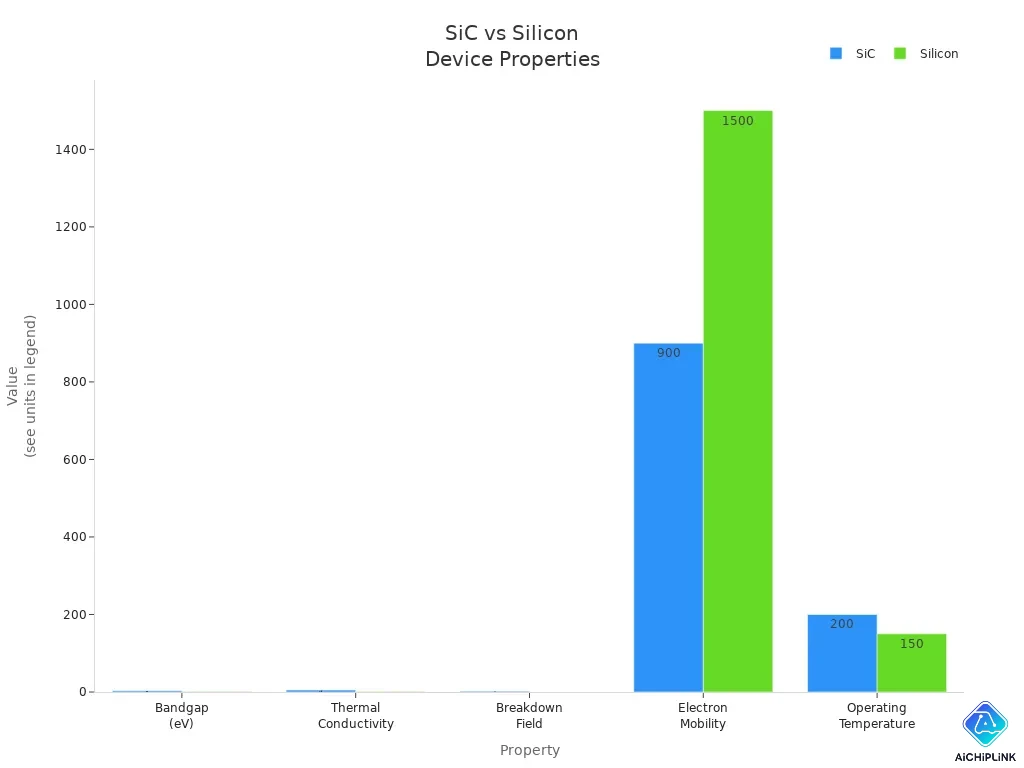
Here is a table that shows how silicon carbide and silicon compare:
| Property | SiC | Silicon |
|---|---|---|
| Bandgap (eV) | 3.3 | 1.1 |
| Thermal Conductivity (W/cm·K) | 4.9 | 1.5 |
| Breakdown Field (MV/cm) | 2.2 | 0.3 |
| Electron Mobility (cm²/V·s) | ~900 | ~1500 |
| Operating Temperature (°C) | 200+ | 150 max |
SiC devices work at higher temperatures and voltages. They control heat better, which helps in tough places.
Efficiency and Durability
Silicon carbide devices are very efficient. SiC MOSFETs have lower ON resistance. This means less energy turns into heat. Electric vehicles can drive farther and chargers work faster. DC/DC converters with silicon carbide reach over 98% efficiency. This saves energy and lowers costs.
Tip: SiC devices stay stable in extreme places. You can trust them for hard jobs.
Silicon carbide lasts longer because it handles heat and stress well. You can use it where other devices might break, like solar inverters and battery systems.
SiC in Power Electronics
Silicon carbide is used in many power electronics. Here are some common uses:
-
Electric vehicles: traction inverters, onboard chargers, DC-DC converters
-
EV charging stations: DC fast chargers, power cabinets
-
Renewable energy: solar inverters, battery storage converters, grid-tied inverters
-
Industrial power: motor drives, industrial inverters
-
Data centers: server power supplies, telecom rectifiers, UPS systems
Silicon carbide helps boost efficiency and cut energy loss. It keeps your systems running in harsh conditions. This makes SiC important for the future of semiconductors.
Gallium Nitride (GaN) Features
High-Frequency Performance
Gallium nitride is great for high-frequency jobs. GaN semiconductors switch much faster than silicon or silicon carbide. This means devices can work at higher speeds and use less energy. Look at the table below to see how GaN is different:
| Semiconductor | Electron Mobility | Switching Speed | Efficiency | Frequency Capability |
|---|---|---|---|---|
| GaN | High | Fast | High | High |
| SiC | Moderate | Moderate | Moderate | Lower |
| Silicon | Low | Slow | Low | Lowest |
GaN devices can switch at much higher frequencies. You lose less energy when switching. This makes GaN good for things that need speed and efficiency.
Power Density and Compactness
GaN technology lets devices have more power in less space. GaN switches quickly and has lower on-resistance. This means it is more efficient when changing power. Here is a table to show how GaN compares:
| Feature | GaN | SiC | Silicon |
|---|---|---|---|
| Band-gap | 3.39 eV | 3.26 eV | 1.12 eV |
| Electron mobility | Superior | Moderate | Lower |
| On-resistance | Reduced | Moderate | Higher |
| Switching losses | Lower | Moderate | Higher |
| Frequency capability | Higher | Moderate | Lower |
| Compact design | Yes | Limited | No |
GaN devices handle heat better. You can make smaller and lighter power systems because of this.
-
GaN helps make smaller designs.
-
You get better performance in less space.
-
Devices stay cooler and last longer.
GaN in Consumer Electronics
Gallium nitride is used in many new electronics. GaN lets you make smaller chargers and power supplies. It works at higher frequencies and wastes less power. This means you get faster charging and smaller devices.
-
GaN fast chargers have power densities of 15-25 W/cm³, which is 2-3 times better than silicon.
-
New GaN chargers can be more than 95% efficient.
-
You find GaN in electric vehicle chargers, smartphones, and laptops.
| Aspect | GaN Technology | Traditional Silicon Technology |
|---|---|---|
| Efficiency | More efficient, faster charging | Less efficient, more power loss |
| Size | Compact, smaller and lighter chargers | Bulkier, larger chargers |
| Heat Management | Better heat management | Less effective heat management |
GaN power ICs let you charge three times faster. They are also half the size and weight of silicon chargers.
You see GaN’s benefits every day. Devices charge faster, stay cooler, and fit in your pocket or bag. GaN helps make electronics smaller and supports fast charging.
Applications of SiC and GaN
SiC in Electric Vehicles and Grids
SiC and GaN power semiconductors are changing electric vehicles and power grids. SiC helps build inverters and converters that manage power better. You get less energy loss and improved heat control. SiC inverters switch faster, which makes vehicles work better. SiC converters help charging systems charge quicker and make less heat. SiC inverters boost energy in solar systems and lower costs. Wind energy uses SiC converters to make power conversion more efficient and cut costs. Grid systems use SiC inverters and converters to send and share power well. SiC technology allows higher voltage systems, so charging is faster and wires are lighter. Efficiency goes up by 3-5%, which lets vehicles go farther. Power density rises by 40-50%, so inverters get smaller and lighter. This makes vehicles lighter and more efficient.
GaN in 5G and Electronics
GaN power semiconductors are important in 5G and new electronics. You find GaN inverters and converters in 5G stations, RF parts, and devices. GaN supports higher frequencies, which is needed for fast data in 5G. GaN converters make base stations use power better and waste less energy. GaN inverters help make small, strong amplifiers for good connections. GaN converters and inverters in phones and chargers help batteries last longer and keep devices cooler. GaN is used in fast chargers, so charging is quicker and more efficient. GaN inverters and converters help build smaller, lighter, and stronger devices.
| Application Area | Performance Metrics |
|---|---|
| 5G Base Stations | Output power, Power Added Efficiency |
| RF Components | High frequency operation, Low power dissipation |
| User Devices | Improved battery life, Reduced heat buildup |
| Fast Chargers | Reduced charging times, Increased efficiency |
Environmental Impact
Using SiC and GaN semiconductors helps the environment. SiC and GaN inverters and converters are 30-50% more efficient than silicon. You see less energy used and fewer greenhouse gases. SiC devices save energy and lower CO2 emissions. Over 100 million GaN and 12 million SiC power devices shipped have cut about 200,000 tons of CO2. By 2050, SiC and GaN could save up to 6 Gtons/year of CO2. SiC and GaN converters and inverters waste less energy when switching and conducting. These technologies make power systems more efficient. They let you build smaller, stronger, and energy-saving electronics. This is important for electric vehicles and renewable energy.
| Factor | Silicon (Si) | Silicon Carbide (SiC) | Gallium Nitride (GaN) |
|---|---|---|---|
| Efficiency in Applications | Standard | 30-50% more efficient than Si | 30-50% more efficient than Si |
| Energy Consumption | Lower during manufacturing | High due to high-temperature processes | Lower due to lower growth temperatures |
| End-of-Life Management | Established recycling pathways | Minimal leaching risk, recycling challenges | Valuable recoverable materials, specialized recycling needed |
Tip: You help the planet by picking SiC and GaN for power semiconductors in your devices.
SiC and GaN semiconductors are making devices use energy in new ways. These materials help you make systems that are smaller and faster. They also make devices more efficient. You can find SiC and GaN in electric vehicles and solar inverters. They are also used in data centers. Their technology helps cut down energy loss. This supports a cleaner and greener world. In the future, you will see more new ideas. This technology will power electric cars and fast chargers. It will also help renewable energy systems.
-
SiC and GaN let devices work better and use more power in less space.
-
You get devices that last longer and save energy.

Written by Jack Elliott from AIChipLink.
AIChipLink, one of the fastest-growing global independent electronic components distributors in the world, offers millions of products from thousands of manufacturers, and many of our in-stock parts is available to ship same day.
We mainly source and distribute integrated circuit (IC) products of brands such as Broadcom, Microchip, Texas Instruments, Infineon, NXP, Analog Devices, Qualcomm, Intel, etc., which are widely used in communication & network, telecom, industrial control, new energy and automotive electronics.
Empowered by AI, Linked to the Future. Get started on AIChipLink and submit your RFQ online today!
Frequently Asked Questions
What makes SiC and GaN better than silicon?
You get higher efficiency and better heat control with SiC and GaN. These materials handle more power and work at higher temperatures. Devices last longer and use less energy.
Where do you find SiC and GaN in daily life?
You see SiC in electric cars and solar inverters. GaN appears in fast phone chargers and 5G devices. Both help make electronics smaller and more efficient.
Are SiC and GaN safe for the environment?
SiC and GaN help reduce energy waste. You use less electricity and lower carbon emissions. These materials support green technology and cleaner energy.
Can you use SiC and GaN together?
Yes, you can. SiC works well in high-power systems. GaN fits best in high-speed, low-voltage devices. You combine them to get the best performance in complex systems.