How to Select Semiconductors for Automotive Radar Systems
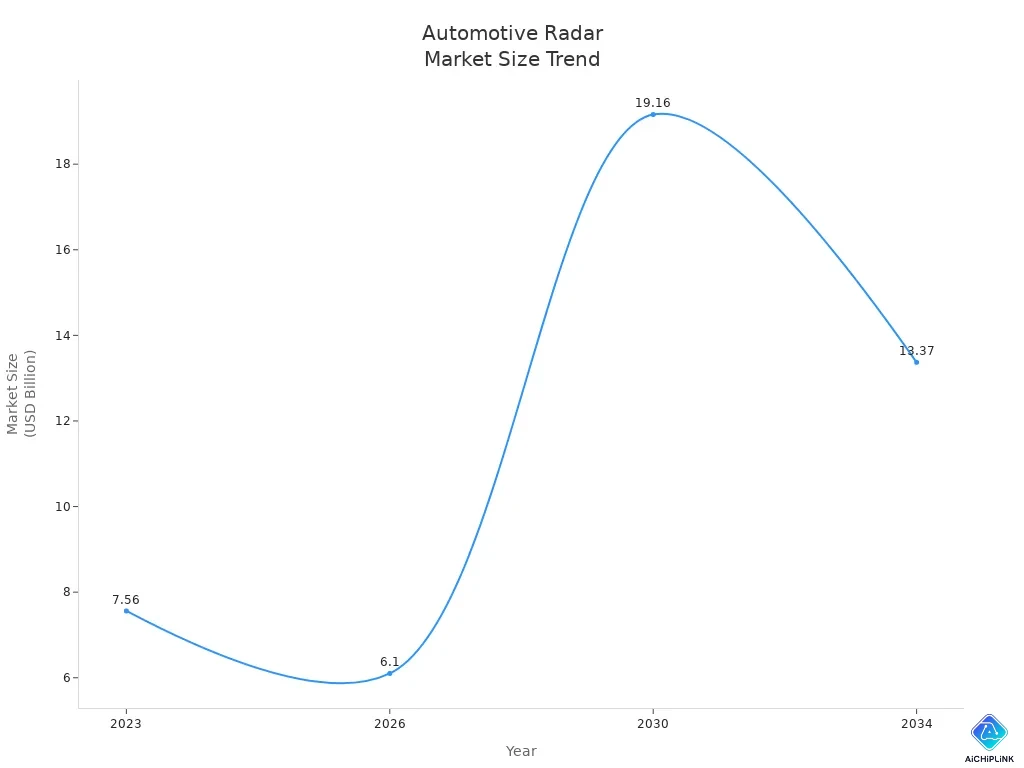
When you engage in semiconductor selection for car radar, you have many options to consider. More cars are incorporating radar systems each year. The table below illustrates the growth of the market for car radar:
| Year | Market Size (USD Billion) | Projected Growth Rate (CAGR) |
|---|---|---|
| 2023 | 7.56 | 14.20% |
| 2026 | 6.10 | 10.30% |
| 2030 | 19.16 | N/A |
| 2034 | 13.37 | N/A |
You need to select semiconductors that meet the radar requirements in cars. Some challenges include supporting large antenna arrays and managing advanced detection algorithms. It is crucial to ensure that the system operates reliably over time. Every semiconductor selection impacts the safety and performance of vehicles on the road.
Key Takeaways
-
Pick the right radar frequency band for your car. The 24 GHz band works for simple jobs. The 77 GHz and 79 GHz bands give better detail and longer range.
-
Choose semiconductor technology that fits your needs. CMOS is common because it is cheap and easy to use. GaAs works best for high-frequency jobs.
-
Make sure your radar system uses power well. Use wide bandgap semiconductors like SiC and GaN to save energy. These also help your system work better.
-
Check that your semiconductors have automotive-grade certification. Following AEC-Q100 and ISO 26262 keeps your car safe and reliable in all driving conditions.
-
Use a semiconductor selection checklist. This helps you stay organized and makes sure your radar system meets all the rules.
Key Criteria for Semiconductor Selection
Frequency Bands & Radar Requirements
You must pick the right radar frequency band for your car’s radar. The most used bands are 24 GHz, 77 GHz, and 79 GHz. Each band changes how well the radar finds objects and how far it can see. The 24 GHz band is good for simple radar jobs. The 77 GHz and 79 GHz bands give better detail and can see farther. These higher bands help the radar tell apart things that are close together. This is important for driver-assistance features in cars.
Car radar sensors use different semiconductor technologies. You can pick CMOS, SiGe, or GaAs. Each one changes how hard your system is to build and how much it costs. The table below shows how they are different:
| Technology | Advantages | Impact on Cost and Complexity |
|---|---|---|
| GaAs | Moves electrons fast, works well at high frequencies | Good for tough radar jobs, but costs more |
| SiGe | Combines good parts of silicon and gallium arsenide | Saves money, lets you put more parts together |
| RF CMOS | Cheap, easy to make more | Lets you put many things on one chip, lowers cost and makes it simpler |
Pick the technology that matches your radar needs and your budget. Many car radar systems now use CMOS. CMOS lets you put the radar on one chip. This helps make sensors smaller and use less power.
Power Efficiency & Integration
Power efficiency is important when picking semiconductors for car radar. You want the radar to use less energy and not get too hot. This is very important for electric cars. New wide bandgap semiconductors, like silicon carbide (SiC) and gallium nitride (GaN), help save energy and keep cool. SiC power modules help your system use energy better and let electric cars go farther. GaN works well for fast switching, making radar and power units smaller and quicker.
You also need to think about putting many functions into one chip. Highly integrated radar systems use RF CMOS to do this. This makes the system simpler and cheaper. SiGe gives a good mix of performance and integration. GaAs is best for high-frequency radar, but it costs more and is harder to make.
Tip: Pick a semiconductor that gives you good power use, integration, and performance. This helps your car radar work well in all situations.
Automotive-Grade Certification
Radar semiconductors in cars must have automotive-grade certification. You need to make sure your sensor meets rules like AEC-Q100 and ISO 26262. These rules check if the part is safe, works well, and lasts long. Your semiconductor must pass tests like stress, lifetime, assembly, and electrical checks. You also need to check for defects and look for hazards.
Car radar sensors must handle temperature changes and work for a long time in heat. For Grade 0, the device should last 2000 cycles and 1000 hours at high heat. It must also pass electrostatic discharge tests. Passing these tests shows your radar is safe and works well in cars.
More car radar systems now use CMOS chipsets. Over half of new ADAS systems use these chips. More cars use 77 GHz radar because it is more exact and reliable. Radar-on-chip with CMOS makes sensors smaller and helps them find things better.
Note: Always make sure your radar semiconductor has automotive-grade certification. This makes sure your car is safe and works well.
Types of Automotive Radar Semiconductors
CMOS & RFIC Technologies
CMOS and RFIC technologies are important for car radar. These chips work at high frequencies and give strong performance. They help make radar signals clear and easy to understand. CMOS chips can put many functions on one chip. This makes radar systems smaller and uses less power. CMOS also lets radar work in more places because it supports many frequency bands.
| Characteristic | Description |
|---|---|
| High-Frequency Operation | Works in MHz to GHz frequency range |
| Low Noise and High Gain | Makes signals clearer and easier to pick up |
| High Integration | Puts many RF functions on one chip, making systems smaller |
| Low Power Consumption | Uses power in a smart way |
| Wide Operating Bandwidth | Works with many frequency bands for different standards |
The 22 nm and 28 nm CMOS processes are very popular now. These processes make radar systems smaller and more efficient. They help save power and handle high-frequency signals better. FD-SOI technology also helps put more functions on one chip and lowers noise. These technologies help meet radar needs for power and amplifier efficiency.
SiGe & GaAs Options
SiGe and GaAs semiconductors are used in many car radar systems. GaAs has high electron mobility and good noise performance. It works well for high-frequency radar in fancy cars. SiGe mixes cheap silicon with germanium for better speed. SiGe is used for fast circuits in regular cars.
| Semiconductor | Advantages | Limitations |
|---|---|---|
| GaAs | Moves electrons fast, works well at high frequencies | Costs more than silicon, breaks down easier, sensitive to heat |
| SiGe | Cheap like silicon, but faster with germanium | Can't go as fast as GaAs, harder to make than plain silicon |
SiGe BiCMOS is a good choice for saving money. It lets you use radar in different types of cars. GaAs is best for tough radar jobs in hard conditions.
Suitability for ADAS & Assistance
CMOS and FD-SOI are used for driver assistance and self-driving cars. These let you put radar on one chip. They use less power and work at high frequencies. This makes radar work better and more efficiently in cars.
Radar helps cars see objects in any weather. It gives clear pictures for safe driving and helps avoid things in the way. MMICs make radar systems work well and cost less. This helps make driver assistance safer and better in new cars.
Tip: Pick semiconductor technologies that fit your car radar needs. This helps your radar find things better and supports smart driving features.
Performance & Safety Evaluation
Noise, Linearity & Signal Integrity
When you check radar semiconductors, you look at important things. These things help you know if your sensor works well in real cars. Low noise, good linearity, and strong signal integrity help your radar find things and keep people safe.
Here is a table that lists the main things to check when you test radar for cars:
| Parameter | Description | Impact |
|---|---|---|
| Noise Figure (NF) | Shows the weakest signal your radar can find | A high NF makes it harder to see far or small things |
| Gain and Linearity | Tells how much your radar can boost signals | Bad linearity can mix up signals and cause mistakes |
| Power Handling | Shows how much power your radar can take | This is important for sending strong radar signals |
| VSWR and Insertion Loss | Tell if your radar matches the rest of the system | Bad matching makes your radar weaker and less clear |
| Group Delay Flatness | Shows if the radar signal stays even | Uneven delay can make it hard to find where things are |
A low noise figure helps your radar find weak signals. Good gain and linearity stop your radar from mixing up signals. Power handling matters for strong radar pulses. VSWR and insertion loss tell if your radar fits with the system. Group delay flatness helps your radar know where things are.
Temperature changes can make your radar work less well. When it gets hot or cold, the inside parts can change. This can make your radar lose signal or make mistakes. You need to keep your radar cool and control the heat. If you do not, your radar can stop working right.
Tip: Test your radar at different temperatures. This helps you find problems early and keeps your radar safe and working well.
Reliability & Safety Standards
You need to make sure your radar sensor is safe and works well. These rules help you build radar that works in all kinds of driving. They also help keep people in cars safe.
Car radar sensors must pass many tests. These tests check how far the radar can see, how well it works, and how it handles heat. You want your radar to be sensitive and use power well. Good heat control helps your radar last longer and use less energy. Grade 1 thermal reliability means your radar can handle tough places and still work.
Here is a table that shows what you need to check for safety and reliability:
| Aspect | Details |
|---|---|
| Range and accuracy | Better sensitivity and smaller chips help radar see better |
| Thermal management | Grade 1 means your radar can handle heat and use less power |
| Production standards | Grade 1 production means you can get good radar chips for cars |
You need to test your radar with big temperature changes. This means you make it very cold and then very hot, over and over. Sometimes, you go from -65°C to +150°C for many times. Good test machines change the temperature fast and keep it even. This helps you know your radar will last a long time.
Note: New laws say cars need more safety features. You must follow these rules to sell your radar. This is why testing radar is so important for safe driving and self-driving cars.
Compliance with AEC-Q100 & ISO 26262
You must check if your radar sensor meets AEC-Q100 and ISO 26262. These are the main rules for car radar. They help make sure your radar is safe and works in all kinds of driving, even self-driving.
AEC-Q100 checks if your sensor is strong. It uses tests like high heat, cold, wetness, and shaking. These tests show your radar can work in tough places.
ISO 26262 is about safety. It uses ASIL levels from A to D. Higher ASIL means more safety steps and more tests. You must plan for problems and make sure your radar keeps working.
Here is a table that explains the main rules:
| Standard | Focus Area | Key Requirements |
|---|---|---|
| AEC-Q100 | Checks if the chip is strong | Uses many tests to make sure the chip is tough |
| ISO 26262 | Checks if the chip is safe | Makes sure you plan for safety and stop problems before they happen |
You need to follow these rules from the start. This helps you stop problems and keeps your radar safe for everyone. Testing helps you check if your radar meets these rules.
Tip: Always ask your chip maker for proof of AEC-Q100 and ISO 26262. This keeps your radar safe and helps with smart driving in new cars.
Integration & Supplier Factors
System Compatibility & Scalability
You need to make sure your radar works with your car’s system. System compatibility means your sensor fits with other car parts. It should not cause any problems. Scalability means you can use the same radar in many cars. This works for simple cars and for cars with advanced driving features.
-
Signal processing integration keeps your radar working well and signals clear.
-
High costs can make it hard to use radar in cheaper cars.
-
Tough environments need special calibration, which can slow down new car launches.
-
Problems in the supply chain can delay making cars and make them cost more.
-
Some ways of making chips are not cheap enough for making lots of car radars.
-
Making sure everything lines up right and using machines to build parts makes things harder.
-
Not having clear rules for optical interposer testing can make things confusing for companies.
Gallium Nitride (GaN) semiconductors help radar work at higher voltages. This means better efficiency and less heat. GaN is good for radar that uses many antennas. This gives strong performance and makes the radar more reliable. You get high efficiency, more power, and better heat control. These things help radar work better and make it easier to use in many types of cars.
Supplier Support & Ecosystem
You need to check if your supplier is stable and helpful. A good supplier gives you clear instructions and helps you put things together. You want a supplier who can handle problems in the supply chain. They should also give you strong technical help. This lets you fix problems fast and keeps your radar working in all cars.
Tip: Pick suppliers who have experience with car radar and driver assistance. They should give you good parts, quick help, and good testing tools.
Semiconductor Selection Checklist
A checklist helps you pick the right semiconductor for car radar. You can use these steps:
-
Start by knowing what your radar needs to do.
-
Look at all the sensor’s details and how it should work.
-
Test your radar in real cars and different places.
-
Make sure the radar matches with other parts and stays cool.
-
Use your checklist to help you at every step.
| Step | What to Do |
|---|---|
| Application Needs | Decide how you will use radar in the car |
| Specifications | Check the sensor’s details for car radar |
| Testing | Try the radar in real driving |
| Matching & Thermal | Make sure it fits and controls heat |
| Checklist | Use your list to keep track |
Note: Using a checklist helps you do things right and fast. You make sure your radar sensor is safe and works well for driving.
You need to follow steps when picking semiconductors for car radar. Rules for the industry change a lot. This makes you use safer and better radar systems. You must check how well the radar works. You also need to check if it is safe and if the supplier helps you. Big car and tech companies make new radar technologies. These new ideas help you decide what to use in the future.
| Level | Key Players | Insights |
|---|---|---|
| System | Continental, Bosch, Hella | These companies lead in making car radar systems |
| Silicon | NXP, Infineon, Arbe, Uhnder | These companies make new designs for radar chips |
| Emerging | Huawei, Qualcomm, Intel | These tech giants work on new radar development |
-
You make radar better by watching what is new in the industry.
-
Electric cars need special semiconductors to work well.
-
Self-driving cars need sensors that are more advanced.
-
Security solutions keep car networks safe.
Keep checking rules and new radar technologies. This helps you make smart choices.

Written by Jack Elliott from AIChipLink.
AIChipLink, one of the fastest-growing global independent electronic components distributors in the world, offers millions of products from thousands of manufacturers, and many of our in-stock parts is available to ship same day.
We mainly source and distribute integrated circuit (IC) products of brands such as Broadcom, Microchip, Texas Instruments, Infineon, NXP, Analog Devices, Qualcomm, Intel, etc., which are widely used in communication & network, telecom, industrial control, new energy and automotive electronics.
Empowered by AI, Linked to the Future. Get started on AIChipLink and submit your RFQ online today!
Frequently Asked Questions
What is the main purpose of automotive radar?
Automotive radar helps cars find objects around them. It tells how far away things are. This helps with safety features like stopping crashes. It also helps with cruise control that changes speed by itself.
How do you choose the right semiconductor for radar?
You look at which frequency bands the radar uses. You check if it saves power and has the right certification. You make sure it fits what your car needs. You also see if it passes safety tests.
Why do you need automotive-grade certification?
Certification shows your radar sensor is safe for cars. It proves the sensor can handle heat and shaking. It also means the sensor will last a long time.
Can you use the same radar sensor in different car models?
You can use some radar sensors in many types of cars. You need to check if the sensor works with each car’s system. You also make sure it meets what each car needs.
What tests should you run on radar semiconductors?
You test for noise and how strong the signal is. You check if it works well in hot and cold. You also test if it is reliable and safe. This makes sure the sensor works right.