How to Select the Correct Wire Size for a 60 Amp Breaker
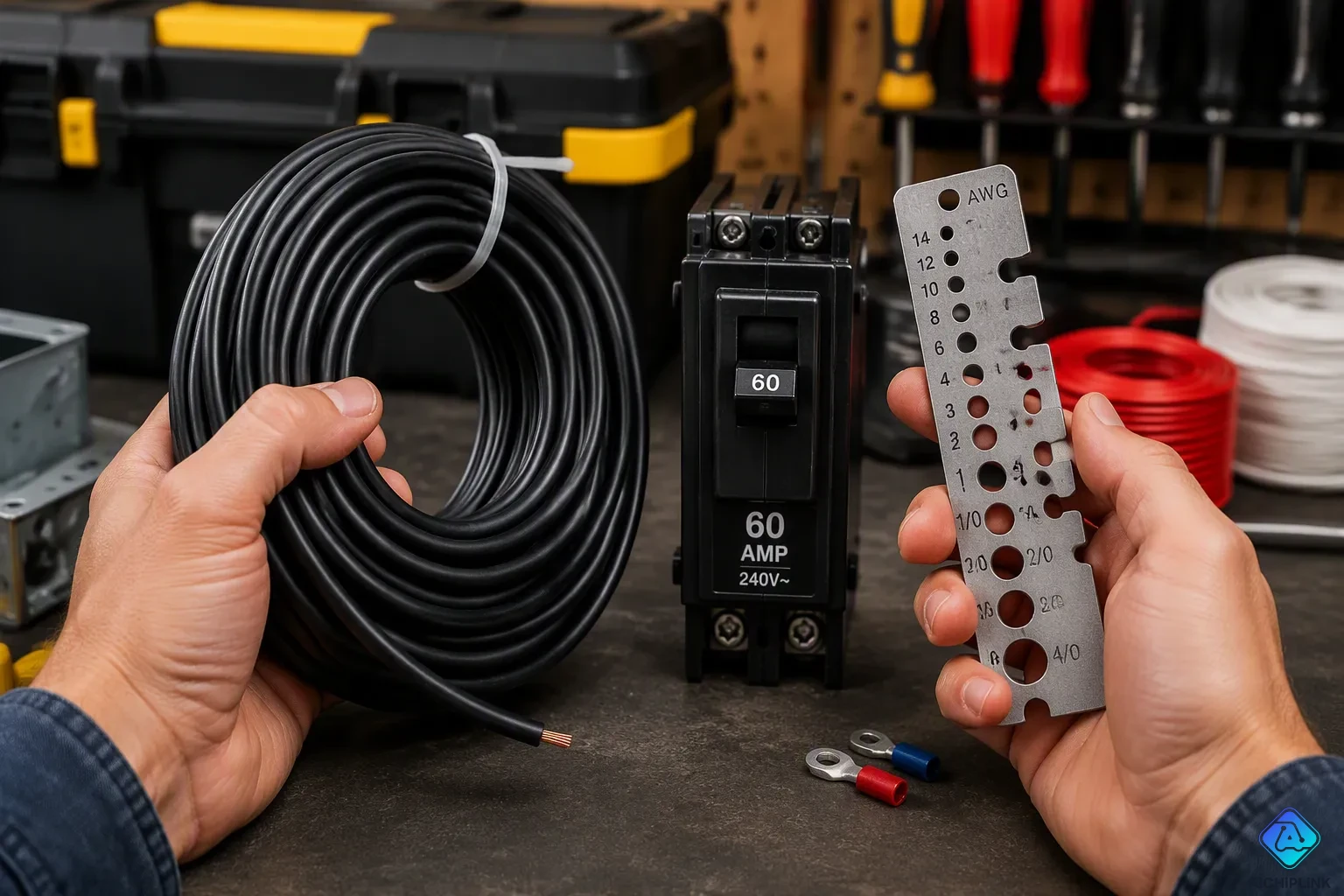
For a 60 amp breaker, the smallest wire you should use is 6 AWG copper or 4 AWG aluminum. But the right choice depends on a few things you need to think about.
| Wire Size | 60°C | 75°C | 90°C |
|---|---|---|---|
| 6 AWG Copper | 55A | 65A | 75A |
| 4 AWG Copper | 70A | 85A | 95A |
| 4 AWG Aluminum | 55A | 65A | 75A |
| 2 AWG Aluminum | 75A | 90A | 100A |
Picking the right wire is not just about the breaker’s number. You have to check the whole circuit to keep it safe and working well. This guide explains the reasons behind the answer. You will learn about material, heat, load, and distance. Use this info to understand, not to replace a licensed electrician.
Key Takeaways
-
You should use 6 AWG copper wire or 4 AWG aluminum wire for a 60 amp breaker.
-
For standard breakers, look at the 75°C column in the ampacity table.
-
For continuous loads, you multiply the load by 1.25 to find the wire size you need.
-
For runs longer than 100 feet, pick a thicker wire to stop voltage from dropping too much.
-
Always follow local codes and hire a licensed electrician for tricky installations.
Wire Size Basics for a 60 Amp Breaker
The standard answer for a 60 amp breaker is 6 AWG copper or 4 AWG aluminum. This recommendation comes directly from the 75°C column of the NEC ampacity table. That column matters because most residential circuit breakers and panel lugs carry a 75°C terminal rating. You need to understand why this column sets the baseline before you choose your wire.
Copper vs. Aluminum Wire
Copper and aluminum behave differently when carrying current. Copper offers superior conductivity, which means you can use a smaller gauge to handle the same load. Aluminum requires a larger cross-section to match copper's performance. For a 60 amp circuit, you need 6 AWG copper wire or 4 AWG aluminum wire. The size difference exists because aluminum conducts at roughly 61% of copper's efficiency.
Cost often drives the decision between these metals. Aluminum wire costs 60-70% less per foot than copper. That price advantage makes aluminum attractive for long feeder runs or subpanels. However, aluminum demands special handling during installation. You must clean the exposed conductor with a wire brush to remove oxidation, then apply anti-oxidant compound immediately. The compound prevents the oxide layer from reforming. You also need a torque wrench to tighten connections to manufacturer specifications. Under-torqueing creates loose connections; over-torqueing crushes the strands. Copper wire avoids these extra steps entirely.
Temperature Ratings and Ampacity
The NEC ampacity table lists three temperature columns: 60°C, 75°C, and 90°C. Each column corresponds to the insulation rating of the wire and the termination points. For most residential work, the 75°C column serves as the practical standard. Here is why: even if you install 90°C-rated wire like THHN, the breaker terminals and panel lugs typically only carry a 75°C rating. The termination becomes the weakest link. You cannot use the 90°C ampacity for your final circuit rating because the connection points cannot handle that heat.
For 6 AWG copper wire, the ampacity values are 55A at 60°C, 65A at 75°C, and 75A at 90°C. The 75°C rating of 65A comfortably exceeds the 60A requirement. This is why 6 AWG copper works for most 60 amp breaker installations. However, a critical exception exists. If you use NM-B cable, commonly known as Romex, the 60°C column applies. That rating drops to 55A for 6 AWG copper, which falls short of the 60A breaker rating. In that case, you must step up to 4 AWG copper wire, rated at 70A in the 60°C column.
The 90°C rating still serves a purpose. You use it for derating calculations when ambient temperatures rise above 30°C or when you bundle multiple current-carrying conductors together. For example, at 75°C insulation, ambient temperatures between 36-40°C require a correction factor of 0.88. The 90°C column provides headroom for these adjustments, but the base ampacity always comes from the 75°C column.
Always check the equipment labels on your circuit breakers and lugs. Confirm the terminal temperature rating before you finalize your wire size. If the equipment lacks markings, the NEC requires you to use the more conservative 60°C column. This conservative approach ensures safety even when termination ratings remain unknown.
Sizing for Load and Distance
Continuous Loads and the 125% Rule
A continuous load is when the highest current runs for three hours or more, says the NEC. This rule comes from Article 100 of the code. Many devices are like this. EV chargers, space heaters, and commercial lights all run for a long time. This matters because continuous loads create steady heat in the wire and breaker.
The NEC says you must size the circuit at 125% of the continuous load. This rule is in sections 210.19(A)(1) and 210.20(A). The math is simple. You multiply the continuous load by 1.25 to get the needed wire ampacity. Normal breakers can't handle 100% of their rating all the time. They get too hot and fail when run at full load for hours. The 125% factor gives a safety margin that keeps everything cooler.
Think about a 48A EV charger. This device pulls current continuously while charging a car. Multiply 48A by 1.25, and you get 60A. That means you need a 60 amp breaker for this circuit. The wire must also handle the calculated load. For this job, 6 AWG copper wire works for runs up to 47 feet. Past that distance, you need 4 AWG copper wire to avoid voltage drop problems.
The total connected load also affects your wire size. For continuous loads, the total must not go over 80% of the breaker rating. For a 60 amp breaker, that limit is 48 amps. If your load gets close to this limit, you need larger wire. The nameplate on your appliance gives the final amperage number. Always check it before doing the math.
Voltage Drop for Long Wire Runs
Voltage drop happens when current moves through a wire over a distance. The wire's resistance makes the voltage go down along the run. This drop lowers how well your equipment works. Motors run hotter. Lights get dimmer. Electronics stop working right.
The NEC suggests a maximum voltage drop of 3% for branch circuits. The total drop for feeder and branch together should not be more than 5%. For a 240V circuit, 3% equals 7.2V. For a 120V circuit, 3% equals 3.6V. These limits make sure your equipment gets enough power.
You can figure out voltage drop with this formula: 2 × K × I × L / CM = VD. The K factor is the resistivity of the wire material. Copper has a K value of 10.8 at 60°C. Aluminum has a K value of 17.0 at 60°C. L is the length of the run in feet. I is the load in amps. CM is the wire's cross-section in circular mils.
Different cable types handle heat differently. NM-B cables use the 60°C column for ampacity ratings. THHN cables can use the 75°C or 90°C columns. Match your cable type to the correct temperature rating. For long runs, aluminum wire might seem good because it costs less. But the larger size and special handling often cancel out the savings.
For runs over 100 feet, think about using bigger wire. A 6 AWG copper wire that works at 50 feet may not work at 120 feet. The voltage drop gets big at longer distances. For runs over 150 feet, use a voltage drop calculator to find the right size. These tools look at all the factors and give you an exact answer.
A case from a manufacturing plant shows this problem. They put in a 3-phase motor with 10 AWG copper wire over 70 meters. The motor ran badly and kept shutting down. A thermal scan showed the wires were overheating. The cause was too much voltage drop. Switching to 6 AWG wire fixed the problem completely. The motor ran well, energy costs went down, and downtime stopped.
Environmental conditions also affect your wire choice. High temperatures and bundling with other current-carrying wires require derating. This means you lower the ampacity of the wire to handle heat buildup. Always check local codes for the final rule on wire sizing.
Step-by-Step Wire Size Selection
A Simple 4-Step Guide
Picking the right wire size for a 60 amp breaker takes a step-by-step plan. If you skip steps, you can make dangerous errors. Follow this simple process to get it right each time.
-
Determine your load type. Look at the nameplate on your equipment. Does it run for 3+ hours at a time (continuous) or not? For continuous loads, use the 125% rule. Multiply the load by 1.25 to get your needed ampacity. A 48A EV charger, for example, needs 48 × 1.25 = 60A.
-
Choose your material. Pick between copper and aluminum. Copper costs more but lets you use a smaller wire. Aluminum needs a bigger size and special care with anti-oxidant paste. For most homes, copper wire makes installation easier.
-
Consult the ampacity table. Use the 75°C column for standard breakers and lugs. Find your calculated ampacity and pick the wire size that matches. Keep in mind that NM-B cable uses the 60°C column instead.
-
Adjust for conditions. Apply correction factors when the temperature goes above 30°C. For 4-6 current-carrying wires in one raceway, multiply by 0.80. Check voltage drop for runs over 100 feet and go bigger if needed.
Common Mistake Why It Fails Systematic Solution Ignoring voltage drop Causes equipment malfunction Calculate drop; upsize if over 3% Using breaker size as wire size Breaker may protect multiple circuits Calculate from actual load first Mixing copper and aluminum Creates fire hazard Use proper AL-rated terminations Overlooking terminal ratings Terminal limits require derating Use correct temperature column
Common Applications: Subpanels and EV Chargers
Different uses of 60 amp breakers need different wire choices. For a 60-amp subpanel, the best wire depends on distance:
| Distance | Copper Wire Size | Aluminum Wire Size |
|---|---|---|
| Under 100 ft | #6 AWG | #4 AWG |
| 150 ft | #4 AWG | #2 AWG |
For a 60-amp EV charger pulling 48A continuously, 6 AWG copper wire with THWN-2 insulation in conduit meets manufacturer requirements. You cannot use 6 AWG NM-B cable because its 60°C rating of 55A falls short. For a 60-amp welder running non-continuously, 6 AWG copper wire remains a safe choice.
Always check your final choice against the local electrical code. These common uses for 60 amp breakers follow NEC guidelines, but your area may add extra rules. When unsure, ask a licensed electrician who knows your specific installation conditions.
The wire you pick depends on the wire type, temperature rating, load, and distance. The same #6 copper wire works for THHN in conduit but not for NM-B cable. The bar chart below shows this difference.
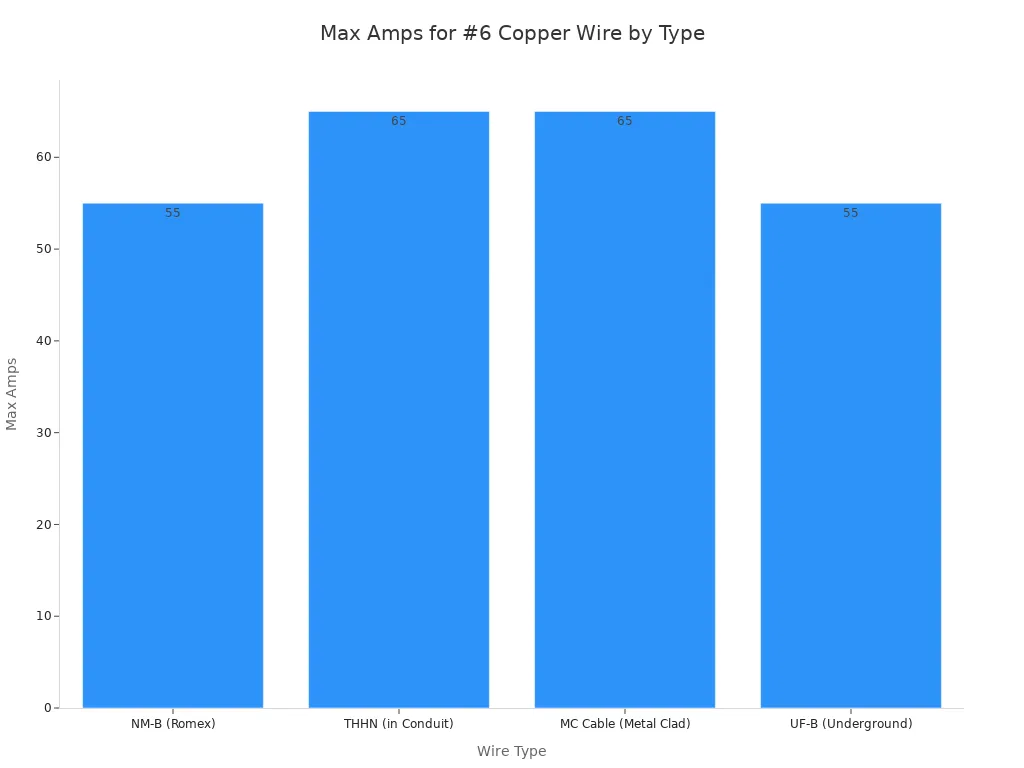
For most home jobs, 6 AWG copper or 4 AWG aluminum is a safe start. The NEC has stricter rules for continuous loads. A 60 amp breaker can only handle a steady current of 48A. This changes the size you need. Always ask a licensed electrician for tricky setups. They use NEC Table 310.16 to match wire insulation types with sizes. They also use derating tables for multiple wires. Knowing these factors helps you make smart choices.

Written by Jack Elliott from AIChipLink.
AIChipLink, one of the fastest-growing global independent electronic components distributors in the world, offers millions of products from thousands of manufacturers, and many of our in-stock parts is available to ship same day.
We mainly source and distribute integrated circuit (IC) products of brands such as Broadcom, Microchip, Texas Instruments, Infineon, NXP, Analog Devices, Qualcomm, Intel, etc., which are widely used in communication & network, telecom, industrial control, new energy and automotive electronics.
Empowered by AI, Linked to the Future. Get started on AIChipLink and submit your RFQ online today!
Frequently Asked Questions
Can I use the same wire size for any 60 amp breaker?
No. The current rating changes with different cables. NM-B cable uses the 60°C column. You need 4 AWG copper for NM-B. THHN wire uses the 75°C column. 6 AWG copper works there.
What happens if you pick the wrong size wire for a 60 amp breaker?
The wire overheats under load. The proper size prevents overheating. Circuit breakers may not trip fast enough. Always match your wire ampacity to the calculated load.
Does the local electrical code affect the size of wire you need?
Yes. Your local electrical code may add stricter rules. Check with your building department. The NEC sets minimums. Your area can require larger wire or different materials.
How does temperature affect wire ampacity for a 60 amp circuit?
High ambient temperatures reduce ampacity. Apply correction factors from the NEC table for circuit breakers. Consider the size of your wire carefully. A 6 AWG copper wire may need upsizing for high current loads in hot environments.
Can I use aluminum wire for a 60 amp subpanel?
Yes. Use 4 AWG aluminum wire for runs under 100 feet. Apply anti-oxidant paste. Tighten connections with a torque wrench. Aluminum costs less than copper.