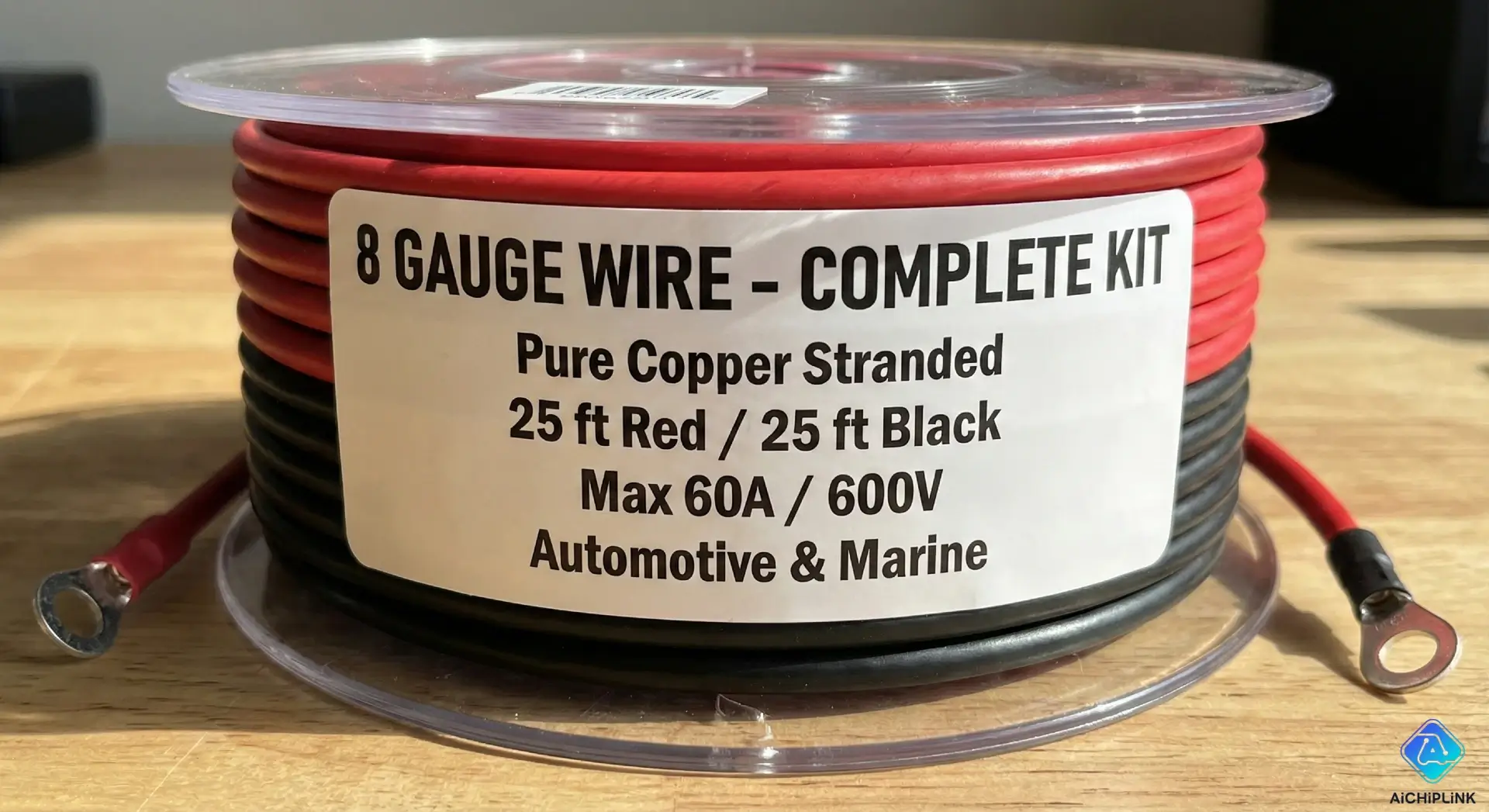
The article compares copper versus aluminum materials, outlines factors that reduce performance—such as voltage drop over long distances—and lists common use cases including electric ranges, hot tubs, and EV chargers, all while emphasizing adherence to NEC safety codes.
Key Takeaways
- Ampacity Standard: 8 gauge copper wire is typically rated for 50 Amps in residential settings (based on the 75°C column of NEC tables).
- Best Applications: It is the "sweet spot" for heavy-duty appliances, including electric ovens, hot tubs, 50A sub-panels, and Level 2 EV chargers.
- Breaker Sizing: Always pair 8 gauge copper wire with a 40-amp or 50-amp circuit breaker. Do not use a 60-amp breaker, as it exceeds the safe limit.
- Watch the Distance: For wire runs longer than 60-70 feet carrying a full load, consider upgrading to 6 gauge wire to avoid issues with voltage drop.
- Material Matters: Copper is preferred over aluminum for its superior conductivity and durability; 8 gauge aluminum wire has a lower ampacity rating (30-40 amps).
Introduction
When planning an electrical project—whether it's wiring a sub-panel, installing a hot tub, or upgrading a car audio system—choosing the correct wire size is critical. Among the most versatile sizes in the American Wire Gauge (AWG) system is the 8 gauge wire.
But how much power can it actually handle?
The Short Answer: Generally, 8 gauge copper wire is rated to carry between 40 and 55 amps, depending on the temperature rating of the insulation. Aluminum 8 gauge wire is rated lower, typically between 30 and 45 amps.
In this guide, we will break down everything you need to know about 8 gauge wire, including detailed NEC ampacity charts, physical dimensions, material differences, and common applications.
8 Gauge Wire Ampacity
The "ampacity" (amperage capacity) is the maximum amount of current a wire can carry before it overheats. This is the most critical specification for safety.
Ampacity Ratings (NEC 310.16)
The National Electrical Code (NEC) provides the standard baseline for wire ampacity. The allowable current depends heavily on the insulation type (measured by its temperature rating).
Here is the standard ampacity for 8 AWG Wire (carrying current in a raceway, cable, or earth):
| Insulation Temp Rating | Insulation Types | Copper Ampacity | Aluminum Ampacity |
|---|---|---|---|
| 60°C (140°F) | TW, UF | 40 Amps | 30 Amps |
| 75°C (167°F) | THW, THWN, RH | 50 Amps | 40 Amps |
| 90°C (194°F) | THHN, THWN-2, XHHW-2 | 55 Amps | 45 Amps |
Key Takeaway on NEC Guidelines
While 8 gauge copper wire can technically handle 55 amps at 90°C, circuit breakers usually limit the termination temperature to 75°C. Therefore, in most residential applications, you should treat 8 gauge copper wire as being rated for 50 Amps.
8 Gauge Wire Physical Properties
Understanding the physical size of the wire helps in planning conduit sizes and understanding flexibility.
Size and Dimensions
"Gauge" works in reverse: the smaller the number, the thicker the wire. 8 AWG is thicker than 10 AWG but thinner than 6 AWG.
- Diameter (Solid): Approx. 3.26 mm (0.1285 inches).
- Area: 8.37 mm².
- Resistance: 0.6282 Ohms per 1000 ft (for copper).
Copper vs. Aluminum
You will encounter both materials on the market.
- Copper: The gold standard. It is more conductive, meaning it can carry more current in a smaller diameter. It is also more durable and resistant to corrosion.
- Aluminum: Lighter and cheaper, but less conductive. As shown in the chart above, an 8 gauge aluminum wire carries significantly less power than an 8 gauge copper wire. It also requires special anti-oxidant paste at connection points to prevent overheating.
Ampacity Factors: What Reduces Performance?
The "50 Amp" rule of thumb isn't absolute. Several factors can reduce (derate) the capacity of your wire.
1. Temperature Ratings
The environment matters. If the wire is installed in a hot attic or near machinery where the ambient temperature exceeds 86°F (30°C), you must "derate" the wire, meaning it can carry fewer amps safely.
2. Wire Length & Voltage Drop
All wires have internal resistance. Over long distances, this resistance causes Voltage Drop, resulting in power loss and potential equipment damage.
- The Rule: If your run is longer than 100 feet, consider upgrading to the next size up (6 gauge) to keep voltage drop under 3%.
3. Installation Conditions
- Conduit Fill: If you pack too many current-carrying wires into a single conduit, heat cannot escape. You must reduce the allowable ampacity per NEC tables.
8 Gauge Wire Uses
Due to its ability to handle 40-50 amps, 8 AWG wire hits the "sweet spot" for high-power residential and hobbyist applications.
Residential Wiring
- Electric Ranges & Ovens: Commonly used for 40-amp electric stove circuits.
- Hot Tubs & Spas: A standard choice for wiring hot tub heaters.
- Sub-Panels: Frequently used to feed small sub-panels (e.g., in a garage or shed) requiring 40-50 amps of service.
- EV Chargers: Suitable for Level 2 Electric Vehicle chargers running on a 40A breaker.
Automotive & Audio
- Car Audio: 8 gauge is the entry-level standard for powering medium-sized amplifiers and subwoofers.
- Battery Relocation: Used for grounding wires or battery leads in custom automotive work.
Solar & Battery Systems
In off-grid solar setups, 8 AWG is often used to connect solar panel arrays to charge controllers, or charge controllers to battery banks, due to its low resistance and high efficiency.
Safety & Installation
Working with electricity carries inherent risks. Proper installation ensures your system lasts and your property remains safe.
Code Compliance
Always adhere to the National Electrical Code (NEC) and your local municipal amendments. Local codes always take precedence over general guides.
Best Practices
- Breaker Sizing: For 8 gauge copper wire, use a 40-amp or 50-amp circuit breaker. Do not use a 60-amp breaker, as this could allow more current than the wire can safely handle, risking a fire.
- Stranded vs. Solid: Use stranded wire if you are pulling through conduit (it is more flexible). Use solid wire for structural wiring where the wire won't move once installed.
- Color Coding: Ensure you use the correct color jackets (Black/Red for hot, White for neutral, Green/Bare for ground).
Conclusion
8 Gauge wire is a powerhouse in electrical installations, bridging the gap between standard household wiring and heavy-service entrance cables. With a typical capacity of 40-55 Amps for copper, it is the go-to choice for heavy appliances like ovens, hot tubs, and EV chargers.
Summary:
- Ampacity: ~50 Amps (Copper, 75°C rating).
- Material: Copper is preferred over aluminum for conductivity.
- Safety: Always account for voltage drop on long runs.
Final Thought: While this guide provides the standards, every electrical environment is unique. If you are unsure about your specific load calculations or local codes, always consult a professional electrician.

Written by Jack Elliott from AIChipLink.
AIChipLink, one of the fastest-growing global independent electronic components distributors in the world, offers millions of products from thousands of manufacturers, and many of our in-stock parts is available to ship same day.
We mainly source and distribute integrated circuit (IC) products of brands such as Broadcom, Microchip, Texas Instruments, Infineon, NXP, Analog Devices, Qualcomm, Intel, etc., which are widely used in communication & network, telecom, industrial control, new energy and automotive electronics.
Empowered by AI, Linked to the Future. Get started on AIChipLink.com and submit your RFQ online today!
Frequently Asked Questions
What size breaker should I use for 8 gauge wire?
For 8 AWG Copper wire, you should generally use a **40-amp or 50-amp circuit breaker**. While the wire can handle up to 55 amps in certain conditions, standard 75°C terminals limit the safe capacity to 50 amps. Never use a breaker larger than the wire's ampacity rating.
Can I use 8 gauge wire for a 60 amp circuit?
**No.** 8 gauge copper wire is typically rated for a maximum of 55 amps (at 90°C), but usually limited to 50 amps in residential settings. For a 60 amp circuit, you must upgrade to **6 gauge wire** or larger to ensure safety and code compliance.
Is 8 gauge wire thick enough for a sub-panel?
Yes, 8 gauge wire is excellent for a small sub-panel, such as one in a detached garage or workshop. It can comfortably support a **50-amp sub-panel**, which is sufficient for lights, outlets, and a few power tools.
How far can I run 8 gauge wire with 50 amps?
If you are running the full 50 amps, you can go approximately **60 to 70 feet** before voltage drop becomes a concern. If your run is longer than 70 feet, you should consider upsizing to 6 gauge wire to prevent power loss and equipment strain.
What is the difference between 8/2 and 8/3 wire?
The numbers refer to the current-carrying conductors. **8/2** has two conductors (black, white) plus a ground; it is used for 240V circuits without a neutral (like some motors). **8/3** has three conductors (black, red, white) plus a ground; it is used for 120V/240V appliances like dryers and ranges that need both hot and neutral wires.