Key Differences Between Carbon Film and Metal Film Resistors
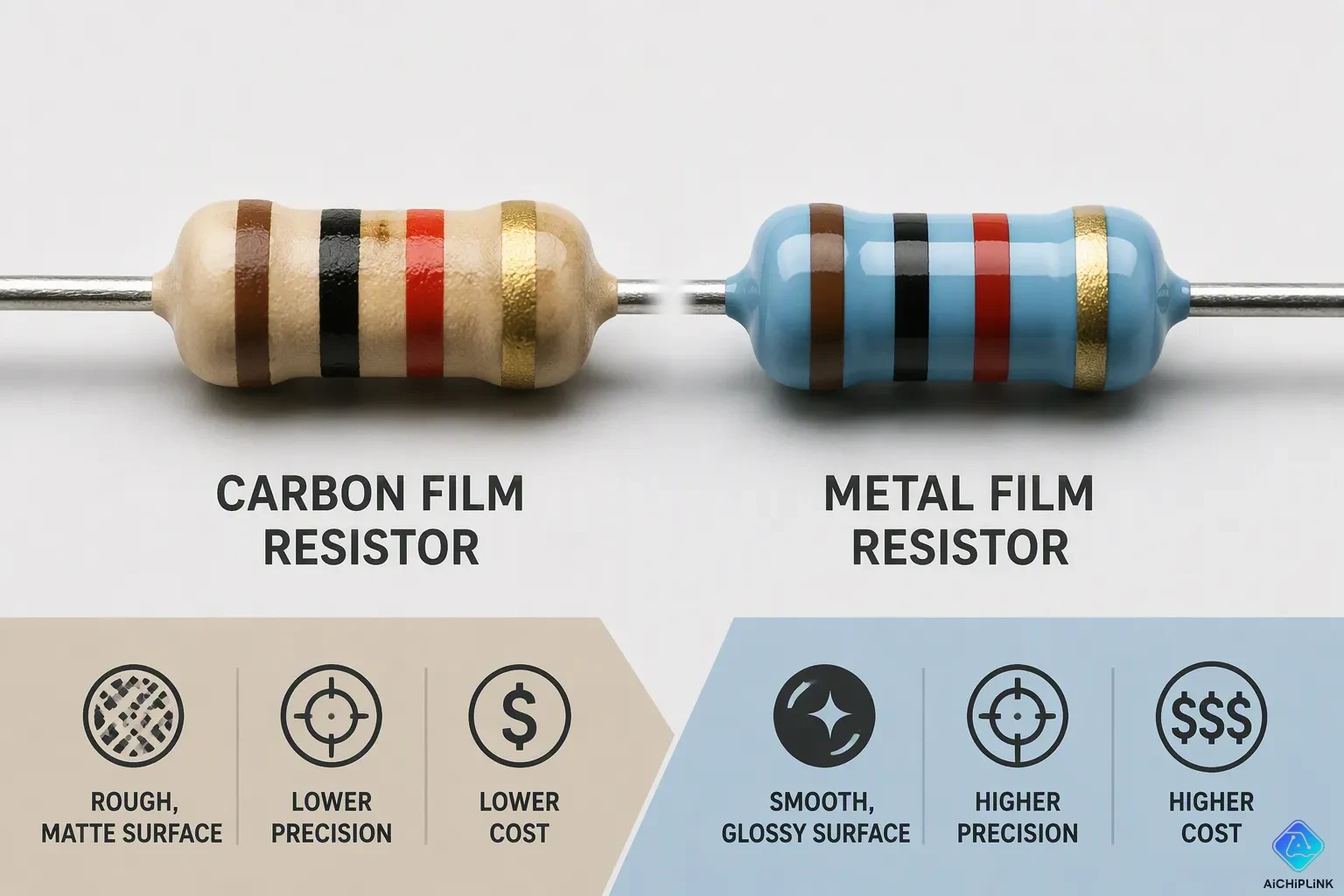
When you start a new electronics project, you face a common choice: which resistor type to pick. You have two main options. A carbon film resistor is cheap and works well for general tasks. A metal film resistor gives better accuracy, steadiness, and less noise, but it costs more. This carbon film resistor vs metal film resistor comparison matters for how your circuit performs. How do you decide which one fits your needs? This guide helps you choose by looking at build, performance, and best uses. The carbon film vs metal film resistors debate often confuses beginners. Comparing carbon film vs metal film shows clear gaps in performance. When you weigh carbon film resistor vs metal film, you'll see differences in noise and stability. The carbon film resistor vs metal film choice depends on what your project needs. These resistors serve different jobs. Both resistors have strengths.
Key Takeaways
-
Carbon film resistors are good for easy jobs like LED current limiting. They are cheaper.
-
Metal film resistors offer more precision and less noise. Choose them for audio circuits.
-
Metal film resistors last longer. Their resistance stays stable for years.
-
Pick the correct resistor for every section of your circuit. Spend less but keep the same quality.
Carbon Film vs. Metal Film Resistors: Construction
When you compare carbon film vs metal film resistors, how they are built shows why they work differently. The material used is the main reason for all other differences. Both types do the same basic job, but they use different materials.
How Carbon Film Resistors Are Made
Makers start with a ceramic core. They add a thin carbon film using vacuum evaporation. This makes a layer that is not even in thickness or density. Then, they cut spiral grooves into the film. These grooves are coarse and have fewer turns. They set the final resistance value. This build method leads to performance gaps.
The way they are made limits how exact they can be. The tolerance is only ±5% to ±10%. Carbon film also does not handle heat well. Grooves reduce the area that lets heat escape. This makes the resistor more sensitive to temperature changes. The TCR for a carbon film resistor is usually between ±100 and ±300 ppm/°C. That means resistance changes a lot with heat. The groove pattern gives it lower inductance than metal film types. This resistor has low parasitic inductance. These traits make it good for general use.
How Metal Film Resistors Are Made
A metal film resistor uses a similar process, but with a metal alloy. The resistive layer often uses nichrome or tantalum nitride. Both can handle high melting points. They also resist oxidation well. The film is added using sputtering, not simple evaporation. Sputtering creates a dense, even alloy film. This gives metal film resistors great long-term stability. Resistance drift stays under 1% after five years. A carbon film resistor can drift over 5% in the same time because it oxidizes and flakes.
The build uses finer grooves with more turns. This raises inductance a little. The effect is small in low-frequency and most mid-frequency uses. The temperature coefficient for nichrome is 0.00005 K⁻¹. This allows steady performance across different temperatures. Some types add titanium oxide to help stability. This lowers the TCR to within ±150 ppm/°C. The build difference explains why metal film gives better accuracy. A metal film resistor also offers better stability.
The material choice is the main reason for all performance differences between these resistors. Knowing this carbon film vs metal film build helps you pick the right one for your circuits.
Carbon Film vs. Metal Film: Key Performance Specs
Once you see how they are built, you can understand why these two resistor types work so differently. The material they are made of decides every important spec. When you compare carbon film vs metal film resistors, the differences in performance are easy to see. These differences affect how accurate, stable, and quiet your circuit is. Let's look at the key specs that set these parts apart.
Tolerance and Temperature Coefficient
Tolerance tells you how close the real resistance can be to the labeled value. Carbon film resistors usually have a tolerance of ±5% to ±10%. Some types go as high as ±20%. This wide range means a 100-ohm carbon film resistor could actually be anywhere from 90 to 110 ohms. For many simple circuits, that variation is fine. But for precise work, it causes issues.
Metal film resistors give much tighter control. Standard metal film types reach ±1% tolerance. High-precision versions go to ±0.1% or even ±0.01%. The way they are made allows this. A vacuum-deposited metal alloy film gives exact control during production. Precision spiral cutting hits exact resistance values. You get steady performance from one part to the next.
Temperature coefficient of resistance (TCR) measures how much resistance changes with heat. Carbon film resistors have a TCR of ±100 to ±300 ppm/°C. Some carbon types reach ±1500 ppm/°C. This means a 1kΩ carbon film resistor can shift by 0.3 ohms for each degree Celsius change. Metal film resistors do much better. Their TCR ranges from ±10 to ±50 ppm/°C. This steadiness matters when your circuit works in changing temperatures.
| Parameter | Carbon Film Resistor | Metal Film Resistor |
|---|---|---|
| Standard Tolerance | ±5% to ±10% | ±1% (precision: ±0.1% to ±0.01%) |
| Typical TCR | ±100 to ±300 ppm/°C | ±10 to ±50 ppm/°C |
| Voltage Coefficient | 10–50 ppm/V | <10 ppm/V |
The voltage coefficient of resistance (VCR) shows another difference. VCR measures how resistance changes when voltage changes. Carbon film resistors have a VCR of 10 to 50 ppm/V. This poor performance makes them prone to nonlinearity at high voltages. Metal film resistors stay under 10 ppm/V. Some special parts reach 0.1 ppm/V. This matters in high-voltage circuits where resistance drift would hurt accuracy.
Noise, Stability, and Frequency Response
Noise performance separates these two resistor types a lot. Carbon film resistors make more thermal noise and excess noise than metal film types. The uneven carbon layer causes more electrical disturbance. Metal film resistors make noise below 0.1 μV/√Hz. This low noise makes them perfect for audio paths and sensitive measurement circuits.
Long-term stability also favors metal film. A carbon film resistor can drift over 5% after five years because it oxidizes and flakes. Metal film resistors keep resistance drift under 1% over the same time. The dense, even alloy film resists oxidation well. Your circuit keeps its calibration much longer.
Frequency response depends on stray inductance and capacitance. Carbon film resistors have lower inductance because of their coarse groove pattern. This property makes them useful in some high-frequency uses. Metal film resistors use finer grooves with more turns. This raises inductance a little. The effect is small in low-frequency and most mid-frequency uses. For very high frequencies, you might pick carbon film for this reason.
Temperature stability affects both types differently. Carbon film resistors do not handle heat well. The grooves reduce the area that lets heat escape. This makes the resistor more sensitive to temperature changes. Metal film resistors handle heat better. Nichrome's temperature coefficient of 0.00005 K⁻¹ allows steady performance across different temperatures. Some metal film types add titanium oxide to improve stability further.
These performance properties guide your choice. When you look at carbon film resistor vs metal film options, think about what your circuit needs. The carbon film resistor vs metal film decision often comes down to noise and stability requirements. Understanding these specs helps you pick the right part for each job.
Choosing Between Carbon Film Resistor vs. Metal Film Resistor
You now know how these resistors are built and how they perform. The next step is using that knowledge in your own project. This choice comes down to a simple trade-off between cost and performance. You need to think about what your circuit needs and where you can accept less. Let's go through a simple guide that helps you pick the right one.
When Carbon Film Resistors Are the Right Choice
Carbon film resistors work fine in many everyday uses. You should choose them when your circuit does not need high accuracy or low noise. Think about LED current limiting, basic voltage dividers, pull-up and pull-down networks, or power supply shunt applications. These circuits handle resistance changes without any real problem. A ±5% tolerance rarely causes issues in these jobs.
Cost drives many choices here. A carbon film resistor costs about one-third to one-fifth of what you pay for a metal film resistor when buying in bulk. When you build hundreds of boards, that difference adds up fast. You can save real money without losing function in non-critical paths. The lifespan data backs this choice too. Carbon film resistors usually last between 10,000 and 50,000 hours in general-purpose circuits. That range covers most consumer electronics and hobbyist projects well.
You should also think about carbon film for some high-frequency uses. Their coarser groove pattern creates lower inductance than metal film types. This makes them useful in some RF and high-speed switching circuits where parasitic inductance matters more than precision. The carbon film resistor vs metal film trade-off here favors carbon for its lower reactance.
However, you must accept the downsides. A carbon film resistor can drift up to ±5% after 10,000 hours of use. Oxidation and flaking cause this wear over time. If your device runs in hot or humid places, that drift speeds up. You should avoid carbon film in circuits where long-term calibration matters. The carbon film vs metal film resistors comparison shows clear gaps in stability and noise performance.
When Metal Film Resistors Are Worth the Cost
Metal film resistors earn their higher price when accuracy and stability directly affect your circuit's performance. You should invest in them for precision analog front ends, ADC and DAC input stages, amplifier bias networks, and voltage reference circuits. In these spots, a ±1% tolerance standard (or ±0.1% for high-precision parts) directly improves your system accuracy. A carbon film resistor's ±5% to ±10% variation would cause unacceptable errors in these sensitive nodes.
Audio applications demand metal film resistors for another reason: noise. Carbon film resistors produce current noise between 0.5 and 1 μV/√Hz. Metal film resistors keep that number below 0.1 μV/√Hz. When you amplify weak signals from sensors or microphones, that noise difference becomes audible or measurable. You cannot fix noise after it enters your signal path. Picking the right resistor from the start prevents this problem.
Long-term reliability also favors metal film. These resistors last between 50,000 and 100,000 hours in similar environments. Their resistance drift stays under 1% after five years, compared to over 5% for carbon film. Industrial equipment and precision instruments run for decades. You need parts that keep their specs throughout that service life. A metal film resistor delivers that durability.
Temperature stability matters in many designs. Metal film resistors keep their resistance across temperature changes with TCR ratings of ±10 to ±50 ppm/°C. This stability stops circuit performance from changing when your device heats up or runs outdoors. The carbon film resistor vs metal film decision becomes clear when your application faces temperature extremes.
You can also use a mixed approach. Use metal film resistors at critical points where precision matters. Use carbon film resistors for non-critical jobs like LED current limiting or basic signal blocking. This method cuts your overall resistor costs by 10% to 30% while keeping performance where it counts. You balance your bill of materials without hurting your design's quality.
The carbon film resistor vs metal film resistor choice ultimately depends on your priorities. Look at your accuracy needs, noise sensitivity, operating environment, and budget. Match the resistor type to each spot in your circuit. That careful approach ensures your project works as intended without extra cost.
You now have the facts to decide between these resistors. The choice balances cost against performance. For most hobbyist and general-purpose projects, carbon film resistors work perfectly well. A carbon film resistor handles LED current limiting and basic voltage dividers without issues. However, for precision circuits, audio applications, or designs requiring high stability and low noise, a metal film resistor is the better investment. The carbon film resistor vs metal film decision comes down to your project's specific needs. Assess your accuracy requirements, noise sensitivity, and budget. Understanding the carbon film vs metal film resistors comparison helps you choose with confidence. The carbon film resistor vs metal film trade-off is clear. Pick the right resistors for each part of your circuit.

Written by Jack Elliott from AIChipLink.
AIChipLink, one of the fastest-growing global independent electronic components distributors in the world, offers millions of products from thousands of manufacturers, and many of our in-stock parts is available to ship same day.
We mainly source and distribute integrated circuit (IC) products of brands such as Broadcom, Microchip, Texas Instruments, Infineon, NXP, Analog Devices, Qualcomm, Intel, etc., which are widely used in communication & network, telecom, industrial control, new energy and automotive electronics.
Empowered by AI, Linked to the Future. Get started on AIChipLink and submit your RFQ online today!
Frequently Asked Questions
Can I Use Carbon Film Resistors in Audio Circuits?
Carbon film resistors make more noise than metal film types. In audio circuits, you can hear this noise. Pick metal film for audio paths. A carbon film resistor is fine for non-critical power supply filtering.
Which Resistor Type Offers Better Long-Term Stability?
Metal film resistors last much longer. Their resistance drifts under 1% after five years. Carbon film types can drift over 5% in the same time. Choose metal film for long-life equipment.
Do These Resistor Types Use Different Color Codes?
Both resistor types use the same standard color code. You read the bands the same way. The difference lies in performance, not in marking. A 100-ohm resistor looks identical regardless of the material inside.
What Happens If I Mix Both Types in One Circuit?
Mixing both types works fine in most circuits. Use metal film resistors where precision matters. A carbon film resistor works for non-critical jobs like LED current limiting. This approach saves money.
Are Metal Film Resistors Always the Better Choice?
A carbon film resistor works well for general-purpose tasks. It costs less than metal film. A carbon film resistor handles LED current limiting without issues. Save metal film for precision circuits.