Best Cell Phone Booster Antennas for Home and Vehicle
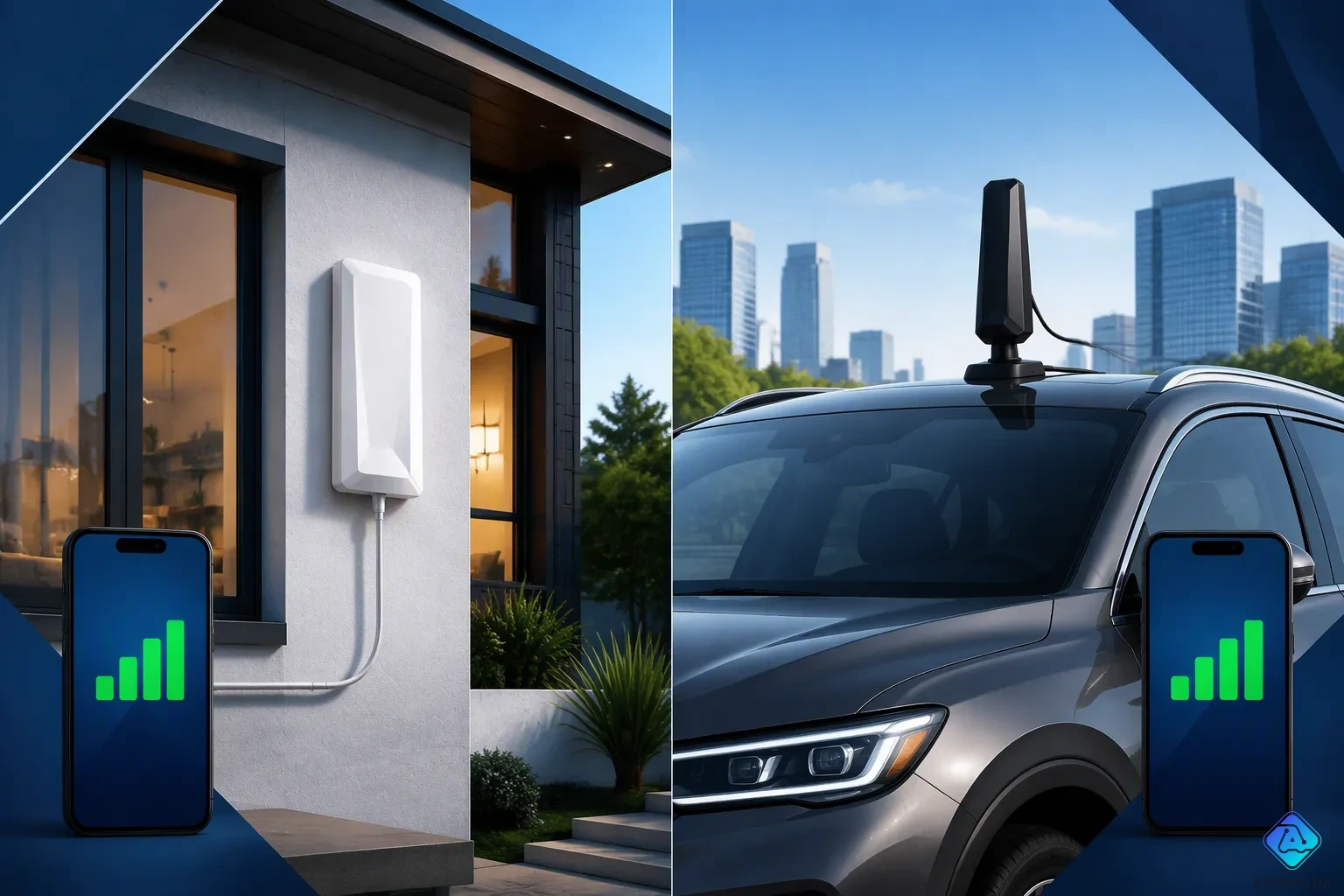
You want better reception right now. The weBoost Home MultiRoom is best for your house, and the weBoost Drive Reach is best for your car. These two systems top our tested lineup.
A cell phone antenna by itself does not boost anything. You need a full cell phone booster system. The amplifier and your existing outside signal create real performance.
We tested weBoost, SureCall, HiBoost, and Cel-Fi gear in real places. Our goal is simple: match you with the right cell phone antenna for your space, not the most expensive one.
Whether you need cell phone signal boosters for homes, vehicles, and commercial buildings, the right setup starts with your environment.
Key Takeaways
-
Use the weBoost Home MultiRoom for your home. Use the weBoost Drive Reach for your car.
-
A cell phone antenna by itself does not make your signal stronger. You need a whole booster system for that.
-
Pick a directional antenna if your signal is weak. Pick an omnidirectional antenna for cities and vehicles.
-
A booster needs at least some signal from outside to work. Check how strong your signal is before you buy one.
Top Picks at a Glance
Best Cell Phone Booster for Home
The weBoost Home MultiRoom is our top choice for home use. This cell phone booster gives strong indoor signal to many rooms. It works with 5G and 4G LTE on all major U.S. carriers. Verizon, T-Mobile, and AT&T customers can use this system without problems.
The Home MultiRoom works best if you already have some outside signal. It makes that signal stronger and spreads it around your home. Installation takes a few hours for most homeowners. You place an outdoor antenna, run cable inside, and set up the indoor unit where you need coverage most.
Best Vehicle Cell Phone Booster
The weBoost Drive Reach is our top choice for your vehicle. This vehicle cell phone booster gives up to 50 dB gain. That is the highest gain allowed by the FCC. It costs less than many other boosters with weaker performance.
The Drive Reach works well because of its uplink power. Here is what the specs show:
The Drive Reach has uplink output power of 29.5 dBm and 50 dB gain – the highest gain allowed by FCC rules. This lets it boost signal from places more than twice as far from cell towers than older models.
This vehicle signal booster works with 5G and 4G LTE for Verizon, T-Mobile, AT&T, and most other carriers. It comes with a magnetic roof antenna that sets up in minutes. The booster works while you drive, so your calls and data stay connected on the road.
Both picks have one thing in common: they work with the carriers you already use. You do not need to change carriers. You just need a good antenna and amplifier that work together.
If you want the best low-cost cell booster for one person, the SureCall N-Range 2.0 offers a cradle-style design with 23 dB gain. But for most drivers, the Drive Reach gives the strongest mobile reception you can get.
Best Cell Phone Boosters for Home
Best for Weak Signal Areas
You live far from town. Your phone shows one bar or no bars. A high-gain directional Yagi antenna with a strong amplifier is your best choice. The weBoost Home MultiRoom and the SureCall Fusion4Home both work well with this setup. These home signal boosters take weak cell signals from far away and send them through your indoor antenna.
A directional Yagi antenna points at the closest cell tower. This narrow focus gives you the best signal capture in rural areas. The SureCall blog says that -91 dBm is the weakest outdoor signal a directional Yagi antenna can use to boost a poor rural signal. Look at this table to see where your location fits:
| Signal Strength Range (dBm) | Recommendation |
|---|---|
| -91 to -105 | Requires a directional antenna (narrow focus) |
| -106 to -135 | Requires a directional antenna with a stronger booster (e.g., Fusion5X) |
Signals above -91 dBm are usually strong enough for an omnidirectional antenna. Signals below -135 dBm are too weak for any booster. So -91 dBm is your limit. If your outdoor signal is at or below that level, you need a directional antenna.
The weBoost Home MultiRoom gives targeted indoor coverage for up to 3 large rooms. That is about 5,000 square feet in a one-story home. This cell phone booster works with 5G and 4G LTE on Verizon, T-Mobile, and AT&T. You get a multi-carrier booster for many users in your home.
Best for Urban and Suburban Homes
You live in a neighborhood with good outside signal. You want easy setup and wide coverage. An omnidirectional antenna is your answer. The Cel-Fi GO G41 and HiBoost Home 10K both use omnidirectional antennas. These antennas pick up signal from all directions. You do not need to point them at a tower.
Directional antennas need to point at the closest cell tower. Omnidirectional antennas pick up signal from all directions. This difference matters for your antenna mount. A directional setup needs careful pointing. An omnidirectional setup goes up and works right away.
Urban and suburban homes are often near many cell towers. An omnidirectional antenna takes signals from all nearby towers. This gives you steady coverage without constant adjustment. The Cel-Fi GO G41 and HiBoost Home 10K both work as a multi-carrier booster. They support many users on different carriers at the same time.
Your outdoor antenna placement still matters. Mount it on your roof or a high wall. Keep it away from metal objects and trees. Your indoor antenna goes in the room where you need coverage the most. Run the coax cable between them. A good cell phone antenna makes a big difference in your final result.
Both antenna types work with a quality cell phone booster. Your choice depends on your outside signal strength and how willing you are to aim. Rural users need directional antennas. Urban and suburban users get better results from omnidirectional antennas. Match your antenna to your environment and you will see real improvement.
Best Vehicle Cell Phone Boosters
Best for Cars and Trucks
The weBoost Drive Reach is the best vehicle cell phone booster for most cars and trucks. It delivers up to 50 dB gain, the FCC maximum for an inside antenna in a vehicle. Its magnetic roof antenna sets up in minutes. You get a strong cell phone antenna without drilling holes or hiring an installer.
The Drive Reach works as a multi-carrier booster. It supports Verizon, T-Mobile, AT&T, and most other carriers. You keep your current plan and your current phone. The system simply makes your existing signal stronger.
Budget matters for many drivers. The SureCall N-Range 2.0 is the best budget cell booster for a single user. This cradle-style car booster gives +23 dB gain. The FCC sets that exact limit for direct contact coupling, so the N-Range 2.0 sits right at the legal ceiling for its design. You place your phone in the cradle. The booster couples directly to your device.
Here is how the FCC caps gain across vehicle booster configurations:
| Booster configuration | Maximum gain |
|---|---|
| Inside antenna (e.g., inside a vehicle) | 50 dB |
| Direct contact coupling (e.g., cradle-type boosters) | 23 dB |
| Directly connected (e.g., physical connection to the phone) | 15 dB |
A truck cell phone booster faces the same rules. The Drive Reach fits pickup trucks, SUVs, and vans with equal ease. A truck cell phone booster needs rugged hardware and steady power. The Drive Reach runs on 12V power from your dash outlet.
Best for RVs and Overlanding
The weBoost Drive Reach OTR is the top pick for RVs and overlanding rigs. It delivers an industry-leading uplink power of 25.4 to 26.9 dBm. That power sends signal to cell towers twice as far away compared to older boosters.
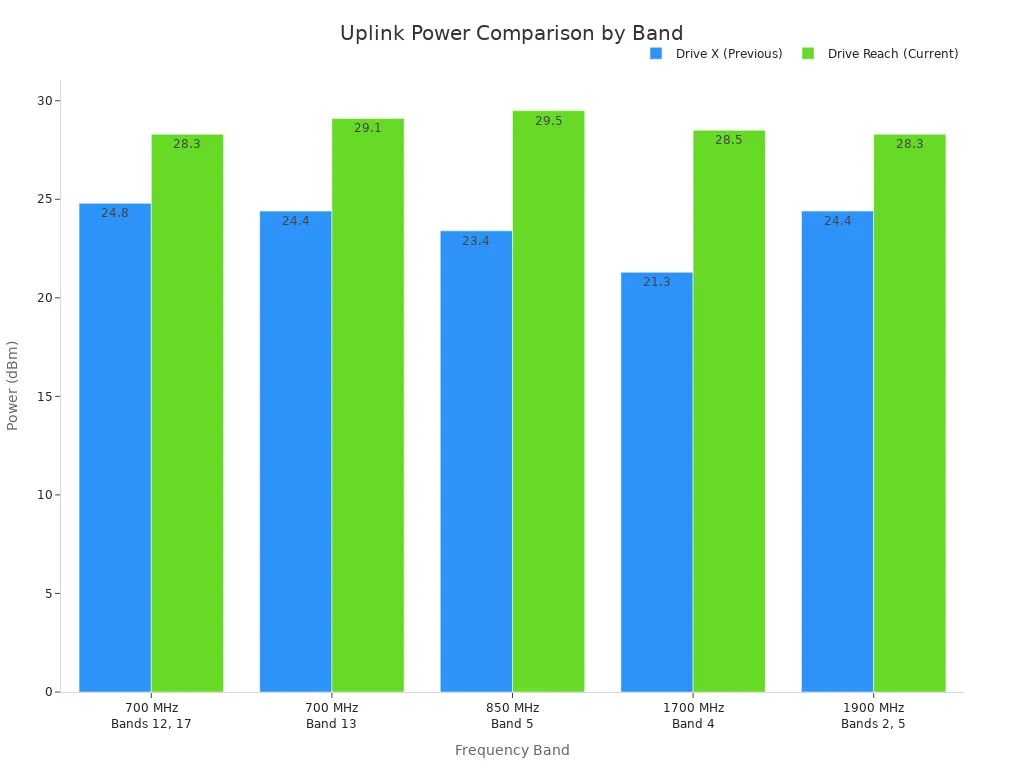
The increase in uplink power to 29.5 dBm doubles the range of the Drive Reach over previous booster models. This is a significant improvement allowing you to reach cell towers from twice as far compared to previous models like the Drive X.
The numbers back that claim. The Drive Reach averages 28.7 dBm uplink power across five bands. The older Drive X averages 23.7 dBm. That is a +5.0 dBm average jump. On the 1700 MHz band alone, the gain climbs +7.2 dBm.
This weak signal vehicle booster works with Verizon, T-Mobile, AT&T, and most other carriers. You drive remote highways and stay connected. You park at a campsite far from town and still make calls.
Vehicle cell phone boosters typically use omnidirectional antennas. These antennas capture cell signals from every direction. You never stop to aim them. That matters when you drive through changing terrain. An omnidirectional antenna mount on your roof keeps working mile after mile.
Your antenna choice shapes your results. A tall roof antenna grabs more signal than a short one. Keep the coax cable short and free of sharp bends. Mount the antenna away from other antennas on your rig.
Both picks solve the same problem: cell reception and coverage inside vehicles. The Drive Reach serves daily drivers. The Drive Reach OTR serves adventurers. Match the booster to your vehicle and your travels.
How to Choose a Cell Phone Booster
Directional vs. Omnidirectional for Vehicle Cell Phone Boosters
You have a clear choice when you pick an antenna for your vehicle cell phone booster. Directional antennas give you higher gain. They focus on just one cell tower. You need to aim them at that tower. This makes them great for home use. You mount the outdoor antenna once and point it the right way.
Omnidirectional antennas work better in a vehicle. They pick up cell signals from all directions. You never have to stop and adjust them. This helps when you drive through changing terrain. Your antenna goes on the roof and works mile after mile. Most vehicle boosters use this setup for a good reason.
Understanding Gain in a Cell Phone Antenna
Gain numbers confuse many buyers. You need to know the difference between dBm and dB. dBm measures absolute signal power. dB measures relative gain or loss. There is no direct way to convert between them. Instead, dB shows the difference between two dBm readings. Going from -95 dBm to -92 dBm is a 3 dB gain.
The FCC limits vehicle boosters to 50 dB gain. This cap affects real-world performance. A multi-carrier booster like the weBoost Drive Reach hits that 50 dB limit. It works well in weak or rural areas. A single-carrier booster like the Cel-Fi GO M can reach 65 dB gain in single-carrier mode. That goes above the FCC limit for multi-carrier use. It works best when everyone in your vehicle uses the same carrier.
Here is how gain translates to real improvement:
| dB Gain | Effect on Signal Power | Impact on Call Clarity |
|---|---|---|
| +3 dB | ~2× signal power | Noticeable improvement; fewer dropped calls |
| +10 dB | ~10× signal power | Significant improvement in voice quality |
| +20 dB | ~100× signal power | Dramatic improvement; near-optimal reception |
dBm means an absolute power level measured in decibels, with reference to 1 milliwatt (mW). Since dB is a relative unit and dBm is absolute, there is no direct dBm-to-dB conversion — dB simply shows the difference between two dBm readings.
Most modern cell phone boosters support 5G and 4G LTE. Always check carrier compatibility before you buy. A cell phone antenna that matches your carrier and environment gives you the best results.
Installation and Real-World Effectiveness
How Hard Is It to Install a Booster Antenna?
You can set up most home systems on your own. You mount an outdoor antenna, run coax cable, and place an indoor antenna. Vehicle setup is often easier. Magnetic mounts and 12V power make it fast to install.
Most cell phone signal booster systems come as self-installed kits with instructions included. If you have a ladder, a power drill, and basic tools, you can finish the job yourself. It usually takes a few hours, depending on the kit and how complex it is. For many people, the hardest part is pulling the coax cables through walls to reach the booster and the inside antenna(s).
Where you mount your antenna matters more than the brand you choose. A vehicle booster with a magnetic roof antenna takes just minutes to set up. A home multi-carrier booster needs careful outdoor antenna placement and a clean cable run.
Will a Booster Antenna Fix My Bad Signal?
A cell phone booster needs at least some outside signal to make it stronger. It cannot create signal where there is none. Check your outdoor signal strength before you buy. A booster works best when the outdoor signal is above -100 dBm, as signals below that are considered very poor or no usable signal.
A high-quality cell phone booster may fix bad service. How well it works depends on installation quality and your environment. Poor cable routing or a bad antenna mount can ruin your results. Vehicle boosters and home cell phone boosters both need a clean signal path. Match your antennas to your environment and you will see real improvement.
The weBoost Home MultiRoom remains your best home pick. The weBoost Drive Reach remains your best vehicle pick. Both deliver strong, reliable performance.
Your environment decides your antenna type. Rural homes need a directional outdoor antenna aimed at a tower. Urban homes and moving vehicles need omnidirectional antennas. That single choice shapes your results more than price.
A quality cell phone booster with the right antenna solves most signal problems. You can fix weak coverage at home. You can fix dropped calls in your vehicle. Pick your antenna to match your space, install it well, and enjoy the bars you deserve.

Written by Jack Elliott from AIChipLink.
AIChipLink, one of the fastest-growing global independent electronic components distributors in the world, offers millions of products from thousands of manufacturers, and many of our in-stock parts is available to ship same day.
We mainly source and distribute integrated circuit (IC) products of brands such as Broadcom, Microchip, Texas Instruments, Infineon, NXP, Analog Devices, Qualcomm, Intel, etc., which are widely used in communication & network, telecom, industrial control, new energy and automotive electronics.
Empowered by AI, Linked to the Future. Get started on AIChipLink and submit your RFQ online today!
Frequently Asked Questions
Do I need a directional or omnidirectional antenna for my home?
The strength of your outside signal decides this. Rural homes with weak signal need a directional antenna aimed at the nearest tower. Urban and suburban homes work better with an omnidirectional antenna that captures signal from all directions. Check your outdoor signal before you buy.
Can a vehicle booster work while I drive?
Yes. Most vehicle boosters use omnidirectional antennas that capture signal from every direction. You never stop to aim them. The weBoost Drive Reach delivers up to 50 dB gain, the FCC maximum, and works mile after mile on the road.
Will a booster help if I have no outside signal?
No. A booster needs at least some existing outside signal to amplify. It cannot create signal where none exists. Check your outdoor signal strength first. For 4G LTE, you need an outdoor signal above -100 dBm for a booster to work.
How long does installation take?
Most home systems take a few hours. You mount an outdoor antenna, run coax cable, and place an indoor antenna. Vehicle setups go faster with magnetic mounts and 12V power. Basic tools and a ladder handle most jobs.
Do boosters support 5G?
Most modern boosters support 5G and 4G LTE. The weBoost Home MultiRoom and Drive Reach both work with Verizon, T-Mobile, and AT&T. Always check carrier compatibility before you buy to ensure your provider is covered.