Qorvo's QPA9510, A Power Amplifier Supporting GSM, UHF, and FM Bands
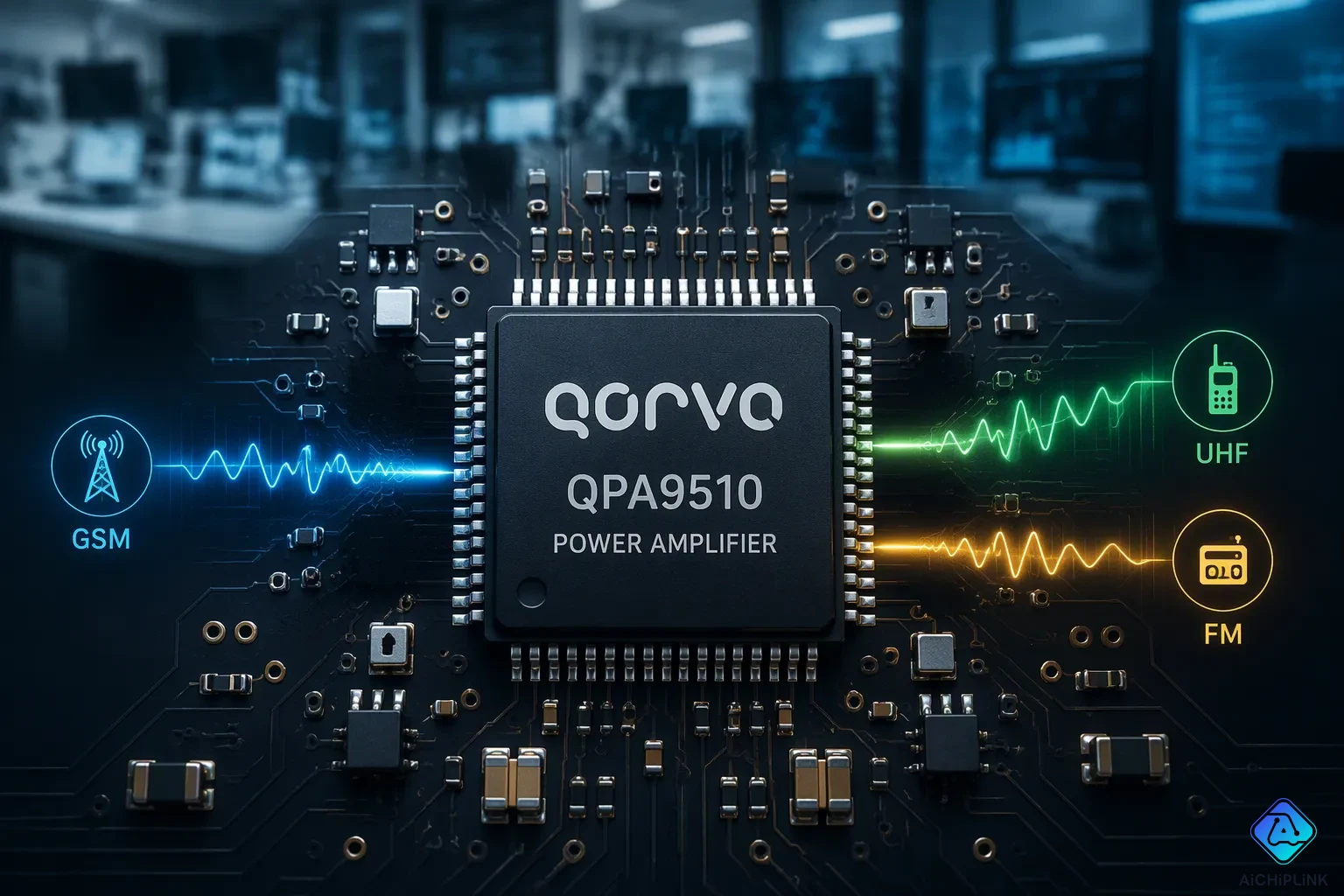
Qorvo's QPA9510 is a sub-1 GHz power amplifier. It covers GSM, UHF, and FM bands with one device. The tunable range runs from 100 MHz to 1 GHz. That range makes the part interesting for multi-band designs.
Engineers can tune the QPA9510 across this wide span. One layout may serve several radio standards. A single board can then cover many markets. The device targets final-stage RF amplification in handheld equipment and other UHF systems.
Qorvo builds the QPA9510 on an advanced GaAs process. The part delivers strong gain and efficiency in a compact package. Designers get a flexible building block for sub-1 GHz radios.
Key Takeaways
-
The QPA9510 amplifier covers 100 MHz to 1 GHz, so one device handles FM, GSM, and UHF bands.
-
It provides up to 34 dB of gain and 55% efficiency, so it is strong and saves energy for battery-powered devices.
-
You can adjust the gain over 70 dB with a simple analog voltage. This gives you precise control for different signals.
-
The evaluation board helps you test each band and quickly copy proven settings to your own design.
-
This one amplifier works in many products, like handsets, smart meters, and public safety radios. That makes your inventory simpler.
Qorvo's QPA9510 at a Glance
Device Overview
Qorvo's QPA9510 is a GaAs power amplifier made with Qorvo's advanced GaAs process. This process gives the device high gain and high efficiency in a small footprint. The part comes in a 3 mm x 3 mm QFN surface-mount package. One supply rail powers it, and it runs from 2.8 V to 4.8 V. That range works well for battery-powered handheld products and fixed radio equipment alike.
Qorvo designed this amplifier as the final RF amplifier in GSM handheld equipment and other UHF applications. The final stage sets the output level that reaches the antenna, so its linearity and efficiency matter a lot. The QPA9510 handles that job with room to spare. It stays linear up to a 1 dB compression point of about +35 dBm. Designers can also shut the device down into a standby mode with a logic-low voltage. That feature saves battery current when the radio sits idle.
The device is a general-purpose amplifier, not a narrowband part tied to one standard. Qorvo tunes it over sub-bands to get the best performance for each target band. Flexible bias settings let the designer trade current draw against linearity. The result is one building block that serves many radio designs.
Tunable 100 MHz to 1 GHz Range
The QPA9510 covers 100 MHz to 1000 MHz. This span reaches the FM broadcast band, the GSM and E-GSM allocations, and the wider UHF range. Few single devices stretch across that much spectrum. Most sub-1 GHz power amplifiers serve one band or a small group of bands. The QPA9510 instead gives the designer room to move.
Tunability makes that range practical. The user adjusts the matching and bias for the specific sub-band of interest. Performance then peaks where the design needs it. A team can reuse the same part across several products and several regional frequency plans. The layout stays mostly the same, and only the tuning values change.
This approach pays off in multi-region products. A public safety radio, a smart utility meter, or a vehicle telematics unit may ship into markets with different allocations. One amplifier design can serve them all. The wide coverage also helps wideband, long-range systems that hop across sub-bands. Engineers gain a single part number to qualify, stock, and support.
Key Power Amplifier Specifications
Gain, Output Power, and Efficiency
The main numbers explain most of what you need to know. Qorvo's QPA9510 gives up to 34 dB of gain and reaches 55% efficiency. Its 1 dB compression point is up to +35 dBm. These numbers apply across the whole 100 MHz to 1 GHz range. The source does not list them by band, so a designer should treat them as typical values for the full range.
| Specification | Value |
|---|---|
| Frequency range | 100 to 1000 MHz |
| Output power (P1dB) | up to +35 dBm |
| Gain | 34 dB maximum |
| Efficiency | 55% |
| Supply voltage | 2.8 to 3.6 V |
| Gain control range | >70 dB (analog) |
High gain at the final stage makes the job easier for earlier stages. A designer can plan a simpler lineup and save board space. The 1 dB compression point marks the edge of linear operation. Signals that go past it distort. The +35 dBm figure gives the designer room to set a backed-off operating point. Efficiency of 55% matters in battery-powered handsets. Less current turns into heat, and more charge reaches the antenna. Single-supply operation from 2.8 to 3.6 V works directly with a three-cell battery. The designer avoids a second rail and the extra biasing and control circuitry that rail would need.
Gain Control and Package
The QPA9510 offers more than 70 dB of analog gain control range. This wide analog gain control range lets the system set transmit power in fine steps. A handset must ramp power up and down when the network commands it. A control span this large covers the full dynamic range a GSM burst needs. The designer adjusts the control voltage and the amplifier follows. Analog gain control keeps the interface simple. No digital bus is needed for level setting.
The device comes in a 3 mm x 3 mm QFN package. This 3 mm x 3 mm QFN package mounts with standard surface-mount reflow. The small outline fits space-constrained designs such as handsets and compact meters. Few external parts surround the die, so the layout stays tight. The source does not specify thermal resistance or mounting details beyond the package style. Designers should confirm thermal performance on their own board with the evaluation hardware. Good grounding under the exposed pad supports both thermal and RF performance. The compact size and wide control range together make the part easy to drop into a new layout.
GSM, UHF, and FM Bands Support
Multi-Band Operation
The 100 MHz to 1 GHz tuning window covers several well-known frequency ranges. At the low end, it includes the FM broadcast band. As you go higher, it covers the GSM and E-GSM cellular bands. The top part reaches the wider UHF range, including the 865 MHz to 928 MHz range that many regional systems use. So one device touches three very different radio worlds.
This coverage makes Qorvo's QPA9510 stand out from narrowband parts. A designer tunes the matching network for specific sub-bands and lets the amplifier work where the product needs it. The same chip serves an FM receiver front end, a cellular handset, or a UHF data radio. Engineers get one part number to qualify and stock across a whole product family.
Design Implications
Multi-region products gain the most from this flexibility. A meter or telematics unit may ship into markets with different frequency allocations. One board layout can serve them all, with only tuning values changing. That approach shortens design cycles and makes inventory simpler. Wideband, long-range systems also fit well here. Smart utility networks often need strong sub-1 GHz radio links across wide areas, and this part delivers the power and gain to support them.
Designers should plan the matching network with care. Each band needs its own tuning for peak performance. GSM performance depends on linearity at the burst power level, while FM and UHF links care more about steady gain and efficiency. The 34 dB of gain and 55% efficiency give room to work across bands. Bench testing on the evaluation board confirms behavior before a design locks in.
Evaluation and Testing
Evaluation Board Role
Qorvo provides an evaluation board for the QPA9510. This board gives engineers a working reference layout for the 3 mm x 3 mm QFN package. It includes the matching network and bias parts the device needs. A designer can power the board and see real performance before committing to a production layout.
The board also makes the tuning cycle shorter. Each target band needs its own matching values. Engineers swap parts on the evaluation board and watch how gain and efficiency change. They can then copy the proven values into their own design. The board acts as a known-good baseline when a new layout acts differently.
Bench Measurement Setup
A basic bench setup covers most checks. The engineer applies a supply voltage within the 2.8 V to 3.6 V range and sets the analog gain control voltage. A signal generator feeds the input, and a power meter or spectrum analyzer reads the output. The engineer sweeps the control voltage to confirm the full gain control range.
Testing should follow the band plan. The engineer tunes the board for one sub-band at a time and records gain, output power at the 1 dB compression point, and efficiency. A sweep across the 100 MHz to 1 GHz window shows where the part works best. The engineer compares results against the datasheet figures, such as the 34 dB gain and 55% efficiency targets. Thermal behavior also deserves a check. The engineer should confirm the exposed pad stays cool enough under sustained drive on the final board.
Availability and Ordering
Ordering Information
Qorvo sells the QPA9510 through its usual distribution channels. Buyers order the part by its full part number and package option. The device comes in the small 3 mm x 3 mm QFN package described earlier. Qorvo also sells the evaluation board as a separate order item. Engineers should order the board along with the first samples. That pairing lets a team check performance before it commits to a production run.
The datasheet has the full specifications. It lists the pinout, the recommended bias values, and the matching guidance for each sub-band. Buyers should read the datasheet before they place a volume order. The document also states the operating conditions and the handling notes for the package. A careful review of the datasheet prevents most layout surprises.
Target Applications
The QPA9510 fits a wide set of sub-1 GHz products. Its single supply and small size suit battery-powered designs. The wide 100 MHz to 1000 MHz coverage lets one amplifier serve several product families. Designers can plan a common RF section across a whole portfolio.
-
GSM cellular handsets, where the part delivers the burst power the standard needs
-
FM radios, which use the low end of the tuning range
-
UHF applications, including public safety radios and RFID readers
-
Smart utility meters and other IoT wireless systems that need long-range links
Public safety radios need reliable output across wide areas. The QPA9510 meets that need with strong gain and efficiency. RFID readers benefit from the steady output the part provides. Smart utility meters gain from the low current draw and the wide tuning window. Each application uses the same device with different matching values. That commonality makes sourcing simpler and shortens qualification work.
Qorvo's QPA9510 is a power amplifier you can tune below 1 GHz. It covers GSM, UHF, and FM bands with up to 34 dB gain and 55% efficiency. One part covers a wide tuning window from 100 MHz to 1 GHz.
The evaluation board helps teams check designs across bands. Engineers can test each sub-band and copy proven matching values into production layouts. The board shortens the tuning cycle and confirms real performance.
Readers can find ordering details and full specifications in the datasheet. The device fits multi-region RF system design well. A single amplifier layout serves many markets, and only tuning values change. That flexibility keeps inventory simple and speeds qualification.

Written by Jack Elliott from AIChipLink.
AIChipLink, one of the fastest-growing global independent electronic components distributors in the world, offers millions of products from thousands of manufacturers, and many of our in-stock parts is available to ship same day.
We mainly source and distribute integrated circuit (IC) products of brands such as Broadcom, Microchip, Texas Instruments, Infineon, NXP, Analog Devices, Qualcomm, Intel, etc., which are widely used in communication & network, telecom, industrial control, new energy and automotive electronics.
Empowered by AI, Linked to the Future. Get started on AIChipLink and submit your RFQ online today!
Frequently Asked Questions
What frequency range does the QPA9510 cover?
The device tunes from 100 MHz to 1 GHz. This window includes the FM broadcast band, the GSM and E-GSM allocations, and the wider UHF range. Designers adjust the matching network for each sub-band. One part then serves several radio standards and regional frequency plans.
How much gain and output power does the amplifier deliver?
The QPA9510 provides up to 34 dB of gain and reaches a 1 dB compression point of up to +35 dBm. Efficiency reaches 55%. These figures apply across the full tuning range as typical values.
How does the gain control interface work?
The part offers more than 70 dB of analog gain control range. The system sets transmit power by adjusting a control voltage. This analog gain control keeps the interface simple, and no digital bus is needed for level setting. A logic-low voltage also puts the device into standby mode.
What supply voltage and package does the device use?
The QPA9510 runs from a single supply of 2.8 V to 3.6 V. That range suits three-cell battery designs. The die sits in a 3 mm x 3 mm QFN package. Standard surface-mount reflow mounts it, and the small outline fits space-constrained products.
Why should a team order the evaluation board?
The evaluation board gives engineers a working reference layout with the matching and bias parts. Teams test each sub-band on the board and copy proven values into production designs. The board shortens the tuning cycle and confirms real performance before a layout locks in.