In our modern digital age, there is a fundamental disconnect: we live in an "analog" world (filled with sound waves, light intensity, temperature, and pressure), but we rely on "digital" brains (computers, smartphones, microcontrollers) to process information.
The bridge that connects these two realities is the Analog-to-Digital Converter (ADC).
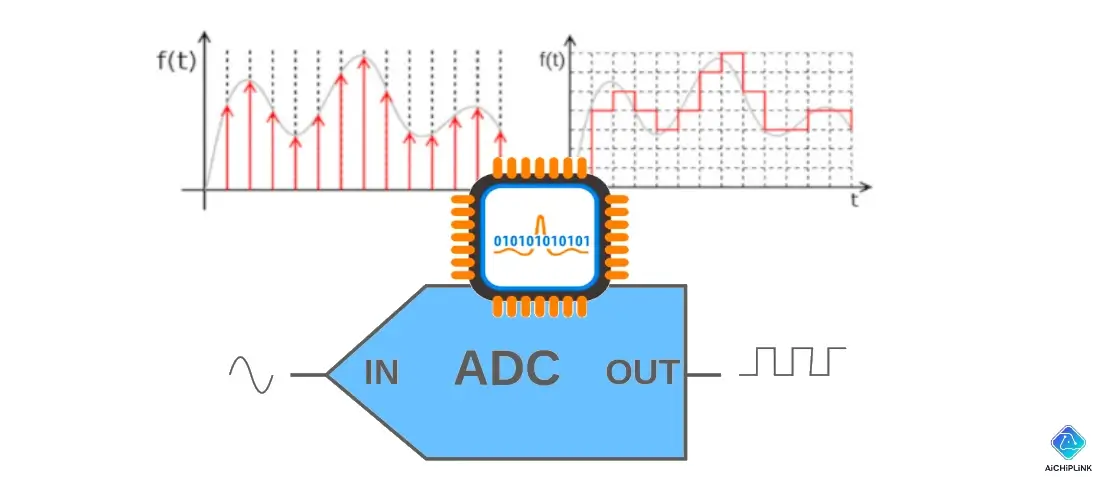
Simply put, an ADC is an electronic component that converts continuous analog signals (like a voltage waveform) into discrete digital signals (binary code of 0s and 1s) that a processor can understand.
Without ADCs, your phone couldn't record your voice, your digital thermometer couldn't display a temperature, and autonomous cars couldn't "see" the road.
How Does an ADC Work?
The process of converting a signal involves three core steps:
-
Sampling: An analog signal is continuous. An ADC takes a "snapshot" of the signal voltage at fixed time intervals. According to the Nyquist–Shannon sampling theorem, the sampling frequency must be at least twice the highest frequency of the signal to reconstruct it accurately without distortion (aliasing).
-
Quantization: While the sample is taken at an exact moment, the value must be mapped to a finite set of digital levels. Quantization involves "rounding off" the exact voltage to the nearest available digital value. The number of available levels depends on the ADC's resolution.
-
Encoding: Finally, the quantized value is converted into a binary sequence (e.g.,
10110010) and output to the digital processor (MCU, DSP, or FPGA).
Key Performance Specifications
When selecting an ADC for a circuit design, three parameters are critical:
-
Resolution (Bit Depth): Measured in Bits. This determines how many discrete levels the analog range is divided into. Higher resolution means finer granularity and a more accurate representation of the signal.
- 8-bit = 256 levels (Basic control systems).
- 16-bit = 65,536 levels (High-fidelity audio).
- 24-bit = 16,777,216 levels (Precision scientific measurement).
-
Sampling Rate: How many times per second the ADC samples the signal, measured in SPS (Samples Per Second).
- Audio typically uses 44.1 kSPS or 48 kSPS.
- RF (Radio Frequency) communications require speeds in the Gigahertz range (>1 GSPS).
-
Signal-to-Noise Ratio (SNR): A measure of signal purity. It compares the level of the desired signal to the level of background noise. A higher SNR indicates a cleaner digital representation.
The 4 Main ADC Architectures
Different applications require different trade-offs between speed, precision, and power consumption. This has led to four dominant ADC architectures:
| Architecture | Speed | Resolution | Power | Best For | Characteristics |
|---|---|---|---|---|---|
| SAR (Successive Approximation) | Medium (≤10 MSPS) | Medium-High (8-18 bit) | Low | Industrial control, Data Acquisition (DAQ) | The All-Rounder. Low latency and power efficient. Ideal for real-time feedback loops. |
| Delta-Sigma ($\Delta\Sigma$) | Slow (≤1 MSPS) | Very High (16-32 bit) | Medium | High-end Audio, Precision Sensors | The Precision King. Uses oversampling and noise shaping to achieve incredible accuracy at lower speeds. |
| Pipeline | Fast (10M - 1 GSPS) | Medium (8-14 bit) | Medium-High | Video, Wireless Comms, Radar | The Speed/Res Compromise. Processes data in stages (like an assembly line) for high throughput. |
| Flash | Ultra-Fast (>1 GSPS) | Low (6-8 bit) | Very High | Oscilloscopes, Fiber Optics | The Speed Demon. Uses hundreds of comparators in parallel. Extremely fast but expensive and power-hungry. |
Common Applications
-
Consumer Electronics:
- Smartphones: Microphones use ADCs to convert voice to digital data; Ambient light sensors adjust screen brightness.
- Digital Cameras: Image sensors (CMOS/CCD) use ADCs to convert light intensity into pixel data.
-
Industrial Automation:
- Factory PLCs use ADCs to read data from pressure transducers, flow meters, and thermocouples to monitor production lines.
-
Medical Technology:
- ECG/EKG: Requires high-precision ADCs to detect minute bio-electric signals from the heart.
- MRI Imaging: Requires high-speed ADCs to reconstruct complex body images.
-
Communications:
- 5G Base stations and Wi-Fi routers use ultra-high-speed ADCs to convert incoming radio waves into digital data packets.
Summary
The ADC is the gateway from the physical world to the digital world.
- Need extreme precision (weigh scales, temperature)? Choose a Delta-Sigma ADC.
- Need blazing speed (RF, Video)? Choose a Pipeline or Flash ADC.
- Need a balance of speed, accuracy, and power (motor control, portable gadgets)? The SAR ADC is likely your best choice.

Written by Jack Elliott from AIChipLink.
AIChipLink, one of the fastest-growing global independent electronic components distributors in the world, offers millions of products from thousands of manufacturers, and many of our in-stock parts is available to ship same day.
We mainly source and distribute integrated circuit (IC) products of brands such as Broadcom, Microchip, Texas Instruments, Infineon, NXP, Analog Devices, Qualcomm, Intel, etc., which are widely used in communication & network, telecom, industrial control, new energy and automotive electronics.
Empowered by AI, Linked to the Future. Get started on AIChipLink.com and submit your RFQ online today!
Frequently Asked Questions
What is an Analog-to-Digital Converter (ADC)?
An Analog-to-Digital Converter (ADC) is an electronic device that converts continuous analog signals (such as voltage, sound, or light intensity) into digital binary data that can be processed by microcontrollers, processors, or digital signal processors (DSPs).
How does an ADC work?
An ADC works in three main steps: sampling the analog signal at fixed time intervals, quantizing the sampled voltage into discrete levels based on resolution, and encoding the result into binary digital values.
What is the difference between ADC resolution and sampling rate?
Resolution determines how precisely the analog signal is represented (number of bits), while sampling rate determines how often the signal is measured per second. High resolution improves accuracy, while a high sampling rate is required to capture fast-changing signals.
What are the main types of ADC architectures?
The four most common ADC architectures are SAR (Successive Approximation), Delta-Sigma, Pipeline, and Flash. Each offers different trade-offs between speed, accuracy, power consumption, and cost.
How do I choose the right ADC for my application?
Choose an ADC based on your application requirements: · High precision & low speed: Delta-Sigma ADC · Balanced performance & low power: SAR ADC · High speed: Pipeline ADC · Ultra-high speed: Flash ADC

.png&w=256&q=75)