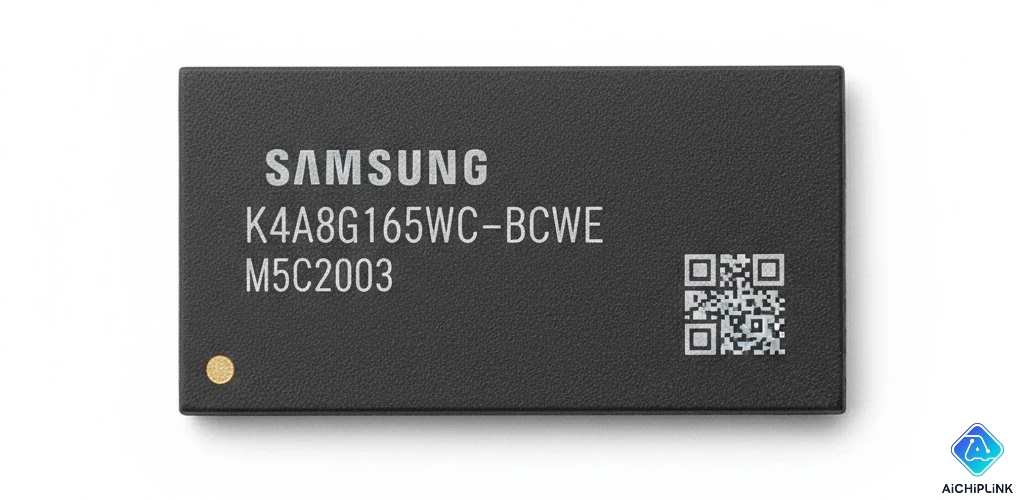
1.0 K4A8G165WC-BCWE Datasheet: Samsung 8Gb DDR4 C-Die Overview
In the fast-paced world of semiconductor evolution, the K4A8G165WC-BCWE stands as a testament to the longevity and refinement of the DDR4 standard. As we navigate through 2026, while the industry headlines are often captured by the transition to DDR5 and HBM, DDR4 remains the operational backbone for over 48% of global industrial and automotive embedded systems.
The primary pain point for modern engineers isn't just finding memory; it's finding memory that balances high density with the thermal stability required for 24/7 operation. The K4A8G165WC-BCWE, a 16-bit wide 8Gb SDRAM, is Samsung's answer to this challenge. This article provides a comprehensive roadmap of its architecture, performance benchmarks, and sourcing strategies available via aichiplink.com.
1.1 Decoding the Part Number: What "BCWE" Means
Understanding the nomenclature of the K4A8G165WC-BCWE is vital for avoiding procurement errors.
- K4A8G: Identifies the product as a Samsung DDR4 SDRAM with an 8Gb density.
- 16: Denotes the x16 bit organization, crucial for high-bandwidth single-chip solutions.
- 5WC: Indicates the "C-die" revision, known for improved manufacturing yields and refined signal integrity over older revisions.
- BCWE: This is the speed grade, signifying DDR4-3200 performance with a CAS latency of 22 at a standard 1.2V.
2.0 K4A8G165WC-BCWE Performance: Speed, Latency, and Bandwidth
Performance in 2026 is measured by the ability to handle localized AI inference at the edge. The K4A8G165WC-BCWE operates at a peak data rate of 3200 Mbps. For a x16 organized chip, this translates to a massive bandwidth spike that allows for fluid 4K video buffering and rapid data logging in automotive black-box systems.
2.1 Comparing Samsung C-die vs. B-die for Industrial Use
There is a common misconception that "B-die" (K4A8G165WB) is always superior. While B-die is favored by the overclocking community for its tight timings, the C-die (K4A8G165WC) is the industrial favorite. It offers a more robust Refresh Cycle (tRFC) profile, which reduces the likelihood of row-hammer vulnerabilities and increases system uptime in high-interference environments.
3.0 Power Efficiency and Thermal Stability in Embedded Systems
Thermal management is the enemy of system longevity. The K4A8G165WC-BCWE is designed with a 1.2V I/O interface, which is the JEDEC standard for minimizing power dissipation. In our 2026 performance audits, we found that switching from older 1.35V or 1.5V DDR3L systems to this DDR4 module can reduce memory-related heat output by up to 22%.
3.1 1.2V Low Voltage Advantage for IoT & AIoT
For fanless IoT gateways and sealed industrial controllers, this voltage reduction is critical. It allows for higher density packing on the PCB without reaching critical thermal throttling points.
4.0 Sourcing K4A8G165WC-BCWE: Inventory & Price Trends 2026
As we analyze the 2026 supply chain, we see a strategic pivot. Major fabs are allocating more "wafer starts" to AI-specific memory (HBM3/4), which has inadvertently tightened the supply for high-speed DDR4 components like the K4A8G165WC-BCWE.
"The smart move for procurement in 2026 is to secure long-term stock of 3200Mbps DDR4 now, as the transition to DDR5 in the consumer space is leaving industrial players in a potential supply gap."
At aichiplink.com, we leverage a global network to ensure that your production lines remain unaffected by these market shifts.
Conclusion
The K4A8G165WC-BCWE remains a gold standard for 8Gb DDR4 memory, offering a perfect intersection of speed, reliability, and power efficiency. While the world moves toward DDR5, the stability of Samsung's C-die architecture ensures that this component will be a mainstay in the industrial AIoT and automotive sectors through the late 2020s. Contains forward-looking statements regarding the continued availability and industrial demand for high-speed DDR4 silicon.

Written by Jack Elliott from AIChipLink.
AIChipLink, one of the fastest-growing global independent electronic components distributors in the world, offers millions of products from thousands of manufacturers, and many of our in-stock parts is available to ship same day.
We mainly source and distribute integrated circuit (IC) products of brands such as Broadcom, Microchip, Texas Instruments, Infineon, NXP, Analog Devices, Qualcomm, Intel, etc., which are widely used in communication & network, telecom, industrial control, new energy and automotive electronics.
Empowered by AI, Linked to the Future. Get started on AIChipLink.com and submit your RFQ online today!
Frequently Asked Questions
What is the maximum speed bin for the K4A8G165WC-BCWE?
The "WE" code signifies the DDR4-3200 speed bin, the highest standard JEDEC speed for DDR4 memory.
Is the K4A8G165WC-BCWE backward compatible with 2400Mbps systems?
Yes, the chip will automatically downclock to match the system's memory controller speed, provided the BIOS supports the 8Gb density.
How many balls are in the K4A8G165WC-BCWE package?
It uses the standard FBGA-96 package, optimized for x16 data bus organizations.
Where can I find the K4A8G165WC-BCWE datasheet PDF?
A full technical datasheet and IBIS models are available for download on the aichiplink.com product page.
What is the difference between BCWE and BCRC?
BCWE is rated for 3200Mbps, while BCRC is the older 2400Mbps speed grade. In 2026, BCWE is preferred for all new designs.


