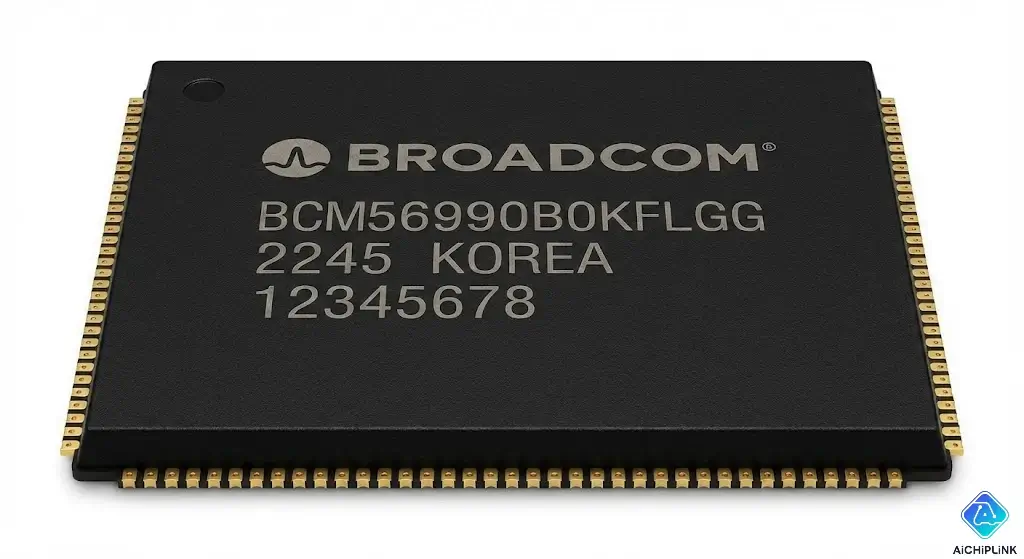
In the hierarchy of silicon, there are microcontrollers, there are processors, and then there are the "Beasts" that run the internet.
The Broadcom BCM56990B0KFLGG belongs to the latter category.
Known widely by its codename Tomahawk 4 (TH4), this chip represented a quantum leap in networking when it launched. It was the industry's first 25.6 Terabits per second (Tbps) switch chip, effectively doubling the bandwidth of its predecessor while maintaining a similar power footprint.
If you are designing white-box switches for hyperscalers or upgrading an AI training cluster, this is the silicon standard. Here is a technical breakdown of what makes the BCM56990 tick.
Table of Contents
- 1. Decoding the Part Number: BCM56990 vs. The Family
- 2. Technical Architecture: 25.6T on 7nm
- 3. The PAM4 Revolution
- 4. Why AI Needs Tomahawk 4
- 5. Comparison: TH3 vs. TH4
- 6. Conclusion
1. Decoding the Part Number: BCM56990 vs. The Family
Broadcom part numbers are specific and tell a story about the chip's capability and generation. Here is what BCM56990B0KFLGG tells us:
The Breakdown Matrix
| Segment | Code | Meaning |
|---|---|---|
| BCM56990 | Base Model | The identifier for the Tomahawk 4 family (25.6T capacity). |
| B0 | Revision | Rev B0. Typically indicates a mature stepping (2nd Gen) with yield optimizations or errata fixes over the A0 initial silicon. |
| K | Temp Grade | Commercial/Industrial range. |
| FLGG | Package | Flip-Chip BGA. A massive package required to route thousands of SerDes lanes. |
Family Lineage
- BCM56960: Tomahawk 1 (3.2 Tbps)
- BCM56970: Tomahawk 2 (6.4 Tbps)
- BCM56980: Tomahawk 3 (12.8 Tbps)
- BCM56990: Tomahawk 4 (25.6 Tbps)
2. Technical Architecture: 25.6T on 7nm
The headline number is 25.6 Tbps. To put that in perspective, a single BCM56990 chip can switch enough data to download the entire Library of Congress in seconds.
- Process Technology: Built on TSMC's 7nm node. This advanced lithography was crucial to pack 31 billion transistors without the chip exceeding thermal limits.
- Port Density: A single chip supports massive configurations natively:
- 64 ports of 400GbE
- 128 ports of 200GbE
- 256 ports of 100GbE
- Efficiency: It reduced power consumption by nearly 75% per gigabit compared to previous generations, a critical metric for hyperscale data centers sensitive to electricity costs.
3. The PAM4 Revolution
How do you get 25.6T out of one chip? You can't just run the clock faster indefinitely. You have to change how you signal.
The BCM56990 relies on 512 instances of 50G PAM4 SerDes.
- NRZ (Non-Return-to-Zero): Used in older chips, signaling just 1s and 0s.
- PAM4 (Pulse Amplitude Modulation 4-level): Encodes two bits per clock cycle (00, 01, 10, 11) by using four different voltage levels.
By using 50G PAM4 lanes, Broadcom allows switch designers to build 400G ports using just 8 lanes (8 x 50G), simplifying the PCB layout and reducing the number of optical transceivers required compared to older, wider parallel interfaces.
4. Why AI Needs Tomahawk 4
The explosion of Large Language Models (LLMs) like GPT-4 has drastically changed networking requirements.
The Bottleneck: In AI training, thousands of GPUs need to synchronize parameters constantly (known as "All-Reduce" operations). If the network is slow or has high latency, expensive H100/A100 GPUs sit idle waiting for data.
The TH4 Solution:
- High Radix: You can connect more GPUs to a single switch, reducing the number of "hops" data has to take (Latency reduction).
- Load Balancing: Advanced hashing and telemetry ensure traffic is spread evenly across links, preventing "elephant flows" (large data bursts) from blocking small synchronization messages.
5. Comparison: TH3 vs. TH4
| Feature | Tomahawk 3 (BCM56980) | Tomahawk 4 (BCM56990) |
|---|---|---|
| Switching Capacity | 12.8 Tbps | 25.6 Tbps |
| Process Node | 16nm | 7nm |
| SerDes Architecture | 256 x 50G PAM4 | 512 x 50G PAM4 |
| Max 400G Ports | 32 | 64 |
| Primary Application | 100G/400G Aggregation | 400G Spine / AI Clusters |
6. Conclusion
The Broadcom BCM56990B0KFLGG is more than just a component; it is the foundation of the modern hyperscale cloud. By delivering 25.6 Tbps of bandwidth in a single 7nm package, it allows data centers to flatten their network topology, reduce power usage, and feed the hungry GPU clusters driving the AI revolution.
Sourcing High-End Broadcom Silicon Supply for Tomahawk series chips is often tightly allocated and hard to find. Visit Aichiplink.com to check availability for BCM56990 and other StrataXGS enterprise switches.

Written by Jack Elliott from AIChipLink.
AIChipLink, one of the fastest-growing global independent electronic components distributors in the world, offers millions of products from thousands of manufacturers, and many of our in-stock parts is available to ship same day.
We mainly source and distribute integrated circuit (IC) products of brands such as Broadcom, Microchip, Texas Instruments, Infineon, NXP, Analog Devices, Qualcomm, Intel, etc., which are widely used in communication & network, telecom, industrial control, new energy and automotive electronics.
Empowered by AI, Linked to the Future. Get started on AIChipLink.com and submit your RFQ online today!
Frequently Asked Questions
What is the switching capacity of BCM56990B0KFLGG?
It delivers 25.6 Tbps, making it a Tomahawk 4-class switch chip.
Which Ethernet speeds does Tomahawk 4 support?
It supports up to 64 × 400GbE, 128 × 200GbE, or 256 × 100GbE ports.
What signaling technology does BCM56990 use?
It uses 50G PAM4 SerDes to achieve high bandwidth with fewer lanes.
Why is Tomahawk 4 popular in AI data centers?
Its high radix and low latency are ideal for GPU clusters and AI training networks.
Is BCM56990B0KFLGG widely available on the open market?
Availability is often limited or allocated, and sourcing typically relies on specialized distributors.