Introduction
Finding total resistance in a parallel circuit is a fundamental skill for anyone working with electronics, but the math often confuses beginners because parallel resistors result in lower total resistance than any individual resistor—the opposite of what many people intuitively expect. This comprehensive guide explains why parallel resistance decreases, provides multiple calculation methods (reciprocal formula, product-over-sum shortcut, and conductance method), and walks through practical examples to master this essential electronics concept.
Basic Principles
What is a Parallel Circuit?
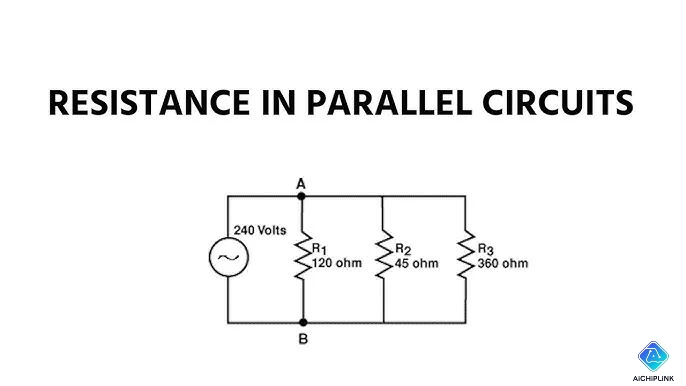
A parallel circuit provides multiple paths for current flow, with all components connected across the same two points (same voltage across each component).
Parallel Circuit Characteristics:
        ┌─── R₁ ───┐
Battery ├─── R₂ ───┤ (All resistors share same voltage)
        └─── R₃ ───┘

Key Properties:
- Voltage across each resistor: V (same for all)
- Current divides: I_total = I₁ + I₂ + I₃
- Total resistance: R_total < smallest individual resistor
vs Series Circuit:
Battery ──R₁──R₂──R₃── (Current flows through each sequentially)

Series properties:
- Current: Same through all (I_total = I₁ = I₂ = I₃)
- Voltage divides: V_total = V₁ + V₂ + V₃
- Total resistance: R_total = R₁ + R₂ + R₃ (sum)
Why Parallel Resistance is Lower
Physical Explanation:
When resistors are connected in parallel, you're adding more paths for current flow—like adding more lanes to a highway reduces traffic congestion.
Mathematical Explanation:
Using Ohm's Law (V = I × R):
- Voltage across each resistor is the same: V
- Current through each: I₁ = V/R₁, I₂ = V/R₂, I₃ = V/R₃
- Total current: I_total = I₁ + I₂ + I₃ = V/R₁ + V/R₂ + V/R₃
- By Ohm's Law: I_total = V/R_total
- Therefore: V/R_total = V(1/R₁ + 1/R₂ + 1/R₃)
- Simplify: 1/R_total = 1/R₁ + 1/R₂ + 1/R₃
Key Insight: More parallel paths → more total current → lower total resistance.
Formulas and Methods
Method 1: Reciprocal Formula (Universal)
For any number of parallel resistors:
1/R_total = 1/R₁ + 1/R₂ + 1/R₃ + ... + 1/Rₙ

Rearranged:
R_total = 1 / (1/R₁ + 1/R₂ + 1/R₃ + ... + 1/Rₙ)
When to use: Always works, regardless of number or values of resistors.
Method 2: Product Over Sum (Two Resistors Only)
Shortcut for exactly two parallel resistors:
R_total = (R₁ × R₂) / (R₁ + R₂)

Example: R₁ = 100Ω, R₂ = 200Ω
R_total = (100 × 200) / (100 + 200) = 20,000 / 300 = 66.7Ω
When to use: Quick calculation for two resistors—easier than reciprocal method.
Method 3: Equal Resistors Shortcut
For n identical resistors in parallel:
R_total = R / n

Where:
R = value of each resistor
n = number of parallel resistors

Example: Four 100Ω resistors in parallel
R_total = 100Ω / 4 = 25Ω
When to use: All parallel resistors have same value—fastest method.
Method 4: Conductance Method
Using conductance (G = 1/R, measured in Siemens [S]):
G_total = G₁ + G₂ + G₃ + ... + Gₙ

Then: R_total = 1/G_total

Example: R₁ = 100Ω, R₂ = 200Ω
G₁ = 1/100 = 0.01 S, G₂ = 1/200 = 0.005 S
G_total = 0.01 + 0.005 = 0.015 S
R_total = 1/0.015 = 66.7Ω
When to use: Easier mental math for some people; equivalent to reciprocal method.
Step-by-Step Examples
Example 1: Two Equal Resistors
Problem: Find total resistance of two 100Ω resistors in parallel.
Method 1 (Product Over Sum):
R_total = (R₁ × R₂) / (R₁ + R₂)
R_total = (100 × 100) / (100 + 100)
R_total = 10,000 / 200
R_total = 50Ω ✓
Method 2 (Equal Resistors Shortcut):
R_total = R / n
R_total = 100Ω / 2
R_total = 50Ω ✓
Result: 50Ω (half of either resistor)
Example 2: Two Different Resistors
Problem: R₁ = 100Ω, R₂ = 200Ω in parallel. Find R_total.
Method 1 (Product Over Sum):
R_total = (100 × 200) / (100 + 200)
R_total = 20,000 / 300
R_total = 66.67Ω ✓
Method 2 (Reciprocal):
1/R_total = 1/100 + 1/200
1/R_total = 2/200 + 1/200 = 3/200
R_total = 200/3 = 66.67Ω ✓
Method 3 (Conductance):
G₁ = 1/100 = 0.01 S
G₂ = 1/200 = 0.005 S
G_total = 0.015 S
R_total = 1/0.015 = 66.67Ω ✓
Result: 66.67Ω (less than smaller resistor!)
Example 3: Three Resistors
Problem: R₁ = 100Ω, R₂ = 200Ω, R₃ = 300Ω in parallel. Find R_total.
Solution (Reciprocal Method):
1/R_total = 1/R₁ + 1/R₂ + 1/R₃
1/R_total = 1/100 + 1/200 + 1/300

Finding common denominator (600):
1/R_total = 6/600 + 3/600 + 2/600
1/R_total = 11/600

R_total = 600/11 = 54.55Ω ✓
Result: 54.55Ω
Example 4: Four Equal Resistors
Problem: Four 1kΩ resistors in parallel. Find R_total.
Solution (Equal Resistors Shortcut):
R_total = R / n
R_total = 1000Ω / 4
R_total = 250Ω ✓
Result: 250Ω (one-quarter of each resistor)
Example 5: Mixed Parallel and Series
Problem:
Circuit:
R₁ = 100Ω (series) ── [R₂ = 200Ω parallel with R₃ = 300Ω]

Find total resistance.
Solution:
Step 1: Calculate parallel section (R₂ and R₃)
1/R_parallel = 1/200 + 1/300
1/R_parallel = 3/600 + 2/600 = 5/600
R_parallel = 600/5 = 120Ω

Step 2: Add series resistance (R₁)
R_total = R₁ + R_parallel
R_total = 100Ω + 120Ω = 220Ω ✓
Result: 220Ω total
Practical Applications
Application 1: LED Current Limiting
Problem: Need to power 3 LEDs (20mA each) from 5V supply using parallel resistors.
Solution:
Each LED needs: R = (5V - 2V) / 0.02A = 150Ω

With three 150Ω resistors in parallel:
R_total = 150Ω / 3 = 50Ω
Total current: 5V / 50Ω = 100mA (wrong approach!)

Correct: Each LED gets separate 150Ω resistor
Total current: 3 × 20mA = 60mA from supply
Lesson: Parallel resistors don't always mean combined calculation—context matters.
Application 2: Reducing Resistance
Problem: Need 25Ω resistor but only have 100Ω resistors.
Solution:
Four 100Ω resistors in parallel:
R_total = 100Ω / 4 = 25Ω ✓

Power rating advantage:
- One 100Ω (1/4W): Max 0.25W
- Four 100Ω (1/4W) in parallel: Max 1W total!
Benefit: Achieve lower resistance AND higher power rating.
Application 3: Voltage Divider with Load
Problem: Voltage divider (R₁ = 1kΩ, R₂ = 1kΩ) from 10V, but load (R_load = 10kΩ) changes output.
Solution:
Unloaded:
V_out = 10V × (1kΩ / 2kΩ) = 5V

Loaded (R₂ parallel with R_load):
R_parallel = (1kΩ × 10kΩ) / (1kΩ + 10kΩ)
R_parallel = 10,000,000 / 11,000 = 909Ω

V_out = 10V × (909Ω / 1909Ω) = 4.76V

Voltage drop: 5V → 4.76V (loading effect!)
Lesson: Parallel loads affect circuit behavior—always consider loading.
Common Mistakes to Avoid
Mistake 1: Adding Resistors Directly
❌ Wrong: R_total = R₁ + R₂ + R₃ (that's series!)
✅ Correct: 1/R_total = 1/R₁ + 1/R₂ + 1/R₃ (parallel)
Mistake 2: Expecting Higher Resistance
❌ Wrong: "More resistors should increase resistance"
✅ Correct: Parallel resistors always DECREASE total resistance
Mistake 3: Using Product-Over-Sum for >2 Resistors
❌ Wrong: Trying (R₁ × R₂ × R₃) / (R₁ + R₂ + R₃) for 3 resistors
✅ Correct: Use reciprocal formula for 3+ resistors
Mistake 4: Forgetting Units
❌ Wrong: Mixing Ω and kΩ without converting
✅ Correct: Convert all to same units first (e.g., 1kΩ = 1000Ω)
Quick Reference
Formula Selection Guide
| Number of Resistors | Best Method | Formula |
|---|---|---|
| 2 resistors | Product over sum | (R₁ × R₂) / (R₁ + R₂) |
| 2+ equal resistors | Division shortcut | R / n |
| 3+ different resistors | Reciprocal | 1/R_total = Σ(1/Rₙ) |
| Any configuration | Conductance | G_total = ΣGₙ, then R = 1/G |
Key Properties to Remember
✅ Parallel resistance is always lower than smallest individual resistor
✅ Voltage across all parallel resistors is identical
✅ Current divides among parallel branches
✅ More parallel paths → lower total resistance
✅ Equal resistors in parallel: R_total = R / n
Conclusion
Finding resistance in parallel circuits requires understanding that parallel paths decrease total resistance through the reciprocal formula (1/R_total = Σ1/Rₙ), with convenient shortcuts for two resistors (product over sum) and equal resistors (R/n). Mastering these calculation methods enables proper circuit design, component selection, and troubleshooting for electronics projects ranging from LED arrays to voltage dividers and power distribution.
Key Takeaways:
✅ Reciprocal formula: Universal method for any parallel resistors
✅ Product over sum: Quick shortcut for exactly two resistors
✅ Equal resistors: Divide by count (R/n) for fastest calculation
✅ Parallel resistance: Always LOWER than smallest individual resistor
✅ More paths: More parallel branches = lower total resistance
✅ Convert units: Always use same units (Ω, kΩ, MΩ) before calculating
✅ Practical benefit: Parallel resistors increase power handling capacity
Building electronics circuits? Visit AiChipLink.com for resistor selection guidance and circuit design consultation.

Written by Jack Elliott from AIChipLink.
AIChipLink, one of the fastest-growing global independent electronic components distributors in the world, offers millions of products from thousands of manufacturers, and many of our in-stock parts is available to ship same day.
We mainly source and distribute integrated circuit (IC) products of brands such as Broadcom, Microchip, Texas Instruments, Infineon, NXP, Analog Devices, Qualcomm, Intel, etc., which are widely used in communication & network, telecom, industrial control, new energy and automotive electronics.
Empowered by AI, Linked to the Future. Get started on AIChipLink.com and submit your RFQ online today!
Frequently Asked Questions
How do you calculate resistance in a parallel circuit?
Resistance in a parallel circuit is calculated using the reciprocal formula, where the inverse of total resistance equals the sum of the inverses of each resistor. This results in a total resistance that is always lower than any individual resistor, because parallel connections create multiple paths for current flow.
Why is parallel resistance always lower than the smallest resistor?
Parallel resistance is always lower than the smallest resistor because additional current paths reduce overall opposition to current. Even adding a very large resistor slightly decreases total resistance, since it still provides an extra path for current to flow.
What is the product over sum formula for parallel resistors?
The product over sum formula is a shortcut used for two resistors in parallel, allowing quick calculation of total resistance by multiplying the two resistances and dividing by their sum. This method only applies to two resistors and simplifies calculations compared to the full reciprocal formula.
How do you calculate three resistors in parallel?
To calculate three resistors in parallel, use the reciprocal formula by adding the inverses of all resistors and then taking the inverse of the result. This method works for any number of resistors and ensures accurate calculation of total resistance.
Is parallel resistance greater than series resistance?
Parallel resistance is always lower than series resistance for the same components. In series circuits, resistances add directly and increase total resistance, while in parallel circuits, multiple current paths reduce total resistance.