How Amp Limiter Circuits Stack Up Against Each Other
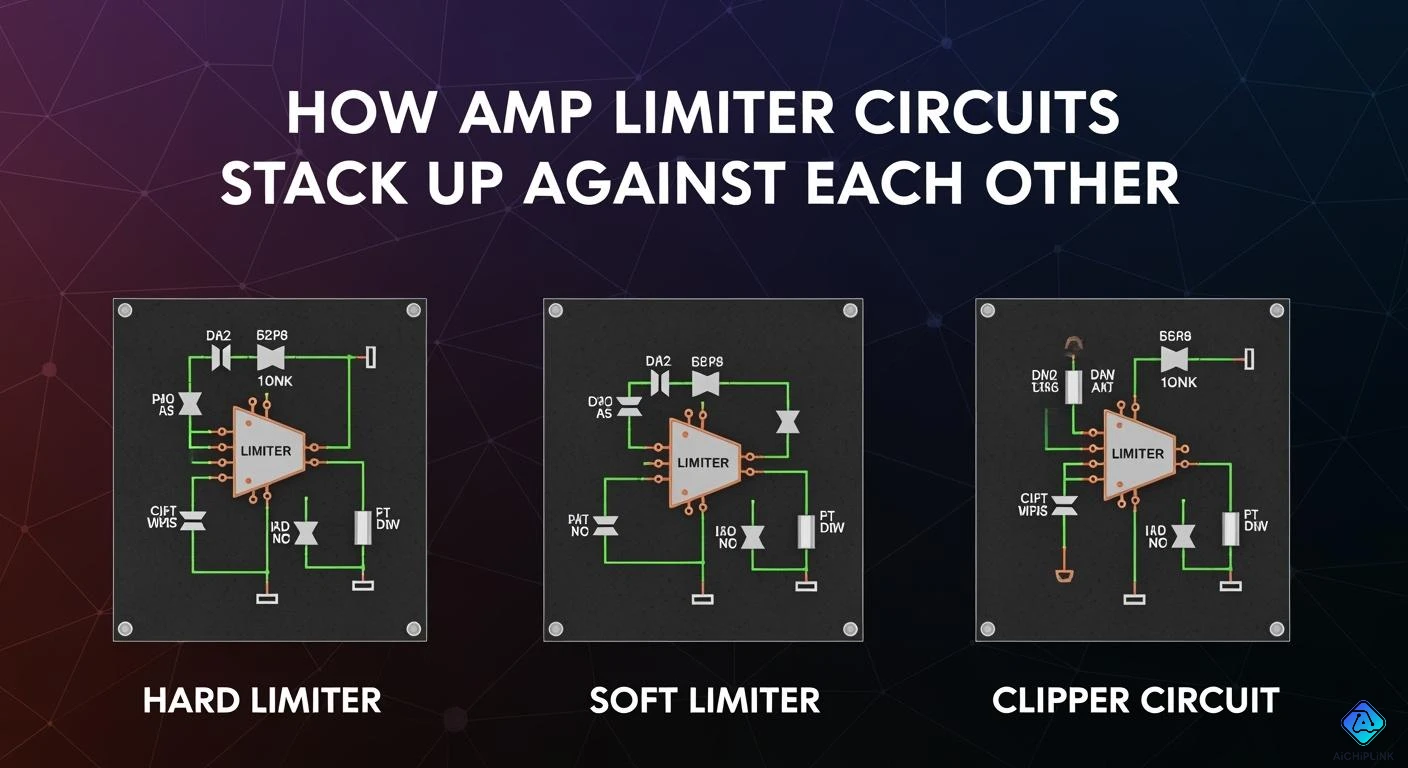
You need to pick the right amp limiter circuit for your needs. This helps balance how well it works, keeps things safe, and fits your use. Limiter designs like diode, op-amp, current limiting circuit, VCA, and IC types are still important in 2026. Each design uses its own way to handle overload and distortion. Your choice changes how good the sound is and how safe it is. Good limiter design stops damage to the amplifier and keeps speakers from breaking. Protection and safety should always come first.
Key Takeaways
- Pick the best amp limiter circuit to keep your audio gear safe and make sound better. - Look at things like how fast it works, how much it changes the sound, and how well it protects when you compare limiter circuits. - Choose a limiter that fits what you need, like clear sound or keeping power supplies safe. - Think about price and how hard it is to build; easy designs can cost less but might not work as well. - Try your limiter circuits with real equipment to make sure they work right and keep your gear safe.
Amp Limiter Circuit Overview
Working Principles
Amp limiter circuits help protect your audio gear from harm. They control how much current or voltage goes to your amplifier or speakers. Some use resistors to lower the current. Others use diodes or transistors for better control. Some circuits use integrated chips or resettable fuses. These limiters keep your system safe if there is too much current or a short circuit.
Here is a table that lists the main types of amp limiter circuits and what they do:
| Type of Circuit | Primary Function |
|---|---|
| Current Limiting Resistors | Lowers current by adding resistance; simple and cheap but turns extra energy into heat. |
| Current-Limiting Diodes | Keeps current close to a set value; gives steady control but has few choices. |
| Transistor-Based Current Limiters | Limits current with a BJT or MOSFET; gives smoother control and works in many uses. |
| Current Limiting ICs | Gives exact control with built-in safety; more complex and costs more. |
| PTC Resettable Fuses | Limits current by raising resistance when hot; resets itself but is not very exact. |
| Linear Regulator Current Limiting | Cuts output to protect itself if overloaded; often used in power supplies. |
| Foldback Current Limiting | Drops allowed current as voltage drops; lowers heat and stress during problems. |
Why Comparison Matters
It is important to compare limiter circuits because each one changes your audio system in its own way. Some limiters make sound better, while others focus on safety or price. For example, a resistor limiter is cheap but wastes energy as heat. A current limiting IC protects more but costs extra and is harder to use.
When you check different amp limiter circuits, you notice big changes in power, distortion, and cooling needs. The chart below shows how five common designs compare in power and distortion. This helps you choose the best limiter for your needs.
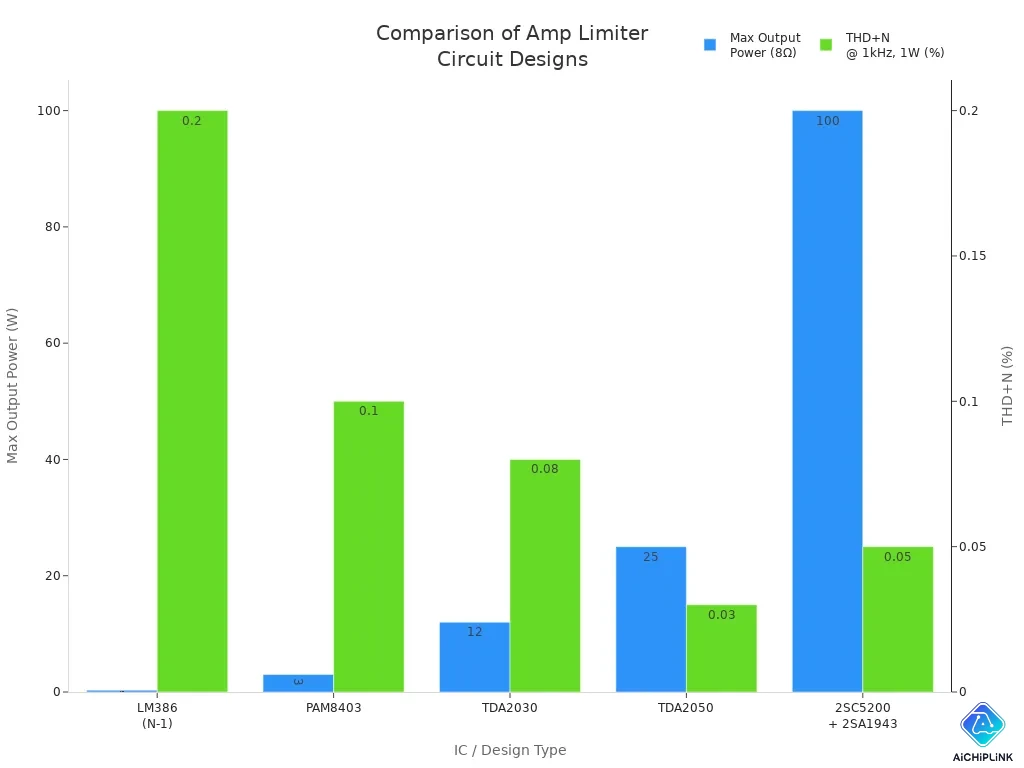
Tip: Always pick a limiter that fits your use. If you want great sound, pick one with low distortion. If you need strong safety, choose a limiter with built-in protection.
Comparing carefully helps you find the best mix of performance, safety, and price for your audio system.
Key Comparison Factors
Performance Metrics
When you compare amp limiter circuits, you should check how well each one works. The most important things to look at are response time, transparency, distortion, and protection. Response time shows how quickly the current limiter reacts to too much current. If it reacts fast, your amplifier and speakers stay safe. Transparency means the limiter does not change the sound much. Low distortion matters if you want clear audio. Protection is the main job of any current limiter circuit. You want a design that stops damage from too much current but keeps the sound good.
Application Suitability
You need to pick the current limiter circuit that fits your needs. Different uses need different designs. For example, a limiter for a guitar amp needs fast response and low distortion. A limiter for an industrial power supply needs strong overcurrent protection. The table below shows what you should think about when you choose a current limiter circuit:
| Factor | Explanation |
|---|---|
| Type of Load | Pick a design that works with your load (resistive, inductive, or capacitive). |
| Current Limit Setting | Set the limit so your load stays safe and does not get too hot. |
| Voltage Level | Make sure your parts can handle the highest voltage. |
| Response Speed | Choose a current limiter that reacts quickly to sudden spikes. |
| Power and Heat | Pick a design that can deal with the heat made during limiting. |
| Temperature Conditions | Make sure the circuit works well in all temperatures. |
| Cost and Complexity | Find a balance between good performance and a price you can pay. |
Cost and Complexity
Cost and complexity affect how you pick a current limiter circuit. Some designs are simple and cheap, like basic current limiter circuits with resistors. Others, like traditional protection circuits, are more complex and cost more. You need to think about your budget and how hard the circuit is to build. The table below shows how different designs compare:
| Design Type | Complexity Level | Cost Considerations |
|---|---|---|
| Basic Compressor/Limiter | Moderate | Good price and keeps sound quality high |
| Traditional Protection Circuits | High | Many trade-offs between performance and cost |
| Current Limiting Circuits | Variable | Depends on load type and how much heat is made |
Tip: Always pick a current limiter circuit that gives you the right mix of protection, cost, and performance for your project.
Diode Clipper Amp Limiter Circuits
Principle and Operation
A diode clipper amp limiter circuit helps protect your amplifier. It stops short-circuit damage from happening. This circuit uses diodes to cut off the highest parts of a signal. When the signal gets too strong, the diodes turn on. They block the extra voltage right away. This keeps the output from going over a set limit. A half-wave rectifier is an example. It clips the negative part of the signal. Other limiter types use feedback or different setups to control signals. Diode clipper circuits work very fast. They do not need many parts. You can make one with just a few diodes and resistors.
-
Diode clipper circuits use diodes to cut off the highest parts of a signal.
-
Other limiter types might use feedback or other setups.
-
A half-wave rectifier clips the negative part of the signal.
Strengths and Weaknesses
A diode clipper amp limiter circuit gives simple protection. The design is easy to make and does not cost much. You can use it for basic current-limiting and short-circuit jobs. The circuit reacts fast to sudden spikes. It keeps your amplifier safe. You do not need many parts, so it fits in small places.
| Strengths | Weaknesses |
|---|---|
| Simple design | Can cause distortion |
| Fast response | Limited precision |
| Low cost | Not ideal for high fidelity |
| Good for short-circuit | May not handle high power |
Note: Use a diode clipper amp limiter circuit when you need quick current-limiting and short-circuit protection. You might hear some distortion in the sound.
Use Cases
You can use diode clipper amp limiter circuits in many ways. These circuits help protect against high voltage. They also help shape signals. You see them used for noise limiting and waveform shaping. If you need a current limiter for a simple amplifier, you can use a diode clipper. You also find them in devices that need short-circuit protection. The circuit works well for simple current limiter jobs.
-
Voltage protection
-
Signal conditioning
-
Noise limiting
-
Waveform shaping
-
Short-circuit protection
-
Basic current-limiting
Op-Amp Zener Limiter Circuits
Precision Limiting
An op-amp Zener limiter circuit is good for precise current-limiting. It uses an op-amp and Zener diodes to control the signal. The op-amp checks the input signal against a set voltage from the Zener diode. If the input is higher, the op-amp changes its output. This keeps the signal safe. The feedback makes the current-limiting very accurate. It gives better control than a simple diode or resistor limiter.
A zener diode across the feedback resistor makes the limiting work well. But zener diodes are not perfect. They can cause small errors in the circuit. You can fix this by changing the design a little.
You can make the circuit more accurate by adding extra parts. Engineers often do this to fix errors from Zener diodes. This makes the op-amp Zener limiter a great choice for audio and measurement systems.
Pros and Cons
It is important to know the good and bad sides of this limiter. The op-amp Zener limiter gives high precision and flexibility. You can pick the right Zener diode to set the limit. The feedback keeps the output clean and lowers distortion. This limiter works for both AC and DC signals.
| Pros | Cons |
|---|---|
| High precision | Needs more parts |
| Flexible current-limiting point | Can cost more |
| Low distortion | Zener diodes may add small errors |
| Good for sensitive loads | Needs careful design for best results |
Extra parts and cost may be worth it for better performance. If you want a limiter that keeps your sound clear, this is a good option.
Typical Applications
You can use an op-amp Zener current limiter in many places. It works well in audio amplifiers to protect speakers and keep sound clear. You also see it in test equipment and lab power supplies. It keeps sensitive devices safe from too much current. You can use it in sensor circuits, analog signal paths, and anywhere you need accurate current-limiting.
-
Audio amplifiers
-
Lab power supplies
-
Sensor protection
-
Analog signal processing
-
Measurement equipment
Op-amp Zener limiter circuits compare input signals to set voltages. If the input is too high, the op-amp changes its output. This keeps the signal within safe limits. The feedback gives more precision and flexibility than other limiter designs.
This current-limiting solution is good when you need safety and high performance.
Current Limiting Circuit Designs
Current-Limiting Methods
There are different ways to make a current limiting circuit. The easiest way uses a current limiting resistor. This resistor lowers voltage if the current gets too high. Some circuits use a transistor to sense and control the current. You can find designs with adjustable current limits. These let you set the highest safe current. Other circuits use integrated chips. These chips sense and control current in one part. Each method has things to think about, like how fast it works and how much heat it makes.
-
Current limiting resistor: Easy and cheap, but not very exact.
-
Transistor-based limiter: Gives better control and reacts faster.
-
Integrated circuit limiter: Has more features by sensing and controlling.
-
Adjustable current limit: Lets you pick the safe current for your device.
Overcurrent Protection
Current-limiting circuits help protect against too much current. They keep the current safe during overloads or short circuits. This stops your devices from getting damaged. These circuits also help your electronics last longer. How well they protect depends on the design and parts you use. Good design means picking the right parts and making sure the limiter reacts fast.
Tip: Always check if your limiter can handle the highest current your device might get. Fast reaction and strong protection keep your system safe.
-
Current limiting circuits keep current safe during overloads.
-
They make electronics last longer and work better.
-
Picking the right parts and design makes protection stronger.
Application Examples
Current-limiting circuits are used in many electronics. They protect devices and help them work safely. Here are some common uses:
| Application | Description |
|---|---|
| Battery Chargers | Limits current to keep batteries safe and make charging better. |
| Motor Control Systems | Protects motors from too much current when starting or stopping. |
| Audio Amplifiers | Keeps speakers and output safe from overload or short circuits. |
| Power Supplies | Stops damage during overloads or shorts, protecting the supply. |
| LED Drivers | Keeps brightness steady and stops LEDs from getting too hot. |
A battery charger uses a current limiting resistor to charge safely. Motor control systems use limiters to stop damage when motors start or stall. Audio amplifiers need current limiting circuit designs to protect speakers. Power supplies use limiters for overcurrent protection. LED drivers use current-limiting to keep lights bright and cool.
VCA and IC-Based Amp Limiter Circuits
Integrated Solutions
VCA and IC-based amp limiter circuits are used in modern audio systems. These circuits use voltage-controlled amplifiers and chips to limit current. You can adjust how much signal goes through the circuit. This lets you set the limiter to react fast or slow. You can change the threshold, attack, and release times. These features help protect loudspeakers and other equipment. They also keep distortion low so your sound stays clear. VCA and IC-based circuits often work with other limiter designs for more control.
Advantages and Drawbacks
VCA and IC-based amp limiter circuits give you many benefits. They offer low distortion and high bandwidth. You get high input impedance and low output impedance. This helps your audio system work better. You can set the compression curve shape just how you want. This lets you design the limiter for your needs. Modular design makes it easy to add signal detection. It does not load the detector circuit. You also get precise control over current-limiting. This is important for professional audio.
But there are some drawbacks. VCA and IC-based circuits are more complex than simple limiter designs. You pay more for these features. You must tune attack and release time constants carefully. If you do not set them right, your limiter may not protect your equipment well. You also need to understand how the circuit works to get the best results.
| Strengths | Drawbacks | Best Applications |
|---|---|---|
| Transparent limiting | More complex | PA systems |
| Adjustable threshold/attack/release | More expensive | Powered speakers |
| Suitable for loudspeaker protection | Attack/release time constants must be tuned | Broadcast chains |
| Precise current-limiting | Requires technical knowledge | Mastering hardware |
Use Scenarios
You use VCA and IC-based amp limiter circuits in many places. These circuits protect audio equipment by controlling signal levels. You find them in PA systems, powered speakers, and broadcast chains. They help keep sound quality high by stopping distortion. You also use them in mastering hardware. Here you need precise current-limiting and limiter control. Professional audio setups depend on these circuits for loudspeaker protection and clear sound.
-
VCA and IC-based limiter circuits protect your gear by controlling signal levels.
-
You keep distortion low with transparent current-limiting.
-
You use these designs in PA systems, powered speakers, broadcast chains, and mastering hardware.
Tip: If you want the best sound and strong protection, pick a VCA or IC-based amp limiter circuit with adjustable current-limiting features.
JFET, BJT, and Resistor-Based Limiters
Constant Current Limiting
You can make a simple limiter with JFETs, BJTs, or resistors. Each one uses a different way to keep current steady. Here is how they work: JFET current-limiting uses the JFET’s pinchoff. You set the gate-source voltage to a certain value. The JFET then limits the current. The drain goes to the positive side. The source connects to the load. The gate connects to the source. A resistor at the source senses the current and gives feedback. This makes the current stay steady by itself. BJT shunt regulators go in parallel with your load. The base connects to a reference voltage. If the load voltage gets too high, the BJT turns on. It sends extra current away. This keeps the current safe. Resistor-based limiters use a resistor to drop voltage if current gets too high. This way is easy but not very exact. These methods help protect your devices from too much current.
Practical Considerations
When you pick a limiter, think about how accurate it is, how much it costs, and how easy it is to build. JFET limiters are simple but may not be very exact. BJT shunt regulators are good if you do not need high accuracy. Resistor-based limiters are the easiest to make. They waste power as heat and are not very precise. You should also check if your limiter can handle the heat and the highest current your device might get.
Tip: Always test your limiter in your real circuit. This helps you find problems before they break your equipment.
Best Applications
You can use these limiter circuits in many places. The table below shows where each type works best:
| Circuit Type | Application Area |
|---|---|
| JFET current limiting | Good for prototypes or simple current-limiting, like in ADC circuits with changing loads. |
| Op-amp constant current controller | Best for jobs that need high accuracy and adjustable current-limiting. |
| BJT shunt regulator | Useful when you need to divert extra current and do not need high accuracy. |
You can pick the right limiter for your project by thinking about how much accuracy you need and how simple you want your circuit to be. JFET and BJT limiters are easy ways to add current-limiting to your designs. Resistor-based limiters are best when you need something quick and cheap.
Advanced Amp Limiter Circuit Technologies
Foldback and Programmable Designs
Foldback current limiting makes your circuits safer and better. This design lowers the output current if there is too much load. It does not just keep the current steady. It also drops the voltage. This keeps your power supply and load safe. The output transistor stays cooler. You do not need a big heat sink. This also lowers the chance of fire. Foldback current limiting protects your devices more than simple limiter circuits. Programmable limiter designs let you set the current limit for each job. You can change the settings with switches or digital controls. This gives you more control and makes things easier.
Note: Foldback current limiting helps you save energy and keeps your equipment safe during problems.
High-Performance Op-Amps
You can use high-performance op-amps to make advanced limiter circuits. These op-amps react fast when the signal changes. They keep the output clean and cut down on distortion. You get better sound in your audio system. Some high-performance op-amps have special features. They can handle high voltages and high currents. You can use them in both simple and complex limiter designs. These op-amps help protect your speakers and other parts without hurting the sound.
Modern Trends
Limiter technology is getting better all the time. Now, you see more digital control in limiter circuits. You can set limits using software. Some systems use microcontrollers to watch the current and change the limiter right away. Foldback current limiting is now used a lot in power supplies and audio gear. You also see more programmable limiter circuits. These let you change settings for different jobs. Modern limiter designs focus on safety, saving energy, and good sound.
Tip: When you pick a limiter, look for designs that use foldback current limiting and digital control. These give you the best mix of safety and performance.
Amp Limiter Circuit Comparison Summary
Quick Reference Table
You might want to compare amp limiter circuits fast. This table shows how each current limiter works for speed, distortion, and safety. You can use it to pick the best one for your project.
| Limiter Type | Response Time | Distortion | Protection Effectiveness | Complexity | Cost | Best Use Case |
|---|---|---|---|---|---|---|
| Diode Clipper | Very Fast | High | Basic | Low | Low | Simple audio, basic safety |
| Op-Amp Zener | Fast | Low | High | Medium | Medium | Audio, lab, sensors |
| Current Limiting Resistor | Instant | Medium | Basic | Very Low | Very Low | Prototyping, low-cost builds |
| Transistor-Based Limiter | Fast | Low | Good | Medium | Medium | Power supplies, motors |
| VCA/IC-Based Limiter | Adjustable | Very Low | Excellent | High | High | Pro audio, mastering |
| Foldback/Programmable | Fast | Low | Excellent | High | High | Power, advanced audio |
| JFET/BJT/Resistor | Fast | Medium | Good | Low | Low | Simple analog, test circuits |
Every current limiter circuit has good and bad points. For example, a diode clipper is very quick but makes more distortion. A VCA or IC-based amp limiter circuit gives you the best safety and sound, but it costs more and is harder to build.
Tip: Always make sure your current limiter can keep your amplifier and speakers safe without making the sound worse.
You can also look at amplifier types. Class A amplifiers have low distortion and almost perfect sound, but they waste a lot of power. Class D amplifiers save power but can add extra sounds called harmonic distortion. You should match your current limiter circuits to your amplifier type for the best results.
| Amplifier Type | Efficiency | Distortion | Signal Quality |
|---|---|---|---|
| Class A | 25-30% | Low | Nearly perfect |
| Class B | 70-80% | Crossover | Good |
| Class AB | 50-70% | Reduced | Good |
| Class C | >80% | High | Poor |
| Class D | >90% | Harmonic | Moderate |
Selection Tips
You want to pick the right amp limiter circuit for your needs. Here are some tips to help you choose:
-
Know Your Application
Think about what you want to protect. If you work with audio, pick a limiter with low distortion. If you need strong safety for power supplies, choose a current limiter circuit that reacts fast. -
Check Signal Modulation
The kind of signal matters. Some current limiter circuits work better with certain signals. For example, audio signals need clear limiting. -
Calculate Peak Power
You should know the highest power your system will use. This helps you set the right current limit and keeps your devices safe. -
Watch Harmonic Levels
Pick a limiter that keeps harmonic distortion low. This means your sound will stay clear and true. -
Look for Accessory Functions
Some amp limiter circuits have extra features. You might want remote control, variable gain, or special safety modes.
Here is a table to help you remember what to check:
| Selection Criteria | Description |
|---|---|
| Signal Modulation | Pick a limiter that matches your signal type. |
| Peak Power | Set the current limiter for your system’s highest power. |
| Harmonic Levels | Choose a limiter with low distortion for better sound. |
| Accessory Functions | Look for features like remote control or extra protection. |
Note: Always test your current limiter circuits in your real setup. This helps you find problems before they cause damage.
You can use these tips to match the right amp limiter circuit to your project. You will get better safety, longer life for your equipment, and the best sound or power.
You now know that amp limiter circuits are different in how fast they work, how much they change the sound, and how safe they are. Pick a circuit that matches what you need. If you want good sound, choose a design with low distortion. If you want strong safety, pick a limiter that reacts quickly. Think about how much money you can spend and how hard the circuit is to build. Use this table to help you decide:
| Recommendation | Details |
|---|---|
| Define load and power target | Make sure the voltage and current fit your speaker and power needs. |
| Select matched transistor pairs | Use matching sets to stop current problems. |
| Verify bias method | Try VBE multipliers for better heat control. |
| Check emitter resistor placement | Put small resistors right on the transistor pins. |
| Test before connecting speakers | Try dummy loads before using real speakers. |
| Cost analysis | Simple designs cost $5–$12; IC modules cost $8–$18. |
You can learn more about advanced limiter designs by reading electronics books or looking in online forums.

Written by Jack Elliott from AIChipLink.
AIChipLink, one of the fastest-growing global independent electronic components distributors in the world, offers millions of products from thousands of manufacturers, and many of our in-stock parts is available to ship same day.
We mainly source and distribute integrated circuit (IC) products of brands such as Broadcom, Microchip, Texas Instruments, Infineon, NXP, Analog Devices, Qualcomm, Intel, etc., which are widely used in communication & network, telecom, industrial control, new energy and automotive electronics.
Empowered by AI, Linked to the Future. Get started on AIChipLink and submit your RFQ online today!
Frequently Asked Questions
What does an amp limiter circuit do?
You use an amp limiter circuit to protect your amplifier and speakers. It stops too much current or voltage from reaching your equipment. This keeps your audio system safe and working longer.
Which amp limiter circuit is best for clear sound?
You get the best sound with op-amp Zener or VCA/IC-based limiter circuits. These designs keep distortion low and protect your speakers. Tip: Choose a limiter with low distortion for music and audio projects.
Can I build a simple amp limiter at home?
You can build a basic limiter using diodes or resistors. These parts cost little and work for simple protection. * Diode clipper: Fast, easy * Resistor limiter: Cheap, basic
How do I set the current limit?
You set the current limit by picking the right resistor or adjusting a control in IC-based designs.
Do limiter circuits affect amplifier power?
Limiter circuits can lower power if they activate. You keep your equipment safe, but you may lose some loudness. Note: Always test your limiter to check how it affects your system.