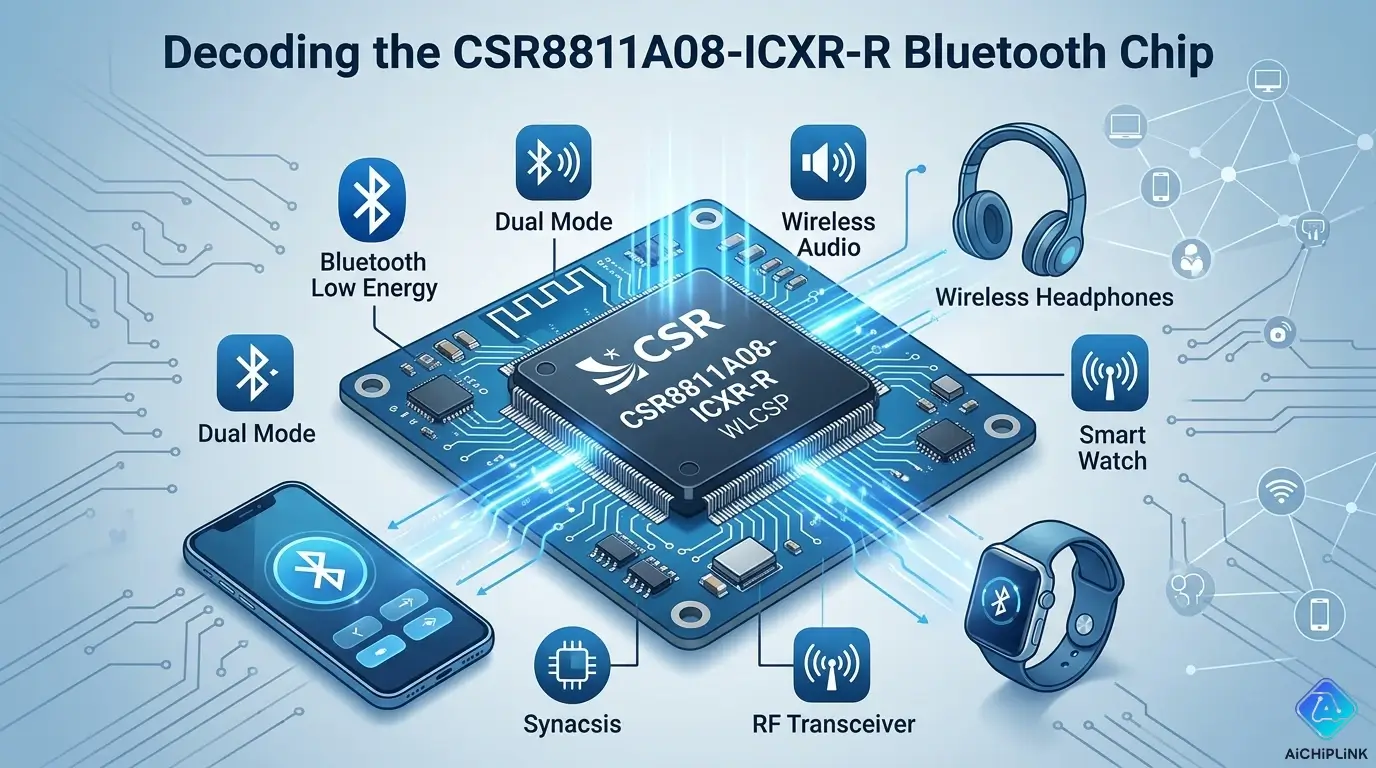
CSR8811A08-ICXR-R: Why "Dual-Mode Bluetooth" Is One Radio, Not Two — and Why That Matters for Audio Design
The CSR8811 is described as a "dual-mode Bluetooth" device — supporting both Classic Bluetooth (BR/EDR, Basic Rate/Enhanced Data Rate) and Bluetooth Low Energy (BLE) simultaneously. The natural reading of "dual-mode" is that two separate radio systems coexist in the chip, each handling its respective protocol independently. That reading is wrong, and the misunderstanding creates real design problems.
The CSR8811 contains one 2.4 GHz radio transceiver. That single radio handles both Classic Bluetooth and BLE by time-division scheduling — the radio alternates between the two protocol stacks according to a time-sharing algorithm managed by the baseband controller. Classic Bluetooth A2DP audio streaming occupies the radio for the vast majority of its time slots. BLE connections get scheduled into the remaining gaps.
This architecture has a direct consequence: when the CSR8811 is actively streaming high-quality A2DP audio to headphones, the time available for BLE advertising and connections is constrained. A BLE sensor that expects a fast connection interval will experience delays. A BLE remote control that needs sub-100 ms response time may miss its connection events. The dual-mode capability is real, but the two modes share a single resource and compete for radio time. Understanding this resource-sharing model is the starting point for any design that uses CSR8811 in applications combining audio with BLE.
Beyond the radio architecture, the CSR8811 is an unusually complete Bluetooth audio SoC: it integrates an 80 MHz RISC MCU, an 80 MIPS Kalimba DSP for audio processing, a mono codec with microphone input, CVC (Clear Voice Capture) noise reduction, a complete power management subsystem including battery charger, and a 2.4 GHz radio with integrated balun. Understanding what each of these components provides — and what the CSR8811 does not provide (stereo codec, for one) — determines whether this is the right device for a given design.
1.0 Part Number Decoded: CSR8811A08-ICXR-R
CSR (Cambridge Silicon Radio, acquired by Qualcomm in 2015) used a structured naming convention for BlueCore products:
CSR — Cambridge Silicon Radio / Qualcomm product prefix
8811 — Product identifier: BlueCore CSR8811
- The 88xx series = BlueCore audio/connectivity SoCs
- 8811 specifically = dual-mode BT4.0 (Classic + BLE) with Kalimba DSP, mono audio codec
- Differentiated from 8610/8615 (mono audio, no BLE), 8630/8640 (stereo audio)
A — Silicon revision: A = first production revision
08 — Package variant code: 08 = 28-ball WLCSP (Wafer Level Chip Scale Package)
- 0.5mm ball pitch
- Package body approximately 3mm × 3mm (chip-scale — body size ≈ die size)
- The smallest available package for CSR8811; other variants use larger packages
-ICXR — Package/configuration suffix:
- IC = specific WLCSP package configuration code
- X = specific flash/ROM configuration variant
- R = specific silicon configuration
-R — Tape-and-Reel packaging (the final -R at the end of the full part number)
Complete ordering context:
- CSR8811A08-ICXR-R = 28-ball WLCSP, revision A, specific configuration, tape-and-reel
- The CSR8811 was also available in a larger QFN package under a different part number suffix for applications requiring easier hand-soldering or rework
2.0 Specifications at a Glance
From the CSR8811 product documentation and BlueCore feature summary:
Wireless:
- Bluetooth specification: v4.0 (includes Classic BR/EDR and BLE in one chip)
- Frequency: 2.4 GHz ISM band
- Transmit power: +8 dBm (Class 1 range — up to approximately 100m line-of-sight)
- Receiver sensitivity: −89 dBm (Classic Bluetooth)
- Integrated balun: Yes — no external matching network required for the RF port
- External crystal load capacitors: Not required for typical crystals (internal capacitors built in)
Processors:
- RISC MCU: 80 MHz — handles application logic, Bluetooth stack, profile management
- Kalimba DSP: 80 MIPS — dedicated audio processing, codec decode, CVC noise reduction, EQ
- Internal ROM: Contains BlueCore firmware, Bluetooth stack, audio codecs
- Flash/EEPROM interfaces: For user firmware storage and configuration parameters
Audio:
- Mono codec — one microphone input (ADC) and one audio output (DAC)
- Codec quality: High-performance mono (not stereo — the CSR8811 is a mono device)
- Stereo line-in — can accept stereo analog input for wired audio (though DSP/output is mono)
- Supported codecs: SBC (mandatory for A2DP), MP3, AAC decode
- CVC (Clear Voice Capture): CSR's noise reduction technology for narrowband and wideband voice, including wind noise reduction
- 5-band fully configurable EQ
- Wideband speech: HFP v1.6 with mSBC codec support
Bluetooth profiles:
- A2DP (Advanced Audio Distribution Profile) — audio streaming
- AVRCP v1.4 — audio/video remote control
- HFP (Hands-Free Profile), HSP (Headset Profile)
- Multipoint: A2DP connection to 2 simultaneous A2DP sources
- Secure Simple Pairing, CSR proximity pairing
Interfaces:
- USB 2.0, UART, I²C, SPI
Power management:
- Integrated dual switch-mode regulators, linear regulators, and battery charger — complete PMIC on-chip
Package (this variant):
- 28-UFBGA / WLCSP, 0.5mm pitch, approximately 3mm × 3mm body
3.0 Architecture: Single Radio, Two Protocol Stacks, One Kalimba DSP
The single-radio dual-mode implementation:
Classic Bluetooth (BR/EDR) and BLE both operate in the 2.4 GHz ISM band using frequency hopping spread spectrum, but they use different modulation schemes, different packet formats, and different time slot structures. In a chip that supports both, there are two implementation approaches:
Two radios: A dedicated Classic Bluetooth radio and a separate BLE radio, each operating independently. This provides maximum concurrent operation but doubles the RF area, power consumption, and cost.
One radio, time-division sharing: A single 2.4 GHz radio handles both protocols by scheduling its use between them. The baseband controller manages a time-division schedule, assigning radio time to Classic BT or BLE based on active connections and priorities.
The CSR8811 uses the single-radio time-division approach. The baseband controller (part of the 80 MHz RISC MCU firmware) maintains awareness of pending Classic BT and BLE radio events and schedules them to avoid collision.
The practical consequence for A2DP + BLE concurrent operation:
A2DP audio streaming over Classic Bluetooth uses continuous synchronized packets at approximately every 2.5ms (for 3-slot packets). These packets must be delivered within their timing windows or audio quality degrades (audible artifacts, dropouts). The Classic Bluetooth A2DP scheduler is therefore given high priority.
BLE connection events are scheduled at configurable intervals (7.5ms to 4s per the BLE spec). When the CSR8811 is actively streaming A2DP, BLE connection intervals shorter than approximately 100ms may not be met consistently — the radio time available for BLE is whatever remains after A2DP packets are served. For BLE peripherals that require fast connection intervals (fitness trackers expecting 20ms update rates, for example), this scheduling conflict produces missed connection events and apparent disconnections or stalls.
Design guidance: when using CSR8811 with concurrent A2DP + BLE, configure BLE connection intervals ≥ 200ms and use BLE notifications rather than indications (notifications do not require acknowledgment, reducing the BLE radio time required per event).
The Kalimba DSP:
The Kalimba DSP is CSR's proprietary audio processing architecture. It provides:
- Hardware-accelerated audio codec decode (SBC, MP3, AAC) — these run on the DSP without consuming MCU cycles
- CVC (Clear Voice Capture) algorithm execution — CSR's microphone noise reduction running at full speed on the DSP
- 5-band parametric EQ processing
- Sample rate conversion
The separation of MCU (80 MHz, application/stack logic) and DSP (80 MIPS, audio processing) is what enables the CSR8811 to simultaneously manage Bluetooth stack processing and real-time audio processing without one task compromising the other.
4.0 ⚠️ Four Design Pitfalls with CSR8811A08-ICXR-R
Pitfall 1: Assuming "mono codec" means only one audio output channel
The CSR8811's mono codec produces one audio output (DAC), not two. For a mono headphone, earpiece, or single-driver speaker application, this is exactly right. For a stereo headphone or stereo speaker application, this is a fundamental limitation — the CSR8811 cannot drive left and right audio channels independently from its DAC. The workaround is to connect the CSR8811's I2S or digital audio output to an external stereo codec or audio amplifier, but this adds BOM cost and complexity. If stereo audio is required from the SoC directly, the correct device choice is CSR8630 (stereo DAC codec) or CSR8640, not CSR8811. Verify the codec configuration against the speaker/headphone design before specifying CSR8811.
Pitfall 2: WLCSP PCB design without proper underfill planning
The 28-ball WLCSP (0.5mm pitch) package requires careful PCB design and, for mechanically demanding applications, underfill. The WLCSP has no package body providing mechanical standoff — the solder balls are directly between the die and the PCB. Mechanical stress (board flexion, thermal cycling, drop impact) is transmitted directly to the solder joints. For portable products subject to drop or flex (wearables, earbuds, fitness trackers — exactly CSR8811's target market), the PCB footprint must follow CSR's WLCSP layout guidelines: correct pad size, solder mask design (SMD or NSMD pad definition), and the recommendation to apply underfill epoxy after soldering to redistribute mechanical stress across the entire component footprint. Boards assembled without underfill in mechanically stressed applications show solder joint fatigue failure after hundreds of drop cycles.
Pitfall 3: Ignoring the -R tape-and-reel vs. cut tape vs. tray distinction for assembly planning
The CSR8811A08-ICXR**-R** suffix indicates tape-and-reel packaging. The -R variant is required for automated pick-and-place assembly. Cut tape (CT) variants are the same reel material cut to smaller quantities — suitable for hand assembly or low-volume prototyping but structurally identical to T&R. The distinction matters for procurement: ordering cut tape for a production run with automated assembly is an assembly line error (the cut tape feeder format may not work on all pick-and-place machines). Specify -R for production and verify the reel quantity (typically 1,000–3,000 units per reel for WLCSP devices).
Pitfall 4: Using CSR Synergy software SDK without accounting for the NDA requirement for full BlueCore documentation
CSR (now Qualcomm) provides the Synergy Software stack and BlueCore development tools for CSR8811 firmware development, but full technical documentation (register maps, RF calibration procedures, and some advanced feature documentation) is provided under NDA to registered customers. Engineers who attempt to develop CSR8811 firmware using only the publicly available documentation may find that certain features (RF calibration adjustment, advanced CVC configuration, some A2DP quality tuning registers) are not accessible without the NDA-controlled documentation. For CSR8811 design-ins, register with Qualcomm's developer portal and request design-in support to obtain full documentation access before committing to this device.
5.0 Application Design Notes: WLCSP Layout, Crystal, and Power
WLCSP PCB footprint:
The 28-ball WLCSP at 0.5mm pitch requires:
- Pad diameter: follow CSR's application note recommendation (typically 0.25–0.30mm for NSMD, or solder mask-defined per CSR's guidelines)
- Solder paste: Type 4 or Type 5 powder size for 0.5mm pitch, stencil aperture per CSR's recommendation
- Solder mask: non-solder-mask-defined (NSMD) pads are preferred for better solder joint reliability at this pitch
- PCB surface finish: ENIG (Electroless Nickel Immersion Gold) recommended for consistent solderability on fine-pitch WLCSP
Crystal:
The CSR8811 does not require external crystal load capacitors for typical crystals — the internal capacitors are sufficient for standard 16 MHz or 26 MHz crystals with typical load capacitance specifications. Use a crystal meeting CSR's specification (frequency, ESR, load capacitance) from the recommended crystal list in the CSR8811 application note. Place the crystal as close as physically possible to the XTAL pins, with no other signal traces running between or adjacent to the crystal traces.
Power supply:
The CSR8811 integrates dual switch-mode regulators, linear regulators, and a battery charger — the complete PMIC for a Bluetooth audio device. For a single-cell Li-ion battery powered design, the CSR8811 accepts battery voltage directly at its VBAT pin and generates all required internal supply voltages. The design requires:
- External inductor for each switch-mode regulator (CSR8811's internal MOSFETs switch the inductors)
- Appropriate bypass capacitors per CSR's application note
- VBAT input protection (reverse polarity diode, TVS for ESD)
RF circuit:
The integrated balun eliminates the need for an external RF matching network. Connect the RF pin directly to the antenna (or a short trace to an antenna connector) according to CSR's RF layout guidelines. Keep the RF trace short (< 5mm preferred), maintain 50Ω impedance on the RF trace, and avoid routing other signals adjacent to the RF trace.
6.0 Comparison: CSR8811 vs CSR8615 vs CSR8640 in the BlueCore Family
| Feature | CSR8811 | CSR8615 | CSR8640 |
|---|---|---|---|
| Bluetooth version | BT4.0 (Classic + BLE) | BT3.0 (Classic only) | BT4.0 (Classic + BLE) |
| BLE support | ✅ Yes | ❌ No | ✅ Yes |
| Audio codec | Mono | Mono | Stereo |
| Kalimba DSP | 80 MIPS | 80 MIPS | 80 MIPS |
| MCU | 80 MHz RISC | 80 MHz RISC | 80 MHz RISC |
| CVC noise reduction | ✅ Yes | ✅ Yes | ✅ Yes |
| A2DP multipoint | 2 sources | 1 source | 2 sources |
| TX power | +8 dBm (Class 1) | +10 dBm | +10 dBm |
| Package (smallest) | 28-ball WLCSP | Various | Various |
| Target application | BLE + audio (mono) | Audio only (mono) | BLE + audio (stereo) |
When CSR8811 is the right choice:
- Mono Bluetooth audio device (earpiece, single-ear headset, hands-free car kit speaker, mono IoT audio node) that also needs BLE for sensor data or remote control
- Applications needing Class 1 range (8 dBm) with BLE coexistence
- Space-constrained designs using WLCSP
When to choose CSR8640 instead:
- Stereo headphones or stereo speakers requiring left and right audio channels from the SoC directly
- Same BLE + audio capability as CSR8811 but with stereo codec output
When to choose CSR8615 instead:
- Audio-only (no BLE needed) mono application where CSR8615's slightly higher TX power (+10 dBm) and lower BOM cost (simpler stack) are advantages
- Legacy designs without BLE requirement
7.0 Sourcing CSR8811A08-ICXR-R
Since Qualcomm's acquisition of CSR in 2015, the CSR8811 has remained in production under Qualcomm's management, though new designs for Bluetooth audio are increasingly directed toward Qualcomm's QCC series (QCC3040, QCC5100) which provide more current Bluetooth 5.x features.
For verified authentic Qualcomm CSR8811A08-ICXR-R with competitive pricing, visit aichiplink.com.
8.0 Real Questions from Bluetooth Hardware Designers
Q: We are designing a fitness tracker that uses CSR8811 for A2DP audio playback and also needs BLE for heart rate sensor data every 200ms. Will this work reliably?
A: Yes, a 200ms BLE connection interval is compatible with concurrent A2DP streaming on CSR8811. The time-division scheduling algorithm in CSR8811 can accommodate BLE connection events at 200ms intervals without significantly disrupting A2DP audio quality. The 200ms interval means the BLE radio event occurs infrequently enough that A2DP audio packets are not impacted. Problems typically arise when BLE connection intervals are ≤ 50ms — at those rates, the BLE events compete with A2DP packet slots and audio glitches may occur. Design the heart rate sensor BLE peripheral to use a 200ms or longer connection interval when paired to CSR8811, and use BLE Notify (not Indicate) to minimize the BLE radio acknowledgment time required per event.
Q: The CSR8811 has "stereo line-in" in its feature list but also "mono codec." How can it accept stereo input if the codec is mono?
A: The stereo line-in accepts a stereo analog signal on two input pins (left and right channels). However, the CSR8811's ADC samples this stereo input and the Kalimba DSP mixes or selects the channels for mono processing and output. The device can accept a stereo source (for example, a 3.5mm stereo headphone jack input) but the processed and transmitted audio is mono — the two input channels are mixed down to one before A2DP streaming. This makes the CSR8811 suitable for a Bluetooth adapter that takes a stereo source and wirelessly transmits it to a mono Bluetooth speaker, but not for preserving stereo separation through the wireless link.
Q: Can CSR8811A08-ICXR-R replace CSR8611 in an existing design? They have similar names.
A: The CSR8611 and CSR8811 are different devices from different generations of the BlueCore family. CSR8611 is an older device without BLE support; CSR8811 adds BLE and other improvements. They are not pin-compatible — the package, pinout, and firmware are different. A direct hardware substitution is not possible without PCB layout changes and firmware re-development for the CSR8811. However, for designs where BLE is now needed and an upgrade from CSR8611-based hardware is planned, CSR8811 is the natural upgrade path — similar architecture, CSR Synergy software carries over much of the application layer, and the improved feature set (BLE, wideband speech, CVC enhancements) justifies the migration effort.
9.0 Quick Reference Card
Part Number Decode:
| Field | Value | Meaning |
|---|---|---|
| CSR8811 | CSR8811 | BlueCore BT4.0 dual-mode audio SoC |
| A | A | Silicon revision A |
| 08 | 08 | 28-ball WLCSP, 0.5mm pitch |
| ICXR | ICXR | Package/config/flash variant code |
| -R | -R | Tape-and-Reel packaging |
Key Specifications:
| Parameter | Value |
|---|---|
| Bluetooth | v4.0 (Classic BR/EDR + BLE) |
| Radio | Single 2.4GHz (time-division dual-mode) |
| TX power | +8 dBm (Class 1) |
| RX sensitivity | −89 dBm |
| Integrated balun | Yes |
| MCU | 80 MHz RISC |
| DSP | 80 MIPS Kalimba |
| Audio codec | Mono (not stereo) |
| Codecs | SBC, MP3, AAC |
| CVC | Yes (narrowband + wideband) |
| Interfaces | USB 2.0, UART, I²C, SPI |
| PMIC | Integrated (regulators + battery charger) |
| Package | 28-ball WLCSP, ~3×3mm |
The Single-Radio Architecture — Key Implication:
A2DP streaming + BLE concurrent use → use BLE connection interval ≥ 200ms to avoid audio glitches from radio time contention.
CSR8811 vs CSR8640 — One Decision:
| Need | Device |
|---|---|
| Mono audio + BLE | CSR8811 |
| Stereo audio + BLE | CSR8640 |
| Mono audio, no BLE | CSR8615 |
For sourcing Qualcomm CSR8811A08-ICXR-R with verified authenticity and competitive pricing, visit aichiplink.com.

Written by Jack Elliott from AIChipLink.
AIChipLink, one of the fastest-growing global independent electronic components distributors in the world, offers millions of products from thousands of manufacturers, and many of our in-stock parts is available to ship same day.
We mainly source and distribute integrated circuit (IC) products of brands such as Broadcom, Microchip, Texas Instruments, Infineon, NXP, Analog Devices, Qualcomm, Intel, etc., which are widely used in communication & network, telecom, industrial control, new energy and automotive electronics.
Empowered by AI, Linked to the Future. Get started on AIChipLink and submit your RFQ online today!
Frequently Asked Questions
What makes CSR8811A08-ICXR-R different from ordinary Bluetooth chips?
CSR8811A08-ICXR-R is a Qualcomm BlueCore Bluetooth 4.0 dual-mode SoC that combines Classic Bluetooth and BLE on a single 2.4GHz radio while integrating an 80MHz MCU, an 80MIPS Kalimba DSP, mono audio codec, CVC noise reduction, and power management functions. Unlike basic Bluetooth controllers that require multiple external chips, CSR8811 provides an all-in-one solution optimized for compact Bluetooth audio and wearable designs.
Can CSR8811A08-ICXR-R run Bluetooth audio and BLE at the same time?
Yes, CSR8811 supports simultaneous A2DP audio streaming and BLE communication through time-division scheduling on a shared radio transceiver. However, because both protocols share one RF resource, BLE connection intervals should generally be set to 200ms or longer during active audio playback to prevent packet collisions, missed BLE events, or audio dropouts.
Is CSR8811A08-ICXR-R suitable for stereo Bluetooth headphones?
Not directly. CSR8811 includes only a mono audio codec, which means it cannot independently drive left and right stereo channels without adding an external stereo codec or DAC stage. For native stereo Bluetooth headphone designs, Qualcomm’s CSR8640 is usually the better choice because it offers integrated stereo codec support while maintaining similar Bluetooth audio capabilities.
Why is PCB layout critical for CSR8811A08-ICXR-R?
The CSR8811A08-ICXR-R uses a 28-ball WLCSP package with 0.5mm pitch, which requires precise PCB pad design, solder mask control, and often underfill reinforcement for mechanical reliability. Poor layout can cause solder fatigue, RF instability, crystal startup issues, or reduced wireless performance, especially in portable devices exposed to vibration, drops, or thermal cycling.
Is CSR8811A08-ICXR-R still a good choice in 2026?
Yes, CSR8811 remains a reliable Bluetooth audio SoC for compact mono Bluetooth + BLE products such as wearables, smart voice devices, and industrial audio nodes. However, for new premium designs needing Bluetooth 5.x features, LE Audio, lower power consumption, or advanced ANC processing, Qualcomm’s newer QCC series may offer better long-term platform support and performance scalability.