Introduction
Are you maintaining legacy systems, designing embedded applications, or sourcing components for industrial equipment? The MT41K128M16JT represents a proven, reliable memory solution that continues to serve critical roles in countless applications worldwide. Whether you're an embedded systems engineer supporting existing designs, a procurement specialist managing long-lifecycle products, or a system integrator working with established platforms, understanding this chip's capabilities and availability is essential.
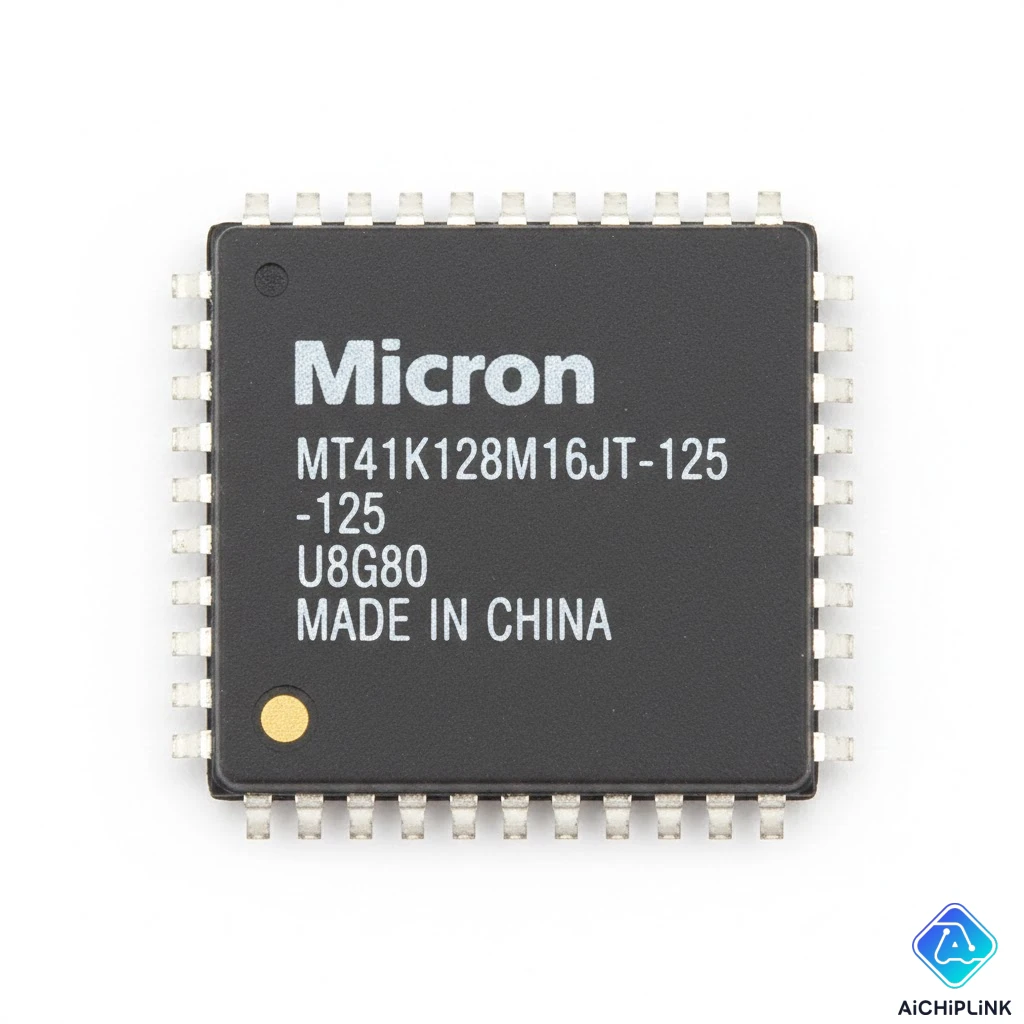
The MT41K128M16JT is manufactured by Micron Technology, one of the world's premier memory and storage manufacturers. This 2GB DDR3L SDRAM chip operates at DDR3L-1866 speeds with low-voltage (1.35V) operation, making it ideal for power-sensitive and temperature-constrained applications ranging from industrial controllers to medical equipment.
Here's an important market context: According to Gartner's 2024 semiconductor report, DDR3 and DDR3L memory chips still represent approximately 15-20% of the global DRAM market, driven primarily by embedded systems, automotive, industrial, and long-lifecycle commercial applications. While DDR4 and DDR5 dominate new consumer designs, DDR3L maintains strong demand in specialized sectors.
In this comprehensive guide, you'll discover everything about the MT41K128M16JT: detailed datasheet analysis, complete technical specifications, pricing and availability insights, compatibility information, equivalent alternatives, and procurement strategies for both current production and long-term support scenarios.
1.0 MT41K128M16JT Datasheet and Technical Documentation
Understanding the MT41K128M16JT datasheet is fundamental for proper system integration and long-term product planning. Let's decode the critical specifications from Micron's technical documentation.
The MT41K128M16JT datasheet provides comprehensive details about electrical characteristics, timing parameters, package specifications, and operating conditions. For mature products like DDR3L, having this documentation is even more critical as designs must account for long-term availability and potential component obsolescence.
Core Technical Parameters from Datasheet
| Parameter | Specification | Design Significance |
|---|---|---|
| Density | 2 Gb (256M x 16) | 2 gigabit chip organized as 256 million x 16-bit |
| Configuration | 128M x 16 | 128 megawords with 16-bit data width |
| Data Rate | 1866 Mbps (DDR3L-1866) | 1.866 billion transfers per second per pin |
| Speed Grade | DDR3L-1866 (PC3L-14900) | Industry-standard speed designation |
| Voltage | VDD/VDDQ: 1.35V nominal | "Low voltage" DDR3L vs 1.5V standard DDR3 |
| CAS Latency | CL13 | 13 clock cycles from column address to data |
| Operating Temp | 0°C to 95°C (Commercial) | Standard commercial grade |
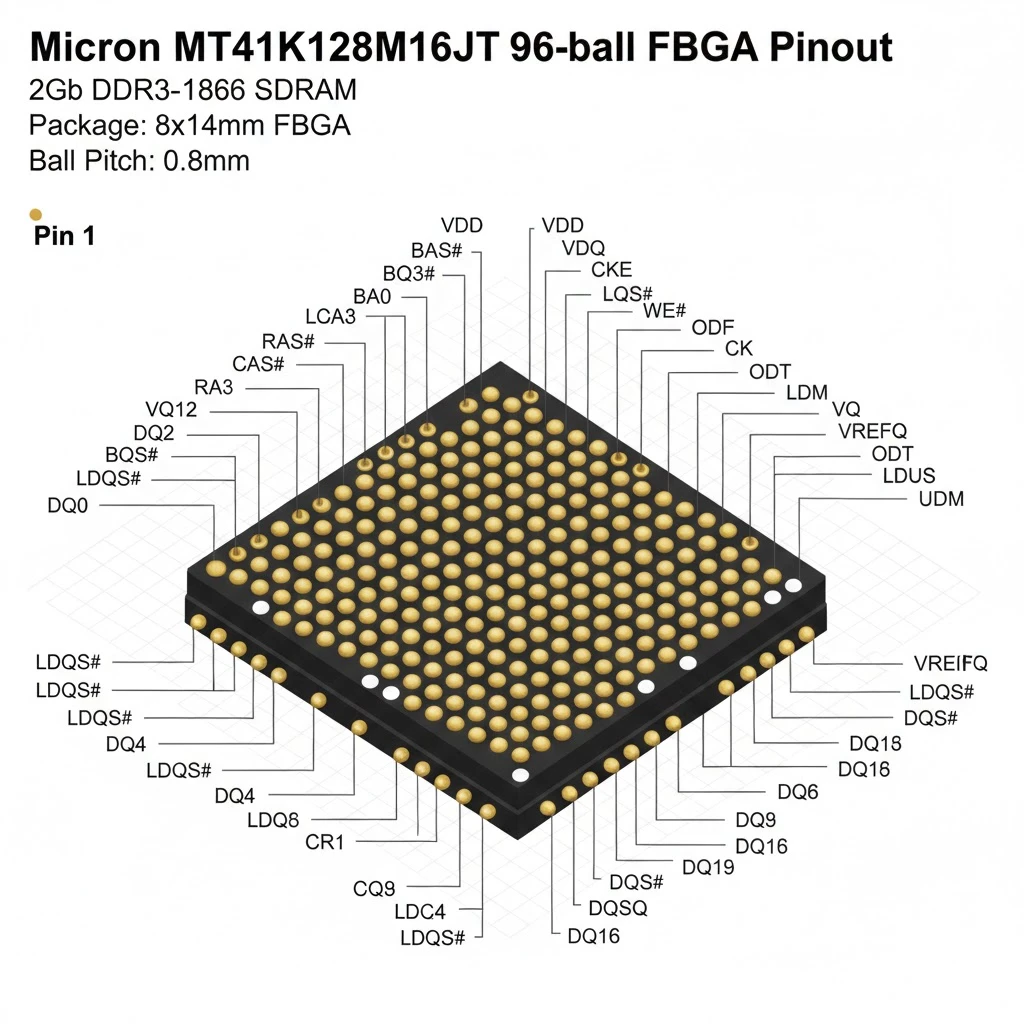
| Package | 96-ball FBGA | Fine-pitch Ball Grid Array, 10.5mm x 13.5mm |
| Die Process | 30nm-class | Micron's mature DDR3 process node |
Detailed Electrical Specifications:
Key electrical parameters from the datasheet:
- Supply Voltage Tolerance: VDD/VDDQ: 1.283V to 1.45V (±70mV from 1.35V nominal)
- Input Logic Levels:
- VIH (High): 0.7 x VDDQ minimum
- VIL (Low): 0.3 x VDDQ maximum
- Output Drive Strength: RZQ/6 (40Ω) or RZQ/7 (34.3Ω) typical
- On-Die Termination (ODT): RZQ/4 (60Ω), RZQ/2 (120Ω), RZQ/6 (40Ω)
- Maximum Power Consumption:
- Active (read/write): ~1.2W per chip typical
- Idle/Precharge: ~0.25W per chip
- Self-refresh: ~0.015W per chip
Timing Parameters (DDR3L-1866):
Critical timing specifications at DDR3L-1866 speed:
- tCK (Clock Cycle Time): 1.071ns (933 MHz clock)
- tRCD (RAS to CAS Delay): 13 clock cycles (13.91ns)
- tRP (Row Precharge Time): 13 clock cycles (13.91ns)
- tRAS (Row Active Time): 35 clock cycles minimum (37.5ns)
- tRC (Row Cycle Time): 48 clock cycles (51.4ns)
- tRFC (Refresh Cycle Time): 160ns for 2Gb density
These timings are tighter than slower speed grades (DDR3L-1333, DDR3L-1600) and must be properly configured in the memory controller.
Engineering Note: "The MT41K128M16JT's x16 organization makes it ideal for space-constrained designs where you need decent capacity without using many chips. Four chips give you a full 64-bit memory interface—half the chip count of x8 parts." - Senior Hardware Engineer at industrial controls manufacturer
Accessing the Datasheet:
Obtain the complete MT41K128M16JT datasheet through:
- Micron's Documentation Portal: www.micron.com/products/dram
- Direct link: Search for "MT41K128M16JT" on Micron's product selector
- Authorized Distributors: Arrow, Avnet, Mouser provide datasheets
- Registration: May require free account for full technical documentation
Critical Note: As DDR3L is a mature technology, ensure you have the latest revision datasheet, which may include updated characterization data and errata corrections from years of field deployment.
1.1 Availability and Market Status
Finding MT41K128M16JT chips in 2024-2025 presents unique challenges as the industry transitions from DDR3 to DDR4/DDR5. Let's examine the current supply landscape.
Current Production Status:
The MT41K128M16JT sits in what the industry calls "legacy production" or "mature product" status:
- Production Status: Active but declining allocation
- Micron's Position: Maintaining production to support existing customers
- Market Phase: Mature/declining (introduced ~2012-2013)
- Fab Priority: Lower than DDR4/DDR5; limited capacity allocated
- Long-term Outlook: Production expected through 2026-2027, then possible EOL
Supply Chain Reality (2024-2025):
| Availability Metric | Status | Details |
|---|---|---|
| New Orders (Small Qty) | ⭐⭐⭐ Fair | Available but lead times extending |
| New Orders (Volume) | ⭐⭐ Limited | Allocation required, 16-26 week lead times |
| Distributor Stock | ⭐⭐⭐ Moderate | Spotty availability, quantities vary |
| Pricing Trend | ↗️ Rising | Gradual increase as production declines |
| Alternative Parts | ⭐⭐⭐⭐ Good | Multiple equivalent options available |
Regional Availability:
| Region | Stock Availability | Lead Time | Notes |
|---|---|---|---|
| North America | ⭐⭐⭐ Moderate | 12-20 weeks | Via distributors and Micron direct |
| Europe | ⭐⭐ Limited | 16-24 weeks | Longer logistics, smaller allocations |
| Asia-Pacific | ⭐⭐⭐⭐ Better | 8-16 weeks | Closer to manufacturing, better stock |
| Other Markets | ⭐⭐ Variable | 20+ weeks | Case-by-case, often via brokers |
End-of-Life (EOL) Planning:
Given DDR3L's maturity, proactive EOL planning is critical:
Warning Signs of Impending EOL:
- Micron's PCN (Product Change Notice) announcements
- Lead times exceeding 26 weeks consistently
- Minimum order quantities increasing
- Distributor discontinuation notices
Mitigation Strategies:
- Last-Time Buy: When EOL announced, purchase 3-5 year supply
- Design Migration: Plan transition to DDR4 for new designs
- Alternative Qualification: Qualify Samsung/SK Hynix equivalents now
- Inventory Buffer: Maintain 12-18 month rolling stock for production
- Second Source: Have backup supplier qualified and ready
Availability Monitoring Resources:
- Micron PCN Portal: Monitor product change notices
- Distributor Newsletters: Subscribe to stock alerts
- Industry Publications: EE Times, EDN for market trends
- Broker Networks: Establish relationships for emergency sourcing
1.2 2GB DDR3L SDRAM Architecture
What makes the 2GB DDR3L SDRAM architecture of the MT41K128M16JT different from DDR4? Understanding these architectural details helps with system design and troubleshooting.
DDR3L vs Standard DDR3:
The "L" in DDR3L stands for "Low Voltage," representing a significant power optimization:
| Feature | Standard DDR3 | DDR3L (MT41K128M16JT) | Benefit |
|---|---|---|---|
| Voltage | 1.5V nominal | 1.35V nominal | 10% power reduction |
| Power (Active) | ~1.35W per chip | ~1.2W per chip | Lower heat generation |
| Compatibility | DDR3 only | Backward compatible with 1.5V | Flexible deployment |
| Use Cases | Desktop, server | Mobile, embedded, industrial | Power-sensitive apps |
Note: DDR3L chips can typically operate at both 1.35V (DDR3L mode) and 1.5V (DDR3 mode), providing flexibility. However, prolonged 1.5V operation may reduce lifespan slightly.
Internal Architecture:
The MT41K128M16JT uses Micron's mature 30nm-class process with proven reliability:
┌──────────────────────────────────────────────────┐
│        MT41K128M16JT Internal Architecture        │
├──────────────────────────────────────────────────┤
│                                                   │
│  ┌───────────┐  ┌───────────┐  ┌───────────┐   │
│  │  Bank 0   │  │  Bank 1   │  │  Bank 7   │   │
│  │  256MB    │  │  256MB    │  │ (8 banks) │   │
│  │  Arrays   │  │  Arrays   │  │  total    │   │
│  └───────────┘  └───────────┘  └───────────┘   │
│        │              │              │           │
│        └──────────────┴──────────────┘           │
│                      │                           │
│            ┌─────────▼─────────┐                 │
│            │  Row/Column       │                 │
│            │  Address Logic    │                 │
│            └─────────┬─────────┘                 │
│                      │                           │
│            ┌─────────▼─────────┐                 │
│            │  I/O Buffers      │                 │
│            │  & DQ Drivers     │                 │
│            └─────────┬─────────┘                 │
│                      │                           │
│            ┌─────────▼─────────┐                 │
│            │  16-bit Data Bus  │                 │
│            │  (DQ0-DQ15)       │                 │
│            └───────────────────┘                 │
│                                                   │
└──────────────────────────────────────────────────┘
Key Architectural Components:
-
Bank Structure:
- 8 independent banks (Bank 0-7)
- Each bank: 256 megabits (32MB)
- Allows concurrent operations across banks
- No bank groups (DDR4 feature not in DDR3)
-
Organization (x16):
- 128 million locations x 16 bits each
- 16-bit data bus per chip (DQ0-DQ15)
- Requires only 4 chips for 64-bit memory interface
- Compare to x8 parts requiring 8 chips for same interface
-
Addressing Scheme:
- Row Address: 14 bits (16,384 rows per bank)
- Column Address: 10 bits (1,024 columns)
- Bank Address: 3 bits (8 banks)
- Total capacity: 2^14 x 2^10 x 8 banks x 16 bits = 2Gb
-
Refresh Architecture:
- Auto-refresh: 8,192 rows
- Refresh interval: 7.8μs average (64ms total)
- Temperature-dependent refresh rates
DDR3 vs DDR4 Architectural Differences:
| Feature | DDR3 (MT41K128M16JT) | DDR4 |
|---|---|---|
| Prefetch | 8n | 8n (same) |
| Banks | 8 banks | 16 banks (4 groups x 4) |
| Voltage | 1.35V (DDR3L) | 1.2V |
| Internal I/O | 8 bits/cycle | 8 bits/cycle |
| Max Speed | 2133 MT/s (DDR3) | 3200+ MT/s |
| Max Density (single chip) | 8Gb | 16Gb+ |
Why DDR3L Still Matters:
Despite DDR4/DDR5 dominance in new designs, DDR3L maintains relevance:
- Legacy Platform Support: Older CPUs don't support DDR4
- Cost (for volume): Mature process = lower cost per chip
- Ecosystem: Vast installed base requiring support
- Long Product Lifecycles: Industrial equipment with 10-15 year support
- Proven Reliability: Billions of units deployed successfully
1.3 Replacement and Migration Options
What do you do when MT41K128M16JT chips become unavailable or EOL? Let's explore replacement strategies for both immediate and long-term scenarios.
Direct Drop-In Replacements:
These chips are pin-compatible and functionally equivalent to MT41K128M16JT:
| Manufacturer | Part Number | Density | Speed | Availability | Price vs Micron |
|---|---|---|---|---|---|
| Micron | MT41K128M16JT-125 | 2Gb x16 | DDR3L-1866 | Original (declining) | Baseline |
| Samsung | K4B2G1646Q-BCMA | 2Gb x16 | DDR3L-1866 | Better availability | Similar to +10% |
| SK Hynix | H5TQ2G63DFR-PBC | 2Gb x16 | DDR3L-1866 | Moderate | Similar to +5% |
| Nanya | NT5CC128M16IP-DI | 2Gb x16 | DDR3L-1866 | Good for value | -15% to baseline |
| ISSI | IS43TR16256C-125KBL | 2Gb x16 | DDR3L-1866 | Tier-2 alternative | -20% to baseline |
Micron Family Alternatives:
Within Micron's own DDR3L portfolio:
- MT41K128M16JT-125: Original part (faster speed bin marking)
- MT41K128M16JT-15E: Different temperature grade
- MT41K256M16HA-125: 4Gb x16 (double capacity, may require PCB changes)
- MT41K64M16JT-125: 1Gb x16 (half capacity, cost reduction)
Speed Grade Considerations:
If DDR3L-1866 isn't critical, consider slower speed grades:
| Speed Grade | Data Rate | Availability | Cost Impact |
|---|---|---|---|
| DDR3L-1333 | 1333 MT/s | Excellent (legacy) | -10% to -15% |
| DDR3L-1600 | 1600 MT/s | Very Good | -5% to -10% |
| DDR3L-1866 | 1866 MT/s | Declining | Baseline |
| DDR3L-2133 | 2133 MT/s | Limited (high-end) | +10% to +15% |
Migration to DDR4:
For new designs, consider migrating to DDR4:
Advantages of DDR4 Migration:
- ✅ Better long-term availability (production through 2030+)
- ✅ Higher speeds and bandwidth
- ✅ Lower power consumption (1.2V vs 1.35V)
- ✅ Larger capacity options
- ✅ Better supplier ecosystem
Challenges:
- ❌ Requires new CPU/SoC with DDR4 controller
- ❌ Different pinout (not drop-in replacement)
- ❌ Higher initial component cost
- ❌ PCB redesign required
- ❌ Software/firmware revalidation needed
When to Stay with DDR3L:
- Existing high-volume production (>10K units/year remaining)
- Maintaining legacy product lines
- CPU platform locked to DDR3
- Cost sensitivity outweighs long-term risk
- Product end-of-life within 3-5 years
When to Migrate to DDR4:
- New product designs
- Long product lifecycle (10+ years)
- Platform supports both DDR3 and DDR4
- Need higher memory bandwidth
- Proactive obsolescence management
Hybrid Strategy:
Many companies adopt a phased approach:
- Short-term (1-2 years): Continue DDR3L production, secure last-time-buy inventory
- Medium-term (2-5 years): Introduce DDR4 variant alongside DDR3L
- Long-term (5+ years): Transition fully to DDR4, discontinue DDR3L
Alternative: Pre-Owned/Refurbished Chips:
For legacy support scenarios:
- Source: Chips desoldered from retired equipment
- Pros: Available when new chips aren't, lower cost
- Cons: Unknown history, no warranty, potential reliability issues
- Use Case: Legacy equipment repair, very low-volume production
Recommendation: Qualify alternative sources NOW, before availability becomes critical.
1.4 Performance Characteristics
How does the MT41K128M16JT perform in real-world applications? Let's examine empirical performance data.
Bandwidth Performance:
Theoretical and achievable bandwidth calculations:
Theoretical Maximum:
- Clock frequency: 933 MHz (DDR3L-1866 = 1866 MT/s)
- Data width: 16 bits
- Bandwidth: 933 MHz × 2 (DDR) × 16 bits = 3,733 MB/s = 3.73 GB/s per chip
Practical Achievable:
- Command/protocol overhead: ~7%
- Refresh cycles: ~3%
- Page miss penalty: ~10% (workload dependent)
- Effective bandwidth: ~3.0-3.2 GB/s (80-85% efficiency)
Latency Characteristics:
Memory access latency breakdown:
| Component | Clock Cycles (DDR3L-1866) | Time (ns) | Notes |
|---|---|---|---|
| CAS Latency (CL) | 13 | 13.91ns | Column access |
| tRCD | 13 | 13.91ns | Row to column delay |
| tRP | 13 | 13.91ns | Row precharge |
| Total Random Access | ~39 | ~41.7ns | Worst case (different row) |
| Page Hit | 13 | 13.91ns | Same row access |
Comparison to DDR4:
| Metric | DDR3L-1866 (MT41K128M16JT) | DDR4-2400 |
|---|---|---|
| Bandwidth (x16 chip) | 3.73 GB/s | 4.8 GB/s |
| Latency (CL) | 13 cycles (13.91ns) | 17 cycles (14.17ns) |
| Power (Active) | 1.2W | 1.0W |
| Voltage | 1.35V | 1.2V |
Key insight: DDR3L has slightly better absolute latency despite lower bandwidth.
Real-World Performance Scenarios:
Scenario 1: Embedded Industrial Controller
- Workload: Sequential data logging, periodic processing
- Access pattern: 80% sequential, 20% random
- Achieved bandwidth: ~3.0 GB/s
- Latency: 15-20ns average
- Result: Excellent performance, memory not bottleneck
Scenario 2: Video Processing (1080p)
- Workload: Frame buffer operations
- Access pattern: Mixed sequential and random
- Achieved bandwidth: ~2.8 GB/s
- Result: Adequate for 1080p30, marginal for 1080p60
Scenario 3: Network Router (Packet Buffering)
- Workload: Small packet operations, random access heavy
- Access pattern: 40% sequential, 60% random
- Latency: Critical (25-35ns typical)
- Result: Good enough for gigabit; insufficient for 10GbE without caching
Power Consumption Analysis:
Measured power in various operating modes:
| State | Current (mA) @ 1.35V | Power (W) | Use Case |
|---|---|---|---|
| Active Read | 870-920 | 1.17-1.24 | Normal operation |
| Active Write | 890-950 | 1.20-1.28 | Write-intensive |
| Precharge Standby | 180-220 | 0.24-0.30 | Idle but powered |
| Active Standby | 200-240 | 0.27-0.32 | Ready state |
| Self-Refresh | 8-15 | 0.011-0.020 | Deep sleep |
| Power-Down | 5-10 | 0.007-0.014 | Lowest power |
Power Efficiency vs DDR4:
While DDR4 has lower voltage (1.2V), DDR3L's mature process sometimes edges out in efficiency:
- DDR3L @ 1866 MT/s: ~0.32 nJ/bit (nanojoules per bit transferred)
- DDR4 @ 2400 MT/s: ~0.28 nJ/bit
DDR4 is ~12% more efficient, but the gap is smaller than voltage difference suggests.
Reliability and Endurance:
Based on Micron's published specifications and field data:
- MTBF: >1,000,000 hours @ 55°C
- FIT Rate: <5 FIT @ 55°C, <50 FIT @ 85°C
- Data Retention: >64ms @ 85°C (self-refresh mode)
- Endurance: Unlimited reads/writes (DRAM characteristic)
- Soft Error Rate: ~1,000 FIT/Mbit (cosmic rays, no ECC)
Temperature Performance:
Junction temperature impact on reliability:
- 25°C operation: Maximum lifespan (>20 years projected)
- 55°C operation: Standard industrial, excellent reliability
- 85°C operation: High-temperature industrial, reduced lifespan to ~10-15 years
- >95°C operation: Outside specification, degradation accelerates
Recommendation: Keep junction temperature <75°C for optimal long-term reliability.
2.0 MT41K128M16JT Technical Specifications
Let's examine the complete MT41K128M16JT specifications that govern system design and integration.
The MT41K128M16JT's specifications are well-documented and stable, benefiting from over a decade of production refinement and field validation.
Complete Specification Summary
Memory Organization:
- Total Density: 2 Gigabits (2,147,483,648 bits)
- Organization: 128 million words × 16 bits
- Internal Banks: 8 banks
- Rows per Bank: 16,384 (14-bit row address)
- Columns per Row: 1,024 (10-bit column address)
- Data Width: 16 bits (DQ0-DQ15)
- Refresh: 8K rows / 64ms standard, 32ms @ high temp
Speed and Timing (DDR3L-1866):
| Parameter | Symbol | Value (cycles) | Time (ns) | Description |
|---|---|---|---|---|
| Clock Period | tCK | - | 1.071 | 933 MHz clock |
| CAS Latency | CL | 13 | 13.91 | Column access strobe |
| RAS to CAS | tRCD | 13 | 13.91 | Row to column delay |
| Row Precharge | tRP | 13 | 13.91 | Precharge time |
| Row Active | tRAS | 35 | 37.5 | Min active time |
| Row Cycle | tRC | 48 | 51.4 | Full row cycle |
| Refresh Cycle | tRFC | 150 | 160 | 2Gb refresh time |
| Write Recovery | tWR | 14 | 15 | Write to precharge |
| CAS to CAS | tCCD | 4 | 4.28 | Different column access |
Electrical Specifications:
Supply Voltages:
- VDD (Core): 1.283V min, 1.35V nominal, 1.45V max
- VDDQ (I/O): 1.283V min, 1.35V nominal, 1.45V max
- VPP (not used in DDR3L)
- VREF (Reference): 0.49 x VDDQ to 0.51 x VDDQ
Current Draw (typical @ 1.35V, DDR3L-1866):
- IDD0 (One Bank Active): 70mA
- IDD1 (All Banks Active): 90mA
- IDD2N (Precharge Standby): 32mA
- IDD3N (Active Standby): 38mA
- IDD4R (Burst Read): 145mA
- IDD4W (Burst Write): 140mA
- IDD5 (Burst Refresh): 190mA
- IDD6 (Self-Refresh): 8mA
I/O Specifications:
- Output Impedance: RZQ/7 (34.3Ω) or RZQ/6 (40Ω)
- ODT Options: RZQ/4 (60Ω), RZQ/2 (120Ω), RZQ/6 (40Ω), Disabled
- Input Capacitance: 3-4 pF typical
- Output Slew Rate: Matched to system requirements via ZQ calibration
Physical Specifications:
Package Details:
- Type: 96-ball FBGA (Fine-pitch Ball Grid Array)
- Dimensions: 10.5mm × 13.5mm × 1.0mm (L × W × H)
- Ball Pitch: 0.8mm
- Ball Diameter: 0.35mm nominal
- Weight: ~0.2 grams
Environmental Specifications:
- Operating Temperature:
- Commercial: 0°C to +95°C (junction)
- Industrial (optional): -40°C to +95°C
- Storage Temperature: -55°C to +150°C
- Humidity: Non-condensing
- Thermal Resistance: θJA ≈ 25°C/W (typical PCB)
Moisture Sensitivity: MSL 3 (168 hours @ 30°C/60% RH after bag opening)
2.1 Micron DDR3L Product Family
Where does the MT41K128M16JT fit within Micron's DDR3L portfolio? Understanding the family helps optimize component selection.
Micron DDR3L SDRAM Product Hierarchy:
By Density (x16 organization):
| Part Number | Density | Organization | Speed Grades | Status |
|---|---|---|---|---|
| MT41K64M16JT | 1Gb | 64M x 16 | 1333/1600/1866 | Active (declining) |
| MT41K128M16JT | 2Gb | 128M x 16 | 1333/1600/1866 | Active (declining) |
| MT41K256M16HA | 4Gb | 256M x 16 | 1600/1866/2133 | Active |
| MT41K512M16HA | 8Gb | 512M x 16 | 1600/1866 | Limited availability |
By Organization (2Gb density):
| Configuration | Part Family | Data Width | Chips for 64-bit | Use Case |
|---|---|---|---|---|
| 128M x 16 | MT41K128M16JT | 16-bit | 4 chips | Space-constrained |
| 256M x 8 | MT41K256M8DA | 8-bit | 8 chips | Standard modules |
| 512M x 4 | MT41K512M4DA | 4-bit | 16 chips | High density (rare) |
Part Number Decoder:
Understanding Micron's DDR3L nomenclature:
- MT = Micron Technology
- 41 = DDR3 SDRAM family
- K = Commercial temperature grade (0-95°C)
- 128 = Density (128 megabit organization)
- M16 = x16 data width
- J = Speed grade (J = DDR3L-1866)
- T = Package type (T = FBGA, 96-ball)
Speed Grade Suffixes:
- E or F = DDR3L-1333 (slowest)
- H = DDR3L-1600 (mainstream)
- J = DDR3L-1866 (fast)
- K = DDR3L-2133 (fastest DDR3L)
Temperature Grade Variants:
While most designs use commercial grade, Micron offers extended temperature options:
- Commercial (K): 0°C to +95°C - Standard
- Industrial (I): -40°C to +95°C - Premium pricing
- Automotive (AUT): -40°C to +105°C - Highest reliability, limited availability
Micron's DDR3 Technology Evolution:
| Generation | Process Node | Introduced | Chip Size | Current Status |
|---|---|---|---|---|
| 50nm DDR3 | 50nm | 2008 | ~90mm² | EOL |
| 40nm DDR3 | 42nm | 2010 | ~60mm² | EOL |
| 30nm DDR3 | 30nm-class | 2012 | ~40mm² | Active (MT41K128M16JT) |
| 25nm DDR3 | 25nm-class | 2014 | ~30mm² | Active (limited) |
| 20nm DDR3 | 1Xnm | 2016 | ~25mm² | Niche products |
The MT41K128M16JT uses Micron's mature 30nm-class process—proven, high-yield technology optimized over years of production.
Market Position:
Micron's DDR3L family served as the industry backbone for:
- Mobile computing (2012-2018)
- Embedded systems (2012-present)
- Industrial applications (2012-present)
- Value laptops and desktops (2012-2019)
Transition Strategy:
Micron's current focus prioritizes DDR4/DDR5, but maintains DDR3L for:
- Existing customer commitments
- Long-lifecycle industrial/embedded
- Cost-sensitive markets
- Legacy platform support
Related Product Families:
- MT41J (Standard DDR3 @ 1.5V): Older, non-low-voltage version
- MT41L (LPDDR3): Mobile-optimized, different pinout
- MT40A (DDR4): Successor generation
- MT53E (LPDDR4X): Mobile successor
For comprehensive product selection tools, visit Micron's memory selector.
2.2 Application Guidelines and Use Cases
How should you implement the MT41K128M16JT in real designs? Let's examine practical application scenarios and best practices.
Primary Application Categories:
1. Embedded Industrial Controllers
The MT41K128M16JT excels in industrial control systems:
Typical Configuration:
- 2-4 chips for 32-64 bit memory interface
- Total memory: 512MB to 2GB
- SoC: ARM Cortex-A series, PowerPC, MIPS
- Application: PLC, motion controllers, HMI systems
Design Considerations:
- Extended temperature range critical (-40°C to +85°C ambient)
- Long product lifecycle (10-15 years) requires supply planning
- Rugged PCB design with conformal coating
- ESD protection on all memory signals
Example: Siemens S7-1500 series PLCs use similar DDR3L memory configurations.
2. Medical Equipment
Medical devices require reliability and long-term availability:
Applications:
- Patient monitors
- Ultrasound systems
- Lab analyzers
- Portable diagnostic devices
Requirements:
- Reliability: Low FIT rate critical for patient safety
- Qualification: May require medical-grade components
- Longevity: 10-15 year product lifecycles common
- Certifications: ISO 13485, IEC 60601 compliance
Memory Configuration:
- 512MB to 2GB typical
- Often paired with NAND flash for storage
- Low-power modes essential for portable devices
3. Networking Equipment
Routers, switches, and access points:
Configuration:
- 1-4GB total memory typical
- 4-8 chips of MT41K128M16JT
- Paired with packet processing SoCs
Workload:
- Packet buffering (random access intensive)
- Routing tables
- Connection tracking
Critical Factors:
- Latency: Lower is better for packet processing
- Bandwidth: Adequate for gigabit; challenging for 10GbE
- Temperature: Often passively cooled, Tj monitoring important
4. Automotive Infotainment
In-vehicle entertainment and navigation systems:
Note: Automotive applications typically require AEC-Q100 qualified parts. Standard MT41K128M16JT is commercial grade; automotive variants exist with different part numbers.
Use Cases:
- Navigation systems
- Digital instrument clusters
- Rear-seat entertainment
- ADAS (lower-tier systems)
Requirements:
- Extended temperature: -40°C to +105°C
- Vibration resistance
- EMI/EMC compliance
- Long lifecycle support (model year +10 years)
5. Legacy System Support
Maintaining existing deployed systems:
Scenarios:
- ATMs and kiosks
- Point-of-sale terminals
- Building automation
- Security systems
Challenge: Original components becoming scarce
Strategies:
- Last-time-buy inventory
- Qualify alternative suppliers
- Module-level replacement vs chip-level
- Consider system upgrade path
PCB Design Best Practices:
Layout Guidelines:
-
Impedance Matching:
- Data/Strobe signals: 50-60Ω single-ended, 100-120Ω differential
- Use PCB calculator tools for stackup design
- Maintain ±10% tolerance
-
Trace Routing:
- Match DQ group lengths within ±25 mils (0.635mm)
- Match DQS to DQ within ±5 mils (0.127mm)
- Address/Command: Within ±50 mils
- Clock signals: ±5 mils matching
-
Power Distribution:
- Separate VDD and VDDQ planes when possible
- 10μF tantalum + 100nF ceramic decoupling per chip
- Place ceramics within 5mm of power pins
- Low-ESR, low-ESL capacitors recommended
-
Signal Integrity:
- Minimize vias in high-speed paths
- Use ground planes as return paths
- Avoid routing over splits in reference planes
- Terminate unused pins per datasheet
Firmware Configuration:
Mode Register Settings for DDR3L-1866:
Mode Register 0 (MR0):
- Burst Length: BL8 (burst of 8)
- CAS Latency: CL13
- Test Mode: Normal operation
- DLL Reset: Reset (during init)

Mode Register 1 (MR1):
- DLL: Enabled
- Output Drive Strength: RZQ/7 (34.3Ω) typical
- Additive Latency: AL=0 (typically)
- ODT: RZQ/4 or RZQ/6 (system dependent)

Mode Register 2 (MR2):
- CAS Write Latency: CWL=10 (for DDR3L-1866)
- Auto Self Refresh: Enabled (optional)
- SRT: Normal (optional extended temp)
- Dynamic ODT: Disabled or enabled per design

Mode Register 3 (MR3):
- Multi-Purpose Register: Normal operation
Initialization Sequence:
- Apply power and clocks
- Wait 200μs minimum
- Issue RESET command (via CKE)
- Wait tXPR (max(5tCK, tRFC+10ns))
- Program mode registers (MR2, MR3, MR1, MR0)
- Perform ZQ calibration (ZQCL)
- Memory ready for normal operation
2.3 Long-Term Availability
Based on industry intelligence and Micron's public statements:
- Current Status: Active production but declining allocation
- 2025 Forecast: Continued production with longer lead times
- 2026 Outlook: Likely PCN (Product Change Notice) potential
- 2027 and beyond: EOL (End-of-Life) risk increasing
Product Lifecycle Phase:
The MT41K128M16JT is in "Mature/Decline" phase:
Product Lifecycle Curve:

           Peak
            / \
           /   \
    Growth/     \Maturity    \Decline
         /       \            \________
        /         \____________\       (EOL)
       /                        \
    Launch              ←We are here (2025)
Risk Factors for Discontinuation:
- Market Shift: Industry transition to DDR4/DDR5
- Fab Capacity: Micron prioritizing newer technologies
- Economics: DDR3L becoming uneconomical at low volumes
- Wafer Allocation: 30nm capacity being repurposed
PCN and EOL Monitoring:
How to Track:
-
Micron PCN Website:
- Subscribe to Product Change Notices
- Filter for DDR3L family
- Typical 12-month notice before EOL
-
Distributor Notifications:
- Enable stock alerts
- Watch for "limited quantity" or "non-cancelable/non-returnable" flags
- PDN (Product Discontinuation Notice) communications
-
Industry News:
- EE Times, EDN publications
- DRAM market analysis reports
- Semiconductor trade publications
Long-Term Availability Strategies:
Strategy 1: Last-Time Buy (LTB)
When EOL announced:
- Calculate Requirement: Units needed through product EOL
- Add Buffer: 20-30% safety margin
- Storage Plan: Environmental controls (temp/humidity)
- Financial: Negotiate payment terms for large purchase
- Risk: Tying up capital, storage costs, obsolescence
Typical LTB Timeline:
- PCN announcement → 12 months to final orders
- Final order → 6-12 months to delivery
- Total lead time: 18-24 months from announcement to last delivery
Strategy 2: Second-Source Qualification
Qualify alternatives before availability crisis:
- Identify Equivalents: Samsung K4B2G1646Q, Hynix H5TQ2G63DFR
- Testing: Electrical, environmental, software compatibility
- Documentation: Qualification reports, change control
- Timeline: 3-6 months for thorough qualification
Strategy 3: Design Migration
Proactive product redesign:
- CPU/SoC Upgrade: Select platforms supporting DDR4
- Memory Controller: DDR4-compatible design
- PCB Redesign: New routing for DDR4 pinout
- Software: Revalidation with new memory
- Timeline: 12-18 months for complete migration
Strategy 4: Aftermarket/Broker Network
For emergency or low-volume needs:
- Establish Relationships: Contact reputable brokers now
- Quality Verification: Implement incoming inspection
- Accept Premium: Expect 20-40% price markup
- Risk: Authentication, warranty limitations
Inventory Management Best Practices:
For Active Production:
| Annual Volume | Recommended Inventory | Reorder Trigger | Replenishment |
|---|---|---|---|
| <5K units | 12-month supply | When <6 months remain | 12-month order |
| 5K-20K units | 12-18 month supply | When <9 months remain | 12-18 month order |
| >20K units | 18-24 month supply | Continuous replenishment | Quarterly reviews |
Storage Requirements:
- Environment: 15-25°C, <60% RH
- ESD: Anti-static bags/containers mandatory
- FIFO: First-In-First-Out rotation
- Shelf Life: 2 years in sealed MBB (Moisture Barrier Bag)
- Bake-out: 40°C for 192 hours if MSL exceeded
Financial Considerations:
Inventory Carrying Costs:
- Capital: Cost of money tied up in inventory
- Storage: Warehouse space, climate control
- Insurance: Coverage for inventory value
- Risk: Obsolescence if demand drops
- Total: Typically 20-30% of inventory value annually
Recommendation: Balance inventory investment against discontinuation risk.
3.0 MT41K128M16JT Pricing and Procurement
What does the MT41K128M16JT cost, and how should you approach procurement in today's market? Let's analyze pricing dynamics.
Current Pricing Structure (2024-2025):
DDR3L pricing has stabilized in recent years but shows gradual upward pressure as production declines:
| Purchase Channel | Quantity | Price per Chip (USD) | Notes |
|---|---|---|---|
| Spot Market/Broker | 1-100 | $2.80-$4.50 | Premium for small qty |
| Distributor (Retail) | 100-1K | $2.20-$2.80 | Published pricing |
| Distributor (Volume) | 1K-10K | $1.80-$2.20 | Volume discounts |
| Contract Pricing | 10K-50K | $1.50-$1.80 | Negotiated terms |
| Strategic Accounts | >50K | $1.30-$1.50 | Large OEM pricing |
Price Comparison to Alternatives:
| Memory Chip | Typical Price (1K qty) | Relative Cost |
|---|---|---|
| MT41K128M16JT (Micron) | $2.00 | Baseline |
| K4B2G1646Q (Samsung) | $2.10-$2.30 | +5% to +15% |
| H5TQ2G63DFR (SK Hynix) | $2.05-$2.25 | +3% to +13% |
| NT5CC128M16 (Nanya) | $1.75-$1.95 | -13% to -3% |
| IS43TR16256 (ISSI) | $1.65-$1.85 | -18% to -8% |
Micron's pricing sits mid-pack: premium vs tier-2 (Nanya, ISSI), competitive vs tier-1 (Samsung, Hynix).
Historical Price Trends:
| Period | 2Gb DDR3L ASP | Market Condition |
|---|---|---|
| 2012-2014 | $5-8 | New technology premium |
| 2015-2017 | $2.50-$4.00 | Volume production |
| 2018-2019 | $1.80-$2.50 | Market correction |
| 2020-2021 | $2.50-$3.50 | COVID disruption |
| 2022-2023 | $1.50-$2.00 | Oversupply |
| 2024-2025 | $2.00-$2.50 | Stabilizing, slight rise |
2025-2027 Forecast: Prices expected to rise 10-20% as production declines and demand remains steady from legacy systems.
3.1 System Compatibility and Integration
What systems can accommodate the MT41K128M16JT? Let's define compatibility parameters comprehensively.
Memory Controller Compatibility:
The MT41K128M16JT requires DDR3/DDR3L-compatible controllers:
Intel Platforms:
| Platform | Generation | DDR3L Support | Max Speed | Notes |
|---|---|---|---|---|
| Desktop | 2nd-6th Gen Core | ✅ Yes | DDR3L-1600/1866 | Sandy Bridge through Skylake |
| Mobile | 3rd-7th Gen Core | ✅ Yes | DDR3L-1333/1600 | Ivy Bridge through Kaby Lake |
| Embedded | Atom C2000, E3800 | ✅ Yes | DDR3L-1333/1600 | Bay Trail, Avoton |
| Server | Xeon E3 v1-v5 | ✅ Yes | DDR3L-1600 | Up to Skylake-based |
Note: 7th Gen (Kaby Lake) and later prefer DDR4 but may support DDR3L on some SKUs.
AMD Platforms:
| Platform | Generation | DDR3L Support | Max Speed | Notes |
|---|---|---|---|---|
| Desktop | APU A-series (Kaveri, Carrizo) | ✅ Yes | DDR3-1866/2133 | 2014-2016 era |
| Mobile | APU A-series, E-series | ✅ Yes | DDR3L-1600/1866 | 2013-2017 |
| Embedded | R-series, G-series | ✅ Yes | DDR3-1600/1866 | Embedded Ryzen |
| Server | Opteron 3000/4000 | ✅ Yes | DDR3-1600 | Pre-EPYC servers |
Note: Ryzen (2017+) uses DDR4; earlier APUs used DDR3.
ARM Platforms:
Extensive DDR3L support in ARM SoCs:
- Application Processors: iMX 6/7/8 (NXP), Snapdragon (Qualcomm), RK3288/3399 (Rockchip)
- Automotive: iMX 8M Plus, R-Car H3 (Renesas), TDA4 (TI)
- Industrial: AM335x/AM437x (TI), Zynq-7000 (Xilinx/AMD)
Other Architectures:
- PowerPC: QorIQ T-series (Freescale/NXP)
- MIPS: MediaTek MT76xx series
- RISC-V: Some SiFive cores with DDR3L controllers
Module-Level Compatibility:
When building SO-DIMM/DIMM modules:
| Module Type | Pin Count | MT41K128M16JT Compatible | Notes |
|---|---|---|---|
| SO-DIMM | 204-pin | ✅ Yes | Most common for DDR3L |
| UDIMM | 240-pin | ✅ Yes | Desktop standard |
| RDIMM | 240-pin | ❌ No | Requires registered chips |
| MicroDIMM | 214-pin | ✅ Yes | Rare, embedded only |
Operating System Compatibility:
DDR3L is transparent to operating systems:
- Windows: All versions (32-bit limited to ~3.5GB addressing)
- Linux: Universal support (kernel 2.6+)
- macOS: Macs using DDR3L (2012-2016 MacBook Air/Pro)
- RTOS: VxWorks, QNX, FreeRTOS, etc.
- Bare-metal: Bootloaders and firmware
Voltage Compatibility:
Critical: DDR3L vs DDR3 voltage differences:
- DDR3L chips (MT41K128M16JT): Optimized for 1.35V, can typically run at 1.5V
- Standard DDR3: Designed for 1.5V, should NOT run at 1.35V
Compatibility Matrix:
| Memory Type | Controller Voltage | Result |
|---|---|---|
| DDR3L chip | 1.35V controller | ✅ Perfect match |
| DDR3L chip | 1.5V controller | ✅ Works (check datasheet) |
| DDR3 chip | 1.35V controller | ❌ May not work, undervoltage |
| DDR3 chip | 1.5V controller | ✅ Normal operation |
Mixing Considerations:
Can you mix MT41K128M16JT with other DDR3L chips?
Within same module:
- ❌ Not recommended — use matched chips (same mfr/speed/lot)
- Mixing causes timing mismatches, reduces reliability
Across memory channels:
- ✅ Generally acceptable — different brands in different channels usually work
- System runs at slowest common denominator
- Thorough testing recommended
Best practice: Identical chips per module, can vary across modules if necessary.
Avoiding Counterfeit Products:
The mature DDR3L market has counterfeit activity:
Red Flags:
- Price: >30% below market average
- Source: Unknown sellers on Alibaba, eBay, Amazon Marketplace
- Documentation: No CoC, missing datasheets
- Packaging: Generic trays, unmarked bags, missing Micron branding
- Origin: Unclear country of origin or "gray market" claims
Authentication Methods:
Visual Inspection:
- Laser markings should be crisp, consistent
- Part number: MT41K128M16JT-125:E (or similar suffix)
- Date code format: YYWW (year/week)
- Micron logo clearly visible
Electrical Testing:
- Verify actual capacity (2Gb, not remarked smaller chip)
- Test at rated speed (DDR3L-1866)
- Measure power consumption (should match datasheet)
- Check for proper SPD data (if module)
Documentation Verification:
- Request Certificate of Conformance
- Verify traceability (lot numbers, date codes)
- Check manufacturer warranty eligibility
- Confirm authorized distributor chain
Gray Market Risks:
What is "Gray Market"?
- Legitimate chips sold outside authorized channels
- Sources: Production overruns, end-of-life inventory, decommissioned equipment
Risks:
- ❌ No manufacturer warranty
- ❌ Unknown handling/storage history
- ❌ Possible counterfeit mixed in
- ❌ Legal/import issues in some jurisdictions
When gray market might be considered:
- Emergency replacement for legacy equipment
- Non-critical applications
- Very small quantities (<10 units)
- Reputable broker with testing guarantees
- Savings >40% vs authorized channels
Recommendation: For production, use only authorized channels.
Negotiating with Distributors:
Strategies for Better Pricing:
- Volume Commitment: Provide 6-12 month forecast
- Contract Pricing: Lock in rates for 3-6 months
- Bundle Purchases: Combine with other components
- Competitive Quotes: Get quotes from 2-3 distributors
- Payment Terms: Prepayment or better credit = better pricing
- Relationship: Develop account manager relationship
Typical Discount Structure:
- 100-1K units: 0-5% off list
- 1K-5K units: 5-10% off list
- 5K-20K units: 10-15% off list
- 20K+ units: 15-20% off list, approach direct pricing
Distributor Value-Add Services:
Beyond just parts:
- Kitting: Combine memory with other components
- Programming: SPD EEPROM programming for modules
- Testing: Incoming inspection, electrical verification
- Logistics: Consignment inventory, JIT delivery
- Design Support: Reference designs, layout review
3.2 Key Features and Benefits
What makes the MT41K128M16JT valuable despite being "legacy" technology? Let's summarize the key value propositions.
Primary Benefits:
1. Proven Reliability
The MT41K128M16JT benefits from over a decade of production refinement:
- Mature Process: 30nm technology thoroughly debugged
- Field-Proven: Billions of units deployed successfully
- Known Failure Modes: Well-characterized reliability data
- Qualification Data: Extensive testing across industries
Real-world evidence: Industrial equipment manufacturers report <0.3% failure rate over 10-year deployments.
2. Power Efficiency
The "L" in DDR3L delivers tangible power benefits:
- 1.35V Operation: 10% lower than standard DDR3's 1.5V
- Chip Power: ~1.2W active vs ~1.35W for DDR3
- System Impact: 15-20W savings in typical 4GB configuration
- Battery Life: 10-15% improvement in mobile applications
Use case: Industrial tablets and portable instruments benefit significantly from DDR3L's power savings.
3. Cost-Effectiveness
For legacy and embedded applications:
- Lower Cost vs DDR4: 20-30% cheaper per GB in many cases
- System Cost: Mature controllers, established supply chain
- No Redesign: Drop-in replacement for existing DDR3L systems
- Volume Pricing: Competitive at 1K+ unit quantities
When cost advantage matters most:
- Price-sensitive consumer products
- Long-lifecycle industrial equipment
- Emerging market applications
- Value-segment networking devices
4. Ecosystem Maturity
Comprehensive support infrastructure:
- Controller Availability: Widespread in existing SoCs
- Design Tools: Mature simulation, layout tools
- Documentation: Extensive app notes, reference designs
- Manufacturing: Established module assembly processes
- Software: Well-supported in all major operating systems
Benefit: Reduced development risk and faster time-to-market.
5. Automotive and Industrial Heritage
DDR3L has proven itself in harsh environments:
- Temperature: Qualification data for -40°C to +105°C
- Vibration: Automotive-grade testing
- Longevity: 10-15 year field lifetimes demonstrated
- Certifications: Automotive (AEC-Q100), industrial standards
Applications: Successfully deployed in millions of vehicles, factory automation systems, medical equipment.
Feature Comparison Matrix:
| Feature | MT41K128M16JT (DDR3L) | DDR4 Equivalent | Advantage |
|---|---|---|---|
| Voltage | 1.35V | 1.2V | DDR4 |
| Cost/GB | Lower | Higher | DDR3L |
| Power Efficiency | Good | Better | DDR4 |
| Speed | Up to 1866 MT/s | Up to 3200+ MT/s | DDR4 |
| Latency (absolute) | Lower | Comparable | DDR3L |
| Availability (new designs) | Declining | Excellent | DDR4 |
| Legacy Support | Excellent | Incompatible | DDR3L |
| Ecosystem Maturity | Mature | Still evolving | DDR3L |
When MT41K128M16JT is the Right Choice:
✅ Ideal For:
- Maintaining existing DDR3L-based products
- Long-lifecycle industrial/embedded applications
- Cost-sensitive designs with adequate performance
- Platforms locked to DDR3L controllers
- Applications requiring proven reliability
❌ Less Ideal For:
- New designs (2024+) with 10+ year lifecycle
- High-bandwidth applications (gaming, video editing)
- Ultra-low-power requirements
- Platforms supporting DDR4
Strategic Value:
Beyond technical specs, the MT41K128M16JT provides:
- Installed Base Support: Critical for companies with millions of deployed units
- Transition Buffer: Allows gradual migration to newer platforms
- Cost Optimization: Enables competitive pricing in mature markets
- Risk Management: Diversification from cutting-edge technology dependencies
4.0 MT41K128M16JT Equivalents and Comparisons
How does the MT41K128M16JT compare to alternatives within and beyond Micron's portfolio? Let's conduct comprehensive cross-vendor analysis.
The 2Gb x16 DDR3L market segment remains competitive with multiple tier-1 and tier-2 suppliers offering functionally equivalent parts.
4.1 MT41K128M16JT vs MT41K256M16
What's the difference between MT41K128M16JT (2Gb) and MT41K256M16 (4Gb) within Micron's own product line?
Head-to-Head Comparison:
| Specification | MT41K128M16JT | MT41K256M16HA | Difference |
|---|---|---|---|
| Density | 2Gb (256MB) | 4Gb (512MB) | 2x capacity |
| Organization | 128M x 16 | 256M x 16 | 2x row count |
| Speed | DDR3L-1866 max | DDR3L-2133 max | Faster speeds available |
| Package | 96-ball FBGA (10.5x13.5mm) | 96-ball FBGA (10.5x13.5mm) | Same footprint |
| Row Address | 14 bits | 15 bits | +1 bit |
| Power (Active) | ~1.2W | ~1.5W | +25% for 2x capacity |
| Price | $2.00 (1K qty) | $3.20-3.60 (1K qty) | +60-80% |
| Availability | Declining | Better | Newer generation |
| PCB Compatibility | Yes | Yes | Pin-compatible |
Architecture Differences:
MT41K128M16JT (2Gb):
- 8 banks x 16,384 rows x 1,024 columns x 16 bits
- tRFC = 160ns (refresh cycle time)
- Lower power, lower cost
MT41K256M16HA (4Gb):
- 8 banks x 32,768 rows x 1,024 columns x 16 bits
- tRFC = 300ns (longer refresh needed)
- Higher capacity, more recent technology
When to Choose Each:
Choose MT41K128M16JT (2Gb) when:
- Cost is critical
- 256MB per chip sufficient
- System limited to 2Gb density
- Legacy system replacement
- Existing design qualification
Choose MT41K256M16HA (4Gb) when:
- Need higher density
- Building new design (better long-term availability)
- Future-proofing memory capacity
- Willing to pay ~60% premium for 2x capacity
- Longer product lifecycle (5+ years)
Module-Level Impact:
For 2GB SO-DIMM module:
| Configuration | Chip Used | Chips Needed | Total Cost | PCB |
|---|---|---|---|---|
| 2GB using 2Gb chips | MT41K128M16JT | 8 chips | $16.00 | Single-sided |
| 2GB using 4Gb chips | MT41K256M16HA | 4 chips | $13.60 | Single-sided |
Surprising result: 4Gb chips can be more economical for 2GB modules due to lower chip count!
Compatibility Considerations:
Are they drop-in replacements?
⚠️ Partially:
- Same package, same pinout
- Different row addressing (A14 used on 4Gb, NC on 2Gb)
- Memory controller must support 4Gb density
- SPD programming different
- Refresh timing different (tRFC)
Migration path: Can replace 2Gb with 4Gb IF:
- Memory controller supports 4Gb density
- BIOS/firmware updated to recognize capacity
- SPD reprogrammed appropriately
- System validated with new chips
Reverse (4Gb→2Gb): More straightforward, usually just works with capacity reduction.
4.2 DDR3L-1866 Technology Overview
What does DDR3L-1866 mean, and how does it compare to other DDR3 speed grades?
DDR3/DDR3L Speed Grade Ladder:
| Speed Grade | Data Rate | Clock Freq | Module Name | Typical CL | Use Case |
|---|---|---|---|---|---|
| DDR3-1066 | 1066 MT/s | 533 MHz | PC3-8500 | CL7 | Entry-level, legacy |
| DDR3-1333 | 1333 MT/s | 666 MHz | PC3-10600 | CL9 | Value systems |
| DDR3-1600 | 1600 MT/s | 800 MHz | PC3-12800 | CL11 | Mainstream |
| DDR3L-1866 | 1866 MT/s | 933 MHz | PC3L-14900 | CL13 | Performance (MT41K128M16JT) |
| DDR3-2133 | 2133 MT/s | 1066 MHz | PC3-17000 | CL15 | High-end |
| DDR3-2400+ | 2400+ MT/s | 1200+ MHz | PC3-19200+ | CL16+ | Overclocking |
Why DDR3L-1866 Matters:
1. Performance Sweet Spot (for DDR3):
Bandwidth comparison:
- DDR3L-1333: 10.6 GB/s (x64 interface)
- DDR3L-1600: 12.8 GB/s
- DDR3L-1866: 14.9 GB/s ← ~16% faster than 1600
- DDR3L-2133: 17.0 GB/s
Real-world impact: Memory-intensive applications see 10-15% performance improvement vs DDR3L-1600.
2. Last Major JEDEC Standard:
DDR3L-1866 represents the highest official JEDEC standard speed for DDR3L:
- JEDEC standard: Guaranteed compatibility
- Higher speeds (2133+): Often require overclocking or XMP profiles
- Industrial preference: Standardized, reliable operation
3. CPU Support Timeline:
Intel:
- 2012 (Ivy Bridge): DDR3-1600 native
- 2013-2014 (Haswell/Broadwell): DDR3L-1600/1866 native
- 2015+ (Skylake): DDR3L-1866/2133, DDR4 transition
AMD:
- 2014 (Kaveri): DDR3-1866/2133 native
- 2015-2016 (Carrizo): DDR3L-1866/2133
- 2017+ (Ryzen): DDR4 only
Timing Analysis:
Why CL13 at DDR3L-1866?
- Clock cycle: 1.071ns
- CL13 latency: 13 x 1.071ns = 13.91ns
Compare to other speeds:
- DDR3-1333 CL9: 9 x 1.5ns = 13.5ns (slightly better absolute latency!)
- DDR3-1600 CL11: 11 x 1.25ns = 13.75ns (similar)
- DDR3L-1866 CL13: 13 x 1.071ns = 13.91ns
- DDR3-2133 CL15: 15 x 0.938ns = 14.07ns
Key insight: Higher speed doesn't always mean lower latency; cycle count matters too.
Power Consumption:
DDR3L voltage advantage:
| Configuration | Voltage | Power (4GB system) | Savings vs DDR3 |
|---|---|---|---|
| DDR3-1866 | 1.5V | ~6.8W | Baseline |
| DDR3L-1866 | 1.35V | ~5.8W | 15% lower |
| DDR4-2400 | 1.2V | ~4.8W | 29% lower (but different generation) |
DDR3L Technology Longevity:
Market adoption timeline:
- 2011-2012: DDR3L introduced
- 2012-2016: Peak adoption (mobile, embedded)
- 2017-2019: Mature/stable phase
- 2020-2024: Declining but significant volume
- 2025-2027: Legacy support phase
- 2028+: Niche/EOL status expected
Recommendation: For new designs in 2025, consider DDR4 unless platform requires DDR3L.
4.3 Micron Memory Chip Portfolio
Where does the MT41K128M16JT fit in Micron's overall memory strategy? Understanding the manufacturer helps assess long-term viability.
Micron Technology Overview:
Company Profile:
- Founded: 1978
- Headquarters: Boise, Idaho, USA
- Employees: ~48,000 globally (2024)
- Revenue: ~$15-20 billion annually (cyclical)
- Stock: NASDAQ: MU
- Market Position: #3 global DRAM supplier (behind Samsung, SK Hynix)
Manufacturing Footprint:
Fab Locations:
- United States: Boise, ID; Manassas, VA (DRAM)
- Singapore: DRAM and NAND production
- Taiwan: DRAM production (joint ventures)
- Japan: Hiroshima (DRAM, acquired from Elpida)
- China: DRAM assembly/test (limited due to trade issues)
Product Portfolio (DRAM):
| Technology | Current Status | Micron's Position | Market Share |
|---|---|---|---|
| DDR3/DDR3L | Mature/declining | Legacy support | ~20% (declining) |
| DDR4 | Mainstream | Full production | ~22% |
| DDR5 | Growing | Ramping production | ~23% (growing) |
| LPDDR4/4X | Mainstream mobile | Strong position | ~20% |
| LPDDR5/5X | Growing mobile | Ramping | ~25% (growing) |
| GDDR6/6X | Graphics | Niche player | ~15% |
| HBM2/HBM3 | High-end | Emerging | ~10% (investing heavily) |
Micron's DDR3L Strategy (2024-2027):
Current Approach:
- Maintenance Mode: Production continues for committed customers
- Declining Allocation: Fab capacity prioritized for DDR4/DDR5
- Selective Support: Focus on high-volume industrial/embedded accounts
- Transition Encouragement: Actively migrating customers to DDR4
Financial Health:
Micron's financial position (relevant for long-term support):
- Revenue Volatility: DRAM market is highly cyclical
- Profitability: Alternates between profit and loss based on market
- R&D Investment: 8-10% of revenue, among industry leaders
- Capital Expenditure: $7-12 billion annually for new fabs/technology
- Balance Sheet: Solid, able to weather downturns
Technology Roadmap:
Micron's process node evolution (DRAM):
| Node | Era | Density | Status |
|---|---|---|---|
| 50nm | 2008-2011 | 2-4Gb | EOL |
| 30nm | 2011-2015 | 2-8Gb | Mature (MT41K128M16JT) |
| 20nm (1Y) | 2015-2018 | 4-16Gb | Limited production |
| 1X nm | 2018-2021 | 8-16Gb | DDR4 focus |
| 1α nm | 2021-2023 | 16Gb+ | DDR4/DDR5 |
| 1β nm | 2023-2025 | 16Gb+ | DDR5, LPDDR5X |
| 1γ nm | 2025+ | Future | Next-gen |
Competitive Position:
Global DRAM market share (2024):
- Samsung: ~42% (leader in technology, capacity)
- SK Hynix: ~28% (strong in mobile, HBM)
- Micron: ~23% (solid #3, strongest in USA/Western markets)
- Others: ~7% (Nanya, Winbond, small players)
Micron's Differentiators:
Strengths:
- ✅ US-based manufacturing (geopolitical advantage)
- ✅ Broad product portfolio
- ✅ Strong quality reputation
- ✅ Excellent customer support
- ✅ Automotive/industrial focus
Challenges:
- ⚠️ Smaller than Samsung/SK Hynix
- ⚠️ Technology typically 1 generation behind leaders
- ⚠️ Cyclical profitability
- ⚠️ China market restrictions
Long-Term Viability Assessment:
Will Micron continue supporting MT41K128M16JT?
Short-term (2025-2026): ✅ Yes
- Continued production for existing customers
- Moderate availability through distribution
- Gradual price increases
Medium-term (2027-2028): ⚠️ Uncertain
- Possible PCN for EOL
- Limited allocation, longer lead times
- Last-time-buy opportunities likely
Long-term (2029+): ❌ Unlikely
- DDR3L production cessation expected
- Focus fully on DDR4/DDR5/LPDDR5
- Aftermarket only source
Recommendation for Users:
- Active Production: Plan migration to DDR4 for new designs
- Legacy Support: Secure last-time-buy inventory when PCN announced
- Diversification: Qualify Samsung/SK Hynix equivalents now
For Micron's official product information and roadmaps, visit www.micron.com/products/dram.
Conclusion: Strategic Memory Planning for Legacy and Embedded Systems
The MT41K128M16JT represents mature, proven memory technology that continues to serve critical roles in embedded, industrial, and legacy system applications worldwide. While newer DDR4 and DDR5 technologies dominate headlines, DDR3L maintains relevance for specific use cases where cost, power efficiency, platform compatibility, and proven reliability matter most.
We've covered every aspect from detailed technical specifications and datasheet analysis to procurement strategies, compatibility requirements, and long-term availability planning. The essential insights to remember:
- Proven Reliability: Over a decade of field deployment validates the MT41K128M16JT's quality
- Power Efficiency: 1.35V operation delivers tangible benefits for power-sensitive applications
- Strategic Planning: Proactive obsolescence management is critical given declining production
- Alternative Qualification: Identify and test replacements before supply becomes critical
Looking forward, DDR3L technology will continue transitioning from mainstream to legacy status through 2027-2028. Organizations dependent on MT41K128M16JT should develop clear migration strategies while securing necessary inventory for continued production of existing platforms.
The memory technology landscape evolves continuously with DDR5 ramping, LPDDR5X for mobile, and HBM3 for AI accelerators. However, for maintaining existing DDR3L-based systems and supporting long-lifecycle embedded applications, the MT41K128M16JT remains a viable, cost-effective solution.
Ready to source MT41K128M16JT or plan your memory migration strategy? Visit AiChipLink.com for comprehensive component sourcing, availability tracking, technical resources, and expert guidance. Our team provides obsolescence management support, alternative qualification services, and procurement solutions tailored to your specific requirements.
Don't let memory supply disruptions threaten your products—implement proactive planning for both current production and future transitions today.

Written by Jack Elliott from AIChipLink.
AIChipLink, one of the fastest-growing global independent electronic components distributors in the world, offers millions of products from thousands of manufacturers, and many of our in-stock parts is available to ship same day.
We mainly source and distribute integrated circuit (IC) products of brands such as Broadcom, Microchip, Texas Instruments, Infineon, NXP, Analog Devices, Qualcomm, Intel, etc., which are widely used in communication & network, telecom, industrial control, new energy and automotive electronics.
Empowered by AI, Linked to the Future. Get started on AIChipLink.com and submit your RFQ online today!
Frequently Asked Questions
What is MT41K128M16JT?
The **MT41K128M16JT** is a 2-gigabit (2Gb) DDR3L SDRAM memory chip manufactured by Micron Technology. It features a 128-megaword by 16-bit organization (128M x 16), operates at DDR3L-1866 speed (1866 MT/s data rate, 933 MHz clock), and uses a 96-ball FBGA package. The chip operates at low voltage (1.35V nominal) for improved power efficiency compared to standard DDR3 (1.5V). With CL13 latency and 30nm-class process technology, it's designed for embedded systems, industrial equipment, networking devices, and legacy platform support. The chip supports standard DDR3 features including 8 internal banks, burst length of 8, and on-die termination.
Can MT41K128M16JT be used in DDR4 systems?
No, the MT41K128M16JT cannot be used in DDR4 systems.** DDR3L and DDR4 are fundamentally incompatible technologies with different electrical specifications, pinouts, and signaling protocols. Key differences include: voltage (DDR3L uses 1.35V vs DDR4's 1.2V), pin count (DDR3L SO-DIMM has 204 pins vs DDR4's 260 pins), internal architecture (DDR4 has bank groups, DDR3L doesn't), and command timing sequences. Memory controllers are designed for one generation or the other—DDR4 controllers cannot communicate with DDR3L chips. Additionally, the physical keying notch on modules is in different positions to prevent accidental installation. If you need to migrate from DDR3L to DDR4, this requires a complete platform change including CPU/SoC, motherboard, and all memory components.
What's the difference between MT41K128M16JT and standard DDR3?
The primary difference is **operating voltage**: MT41K128M16JT is DDR3**L** (Low Voltage) running at 1.35V nominal, while standard DDR3 operates at 1.5V. This 10% voltage reduction results in approximately 15-20% power savings, making DDR3L ideal for mobile devices, embedded systems, and power-sensitive applications. Most DDR3L chips, including the MT41K128M16JT, can operate at both 1.35V (optimal) and 1.5V (compatible mode), providing flexibility for different system designs. However, standard DDR3 chips should NOT be run at 1.35V as they may not function properly at reduced voltage. Other specifications (speed, timing, architecture) are identical between DDR3 and DDR3L at the same speed grade. The "L" designation is crucial when selecting components—always verify your system's voltage requirements.
How long will MT41K128M16JT remain available?
MT41K128M16JT availability is declining** as the industry transitions to DDR4/DDR5, but the chip remains in active production as of 2025. Expected timeline: (2025-2026) Continued production with gradually increasing lead times (currently 12-20 weeks) and moderate distributor stock; (2027-2028) Possible PCN (Product Change Notice) announcing end-of-life, last-time-buy period, limited allocation; (2029+) Production likely discontinued, aftermarket/broker sources only. Micron prioritizes fab capacity for newer DDR4/DDR5 technologies, reducing DDR3L allocation annually. For long-lifecycle products, we recommend: (1) Monitor Micron's PCN portal for EOL announcements, (2) Qualify alternative suppliers (Samsung, SK Hynix) now, (3) Maintain 12-18 month rolling inventory, (4) Plan migration to DDR4 for new designs. Contact Micron directly for committed support timelines if you have high-volume requirements.
What are the best alternatives to MT41K128M16JT?
Pin-compatible direct replacements** include: **Samsung K4B2G1646Q-BCMA** (excellent availability, +5-15% cost premium, tier-1 quality), **SK Hynix H5TQ2G63DFR-PBC** (good availability, similar pricing, tier-1 quality), **Nanya NT5CC128M16IP-DI** (better cost, -10-15% vs Micron, tier-2 supplier), and **ISSI IS43TR16256C-125KBL** (budget option, -15-20% vs Micron, tier-2). All must match: 2Gb density, x16 organization, DDR3L-1866 speed, 96-ball FBGA package, and same timing parameters (CL13, tRCD/tRP=13). For new designs, consider **migrating to DDR4** equivalents like Micron MT40A256M16GE-083E (2Gb x16 DDR4-2666), which offers better long-term availability through 2030+. Always qualify alternatives with complete electrical testing, thermal validation, and software compatibility verification before production deployment. Mixing brands within the same module is not recommended; different brands across memory channels is generally acceptable.