What Is MEMS Technology? A Simple Definition for Beginners
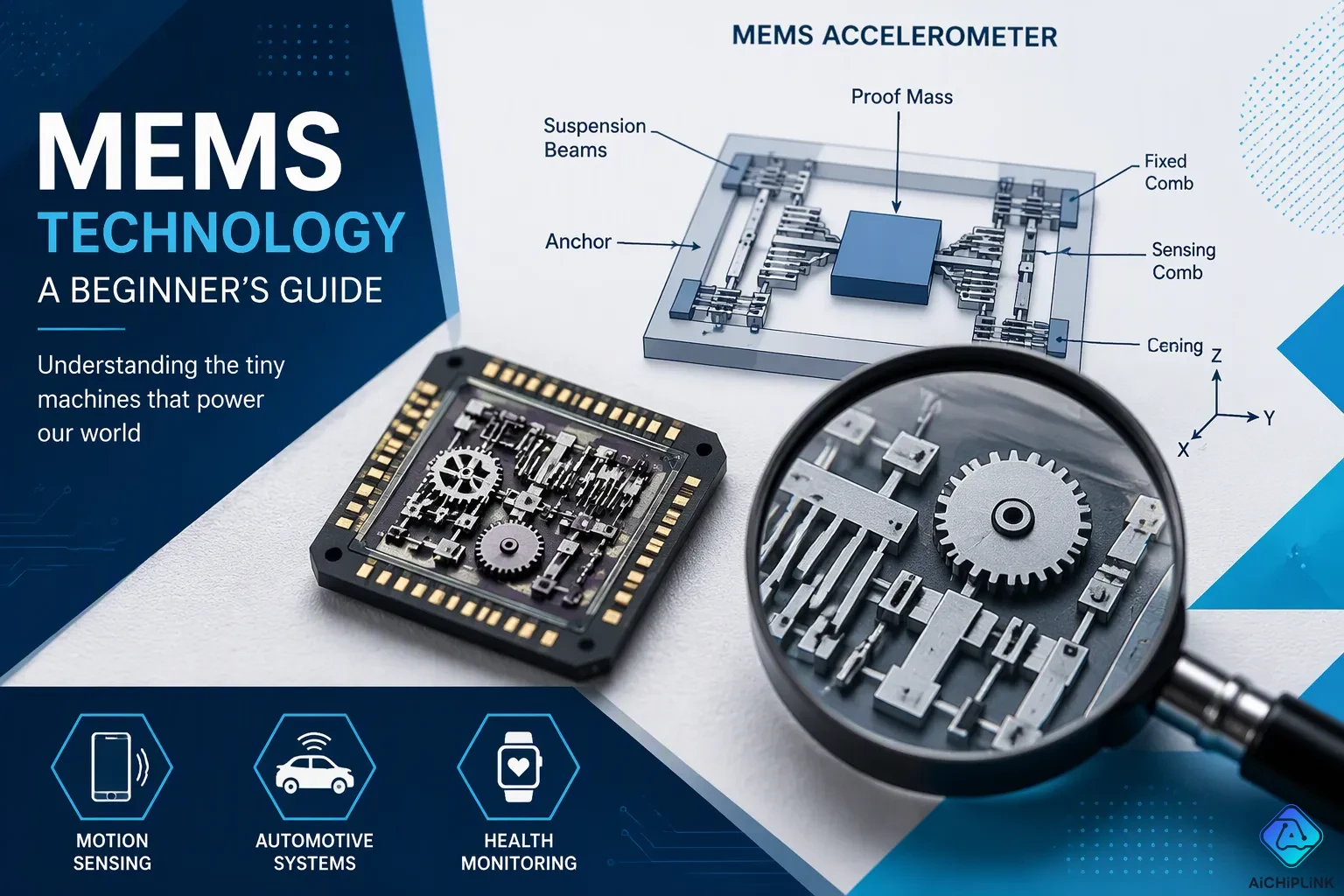
MEMS stands for Micro-Electro-Mechanical Systems. It builds tiny machines on a silicon chip. These small machines join moving parts and electronics. They can detect motion, light, or pressure. They change this data into electrical signals. A smartphone uses this technology. It turns the screen when you move the phone. A car has a similar system. It knows the right time to open the airbag. These examples show the power of small machines. MEMS Basics are simple to understand. Small size leads to big possibilities for technology.
Key Takeaways
-
MEMS are tiny machines on a chip that mix moving parts and electronics to sense the world.
-
They detect changes like motion or pressure and turn them into electrical signals.
-
You can find MEMS in everyday things like smartphones, cars, and medical devices.
-
Their small size lets them use very little power. It also helps them fit into tight spots where regular machines cannot go.
-
MEMS technology has a big effect on many industries and keeps growing.
What Is MEMS? A Simple Answer
Micro-Electro-Mechanical Systems Explained
MEMS is a way to make very small machines on a chip. These machines have moving parts and electrical circuits. They work together on a very small scale. This technology is called micro electro-mechanical systems. The name tells you what it is: mechanical parts, electrical parts, and a tiny size.
Micro-Electro-Mechanical Systems, or MEMS, is a technology that in its most general form can be defined as miniaturized mechanical and electro-mechanical elements (i.e., devices and structures) that are made using the techniques of microfabrication.
So what is MEMS technology in simple words? It is the skill of making machines so small that you need a microscope to see them. These machines can sense the world and respond to it. They can also handle signals, just like a computer chip.
In Europe, people often call this field microsystems technology. The word microsystems means the same thing as MEMS. Both terms describe tiny devices that mix mechanics and electronics. Engineers in different places just picked different names for the same idea.
The story of MEMS started in the 1960s. Industry engineers came up with the term back then. It took until the 1980s for these devices to be used in business. Today, microelectromechanical systems are everywhere. They are inside phones, cars, and medical tools. The technology grew slowly at first. Now it powers many products we use every day.
Tiny Transducers on a Micron Scale
A micron is one-millionth of a meter. That is one-thousandth of a millimeter. To picture this, 25,000 microns fit within one inch. Objects smaller than 40 microns become invisible to the naked eye. A human hair measures about 70 microns in diameter. That gives you a sense of the scale.
Here is a simple table to compare sizes:
| Object | Approximate Size (Microns) |
|---|---|
| Single Micron | 1 µm |
| Smallest Bacteria | ~1 µm |
| Red Blood Cell | ~7-8 µm |
| Pollen Grain | 10-50 µm |
| Human Hair (Width) | 50-100 µm |
| Eye of a Needle | 500-1000 µm |
MEMS devices are called transducers. A transducer changes one form of energy into another. These tiny machines turn mechanical, magnetic, or chemical changes into electrical signals. That is how a phone knows you turned it. That is how a car knows when to fire an airbag.
Think of MEMS as tiny machines on a chip. Each machine has parts that move. Each machine has parts that think. The moving parts sense motion, pressure, or light. The thinking parts turn that information into useful data. All of this happens on a scale smaller than a grain of pollen.
The small size makes these devices special. They use very little power. They fit into spaces where no normal machine could go. They work fast and last a long time. When you ask what is MEMS, the answer is simple: it is a tiny machine that senses and acts. When you ask what is MEMS technology, the answer is the same. It is the science of building these tiny machines. Microelectromechanical devices have changed how we live. They are small, but their impact is huge.
MEMS Basics: How Does It Work?
Mechanical Parts Meet Electronics
MEMS basics start with three main parts. These parts are microsensors, microactuators, and microelectronics. These parts work together as a team. Microsensors and microactuators are transducers. A transducer changes energy from one form to another. Microsensors detect changes in the world. Microactuators create movement or action. Microelectronics control the system and handle signals.
The real magic of MEMS is how they combine things. Mechanical structures and electronic circuits sit on the same silicon chip. This pairing lets a tiny machine sense and think at the same time. A MEMS accelerometer shows this clearly. Imagine tiny silicon fingers like interlocking combs. A sudden stop makes the combs move. That movement changes the gap between the fingers. The change in gap changes the electrical voltage. The electronics measure this change and turn it into a signal. Mechanical action becomes electronic data on one chip.
This is the main idea of MEMS basics. Mechanical structures and electronic circuits do not just sit side by side. They work together. The mechanical part reacts to the physical world. The electronic part reads that reaction and understands it. This connection is what makes MEMS devices so useful.
Sensing and Acting at a Tiny Scale
MEMS sensors work by detecting physical changes. These devices can detect many things. Common ones include:
-
Force, pressure, and movement
-
Acceleration and strain
-
Humidity through capacitive sensing
-
Angular velocity through gyroscopes
-
Biomarkers at very low concentrations
A MEMS gyroscope senses rotation using the Coriolis effect. A vibrating mass moves along one axis. When the device rotates, a force pushes the mass sideways. The sideways movement is linked to the rotation speed. Capacitive structures measure this movement. A design like a tuning fork with two masses cancels out straight-line acceleration. This gives a clean reading of rotation.
Microsensors and microactuators also handle the acting part. Microactuators respond to their environment by moving, regulating, positioning, pumping, or filtering. They receive signals from microelectronic systems. One example is a micro-thermal actuator. It converts thermal energy into force and motion. A difference in voltage across its pads creates a temperature difference. The mechanical displacement from thermal expansion can reach 16.99 µm.
The processing step finishes how MEMS work. An application-specific integrated circuit often sits with the MEMS chip. It makes the signal stronger, removes noise, and turns it into digital data. Sampling at high speed above 1 kHz avoids data errors and improves sensor reading quality. This three-step process — sense, transduce, process — defines MEMS basics. Sensors and actuators pair with electronics to sense and control the surroundings with great precision. That is the simple story of how micromechanical parts work.
Where MEMS Technology Is Used
Consumer Electronics and Automotive
MEMS technology appears in things people use every day. Smartphones have a mems sensor. It detects how the phone is held. So the screen turns when you rotate the phone. The same phone uses a mems sensor to count steps. It also helps steady the camera. These chips are good examples of what mems sensors are. They are small transducers that change motion into electrical signals.
Cars use mems devices for safety. A mems-based accelerometer detects a sudden stop. That is the trigger for deploying airbags. Standalone accelerometers may sit at different points around the car. They detect crashes based on how close they are to the impact. This is the sensing function at work. It saves lives.
Many industries depend on these chips. Here is a long list:
-
Automotive
-
Consumer electronics
-
Industrial
-
Healthcare
-
Defense
-
Aerospace
-
Telecommunication (including IT and telecommunications)
Environmental monitoring also fits on that list. Each field uses tiny sensors. They measure pressure, motion, or chemical changes.
Healthcare and Beyond
Medical care is now a big home for mems applications. MEMS pressure sensors have been used in non-invasive gear since the 1980s. This gear includes respiratory machines and blood pressure cuffs. Today they also work inside the body. For example, catheter tip sensors and implants report blood pressure, heart rate, and cardiac output around the clock.
| MEMS Application | Example | Status |
|---|---|---|
| Implantable pressure sensors | CardioMEMS, Camino ICP monitor | FDA-approved |
| Continuous glucose monitoring | FreeStyle Libre, Dexcom | Large commercial market |
| Wearables and prosthetics | MEMS accelerometers, IMU gait sensors | Widely used |
| Lab-on-a-chip diagnostics | Abbott i-STAT, Cepheid GeneXpert | Point-of-care testing |
| Drug delivery | MEMS micropumps, JewelPump | Mostly preclinical |
Continuous glucose monitoring has grown a lot. The U.S. CGM device market was $1.62 billion in 2024. It is expected to hit $2.39 billion by 2030. Lab-on-a-chip platforms shrink entire diagnostic steps onto disposable cartridges. Drug delivery is the least developed area. Most micropump research is still preclinical. Typical mems devices in this field sense a biological change. Then they trigger a precise response.
How MEMS Devices Are Made
Building at a Microscopic Scale
MEMS devices are built on a micron or sub-micron scale. The techniques of microfabrication borrow heavily from the semiconductor industry. Engineers start with a silicon wafer. They add and remove layers of material to create tiny mechanical parts. Feature sizes range from a few micrometers to millimeters. Some MEMS devices are one millimeter down to one micron in characteristic length. That is many times smaller than the diameter of a human hair.
Photolithography is the core patterning step in mems fabrication. A wafer gets coated with a light-sensitive material called photoresist. The pattern is aligned to the wafer. Then it is exposed to ultraviolet light, commonly the 365 nm i-line from a mercury source. The resist is developed to reveal the pattern. In a positive resist, exposed areas are cleared away. In a negative resist, exposed areas remain. This step repeats many times to build membranes, cavities, beams, channels, and electrodes.
Common fabrication methods include:
-
Wafer bonding (eutectic, glass frit, polymer layers)
-
Deep reactive ion etching (DRIE) of silicon and glass
-
Surface micromachining (using sacrificial and structural layers)
-
LIGA (X-ray lithography and electroplating for high-aspect-ratio metal parts)
-
Anisotropic wet etching (e.g., KOH, TMAH on <100> silicon)
-
Laser micromachining
Materials vary widely. A free-standing polymer was tested as a micron-scale MEMS material. An aluminum specimen was tested with a thickness of 110 nanometers. Another specimen had a thickness of 1.3 microns. According to the Wyss Institute, Pop-Up MEMS fabrication can incorporate virtually any material, including polymers, metals, ceramics, and composites.
Why Small Size Matters
Small size brings big benefits for mems manufacturing. Compact dimensions let these chips fit inside phones, cars, and medical tools. They use very little power. They work fast and last a long time. Micromachined devices combine mechanical and electronic functions on one chip. This integration is the key advantage. A tiny sensor can detect motion and process the signal in the same place.
The small scale also enables new applications. MEMS devices can go where no normal machine could fit. They measure pressure inside blood vessels. They trigger airbags in a crash. They steady camera lenses in a smartphone. Each function depends on the same principle: sense, transduce, process. The tiny size makes all of this possible. MEMS is a small technology with a huge impact.
MEMS is all about building tiny machines on a silicon chip. These machines have moving parts and electrical circuits. They work together on a very small scale.
A single chip holds tiny sensors, actuators, and electronics. This team senses the world and then responds. MEMS quietly powers phones, cars, and medical tools. It is a very small technology with a big impact on the future.

Written by Jack Elliott from AIChipLink.
AIChipLink, one of the fastest-growing global independent electronic components distributors in the world, offers millions of products from thousands of manufacturers, and many of our in-stock parts is available to ship same day.
We mainly source and distribute integrated circuit (IC) products of brands such as Broadcom, Microchip, Texas Instruments, Infineon, NXP, Analog Devices, Qualcomm, Intel, etc., which are widely used in communication & network, telecom, industrial control, new energy and automotive electronics.
Empowered by AI, Linked to the Future. Get started on AIChipLink and submit your RFQ online today!
Frequently Asked Questions
What does the acronym MEMS stand for?
MEMS is short for Micro-Electro-Mechanical Systems. This name covers three things: moving parts, electric parts, and a very small size. Engineers in Europe use microsystems technology for the same idea. Both names point to machines built on a silicon chip.
How is a MEMS device different from a normal computer chip?
A regular chip only moves electrons. A MEMS device also has parts that move. Tiny sensors and actuators sit next to electronic circuits on one chip. The moving parts react to the real world. The electronics read that reaction and turn it into data.
Where can I find MEMS in daily life?
You can find these chips in your pocket and your car. A smartphone uses them to turn the screen and count your steps. A car uses them to set off airbags in a crash. Medical tools use them to track blood pressure and glucose all the time.
Why does the tiny size of MEMS matter?
Being small brings real benefits. These devices use very little power and fit where normal machines cannot go. A human hair is about 70 microns wide, and some MEMS parts are even smaller. That size lets them measure pressure inside blood vessels.
Are MEMS devices expensive to make?
The cost depends on the design and how many units are made. Makers use methods from the semiconductor industry to build many devices on one silicon wafer at once. That shared process keeps the cost per device low for products made in large numbers.