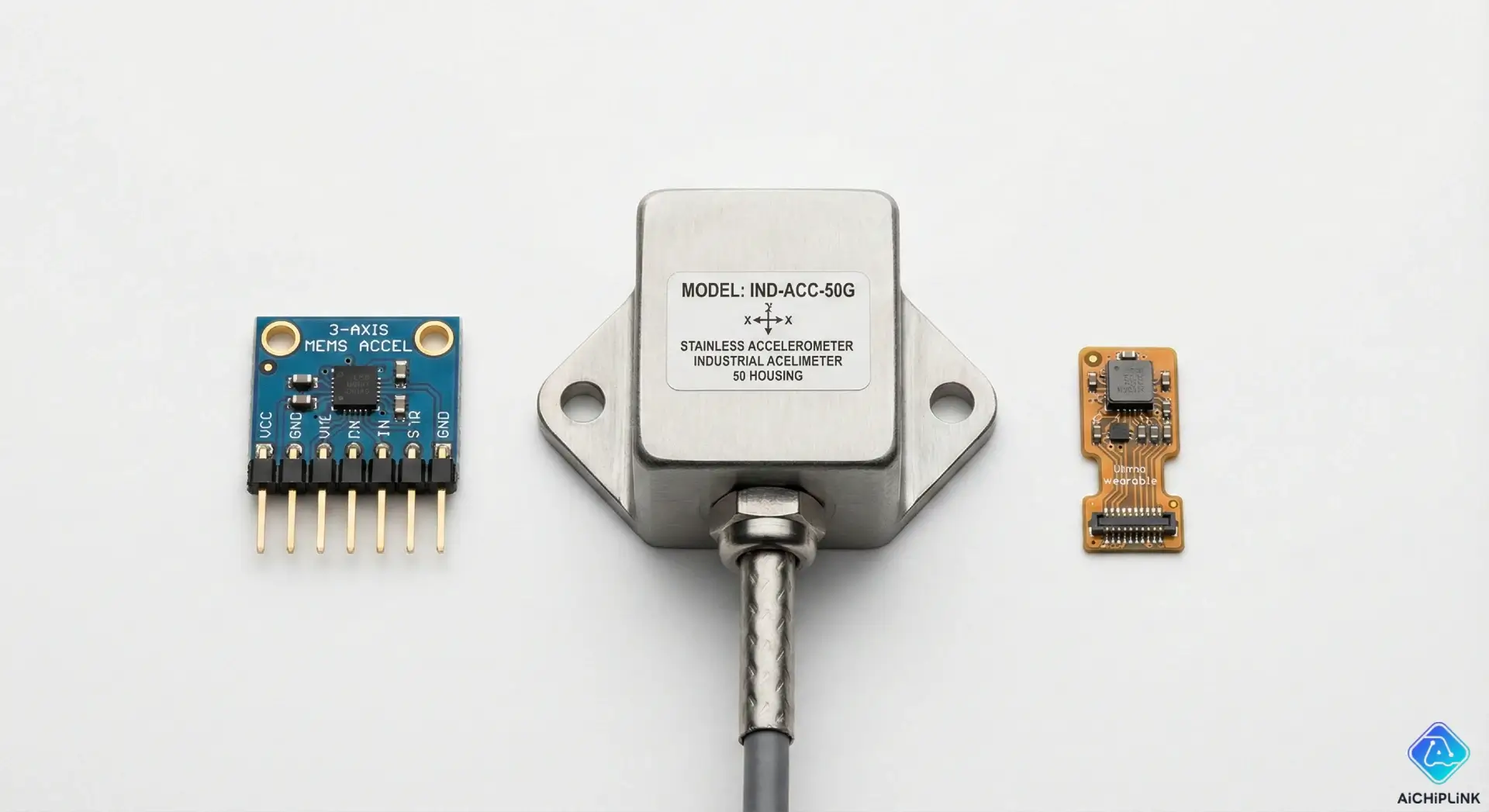
Accelerometer sensors are the hidden heroes of modern technology, responsible for everything from rotating your smartphone screen to deploying airbags in cars. We also explore key specifications like sensitivity and axis configuration, and conclude with practical applications in consumer electronics and industrial monitoring.
Key Takeaways
- Definition: An electromechanical device that measures acceleration forces (change in velocity per unit of time).
- Types of Forces: It measures both Static forces (like gravity/tilt) and Dynamic forces (like vibration, movement, or shock).
- Technology: Most modern accelerometers use MEMS technology, functioning like a microscopic mass on a spring.
- Core Spec: The measurement range is usually expressed in g-force (e.g., ±2g, ±16g).
- Applications: Critical for image stabilization, drone flight stability, machinery vibration analysis, and crash detection.
Introduction
How does your phone know to switch from portrait to landscape mode when you turn it? How does your fitness tracker know you are running? The answer lies in a tiny component called an Accelerometer.
While often confused with gyroscopes (which measure rotation), accelerometers specifically measure the rate of change of velocity. Whether you are an electronics hobbyist using an Arduino or an engineer designing a vibration monitoring system, understanding how to select and interface with these sensors is essential.
What is an Accelerometer?
An accelerometer is a device that measures proper acceleration—the acceleration experienced relative to freefall.
Mathematically, acceleration ($a$) is the rate of change of velocity ($v$) over time ($t$), often described by Newton’s Second Law:
$$F = ma$$
Where:
- F = Force
- m = Mass
- a = Acceleration
The sensor detects these forces and converts them into an electrical signal (analog voltage or digital data) that can be interpreted by a microprocessor.
How Do They Work? (The MEMS Revolution)
Early accelerometers were bulky mechanical devices. Today, almost all consumer accelerometers are MEMS (Micro-Electro-Mechanical Systems).
The Spring-Mass System
Imagine a tiny mass suspended by microscopic springs inside a silicon chip.
- Rest: When the sensor is stationary, the mass stays in the center (or is pulled down by gravity).
- Movement: When the sensor accelerates, inertia causes the mass to lag behind.
- Detection: This displacement changes the capacitance between fixed plates and the moving mass. The circuitry measures this capacitance change and converts it into a voltage signal proportional to the acceleration.
Types of Accelerometers
Different applications require different sensing technologies.
1. Capacitive Accelerometers (MEMS)
- How it works: Measures changes in capacitance between microstructures.
- Best for: Consumer electronics (phones, tablets), low-frequency vibration, and measuring gravity (tilt).
- Pros: Cheap, small, low power, can measure DC (static) acceleration.
- Popular Models: ADXL345, MPU6050.
2. Piezoelectric Accelerometers
- How it works: Uses crystals (like quartz) that generate a voltage when stressed.
- Best for: Industrial vibration monitoring, shock testing.
- Pros: Very wide bandwidth, excellent for high-frequency dynamic measurements.
- Cons: Cannot measure static gravity (cannot detect tilt).
3. Piezoresistive Accelerometers
- How it works: Resistance of a material changes when mechanically stressed.
- Best for: High-shock applications (e.g., crash testing).
Key Specifications to Watch
When buying a sensor, check the datasheet for these critical values:
- Axes (1, 2, or 3): Most modern sensors are 3-axis (X, Y, Z), allowing them to detect orientation in 3D space.
- Range (g-force):
- ±2g to ±8g: Good for tilt sensing and human motion (phones).
- ±16g to ±200g: Required for crash detection or high-impact sports.
- Sensitivity: How much the voltage changes per unit of 'g'. Higher is better for detecting subtle movements.
- Interface:
- Analog: Outputs a variable voltage.
- Digital (I2C/SPI): Outputs data directly to microcontrollers.
Applications
Consumer Electronics
- Screen Rotation: Detecting which way is "down."
- Step Counting: Analyzing the rhythmic acceleration of walking.
- Gaming: Wii remotes and VR headsets.
Automotive & Industrial
- Airbag Deployment: Detecting the sudden negative acceleration (deceleration) of a crash.
- Condition Monitoring: Listening to the "heartbeat" of a motor. If a bearing is failing, the vibration pattern (acceleration) changes.
Drones & Robotics
- Flight Stability: Working with gyroscopes to tell the flight controller if the drone is drifting or falling.

Written by Jack Elliott from AIChipLink.
AIChipLink, one of the fastest-growing global independent electronic components distributors in the world, offers millions of products from thousands of manufacturers, and many of our in-stock parts is available to ship same day.
We mainly source and distribute integrated circuit (IC) products of brands such as Broadcom, Microchip, Texas Instruments, Infineon, NXP, Analog Devices, Qualcomm, Intel, etc., which are widely used in communication & network, telecom, industrial control, new energy and automotive electronics.
Empowered by AI, Linked to the Future. Get started on AIChipLink.com and submit your RFQ online today!
Frequently Asked Questions
What is the difference between an Accelerometer and a Gyroscope?
An **Accelerometer** measures linear acceleration (movement in a straight line) and gravity (tilt). A **Gyroscope** measures angular velocity (rotation or spin). Most modern IMUs (Inertial Measurement Units) combine both to track complex motion accurately.
Can an accelerometer measure speed/velocity?
Theoretically, yes, by integrating acceleration over time. However, in practice, small sensor errors accumulate rapidly ("drift"), making accelerometers very poor for tracking speed or position over long periods without GPS or other corrections.
What is "g-force"?
One "g" is the acceleration due to gravity at Earth's surface, approximately $9.8 m/s^2$. If an accelerometer reads **1g** on the Z-axis while sitting on a table, it is measuring Earth's gravity pulling it down.
Why does my accelerometer read 1g when it is not moving?
Accelerometers measure both static (gravity) and dynamic forces. When stationary, the sensor still detects the pull of gravity (1g). This feature is exactly how the sensor calculates **tilt angles**.
Which accelerometer should I use for Arduino projects?
For beginners, the **ADXL345** or the **MPU6050** (which includes a gyro) are the best choices. They are affordable, communicate via I2C, and have extensive code libraries available.