Introduction
Every switching power supply engineer has faced the same challenge: your MOSFET or diode bridge is generating far more heat than the simulation predicted, switching waveforms show ugly ringing transients, and efficiency is falling short of your target. More often than not, the culprit is the rectifier diode — specifically, a device with insufficient recovery speed for your operating frequency.
The MURS140T3G from onsemi (ON Semiconductor) is engineered precisely to eliminate this problem. As a 400V, 1A ultrafast rectifier in the surface-mount SMB (DO-214AA) package, it delivers a maximum reverse recovery time (trr) of just 75 ns — fast enough to operate cleanly in switching converters running into the hundreds of kilohertz range.
According to IEC 60747-2, the international standard for semiconductor diodes, reverse recovery characteristics are a primary selection criterion for diodes in high-frequency power circuits. A rectifier that is too slow will not block reverse voltage cleanly, causing shoot-through losses, EMI, and stress on switching transistors. The MURS140T3G's ultrafast recovery characteristic makes it one of the most reliable choices in its class.
In this complete guide, you'll find the full specification breakdown, trr analysis, real-world application guidance for SMPS and flyback circuits, head-to-head comparisons with competing rectifiers, PCB layout advice, and expert sourcing tips.
1.0 What Is the MURS140T3G? An Overview
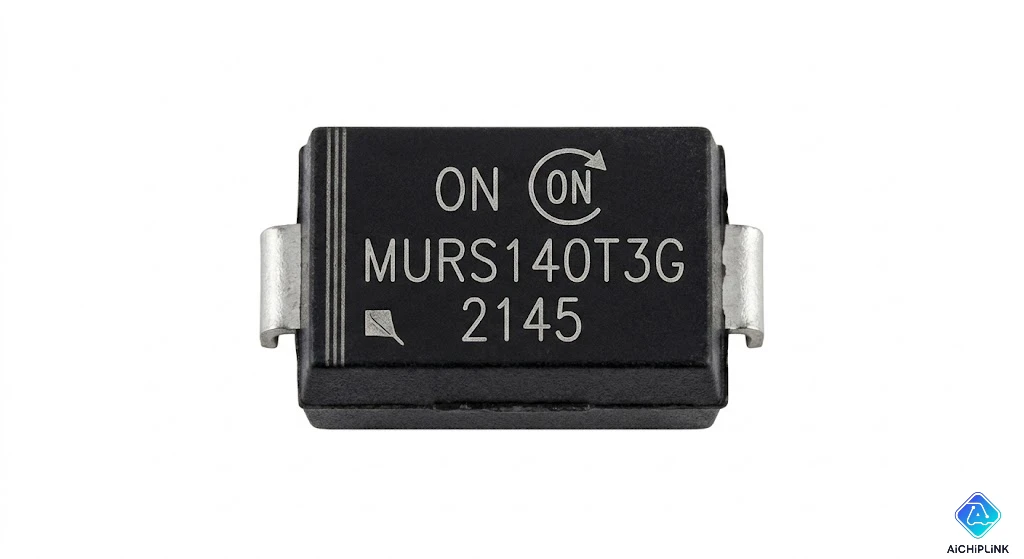
The MURS140T3G is a surface-mount ultrafast power rectifier manufactured by onsemi (formerly ON Semiconductor). It is a member of the MURS1xx series — a family of high-voltage, high-frequency rectifiers designed for demanding switching applications where conventional rectifiers would generate unacceptable switching losses and EMI.
Decoding the part number:
- MUR — Metal-oxide-semiconductor Ultrafast Rectifier (onsemi family designation)
- S — Surface-mount package (SMB / DO-214AA)
- 1 — 1A average forward current rating
- 40 — 400V peak repetitive reverse voltage (VRRM)
- T3 — Tape-and-reel packaging, 3,000 pieces per reel
- G — Green / RoHS-compliant, lead-free termination (replaces legacy non-"G" part)
"The MURS140T3 series are Surface Mount Ultrafast Power Rectifiers, ideally suited for high voltage, high frequency rectification, or as free-wheeling and protection diodes in surface mount applications where compact size and weight are critical to the system." — onsemi Product Brief
The device is housed in the SMB (DO-214AA) package — a rectangular, J-bend lead, surface-mount body that sits flat on the PCB for excellent thermal coupling to the board's copper ground planes. Its compact footprint, combined with the ultrafast switching performance, makes it a first-choice component in modern high-density power designs.
2.0 Full Technical Specifications & Electrical Parameters
2.1 Core Electrical Ratings
Here is a complete summary of the key parameters from the MURS140T3G datasheet:
- Peak Repetitive Reverse Voltage (VRRM): 400 V
- Average Rectified Forward Current (IF(AV)): 1 A
- Non-Repetitive Peak Surge Current (IFSM): 35 A (8.3 ms half-sine pulse)
- Maximum Forward Voltage (VF): 1.25 V @ IF = 1 A
- Maximum Reverse Current (IR): 5 µA @ VR = 400 V, 25°C; 200 µA @ 100°C
- Maximum Reverse Recovery Time (trr): 75 ns
- Junction Capacitance (CJ): 15 pF @ VR = 4V, f = 1 MHz (typical)
- Maximum Junction Temperature (TJ): 175°C
- Operating Temperature Range: −65°C to +175°C
- Storage Temperature Range: −65°C to +175°C
- Thermal Resistance, Junction-to-Lead (RθJL): 20°C/W
- Thermal Resistance, Junction-to-Ambient (RθJA): 65°C/W (on PCB with 1 oz copper pad)
- Package: SMB (DO-214AA), J-bend leads
- Marking Code: U1G
- Tape and Reel: 3,000 pcs/reel
- RoHS Compliant: Yes (G suffix, lead-free matte tin termination)
- AEC-Q101 Automotive Qualified: Yes (NRVUS prefix variant available for automotive)
- ECCN: EAR99
The 175°C maximum junction temperature is notably high compared to many competing ultrafast diodes rated at 150°C — this extra thermal headroom is a meaningful reliability advantage in high-ambient or high-current applications where junction temperature margins are tight.
2.2 Reverse Recovery Time (trr) and Switching Performance
The reverse recovery time (trr) is the single most important switching parameter for a rectifier diode used in high-frequency circuits. When a forward-biased diode is suddenly reverse-biased (as happens in every switching cycle of an SMPS), minority carriers stored in the junction must be swept out before the diode can block reverse voltage. During this interval, a reverse current flows — wasting energy, stressing the switching transistor, and generating EMI.
The MURS140T3G's 75 ns maximum trr places it firmly in the "ultrafast" category by IEC classification (< 100 ns). In practical terms:
- At a switching frequency of 100 kHz, each switching period is 10 µs. The 75 ns trr represents less than 0.75% of the switching period — negligible switching loss contribution.
- At 500 kHz, trr represents 3.75% of the switching period — still manageable, but now worth accounting for in efficiency budgets.
- Above 1 MHz, the 75 ns trr becomes significant; for MHz-range converters, consider Schottky diodes with near-zero trr instead.
The peak reverse recovery current (Irr) and the reverse recovery charge (Qrr) determine how much energy is dissipated per switching cycle. While onsemi's datasheet provides typical curves, Qrr ≈ ½ × Irr × trr — lower is always better for efficiency.
2.3 Forward Voltage Drop and Conduction Loss
The maximum forward voltage (VF) of 1.25 V at 1 A is the trade-off price for the 75 ns ultrafast recovery. This is higher than a typical Schottky diode (0.4–0.6 V at the same current) but significantly lower than a standard recovery diode with comparable voltage rating.
Conduction power loss per diode:
P_cond = VF × IF(AV) = 1.25 V × 1 A = 1.25 W (worst case at full current)
In typical operating conditions (VF ≈ 0.95–1.1 V at 1 A, 25°C), actual conduction loss is closer to 1.0–1.1 W. Combined with the 20°C/W junction-to-lead thermal resistance, junction temperature rise above lead temperature at full load is:
ΔTJ = P × RθJL = 1.1 W × 20°C/W ≈ 22°C
This is well within the 175°C junction limit for virtually all operating environments, confirming the MURS140T3G can safely handle rated current without external heatsinking when mounted on a properly designed SMB copper land.
2.4 Surge Current, Thermal Resistance & Reliability
The 35 A non-repetitive surge current (IFSM) — measured as a single 8.3 ms half-sine pulse at 25°C — provides substantial margin against startup inrush events. In a bridge rectifier powering a large filter capacitor, startup inrush can be 10–20× the rated average current; the MURS140T3G's 35 A IFSM rating handles this comfortably for a 1 A average load.
Glass passivated junction: The MURS140T3G uses a high-temperature glass passivation layer over the silicon junction. This passivation dramatically improves reliability by:
- Sealing the junction against contamination from moisture, ionic impurities, and flux residue
- Stabilizing reverse leakage current over temperature and time
- Extending operational lifetime in humid or corrosive environments compared to non-passivated junctions
This feature, combined with the AEC-Q101 automotive qualification pathway (via the NRVUS prefix variant), reflects onsemi's commitment to industrial and automotive-grade reliability standards.
3.0 Switching Circuit Applications
3.1 Switch-Mode Power Supply (SMPS) Rectification
The MURS140T3G is purpose-designed for output rectification in high-frequency SMPS topologies operating at input voltages from 85 VAC to 265 VAC (universal mains). In a flyback converter, the secondary rectifier sees a peak reverse voltage equal to (VIN_peak / turns_ratio) + VOUT. For a 400V VRRM device in a 5 W to 20 W flyback stage, the MURS140T3G provides adequate reverse blocking margin while keeping switching losses minimal at typical 65–130 kHz operating frequencies.
Typical SMPS applications include:
- Flyback converter secondary rectifier: 12 V / 1 A output at 65–130 kHz
- Forward converter output rectifier: 5 V / 1 A at up to 300 kHz with appropriate dead time
- Boost PFC stage bypass diode: Catching reverse transients in CCM boost stages
- Auxiliary supply rectifier: Self-powered bias winding rectification in isolated converters
- High-voltage half-wave rectifier: Battery charger stages and industrial 24 V supplies
For boost PFC or active clamp circuits where the diode sees high dV/dt transients, the low 15 pF junction capacitance of the MURS140T3G limits reactive displacement current spikes that would otherwise couple noise into the control loop.
3.2 Freewheeling and Flyback Snubber Protection
Beyond rectification, the MURS140T3G is widely used as a freewheeling diode (also called a flywheel or catch diode) in inductive switching circuits. When a MOSFET or IGBT driving an inductive load (motor winding, transformer primary, relay coil) turns off, the collapsing magnetic field forces current to continue flowing — the freewheeling diode provides a safe path for this current, clamping the drain voltage and preventing destructive voltage spikes.
The key requirements for a freewheeling diode match exactly what the MURS140T3G delivers:
- High enough VRRM (400 V) to block the full supply rail voltage during the off-state
- Fast recovery (75 ns) so the diode blocks cleanly before the transistor turns on again, preventing shoot-through and cross-conduction losses
- Sufficient IF(AV) (1 A) to carry average inductor current during the freewheeling interval
- Low junction capacitance (15 pF) to minimize dV/dt-induced switching noise
In flyback snubber circuits, the MURS140T3G is commonly placed in series with an RC snubber across the primary switch. During transistor turn-off, the snubber diode conducts briefly, routing the leakage inductance energy into the RC network rather than allowing it to ring freely on the drain node.
4.0 MURS140T3G vs. Competing Ultrafast and Schottky Rectifiers
4.1 MURS140T3G vs. MURS160T3G and ES1D {#compare-family}
| Feature | MURS140T3G | MURS160T3G | ES1D (Various) | VS-1EZ400 |
|---|---|---|---|---|
| Manufacturer | onsemi | onsemi | Various | Vishay |
| VRRM | 400 V | 600 V | 200 V | 400 V |
| IF(AV) | 1 A | 1 A | 1 A | 1 A |
| VF Max | 1.25 V @ 1 A | 1.25 V @ 1 A | 1.7 V @ 1 A | 1.3 V @ 1 A |
| trr Max | 75 ns | 75 ns | 50 ns | 50 ns |
| IFSM | 35 A | 35 A | 30 A | 30 A |
| TJ Max | 175°C | 175°C | 150°C | 175°C |
| Package | SMB (DO-214AA) | SMB (DO-214AA) | SMA (DO-214AC) | SMA (DO-214AC) |
| AEC-Q101 | Yes (NRVUS variant) | Yes (NRVUS variant) | No (standard) | No |
| RoHS | Yes | Yes | Yes | Yes |
The MURS140T3G vs. MURS160T3G decision is straightforward: if your circuit's maximum reverse voltage can reach above 400 V (e.g., universal input flyback at 265 VAC with 1.4× peak factor and reflected voltage), choose the MURS160T3G at 600 V VRRM. For dedicated 110 VAC or 230 VAC single-range inputs where peak voltage is well below 400 V, the MURS140T3G's lower capacitance and identical forward voltage make it the better-optimized choice.
The ES1D (200 V VRRM) in a SMA package is faster (50 ns trr) but limited to lower-voltage secondary rails. It is not a substitute in universal-input mains-connected circuits.
4.2 Ultrafast vs. Schottky: When to Choose Which
Engineers frequently ask whether to use the MURS140T3G (ultrafast silicon p-n junction) or a Schottky rectifier like the MBRS140T3G for the same circuit position. The answer depends on three factors:
Choose MURS140T3G (ultrafast silicon) when:
- Your circuit requires 400 V or higher VRRM — silicon Schottky diodes are generally limited to 200 V or below at practical current ratings
- Your load is inductive and requires a freewheeling diode on a high-voltage rail
- Your operating frequency is 100 kHz–500 kHz — the 75 ns trr is adequate and forward voltage is acceptable
- You need AEC-Q101 automotive qualification (Schottky equivalent may not be available)
Choose Schottky (e.g., MBRS140T3G) when:
- Your circuit operates at a low voltage rail (≤ 40 V)
- Conduction efficiency is paramount — Schottky VF of 0.4–0.6 V vs. 1.25 V for the MURS140T3G can make a measurable efficiency difference at high average currents
- Your frequency exceeds 1 MHz — Schottky devices have near-zero trr (no minority carrier storage), making them the only practical choice above ~1 MHz
- Reverse leakage is not critical (Schottky IR is higher, especially at elevated temperatures)
4.3 Pricing, Availability & RoHS Status
The MURS140T3G is an active production part with broad global distribution:
- Authorized distributors: DigiKey, Mouser, Arrow, Avnet, Newark, Future Electronics
- Typical unit price: ~$0.12–$0.36 USD depending on quantity and distributor
- Packaging: 3,000 pcs/reel (T3G suffix) — cut-tape available at most distributors
- RoHS status: Fully compliant — lead-free matte tin termination, no restricted substances
- ECCN: EAR99 (no export license required for most destinations)
- Lifecycle: Active production — no pending EOL or last-time-buy notices
For competitive pricing, verified original onsemi inventory, and volume procurement support, visit aichiplink.com — MURS140T3G listing.
5.0 PCB Design, Footprint & Assembly Guidelines
5.1 SMB (DO-214AA) Footprint and Layout Best Practices {#pcb-layout}
The SMB (DO-214AA) package body measures approximately 4.8 mm × 3.9 mm × 2.4 mm with J-bend leads. The recommended PCB land pattern per IPC-SM-782 is:
- Pad size: 2.6 mm × 2.2 mm per pad (cathode and anode)
- Pad pitch (center-to-center): 5.6 mm
- Courtyard clearance: 0.5 mm minimum around the component body
- Cathode identification: The cathode is marked with a stripe on the component body; ensure the PCB silkscreen clearly reflects polarity
Layout recommendations for high-frequency switching circuits:
- Minimize lead inductance: Route the cathode copper pour directly to the switching node with the shortest possible trace length. Every mm of trace adds ~1 nH of parasitic inductance, which creates voltage ringing at high di/dt.
- Thermal management via copper pour: Extend both the anode and cathode copper pads into larger copper fills connected to the ground plane. For full 1 A operation, a minimum 1 cm² copper pour per pad is recommended to achieve the 65°C/W junction-to-ambient specification.
- Keep sensitive analog nodes away: At 75 ns switching transitions with 35 A surge capability, the MURS140T3G generates measurable radiated EMI. Maintain at least 5 mm separation from high-impedance analog input traces.
- Snubber placement: If using an RC snubber in parallel with the diode to damp ringing, place the snubber components within 5 mm of the diode body to minimize the current loop inductance.
5.2 Reflow Soldering and Thermal Management
The MURS140T3G's glass passivated junction and J-bend lead construction are compatible with standard SMT reflow assembly:
Recommended reflow profile (SAC305 lead-free solder):
- Preheat zone: 150–180°C for 60–120 seconds
- Soak zone: 180–220°C for 30–60 seconds
- Peak reflow temperature: ≤ 260°C
- Time above 217°C (liquidus): ≤ 30 seconds
- Cooling rate: ≤ 3°C/second
Rework guidance:
- Hot-air rework: 300–350°C nozzle, ≤ 10 seconds direct exposure
- Do not stress the J-bend leads with mechanical force during rework — the leads are pre-formed and resist bending without cracking the glass passivation
Thermal derating: onsemi provides a standard forward current derating curve in the datasheet. At ambient temperatures above 50°C, the 1 A rated average current must be derated linearly. At 100°C ambient with the standard SMB copper land, derated continuous current is approximately 0.6–0.7 A — a key consideration for automotive or industrial equipment operating in high-temperature enclosures.
6.0 How to Source Authentic MURS140T3G Units
While rectifier diodes are simple two-terminal components, the market for counterfeit and substandard discrete semiconductors is significant — particularly for popular parts like the MURS140T3G that appear in consumer power supplies, industrial equipment, and automotive designs. A remarked or cloned diode may pass a static forward voltage test yet fail catastrophically in switching operation, with trr 3–10× the specified 75 ns.
Here's how to protect your procurement:
- Buy from authorized onsemi distributors only: DigiKey, Mouser, Arrow, Newark, and Avnet are authorized. These distributors stock genuine onsemi parts with full traceability.
- Check the "G" suffix: Ensure the part number ends in "T3G" — the G suffix confirms RoHS-compliant lead-free termination. Non-G parts (if encountered) use tin-lead solder, which has different reflow profiles and is restricted under RoHS Directive 2011/65/EU for most product categories.
- Verify the "U1G" marking code: Authentic MURS140T3G devices are marked "U1G" on the top of the SMB body. Verify this marking under magnification — characters should be laser-etched, not ink-printed.
- Electrical spot-check: Measure forward voltage at 1 A using a curve tracer or bench power supply. Genuine parts should show VF between 0.9 V and 1.25 V at 25°C. Measure reverse blocking at a safe sub-breakdown voltage (e.g., 100 V); IR should be well below 5 µA.
- Request CoC for production lots: For volume orders from any secondary market source, demand a Certificate of Conformance (CoC) and lot date code traceability to onsemi's manufacturing facility.
For verified original onsemi MURS140T3G stock with full documentation and competitive pricing, visit aichiplink.com.
8.0 Conclusion
The MURS140T3G earns its place as one of the most widely used surface-mount ultrafast rectifiers in industrial and consumer power electronics. Its combination of 400 V blocking voltage, 1 A average current, 75 ns maximum trr, 35 A surge capability, 175°C junction temperature rating, and glass passivated junction covers the essential requirements of the vast majority of SMPS secondary rectification, freewheeling, and snubber protection applications operating from 50 kHz to 500 kHz.
onsemi's active production commitment, broad authorized distributor availability, and established automotive qualification pathway (NRVUS variant) ensure the MURS140T3G will remain a viable, supportable design choice for new and sustaining engineering programs through the foreseeable future. As switching power supply operating frequencies continue to rise and efficiency regulations tighten, fast, reliable rectifiers like the MURS140T3G will remain indispensable elements of every power electronics engineer's component toolkit.
Ready to order? Explore verified onsemi inventory, competitive pricing, and expert procurement support for the MURS140T3G at aichiplink.com — with original tape-and-reel packaging, complete documentation, and fast global fulfillment.

Written by Jack Elliott from AIChipLink.
AIChipLink, one of the fastest-growing global independent electronic components distributors in the world, offers millions of products from thousands of manufacturers, and many of our in-stock parts is available to ship same day.
We mainly source and distribute integrated circuit (IC) products of brands such as Broadcom, Microchip, Texas Instruments, Infineon, NXP, Analog Devices, Qualcomm, Intel, etc., which are widely used in communication & network, telecom, industrial control, new energy and automotive electronics.
Empowered by AI, Linked to the Future. Get started on AIChipLink.com and submit your RFQ online today!
Frequently Asked Questions
What is the difference between MURS140T3G and MURS160T3G?
The only difference is reverse voltage rating. MURS140T3G = 400 V, MURS160T3G = 600 V. All other key parameters (1 A current, ~75 ns recovery, SMB package, temperature rating) are the same.
Is MURS140T3G suitable for automotive applications?
The standard MURS140T3G is a commercial-grade device from onsemi. For automotive designs, use the AEC-Q101 qualified equivalent (NRVUS140T3G).
Why does MURS140T3G have higher forward voltage than a Schottky diode?
It is an ultrafast silicon PN diode, so its forward voltage is higher, but it supports much higher reverse voltage (up to 400 V), which Schottky diodes typically cannot.
What does “glass passivated junction” mean?
It improves long-term reliability by protecting the junction edge from moisture and contamination, reducing leakage and improving high-temperature stability.
What switching frequency is MURS140T3G suitable for?
With a 75 ns reverse-recovery time, it is typically suitable for SMPS designs up to about 500 kHz.