What Is a Microwave Diode and How Does It Work
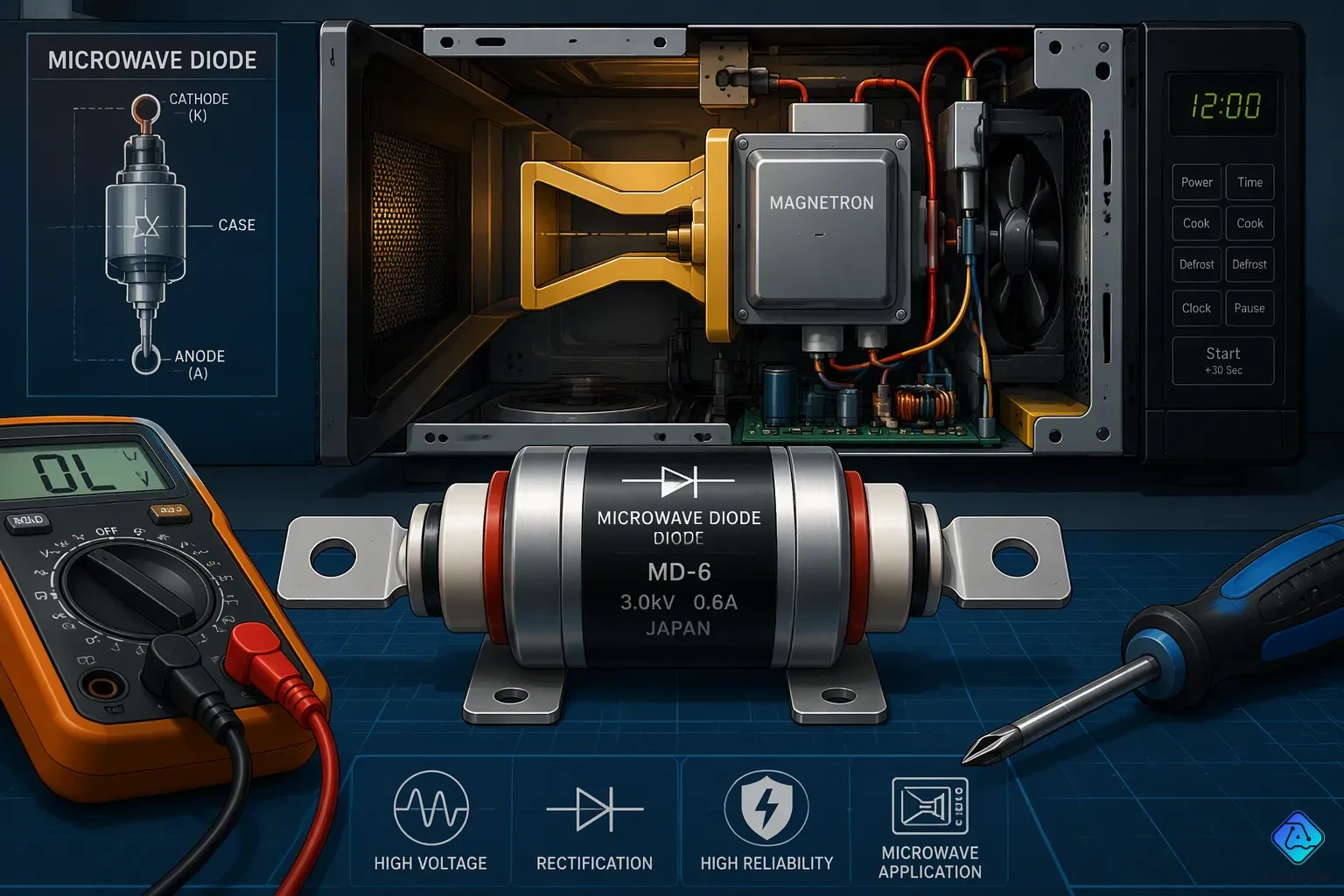
A microwave diode is a part that lets electricity flow in just one direction. This simple job becomes very important at high frequencies. You often find this part inside a microwave oven's high-voltage circuit. The diode changes alternating current (AC) from the transformer into direct current (DC). It also doubles the voltage to almost 5,000 volts. This high-voltage DC powers the magnetron. The magnetron then makes the microwave energy that heats your food. Knowing how this works helps you see how the diode controls electricity in these circuits. Every part of the system depends on the diode to do its job right.
Key Takeaways
-
A microwave diode lets electricity flow in one direction only.
-
It changes AC to DC and doubles voltage to about 5,000 volts.
-
The diode powers the magnetron, which heats your food.
-
Different types like Schottky and PIN diodes serve special high-frequency jobs.
-
You can test a diode with a multimeter; a good one shows 5 to 10 volts.
What a Microwave Diode Is
A microwave diode is a semiconductor part that lets current flow in only one direction. You can picture it as a one-way valve for electricity. A regular diode does this same basic job. The difference is in how each device deals with speed. A standard silicon rectifier diode works fine at low frequencies. Its operating frequency is usually under 3 kHz. A microwave diode, on the other hand, is made to work at much higher rates. AC transient analysis and theoretical calculation done on a full-wave rectifier shows an estimated cut-off frequency at about 12 GHz. That gap matters when signals change millions of times per second.
One-Way Current Flow
Current goes into the diode through one terminal and comes out the other. This path only opens in one direction. When you apply voltage in the forward direction, current passes through easily. When you reverse that voltage, the device stops the flow. This behavior gives the component its main trait. A PIN diode shows how frequency changes this behavior. It will act as a rectifier at lower frequencies. At HF frequencies and above, it becomes purely resistive. The resistance value then depends on the applied DC bias current. So the same physical part can act quite differently depending on the signal rate you give it.
Anode, Cathode, and Reverse Blocking
The two terminals of a diode have specific names. The anode takes in conventional current. The cathode sends it out. Forward conduction happens when the anode is at a higher voltage than the cathode. Reverse blocking happens when that polarity flips. A microwave oven diode takes this blocking ability to an extreme level. It is designed with a very high reverse voltage rating, often greater than 12,000 V. Manufacturers achieve this by stacking multiple diodes in series inside one package. That stacking also raises the forward voltage drop. The typical forward voltage drop of a microwave oven diode falls between 6 V and 12 V. Field measurements and datasheets report a range of values.
| Reported forward voltage drop | Additional detail |
|---|---|
| About 7.5 V | A user measured similar high-voltage diodes and found approximately 7.5 V forward voltage. |
| Up to 10 V | A datasheet cited in the forum indicates the forward voltage may be as high as 10 V. |
| About 5 V to 10 V | When forward biased during testing, the voltage across the diode should be about 5 V to 10 V. |
| About 7 V to 8 V | A forum comment states that around 7 V to 8 V should be sufficient to test a microwave diode. |
The reverse voltage rating tells you how much pressure the part can take before it breaks down. Most replacement microwave oven diodes are rated 12 to 15 kV PRV at 0.5 A. A PRV of around 8 kV is actually required even for a small oven. These figures explain why the component plays such a critical role in the high-voltage circuit. It must hold back thousands of volts during every cycle. That demand shapes both its internal design and its physical size.
How a Microwave Diode Works
AC to DC Conversion
The transformer in your microwave oven steps up the wall voltage to a much higher level. That output is still alternating current. The magnetron cannot use AC directly. It needs a steady one-way flow of electrons. This is where the microwave diode earns its place in the circuit.
The CL01-12 is a high-voltage rectifier diode built for microwave oven power supplies. It performs high-voltage AC-to-DC rectification. During one half of the AC cycle, the diode conducts and lets current pass. During the other half, it blocks the flow completely. This action changes the high-voltage alternating current into direct current before it reaches the magnetron. The result is a one-way flow of electricity. The magnetron needs this steady flow to produce consistent microwave energy for heating your food.
A smoothing capacitor often works alongside the diode to steady the DC output. The capacitor stores charge during peaks and releases it during dips. This reduces ripple and keeps the voltage more stable. For similar rectifier circuits in electric vehicle applications handling 3.3 kW to 7.7 kW, engineers recommend capacitors with high capacitance in the microfarads range. They often choose large capacitance, small size multilayer ceramic capacitors.
For smoothing capacitors placed after the rectifier in electric vehicle applications handling 3.3 kW to 7.7 kW of grid power, the capacitor must have a relatively high capacitance ranging in the microfarads range.
A typical smoothing capacitor for this kind of circuit has these specifications:
| Parameter | Typical Specification |
|---|---|
| Capacitor Type | Aluminium Electrolytic |
| Capacitance Value | 100µF or more |
| Working Voltage | Higher than the no-load output value of the rectifier |
| Ripple Voltage Target | Less than 100mV peak to peak |
Voltage Doubling for the Magnetron
The diode does more than rectify. It also helps double the voltage. The transformer first steps up 120 VAC to 2,000 volts. A Villard voltage doubler then doubles this using two half-cycles. During the charging half-cycle, the diode conducts. Electrons flow from ground into the capacitor, storing 2,000 volts. During the discharging half-cycle, the capacitor's stored voltage adds directly to the transformer's 2,000 volts. This produces a total of 4,000 volts. The diode prevents current from flowing back to ground. This combined voltage forces current through the magnetron, which generates microwaves.
The Villard circuit uses a single diode and capacitor to double voltage. During the negative half-cycle of the AC input, the diode conducts and charges the capacitor to the peak AC voltage. This clamps the negative peaks of the waveform to approximately 0 V. On the positive half-cycle, the diode is reverse-biased. The capacitor's stored voltage adds in series with the AC input. The output waveform is the superposition of the AC signal and the DC voltage across the capacitor. Positive peaks reach twice the peak AC voltage. Microwave ovens use this configuration with reversed diode polarity to generate the high negative voltage the magnetron needs.
In a standard domestic microwave oven, a high-voltage transformer and a 2× voltage doubler convert 220–240 V AC mains into approximately 4–5 kV DC for the magnetron cathode. A no-load calculation gives V_out ≈ 2 · √2 · V_sec, where V_sec ≈ 2.1 kV AC. This yields V_out ≈ 5.9 kV DC. The doubler uses two capacitors and two diodes. This voltage level is what pushes the magnetron into oscillation. The magnetron then emits the microwave energy that heats your food.
Main Microwave Diode Types
Not every part works the same way at high frequency. Different kinds use different physical methods. Each kind has a special job. Knowing the differences helps you pick the right one.
Schottky, PIN, and Varactor Diodes
A Schottky diode has a metal-semiconductor junction. This makes it switch very fast. You see this type in mixers. A Schottky diode works from hundreds of MHz up to 300 GHz. The noise figure of a Schottky diode ranges from 4.0 to 70 dB. This diode handles high-frequency signals well. Its low noise makes it perfect for sensitive receivers. Gallium arsenide (GaAs) is a common material. GaAs works at very high frequencies and resists noise well. GaAs transistors switch faster. A Schottky diode works well for microwave-frequency integrated circuits and antennas.
PIN diodes have a different structure. They have an intrinsic layer between P and N regions. This design changes resistance. With forward bias, PIN diodes create a low microwave impedance plasma state. With reverse bias, they show high microwave impedance. You use PIN parts for switching and weakening signals in radar systems.
Varactor diodes change capacitance with voltage. The tuning frequency depends on the voltage level. They work in the microwave frequency band. Parametric varactors can reach noise temperatures as low as 30 K.
IMPATT, Gunn, and Tunnel Diodes
IMPATT diodes make microwave power using impact ionization. They work from hundreds of MHz to 300 GHz. An IMPATT device at 92-96 GHz can give pulse power of at least 20 W. DC-RF efficiency is about 15 percent. These devices use silicon and GaAs.
Gunn diodes use the Gunn effect in GaAs and InP. They have lower operating voltage and lower FM noise. InP works better than GaAs for Gunn devices. This makes them good for local oscillator sources.
Tunnel diodes use quantum tunneling for fast operation. Each type has a unique job. The Schottky diode gives you low noise detection. This solid-state microwave device handles the highest signal rates.
Microwave Diode Applications
Inside a Microwave Oven
The microwave oven rectifier is the most common use of a microwave diode. You count on this part every time you warm up leftovers. The diode works with the transformer and capacitor to feed the magnetron. This circuit needs a part that can block thousands of volts. A regular diode would break under that stress. The high-voltage diode carries this load for years. When it fails, you may notice no heat and a loud humming sound. That hum comes from the transformer running without the diode's one-way control.
Radar, Communications, and Sensing
Radar systems need diodes that switch at very high speeds. A PIN diode works as a switch or attenuator in these systems. Satellite communications use similar parts to mix and detect weak signals. A schottky diode is the top pick for these receivers. Its low noise figure makes weak signal detection possible. A schottky diode runs from hundreds of MHz up to 300 GHz. That range covers most of the microwave frequency band. Sensing systems also use varactor diodes for tuning. The tuning frequency changes with the applied voltage. This lets a single circuit scan across many channels.
High-frequency performance matters in all these devices. A slow diode cannot keep up with signals that change billions of times per second. The diode must switch on and off without delay. A schottky diode meets this need with its metal-semiconductor junction. A schottky diode also makes less noise than a standard junction diode. A schottky diode therefore protects the integrity of weak signals. A schottky diode remains the standard choice for sensitive microwave receivers. The same frequency demands apply inside your microwave oven. The diode there must rectify the transformer output at the line frequency. That rate is far lower than radar signals. Yet the diode still needs a high reverse voltage rating. This rating lets it block the peak voltage without breaking down.
A microwave diode works like a one-way valve for electricity. It lets current flow in just one direction and stops it from going backward. Inside a microwave oven, it changes AC into DC and doubles the voltage to almost 5,000 volts for the magnetron. You also learned about Schottky, PIN, varactor, IMPATT, Gunn, and tunnel diodes. Each type handles mixing, switching, tuning, or oscillating. This tiny part powers ovens, radar, satellite links, and sensing systems. Without it, modern microwave technology would not work. The next time you heat a meal, remember the diode doing its quiet job.

Written by Jack Elliott from AIChipLink.
AIChipLink, one of the fastest-growing global independent electronic components distributors in the world, offers millions of products from thousands of manufacturers, and many of our in-stock parts is available to ship same day.
We mainly source and distribute integrated circuit (IC) products of brands such as Broadcom, Microchip, Texas Instruments, Infineon, NXP, Analog Devices, Qualcomm, Intel, etc., which are widely used in communication & network, telecom, industrial control, new energy and automotive electronics.
Empowered by AI, Linked to the Future. Get started on AIChipLink and submit your RFQ online today!
Frequently Asked Questions
How do you test a microwave diode?
You can test it with a multimeter set to the diode mode. A good diode shows a forward voltage drop between 5 V and 10 V. A reading of zero or infinite means the part has failed. Always unplug the oven first for safety.
Why does a microwave diode fail?
Heat and age wear down the component over time. The high-voltage stress slowly damages the internal junctions. A failed diode often causes no heat and a loud humming noise.
Can you replace a microwave diode with a regular one?
No, a standard diode cannot handle the stress. A microwave oven diode blocks over 12,000 volts in reverse. A regular diode would break down under that pressure. You must use a replacement rated for the same voltage and current.
What happens when the diode shorts out?
A shorted diode lets current flow both ways. This overloads the high-voltage circuit. The fuse often blows to protect the transformer. You may hear a loud hum or see no heating at all.
Do all microwave ovens use the same diode?
No, ratings vary between models. Most replacement diodes are rated 12 to 15 kV PRV at 0.5 A. Always match the specifications of your original part. Check your oven's model number before buying a replacement.