What is a Fixed Inductor, Its Core Types, and Construction?
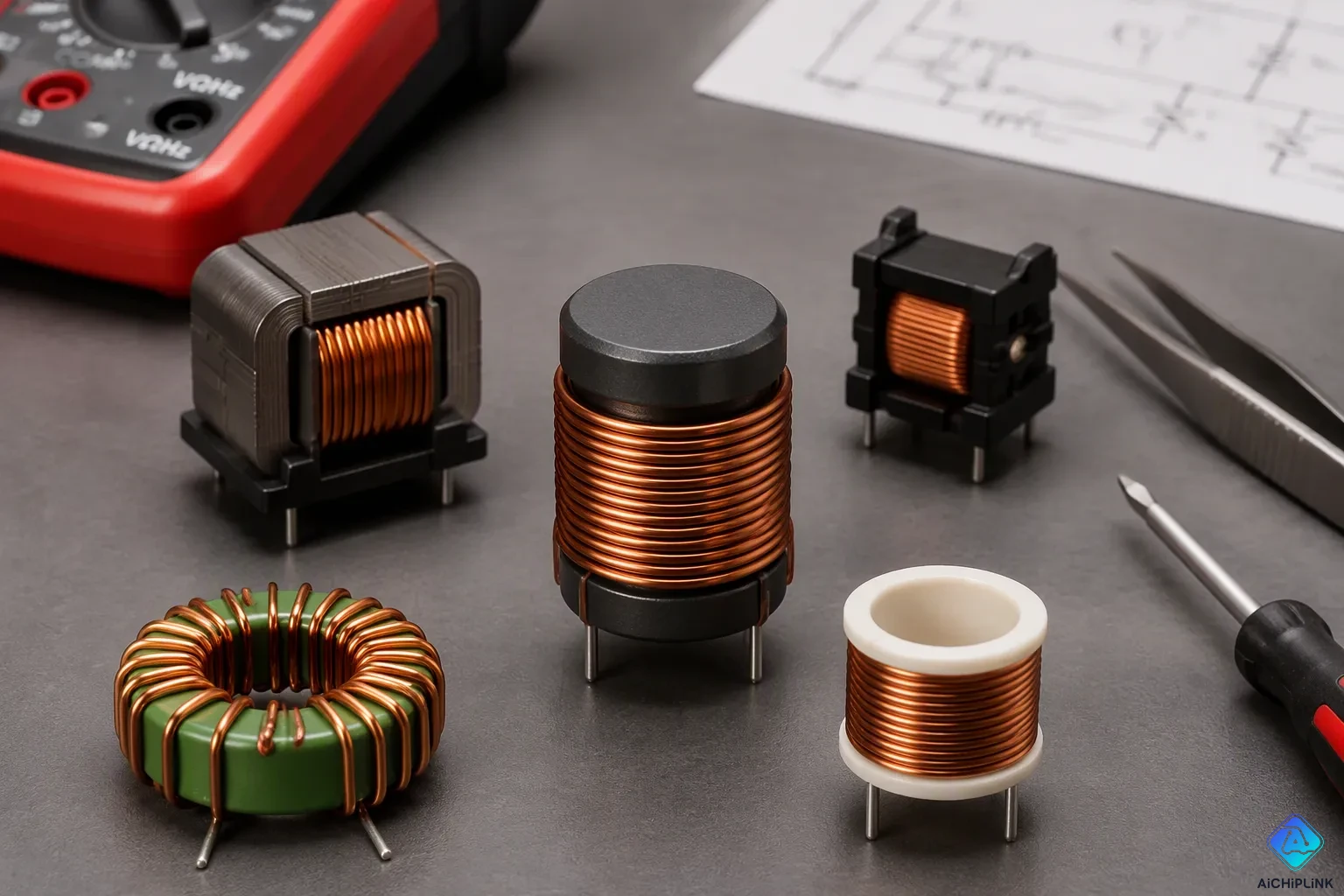
A fixed inductor is a passive two-terminal component that stores energy in a magnetic field. This magnetic field regulates current in an electrical circuit. Unlike variable inductors, fixed inductors have a set inductance value. Core materials affect an inductor's inductance, and magnetic cores increase it. But magnetic saturation can limit current, and magnetic properties also influence frequency response. A coil wound around a magnetic core creates the inductor, and the coil turns and magnetic permeability matter. The core concentrates magnetic flux and stores energy in the magnetic field during operation. All inductors have a coil, and these inductors filter signals. An inductor's design matters because current flows through the coil. Understanding these magnetic factors helps you choose the right fixed inductor.
Key Takeaways
-
A fixed inductor stores energy in a magnetic field and has a set inductance value that never changes.
-
Core materials like air, iron, and ferrite decide how an inductor performs, including saturation and frequency response.
-
Construction types include wire-wound, multilayer chip, and printed. Each one affects size, cost, and shielding.
-
Fixed inductors filter signals, control current, and team up with capacitors to tune circuits in many devices.
-
Always match the inductance, current rating, and shielding to what your circuit needs for it to work reliably.
What Is a Fixed Inductor?
Definition and Energy Stored in an Inductor
A fixed inductor is a passive two-terminal electrical part that stores energy in a magnetic field when electric current flows through it. The inductance value is set at the factory and never changes. You will also hear this part called a coil, a choke, or a reactor. The definition below captures the mechanical idea well:
An inductor whose coils are wound in such a manner that the turns remain fixed in position with respect to each other, and which either has no magnetic core or has a core whose air gap and position within the coil are fixed.
The energy stored in an inductor depends on two things: the inductance value and the current. You can express the energy stored in an inductor as one half times the inductance times the current squared. When current increases, the magnetic field stores more energy. When current decreases, the field collapses and returns that energy to the circuit. This behavior gives the inductor its two best-known habits: passing direct current easily and resisting alternating current. The voltage across the inductor depends on the rate of change of current, so a steady current produces almost no voltage. This current–voltage relationship makes the fixed coil useful in filters and power supplies. Every change in current meets an opposing magnetic effect, and that opposition smooths out sudden changes in current.
How It Differs from Variable Inductors
A variable inductor lets you adjust its inductance, while a fixed inductor holds one value for life. The table below compares the two.
| Aspect | Fixed Inductor | Variable Inductor |
|---|---|---|
| Inductance adjustability | Has a predetermined inductance value that cannot be changed | Can be adjusted to provide different inductance values |
| Construction | Available in surface mount and through-hole configurations; made from ceramic, ferrite, or air-core materials | Constructed by winding copper wire around a hollow bobbin; inductance changed by positioning or moving a brass or ferromagnetic core |
| Applications | Used where a specific inductance is required, such as filters or tuning circuits | Used in tunable circuits such as oscillators and filters |
| Adjustment method | Not adjustable | Adjusted by moving a movable core or using a rotary or slider switch that changes the number of turns in the coil |
| Selection guidance | Best choice when a fixed inductance value is needed | More appropriate when the inductance value needs to be adjusted |
You choose fixed inductors when your circuit needs steady inductance. You choose variable inductors when you must tune a circuit after assembly. A variable unit moves its ferrite core deeper into the coil to raise permeability and inductance, and pulls it out to lower both. That moving core adds size and cost. Fixed inductors stay more compact and more convenient, and they suit most modern boards. The next section covers the core materials and construction styles that shape their performance.
Core Types of Fixed Inductors
Air-Core, Iron-Core, and Ferrite-Core
When you choose a fixed inductor, the core material determines its performance limits. Three core types dominate the market: air, iron, and ferrite. Each one fits different circuit needs.
Air-core inductors contain no magnetic core. They rely only on air as the magnetic medium. This design eliminates core losses and avoids saturation completely. You get a linear inductance response with minimal signal distortion. These inductors support high current ratings without overheating. Their high Q factor means low energy loss and a cleaner signal. You find air-core inductors in RF applications where precision matters most. Common uses include oscillators, RF filters, tuning circuits, and matching networks. They also appear in wireless power transfer systems and medical equipment like MRI scanners. The compact, lightweight construction suits portable electronics very well.
Iron-core inductors use a magnetic core made from iron or silicon steel. This core increases inductance per volume dramatically. You store much more energy in a smaller physical space compared to an air-core design. Iron cores handle higher currents and voltages without saturating when built properly. They offer better power handling and improved efficiency at low frequencies. However, core losses rise sharply at high frequencies. This limitation makes iron-core inductors suitable mainly for low-frequency operation at 50 to 60 Hz. You see them in power supplies, transformers, voltage regulation circuits, and DC link chokes. Laminated steel cores reduce eddy current losses in these applications, boosting overall efficiency.
Ferrite-core inductors use a ceramic magnetic material made from iron oxide and other metal compounds. Ferrite provides high magnetic permeability and very low core losses at high switching frequencies. You achieve the same inductance with fewer turns of wire, creating a smaller and more compact part. Ferrite cores also give excellent EMI suppression and remain lightweight and corrosion-resistant. Their best efficiency lives at hundreds of kilohertz to several megahertz. You encounter ferrite-core inductors in power electronics, DC-DC converters, switching regulators, and telecommunications gear. They also appear in automotive electronics, EV chargers, and aerospace systems. The combination of small size and high-frequency performance makes ferrite the top choice for modern switching power supplies.
How Core Material Affects Inductance
The core material directly controls the inductance value you achieve. Higher effective permeability lets you get more inductance with fewer turns and a smaller core. However, permeability is not a fixed number. It varies with frequency, field strength, temperature, and the DC operating point. As you increase DC bias, permeability rolls off. Inductance falls, and current can rise rapidly. Air gaps reduce this effect by lowering effective permeability. They help prevent saturation and allow the inductor to store energy safely.
Saturation behavior differs sharply between core types:
-
Ferrite cores show sharp, hard saturation. When they approach saturation, inductance drops very quickly. This can cause sudden current spikes. Ferrite works best in low-current, high-frequency applications.
-
Powder iron cores show gradual, soft saturation. They tolerate higher flux density. They operate from DC to 500 kHz. Soft saturation allows controlled operation during current transients without catastrophic failure.
-
Sendust and composite cores also show gradual saturation. They offer very good temperature stability from 50 kHz to 1 MHz.
-
Nanocrystalline cores show soft saturation too. They work from DC to 100 kHz and suit low-noise power applications.
Frequency response also depends on core material. Ferrite maintains low core losses at high frequencies but collapses abruptly near saturation. Powder iron materials tolerate transient overcurrent without a sudden inductance drop. This makes them ideal for high-frequency converters with fast current slew rates, such as GaN-based designs. DC bias causes permeability to roll off. As you increase direct current through the coil, the core gradually loses its magnetic properties. Inductance falls, and current can rise quickly if you do not account for this effect. Always consider these factors when selecting your fixed inductor. The right core type keeps your inductance stable under real operating conditions.
Construction of a Fixed Inductor
Wire Winding, Core, and Shielding Cover
Every fixed inductor has three main parts: a magnetic core, a wire winding, and often a shielding cover. A wire-wound resistor uses an insulator as its core, but an inductor usually uses a ferrite core with a more conductive wire. The build process follows a clear order:
-
Pick a good magnetic core and enameled wire for the winding step.
-
Wind the coil the way the process requires, which may mean setting things like inductance, polarity, and number of turns.
-
Check the wound coil; if it fails quality tests, you may need to fix or rewind it.
A shielding cover changes how the part acts in your circuit. Most magnetic flux stays inside the component, so less leaks out. You get better control of electromagnetic interference and more room in tight PCB layouts. The trade-offs are real: shielding raises cost, adds size, and adds weight. Shielding does not automatically make inductance, DCR, or current rating better. It also does not remove all EMI sources. Good switching-loop layout, grounding, and power-path routing still matter. An inductor shield only deals with magnetic flux leakage.
Wire-Wound, Multilayer Chip, and Printed Types
Inductor construction comes in three main groups. Wire-wound parts use a coil wound on a core, which lowers DC resistance and boosts efficiency. They cover a wide inductance range and handle high current, so you find them in power circuits. Multilayer chip inductors use screen-printed coil patterns on ferrite layers. The ferrite fully covers the three-dimensional structure, which gives magnetic shielding and cuts leakage. Printed types use laminated structures on ferrite substrates and fit high-density mounting.
| Type | Construction | Inductance / Current | Shielding & Size |
|---|---|---|---|
| Wire-wound | Wire coil on a core | Wide range; high current | Limited miniaturization |
| Multilayer chip | Printed patterns on ferrite layers | Lower than wire-wound | Excellent shielding; compact |
| Printed | Laminated ferrite substrate layers | Lower power handling | Ferrite shield; high density |
Construction choices shape size, cost, and performance. Wire-wound parts cost less and carry more current. Multilayer and printed parts shrink the footprint and add shielding. Match the type to your circuit needs.
Functions and Testing of Inductors
Filtering, Oscillation, and Current Regulation
A fixed inductor does several jobs in a circuit. It blocks alternating current and lets direct current through. It stores energy in a magnetic field and gives that energy back when needed. It also works as a choke that stops AC parts. When you pair it with capacitors, you make an LC filter circuit that picks certain frequencies.
| Function | Description |
|---|---|
| LC Filter Networks | A fixed inductor with a capacitor blocks high-frequency noise and smooths power voltage. |
| Low-pass / High-pass Filtering | In audio circuits, a fixed inductor helps split frequencies and keeps sound clean. |
| Notch (Trap) Circuits | The inductor and capacitor make an impedance peak that blocks one frequency. |
| Common Mode Choke | Two windings on one core block common-mode noise while differential signals pass. |
An inductor also works with a capacitor to form an LC loop. This resonant circuit makes an oscillating electric current. The inductor and capacitor trade energy back and forth. For current regulation, inductive reactance goes up with frequency and inductance, so higher frequencies meet more opposition. The voltage across the inductor depends on how fast current changes. This current–voltage relationship lets the part store energy and keep current flowing during switching off-periods. The same current–voltage relationship explains why changes in current meet opposition.
Testing and Replacing a Fixed Inductor
You can test a fixed inductor with a multimeter in a few steps.
-
Set the multimeter to resistance measurement mode (ohms).
-
Connect the two probes to the two terminals of the inductor.
-
Read the resistance value on the display.
-
Interpret the reading: a good inductor shows fairly low resistance; infinite resistance means an open coil; near-zero resistance may mean a shorted coil.
Before you replace any inductor, follow these safety steps.
-
Turn off the power source and discharge the inductor with a resistor to prevent electric shock.
-
Insulate all connections, use insulated tools, and keep the part away from other components.
-
Secure the inductor with proper hardware to avoid vibration damage.
-
Handle leads and the core with care, and store the part in a dry, clean place.
-
Add heat sinking or ventilation if you install a higher-power unit.
These steps protect both you and the component during detection and replacement.
Applications and Precautions
Common Uses in Networks, Telecom, and Computers
Fixed inductors show up in many systems you use every day. In networks and telecom equipment, they process high-frequency signals. Base stations, routers, and antennas all depend on them. The 5G build-out creates strong demand for these parts. Smartphones add even more pressure. The RF and telecom segment will make the most money by the end of 2035.
Computers use them to deliver power and control noise. You find them in analog circuits, signal processing, and ripple removal. They also handle RF interference and store energy. Designers team them with capacitors to build tuned circuits. These circuits tune radio and TV receivers.
| Application Area | Role of Fixed Inductors |
|---|---|
| Consumer electronics | Power supplies, filters, and signal processing |
| Telecommunications/5G | Base stations, routers, antennas, and RF circuits |
| Computers | Ripple removal, RF interference control, energy storage |
Fixed inductors are often used with capacitors to make tuned circuits, which tune radio and TV receivers.
Key Performance Factors and Precautions
Three things guide your choice. First, check the inductance value and Q value. A higher Q means less energy is lost. Second, match the current rating to your load. A part that saturates early loses its inductance value fast. Third, confirm the frequency range. A ferrite core works well at high switching speeds. An iron core fits lower frequencies instead.
Follow these precautions when you select and replace parts:
-
Check the inductance value and Q value against your circuit needs.
-
Look at the current rating before you install the part.
-
Discharge the inductor with a resistor before you touch it.
-
Keep the magnetic core away from sensitive components.
-
Store parts in a dry, clean place.
A magnetic core pulls flux together, so nearby parts can pick up interference. Shielded types lower this risk. Always check the frequency range and current rating together. The right fixed coil keeps your circuit stable for years.
A fixed inductor is a part that stores energy in a magnetic field. Its magnetic core, winding, and shielding all shape how it performs. Air, iron, and ferrite cores each change inductance, saturation, and frequency response. The way it is built also affects size, cost, and efficiency. You can test a coil with a multimeter and swap it out safely. Always match inductance, current rating, and shielding to your design. Pick the right fixed inductors for your project, and your circuit will work well for years.

Written by Jack Elliott from AIChipLink.
AIChipLink, one of the fastest-growing global independent electronic components distributors in the world, offers millions of products from thousands of manufacturers, and many of our in-stock parts is available to ship same day.
We mainly source and distribute integrated circuit (IC) products of brands such as Broadcom, Microchip, Texas Instruments, Infineon, NXP, Analog Devices, Qualcomm, Intel, etc., which are widely used in communication & network, telecom, industrial control, new energy and automotive electronics.
Empowered by AI, Linked to the Future. Get started on AIChipLink and submit your RFQ online today!
Frequently Asked Questions
What does a fixed inductor do in a circuit?
It stores energy in a magnetic field when electric current flows. It blocks AC and lets DC pass. You use it to filter noise, smooth power, and tune circuits. Its inductance value stays fixed for life.
Which core type should you pick?
Air cores work well for radio and avoid magnetic saturation. Iron cores give high inductance at low frequency. Ferrite cores stay small and work well at high switching speeds. Most fixed inductors use one of these three cores.
How do you test one with a multimeter?
Set the meter to ohms. Touch both probes to the terminals. A good magnetic coil reads low resistance. Infinite resistance means an open winding. Near-zero resistance points to a shorted turn. You can test most inductors this way.
What happens when a core saturates?
The magnetic material cannot hold more magnetic flux. Inductance drops fast, and current can spike. Ferrite saturates sharply. Powder iron saturates slowly. Always check the current rating of the inductor before you install it.
Can you replace one with a different value?
No. A different inductance changes how your circuit acts. Pick a part with the same value, current rating, and shielding. Discharge the old coil with a resistor first. Then solder the new one in place.