How to identify vehicles using AI technology in 2026
You now live in a world where artificial intelligence can find and name cars very well. Using advanced computer vision, vehicle ai tools like Vehicle AI and CarNet.AI can quickly tell the make, model, year, and color of cars from pictures or sensor data. Artificial intelligence systems look at details, check them with huge databases, and can even match cars from videos. With ai in cars, you get quick and trusted identification that helps you stay safe and know what is happening.
Key Takeaways
-
AI technology in cars has gotten much better. It helps make driving safer and more efficient.
-
Sensor fusion mixes data from cameras, LIDAR, and radar. This helps cars find other vehicles and make fewer mistakes.
-
Real-time vehicle identification uses machine learning models. These models look at pictures and sensor data very fast.
-
AI can help with traffic management and smart parking. This can save time and cut down on pollution.
-
Using vehicle AI needs good planning, training, and teamwork. These steps help make sure it works well.
Vehicle AI in 2026
Key Advancements in Vehicle Identification
Vehicle ai technology got much better in 2026. Artificial intelligence now helps driver-assistance systems work faster and better. New AI architectures use end-to-end neural networks, not old rule-based programming. These networks help cars see what is around them and make smart choices. Vision-language models and lightweight models work together. This lets cars look at pictures and understand the environment at the same time.
Sensor technology is now better than before. LiDAR and high-resolution cameras are cheaper, so more cars have them. 5G-based V2X technology lets cars talk to traffic lights and roadside units. This makes driving safer and more efficient. The table below lists the top advancements in vehicle ai technology in 2026:
| Advancement Type | Description |
|---|---|
| AI Architecture | End-to-end neural networks take the place of rule-based programming. |
| Vision-Language Models | Cars use environmental context to make complex decisions. |
| Sensor Technology | Multi-modal stacks with LiDAR and high-resolution cameras are now common. |
| V2X Technology | 5G-based C-V2X lets cars talk to infrastructure. |
LiDAR sensors are now in premium cars because they cost only USD 200 - USD 500. This means more cars can use advanced driver-assistance systems for safer trips.
Computer Vision and Deep Learning
Artificial intelligence uses computer vision to help cars spot vehicles very well. Convolutional neural networks (CNNs) help find important features in images. These networks pick out details and understand how things are placed. Cars can still identify vehicles from blurry or low-quality images. This is important for advanced driver-assistance systems.
-
CNNs help cars find and sort vehicles.
-
Deep learning models help stop accidents and keep driving safe.
-
Computer vision helps cars know the make, model, year, and color fast.
You can trust ai in cars because artificial intelligence and driver-assistance systems work together to keep you safe and aware.
Core Technologies for Autonomous Vehicles
Sensor Fusion: Cameras, LIDAR, Radar
Self-driving cars use many sensors to see around them. Cameras show clear pictures and help find objects. LIDAR makes 3D maps and measures distance very well. Radar works in bad weather and tracks how fast things move. Each sensor is good at some things and bad at others. Cameras do not work well in the dark. LIDAR can have problems with shiny things. Radar does not show much detail but works in fog or rain.
Sensor fusion mixes these sensors to make a full picture. This lets self-driving cars use the best parts of each sensor. You get better detection and fewer mistakes. When you mix camera, LIDAR, and radar data, you make driving safer and more accurate. The table below shows how mixing sensors helps:
| Sensor Combination | Benefits |
|---|---|
| Camera-LiDAR (CL) | Gives depth and clear images for better obstacle detection. |
| Camera-Radar (CR) | Offers pictures plus distance and speed for nearby objects. |
| Camera-LiDAR-Radar (CLR) | Helps cars see far and adds safety by using strong data together. |
Note: Sensor fusion helps self-driving cars see well in many situations. It lowers mistakes and helps you trust the car.
AI for Autonomous Vehicles
AI helps self-driving cars understand all the sensor data. Artificial intelligence uses deep learning to spot and name vehicles on the road. Convolutional neural networks (CNNs) and long short-term memory (LSTM) networks are important. These models are very accurate and precise. For example, LSTM models can get perfect scores in precision, accuracy, recall, and F1-score. CNNs also do well, with accuracy almost 99.7%.
AI mixes information from cameras, LIDAR, and radar. This helps the system find vehicles even in hard situations. You get quick and trusted identification. Self-driving cars use these AI models to make fast choices and keep you safe.
-
Cameras give sharp pictures for finding vehicles.
-
LIDAR maps the world in 3D.
-
Radar tracks speed and works in bad weather.
-
Sensor fusion and AI work together for the best results.
These core technologies help self-driving cars get smarter and safer every day.
Step-by-Step Vehicle Identification Process
You can use vehicle ai to find cars with artificial intelligence. The process has clear steps. Each step turns raw data into useful results. Computer vision and machine learning models work together. They make identification fast and accurate.
Data Collection and Preprocessing
First, you collect data. You get images and sensor records from cameras, LIDAR, and radar. These pictures show cars in many places and conditions. You need photos of different makes, models, years, and colors. You also gather sensor data from self-driving cars.
Before using the data, you clean it. You remove blurry or unclear pictures. You label each car with details like make and model. You use image segmentation models to mark car parts. This step helps object detection models learn what to find.
Tip: Use pictures from day and night. Include cars in rain, fog, and sunlight. This makes your vehicle ai more reliable.
Model Training and Selection
You train machine learning models to spot cars. You use object detection models like Faster R-CNN for detailed recognition. You use SSD models for speed and accuracy. You mark each car with boxes and labels. You change settings to make models work better.
You test models with new pictures. You check how well they find and name cars. You use scores like Intersection over Union (IoU) and Mean Average Precision (MaP) to measure how good they are. You pick the model that fits your needs best.
-
Pick models for speed or precision.
-
Use data annotation to help models learn.
-
Test models with different pictures.
-
Optimize models to lower mistakes.
Real-Time Detection and Classification
You use vehicle ai to spot cars quickly. Object detection models scan images and sensor data fast. They find cars even when pictures are blurry or conditions are tough. Deep learning models like YOLO and CNNs help with quick detection.
Real-time detection has challenges. You must handle lots of data from cameras and sensors. You use data fusion to mix records from different sources. You use cloud-based AI to process data fast. You use edge AI for quick results right where you need them.
Note: Real-time detection helps you track cars on busy roads. It keeps self-driving cars safe and aware.
Output and Integration
You use vehicle ai results in real-world apps. You send car details to traffic systems, parking apps, and fleet management tools. You use reverse image search to match cars with databases. You connect outputs with smart city platforms.
You make sure results are easy to use. You show car details on dashboards or mobile apps. You use alerts to warn about unknown or suspicious cars. You link the system with law enforcement and security tools.
| Step | Action |
|---|---|
| Data Collection | Gather images and sensor data from cameras, LIDAR, and radar |
| Preprocessing | Clean and label data, use image segmentation models |
| Model Training | Train object detection models, test and optimize |
| Real-Time Detection | Use vehicle ai for fast car identification |
| Output Integration | Send results to apps and systems, use reverse image search |
You follow these steps to turn raw data into useful information. Vehicle ai helps you find cars quickly and accurately. Artificial intelligence and computer vision make the process smooth and reliable.
Applications and Use Cases
Traffic and Fleet Management
Vehicle AI helps make traffic and fleet management smarter. AI in cars lets you see traffic patterns and pick good routes. You get updates about road conditions right away. This helps you avoid traffic jams and save time. Fleet managers use AI to watch how cars work and plan fixes before problems happen. You can also help drivers be safer.
-
AI checks traffic and finds the fastest way.
-
You get alerts about accidents or dangers on the road.
-
Fleet managers use AI to spend less and keep cars working.
-
You can guess traffic jams up to an hour early.
-
AI helps you manage many types of transportation at once.
Smart Parking Solutions
Smart parking uses AI to help you find a spot fast. You do not need to drive around looking for parking spaces. AI systems read license plates for quick entry and exit. You pay automatically and see open spots in real time. These systems help cities lower pollution because cars spend less time searching.
-
AI shows you where to park and saves time.
-
You feel less stress and enjoy city trips more.
-
Smart parking lowers car emissions and keeps air cleaner.
Security and Law Enforcement
Vehicle AI helps keep streets safe. Police use AI to find stolen cars or track suspects. AI systems check license plates and match them with big databases. You get alerts if a suspicious car enters a secure area. This helps law enforcement act fast and protect people.
AI Car Damage Detection
AI car damage detection changes how you check cars for damage. You can use your phone or a camera to scan a car. The system finds dents, scratches, and broken parts. Vehicle damage detection works fast and gives you a report in seconds. Insurance companies use vehicle damage detection to speed up claims. Rental agencies use it to check cars before and after rentals. Recent studies show that vehicle damage detection can reach up to 96% accuracy, but some systems score lower, around 47% to 90%. You get quick results and fewer mistakes. AI car damage detection helps you trust the process and saves you time.
| Study | Accuracy Rate |
|---|---|
| Kyu and Woraratpanya | 70% |
| Artan and Kaya | 47% - 90% |
| Chua et al. | 49.28% |
| Dwivedi et al. | 96.39% |
You can see that vehicle damage detection is getting better every year. AI car damage detection makes life easier for drivers, businesses, and cities. Self-driving vehicles and autonomous vehicles use these tools to keep roads safe and cars in good shape.
Benefits and Challenges
Advantages of Vehicle AI
There are many good things about using artificial intelligence for vehicle identification. AI makes transportation safer and helps it run better. You can see travel patterns and learn how people move. AI cuts down traffic jams and lowers pollution and noise. You can plan cities better and use space in smarter ways. Cities can give more areas back to people and study how pedestrians act.
-
More safety for transportation
-
Less traffic jams
-
Less pollution and noise
-
Better city planning
-
Learn about travel needs
Artificial intelligence gives you solutions that fit your needs. You get traffic updates right away and connect with phones and other devices. AI for driver assistance helps keep you safe by watching for dangers. Businesses save money and work better with AI. UPS saved lots of miles and fuel by using AI to plan routes. A McKinsey survey found 41% of companies in supply chain management cut costs by at least 10% with AI. Predictive maintenance can lower yearly costs by 10% and cut surprise breakdowns by up to 25%. Deloitte found predictive maintenance lowers breakdowns by 70% and cuts maintenance costs by 25%.
| Benefit | Impact |
|---|---|
| Real-time traffic updates | Faster routes and safer driving |
| Predictive maintenance | Fewer breakdowns and lower costs |
| Personalized solutions | Better experiences for drivers |
| Urban space management | More space for residents |
Overcoming Common Challenges
There are problems when you use artificial intelligence for vehicle identification. Sometimes, you do not know the best way to use AI or what value it brings. It can be hard to mix AI with old systems. Rules, risks, and compliance can slow things down. You need skilled people to use AI well. Privacy and data security can be a problem because AI uses lots of personal data. Sending sensitive vehicle data to the cloud can make people worry about safety and rules.
-
Not clear how to use AI or what it is worth
-
Hard to mix with old systems
-
Rules, risks, and compliance issues
-
Not enough skilled workers
-
Privacy and data security worries
You can solve these problems by trying new things and learning all the time. Groups build a culture of teamwork and flexibility. You make supply chains better and use AI to give customers what they want. Privacy tools, consent, and data rules help with privacy worries. You protect against data leaks and people getting into data without permission. Ethical questions about who is responsible in accidents need careful thinking, especially with self-driving cars.
Tip: Keep up with world rules and use safe ways to talk so your data stays safe and people trust you.
Getting Started with Vehicle AI
Choosing Tools and Platforms
You can begin using vehicle AI by picking tools and platforms that fit your needs. There are many choices, so you should find ones that match your skills. Here are some steps you can follow:
-
Try cloud prototyping with NeMo and NIMs.
-
Use TensorRT-LLM for fast AI inference.
-
Build your own orchestrator with NeMo Agent Toolkit.
-
Deploy your solution on DRIVE AGX DevKit using TensorRT Edge-LLM.
-
Work with partners for DRIVE AI Box production, including hardware and software.
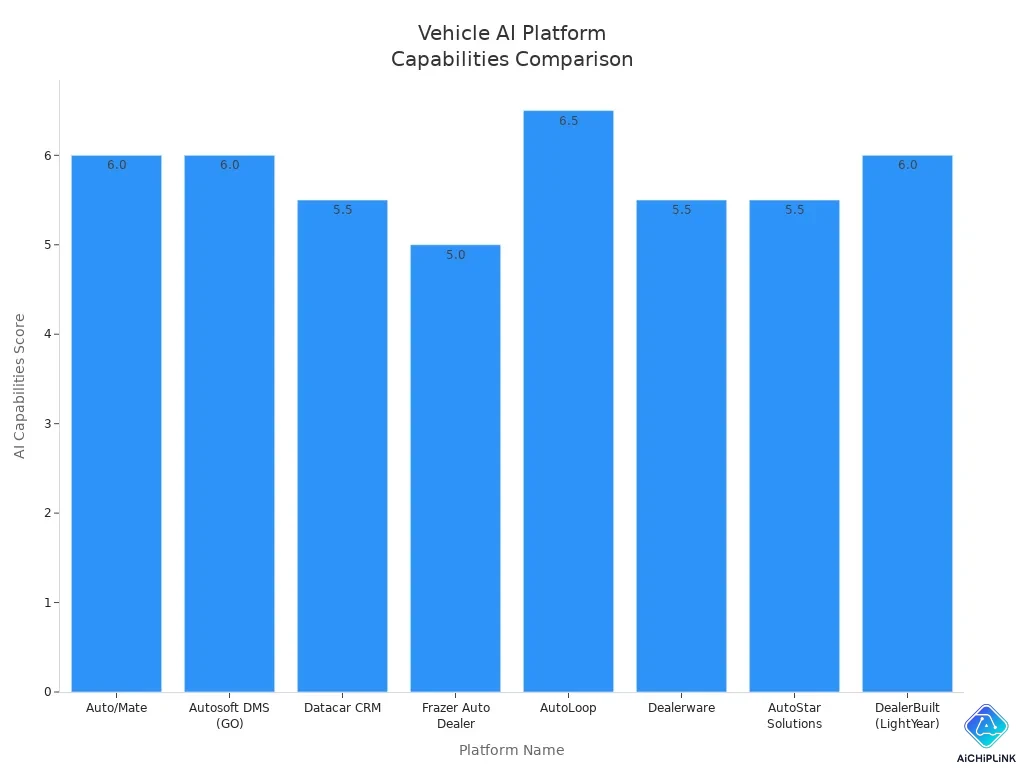
You can look at the table below to compare popular platforms. This helps you see which one is best for features, ease of use, and integration.
| Platform Name | AI Capabilities Score | Key Strengths | Potential Drawbacks |
|---|---|---|---|
| Auto/Mate | 6.0/10 | Great customer service, dealer-friendly contracts | AI features not as advanced as others |
| Autosoft DMS (GO) | 6.0/10 | Highest dealer satisfaction, easy interface | Less CRM-focused, basic AI compared to specialized CRMs |
| Datacar CRM | 5.5/10 | Latin America market expertise, local features | Limited US market, fewer integrations |
| Frazer Auto Dealer | 5.0/10 | Very affordable, easy to learn | Limited AI, not good for scaling |
| AutoLoop | 6.5/10 | Best service retention, strong loyalty features | Less focused on sales CRM |
| Dealerware | 5.5/10 | Best loaner management solution | Niche focus, not a full CRM solution |
| AutoStar Solutions | 5.5/10 | Regional focus, personalized support | Limited AI, fewer integrations |
| DealerBuilt (LightYear) | 6.0/10 | True variable + fixed ops integration | Smaller market, less mature AI features |
Tip: You can ask partners and schools for extra help and training. This makes it easier to use new AI tools for cars.
Best Practices for Implementation
You can follow some best practices to make your vehicle AI project work well:
-
Try new ideas and keep learning.
-
Use open source solutions to connect systems and stay flexible.
-
Build partnerships with tech startups and schools for new skills.
-
Invest in software and digital research for better user experiences.
-
Focus on teamwork for sharing knowledge and lowering costs.
-
Set up strong data strategies to collect and use data safely.
You should also take these steps for a smooth rollout:
-
Start with pilot programs and test your ideas on a small scale.
-
Use phased rollouts to add new features step by step.
-
Give everyone full training so all users know how to use the system.
Note: You can join pilot programs and work with partners to get the most from your vehicle AI solution. Training and teamwork help you avoid mistakes and reach your goals faster.
You can find vehicles with AI by using simple steps and smart tools. Important things like VIN, license plates, and tire DOT numbers help you follow vehicles. AI uses lots of data and OCR technology to get quick answers.
| Key Takeaway | Description |
|---|---|
| VIN | Special code for each vehicle |
| License Plates | Shows who owns the car |
| Tire DOT Numbers | Tells about tires and where they were made |
Check out vehicle AI tools that fit what you need. Keep learning from news and research about the industry. AI will help you see better, work faster, and make roads safer soon.

Written by Jack Elliott from AIChipLink.
AIChipLink, one of the fastest-growing global independent electronic components distributors in the world, offers millions of products from thousands of manufacturers, and many of our in-stock parts is available to ship same day.
We mainly source and distribute integrated circuit (IC) products of brands such as Broadcom, Microchip, Texas Instruments, Infineon, NXP, Analog Devices, Qualcomm, Intel, etc., which are widely used in communication & network, telecom, industrial control, new energy and automotive electronics.
Empowered by AI, Linked to the Future. Get started on AIChipLink and submit your RFQ online today!
Frequently Asked Questions
How does vehicle AI identify cars in real time?
You collect data with cameras and sensors. AI models look at pictures and sensor records. The system finds cars fast. It shows details like make, model, and color.
Can vehicle AI help with claims automation?
Yes. Vehicle AI checks car damage and speeds up claims. The system gives quick reports for insurance companies and rental agencies.
Is vehicle AI accurate in bad weather?
AI uses sensor fusion. Cameras, LIDAR, and radar work together. You get good results even in fog, rain, or low light.
What tools do you need to start using vehicle AI?
You need cameras, sensors, and a platform like Vehicle AI or CarNet.AI. Cloud-based tools help you set up fast and get easy results.
How does vehicle AI protect your privacy?
You use data encryption and follow privacy rules. The system keeps your information safe and limits who can see sensitive data.