Top 10 Popular Semiconductor Companies in 2026

Five major industry leaders make up the top semiconductor companies by market value for 2026. Nvidia reaches $4.32 trillion because companies need more AI hardware. TSMC earns $1.76 trillion with its advanced 2nm chip making process. Broadcom hits $1.57 trillion by building custom silicon computer chips. Samsung holds $848 billion through its memory chip factories. ASML reaches $507 billion by selling High-NA EUV lithography machines.
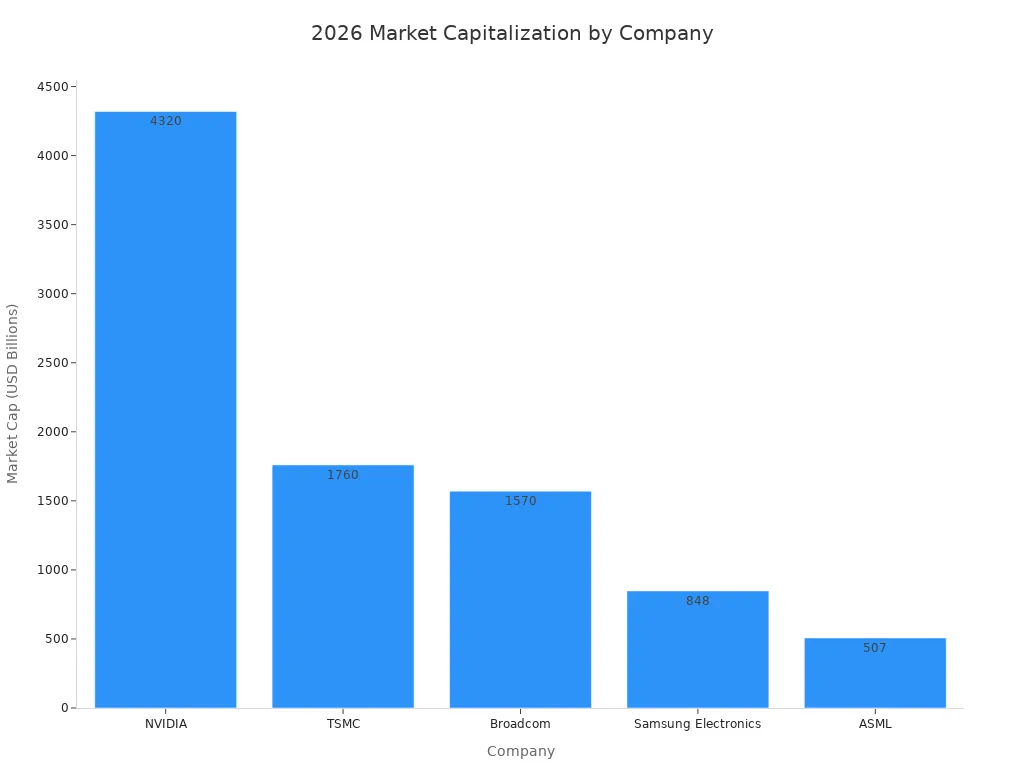
Generative AI technology pushes huge spending increases into these massive semiconductor companies. High-Bandwidth Memory chips help data centers process information much faster. Big financial investors watch strong semiconductor stocks for smart long-term growth. The worldwide semiconductor market reaches $760.7 billion while growing 8.5% year over year. Solid financial strength boosts top-performing semiconductor stocks across global stock markets.
Key Takeaways
-
The rise of artificial intelligence pushes huge investments into the worldwide computer chip industry.
-
Nvidia and Broadcom lead the business in making quick chips for data centers.
-
TSMC creates actual computer chips for big customers using top-notch technology.
-
Samsung and SK Hynix build fast memory parts for modern computers.
-
ASML provides important machines to help factories create smaller silicon chips.
Top Semiconductor Companies in Fabless Chip Design
Fabless semiconductor firms create smart digital designs without building costly manufacturing plants. These active companies shape our digital world through constant engineering progress. Big global tech businesses rely on these creators to run modern software programs. System makers purchase these designs to build connected cloud networks. Investors watch top-performing tech stocks closely in this fast-growing market sector. Major companies buy millions of computer chips every year to grow digital services. These modern chips power main server setups.
Nvidia Leading AI Workloads and Data Center Hardware
Nvidia holds an unheard-of $4.32 trillion market value thanks to huge company demand. Corporate leaders purchase advanced chips to teach complex artificial intelligence programs. Strong buyer demand for business AI server GPUs creates this massive valuation. Tech firms build giant computer networks with these powerful chip units. The Nvidia Data Center division made $115.2 billion in sales for fiscal year 2025. This huge number shows a 142% gain over the previous year. Millions of fast chips handle tricky data jobs across global networks every day. Systems engineers tweak these setups for deep learning work.
Nvidia holds the top spot for artificial intelligence speed-boosting computer hardware. Financial experts watch market trends for Nvidia hardware very carefully over recent business years:
| Metric | Value | Period |
|---|---|---|
| Nvidia AI accelerator data center GPU revenue share | 80–90% | 2025 |
| Revenue share peak | ~87% | 2024 |
| Projected revenue share | 75% | 2026 |
Market experts keep an eye on Nvidia as rival tech companies grow worldwide. Tech managers need these chips to run their software programs. Many money experts judge chip stocks using Nvidia sales numbers and earnings reports. Large money managers check quarterly profit reports on a regular basis.
Broadcom and AMD Driving Custom ASIC and Edge Chips
Broadcom hits a $1.57 trillion market value by using clever engineering ideas. The business builds custom AI boosters and fast networking silicon chips. Big cloud computer operators build custom chips with Broadcom to cut running costs. Engineers draw special chip patterns for unique server computer jobs. Broadcom makes custom chips to send data across huge business networks. Tech sellers put these chips inside top server rack switches.
Broadcom expects huge growth for custom chip sales in future business cycles. The company plans to remain a key partner for large cloud providers:
| Indicator | 2026 figure |
|---|---|
| Broadcom projected AI ASIC custom accelerator revenue | $38–42 billion |
| Implied FY2026 AI chip revenue run rate | ~$33 billion |
Big investment managers purchase Broadcom stock for safe long-term money growth. The firm grows its presence inside network setups and cloud computer systems. Experts review company profit details before giving strong investment advice. Money research team members suggest this firm to buyers wanting safe chip stocks.
AMD grows its market share in server chips to test top rivals. AMD battles Nvidia directly inside big corporate cloud computing facilities. Cloud providers put these alternative chips into server rooms to spread out chip suppliers.
-
AMD MI-series AI accelerator market share reached roughly 5–7% overall in 2025.
-
FY2025 MI-series GPU revenue reached $6–8 billion, while the AMD Data Center segment reached $16.6 billion.
-
AMD ramped the MI300X chip faster than any prior AMD product in company history.
Financial teams study top growth stocks to win market gains during tech changes. Investment leaders track quarterly income reports to measure customer demand across global sales routes. Wise investors balance stock holdings between major chip companies and new hardware designers.
Best-Performing Semiconductor Stocks in Chip Manufacturing
Making physical computer chips takes huge money and exact tech tools. Strong worldwide sales put top chip makers and design builders among the highest-earning tech stocks. Experts calculate total sales for the global chip factory market at $162.7 billion during 2025. Another financial report sets this full market value at $157.03 billion that same year. Smart market experts study worldwide factory bases when choosing chip stocks for long-term growth. Big investment funds compare working production lines before spending money on major tech stocks.
TSMC Dominating Advanced Node Pure-Play Fabrication
Top producer TSMC holds a massive $1.76 trillion company value by leading all chip production. Huge business orders give TSMC a strong 69.9% market share across global chip factories in 2025. Smart money planning keeps the business ahead in high-tech node design. Official company records show TSMC building spending between $52 billion and $56 billion for 2026. That total jumps up from $40.9 billion in 2025 and $28.9 billion during 2024. New money forecasts show this target budget reaching $60 billion to $64 billion. Steady budget increases help TSMC stay way ahead of all other market rivals.
TSMC puts 70% to 80% of its 2026 build budget into top node tech, while spending 10% to 20% on advanced CoWoS box builds.
Major tech buyers need cutting-edge chip power to run modern software programs. Main global factories spend billions of cash to prepare 2nm mass production lines:
| Foundry | 2nm investment evidence | Volume production outlook |
|---|---|---|
| TSMC | $38–$42 billion roadmap for Kaohsiung and Hsinchu fabs plus $65B+ Phoenix Fab 21 program | 2nm output expanding in 2027–2028+ timeframe |
| Intel | $32 billion investment for Fabs 52 and 62 in Chandler, Arizona | 2026–2027 volume timeline |
The massive size of TSMC protects its top spot among giant tech hardware firms everywhere. Big tech clients trust TSMC to produce steady chip supplies through every business season.
Samsung Electronics and Intel Expanding Systems Foundry Capabilities
Rival factories use new sales ideas to take client orders from top leaders. Researchers watch Samsung and Intel as both active brands grow local factory work. Business charts show Samsung reaching an $848 billion total value across international branches. Still, Samsung gained a 7.2% factory sales slice with $12.63 billion total money in 2025. That overall sum shows a 3.9% drop from the prior year. In February 2026, Samsung built a better 2nm build design and boosted special packing options to gain market strength. Corporate buyers watch these tech upgrades closely before buying special custom computer chips.
Intel uses its IDM 2.0 factory setup to build custom silicon chips right inside American plants. Main technical goals show clear Intel progress across next-generation build steps:
-
Intel launched the 18A build step using new RibbonFET parts and PowerVia back-side power wires.
-
Production groups made in Arizona hit smooth build rates for Core Ultra 300 Panther Lake units in 2025.
-
TechInsights scores rated Intel 18A at 2.53 to beat TSMC N2 at 2.27 and SF2 at 2.19.
Traders purchase chip stocks to gain money profits as global computer hardware keeps growing everywhere. Large financial firms hold solid hardware stocks inside active growth funds. Safe tech stocks gain constant money support as multi-year processor designs keep changing over time. Smart investors watch how top chip makers improve factory output to pick winning companies for future wealth.
Leading Memory Semiconductor Companies Powering AI Hardware
Memory parts play an important role when running big compute jobs inside modern data halls. Smart AI server units need steady data streams to run complex computer code without stopping. The global High-Bandwidth Memory space reached 6.96 billion dollars in 2025. Speedy memory chips stop system slowdowns while handling big computing tasks. Smart investors track memory chip makers to find the best hardware suppliers. Modern computer networks need larger memory space and quicker data speeds every single day.
SK Hynix Pioneering High-Bandwidth Memory Architecture
SK Hynix leads the industry by making high-speed memory systems. The firm held a top supply spot through recent chip making cycles. Experts predict SK Hynix will ship the biggest HBM4 share to NVIDIA in 2026. The business plans to open its M15X factory in Q4 to boost physical build output. This smart site expansion helps fill growing global chip orders.

Market numbers show changing quarterly spots for SK Hynix during 2025:
| Quarter in 2025 | SK Hynix HBM Market Share |
|---|---|
| Q1 2025 | 69% |
| Q2 2025 | 64% |
| Q3 2025 | 56% |
| Q4 2025 | 57% |
Big investment funds buy top chip stocks to join in on growing AI markets. Financial experts check quarterly sales reports before adding memory shares to growth funds. SK Hynix keeps improving stacked chip layers to cut down on total power use.
Micron Technology Scaling Next-Generation DRAM and NAND Flash
Micron Technology speeds up output for high-capacity DRAM and NAND flash memory units. Web server networks need these large storage drives to keep business records safe. Large companies pick high-speed storage drives to make real-time data work much faster. Investors watch chip stocks to find steady long-term tech holdings.
Growing market rival samsung pushes to expand its own high-tech memory work. Industry news shows samsung delivered early HBM4 goods to key corporate accounts. Micron fights this market pressure by improving factory output across local plant sites. Money managers study top chip stocks to build strong investment holdings.
Equipment Enablers and Process Control Leaders
Equipment suppliers build the critical machinery for modern chip fabrication plants. The global semiconductor equipment market size reached USD 118.9 billion in 2025. Global chip manufacturers rely on precision tools to increase wafer output. Institutional investors closely monitor specialized equipment toolmakers to discover high-performing growth stocks.
ASML Controlling Photolithography and High-NA EUV Systems
ASML holds a supreme monopoly on High-NA EUV lithography tools. Modern chipmakers require these advanced machines to produce computer chips at 2nm node sizes. ASML commands an unprecedented $507 billion valuation because every leading factory purchases ASML scanners. ASML expands its primary assembly lines in Europe to meet rising global factory orders. Analysts consider ASML a foundational titan for the entire semiconductor industry.
ASML ships top-tier lithography systems to advanced logic and memory foundries worldwide. ASML maintains complete market dominance over extreme ultraviolet technology. ASML optics allow engineers to print microscopic circuit features onto silicon wafers with extreme precision. Industry experts watch corporate earnings reports to evaluate capital hardware spending trends across major markets. Financial institutions buy semiconductor stocks tied to essential manufacturing machinery providers to secure long-term capital expansion.
KLA Corp Driving Yield Optimization and Process Control
KLA Corp secures high manufacturing efficiency and yield stability inside advanced chip factories. KLA Corp equipment inspects microscopic wafer layers during complex fabrication cycles. KLA held ~56% share of the semiconductor process control market in late 2025.
| Metric | Fiscal 2024 | Fiscal 2025 | Growth |
|---|---|---|---|
| Defect Inspection Revenue | $4.33B | $6.20B | +43.05% |
| Semiconductor Process Control Revenue | $8,733,556K | $10,947,359K | +25.35% |
KLA controls between 50% to over 80% market share across key inspection and metrology segments. Defect inspection revenue reached 50.99% of total company revenue in fiscal 2025. KLA helps factories raise silicon yield and minimize costly production defects. Institutional investors select top semiconductor stocks for consistent long-term portfolio growth. Asset management funds add these equities to capture stable returns. Wealth managers track growing semiconductor stocks to build financial value over long investment cycles.
Strategic Drivers and Risks for Semiconductor Stocks
High-Bandwidth Memory and Custom Silicon Expansion
Fast changes in semiconductor growth trends shift technology markets around the world. Big cloud companies design custom chips to lower server costs and process data much faster. Google works with Broadcom to make TPU boosters, while AWS put out more than 500,000 Trainium2 chips by late 2025. Microsoft built the Maia 200 with 216 GB of fast memory. This setup sends 7 TB of data every second for heavy data tasks. Broadcom handles 60% to 80% of custom AI chip design jobs, while Marvell holds 20% to 25% of the market. Nvidia bought Groq in December 2025 to sell super-fast data center chips.
High-Bandwidth Memory drives these advanced computer systems. The market for this memory expands from $3 billion in 2025 up to $3.81 billion in 2026. This fast growth represents a 26.7% yearly gain. Main chip designers rely on top factories to build their real physical products. High demand for data processing increases sales across the entire semiconductor field. Investors weigh the pros and cons of buying semiconductor stocks before picking tech shares. Money managers look at individual semiconductor stocks to grab long-term hardware profits.
Geopolitical Dynamics and Global Supply Chain Bottlenecks
World political problems create real work risks across global trade paths. Middle East fights near the Strait of Hormuz disrupt oil shipments and threaten key suppliers. Rules on trade also affect how computer chips get shipped across borders. In April 2025, U.S. officials stopped Nvidia from selling H20 processors to China. Leaders dropped the ban in July 2025 after Nvidia agreed to pay a 15% revenue share. Nvidia expanded its global deliveries while updating its internal compliance rules. Tool companies like ASML follow strict trade policies.
Governments spend public money on local factories to make regional supply chains stronger. Texas Instruments planned a $60 billion investment to build seven factories across Texas and Utah. Applied Materials announced a $400 million research center in Bengaluru to help local market growth. Plant managers need specialized gear from ASML and custom box packing from TSMC to keep factory output steady. TSMC works with world partners while building regional factories. TSMC grows its chip box packing setup to stop annoying shipping delays. Experts watch top-performing chip stocks to help people manage their money holdings. Investors pick separate chip stocks to keep their investments balanced.
The top semiconductor companies hold supreme market power across chip design, memory, manufacturing, and process tools. Design leaders nvidia and broadcom create fast processors to handle enterprise data operations. Yet, fabless giants depend on tsmc manufacturing and asml lithography tools to produce silicon. Memory leaders like samsung supply high-speed modules for data hardware. These largest semiconductor companies form an interconnected global market.
Institutional investors evaluate semiconductor stocks to capture technological expansion. Bottlenecks at semiconductor foundries can impact total node output. Analysts recommend tracking capital expenditure trends before purchasing individual semiconductor stocks. Financial managers monitor nvidia and tsmc during production shifts. Industry experts guide semiconductor companies while buyers analyze nvidia to evaluate semiconductor stocks.

Written by Jack Elliott from AIChipLink.
AIChipLink, one of the fastest-growing global independent electronic components distributors in the world, offers millions of products from thousands of manufacturers, and many of our in-stock parts is available to ship same day.
We mainly source and distribute integrated circuit (IC) products of brands such as Broadcom, Microchip, Texas Instruments, Infineon, NXP, Analog Devices, Qualcomm, Intel, etc., which are widely used in communication & network, telecom, industrial control, new energy and automotive electronics.
Empowered by AI, Linked to the Future. Get started on AIChipLink and submit your RFQ online today!
Frequently Asked Questions
What drives market value for nvidia in enterprise tech?
High enterprise GPU demand helps Nvidia control data center workloads. Fiscal year 2025 data center sales brought the business $115.2 billion in revenue. Corporate clients depend on nvidia hardware to run artificial intelligence programs. For this reason, the firm tops major semiconductor companies in market value.
Why do tsmc and asml dominate hardware manufacturing?
Tsmc holds a massive 69.9% share of the worldwide foundry market. At the same time, asml provides essential High-NA EUV lithography machinery. Working together, tsmc and top equipment makers control production lines for advanced node computer chips.
How do custom chip designs benefit broadcom and cloud providers?
Broadcom builds custom accelerators for major cloud computing companies. Enterprise operators work with broadcom to lower running costs and process special workloads much faster. These unique chip designs manage heavy data center traffic with high efficiency.
How should investors evaluate semiconductor stocks?
Financial managers buy semiconductor stocks to profit from expanding hardware markets. To analyze individual semiconductor stocks properly, experts check tech execution schedules for chip nodes. Additionally, financial advisors track tech stocks alongside cyclical stocks to manage total portfolio risks.