How to select the best low offset operational amplifier for your project
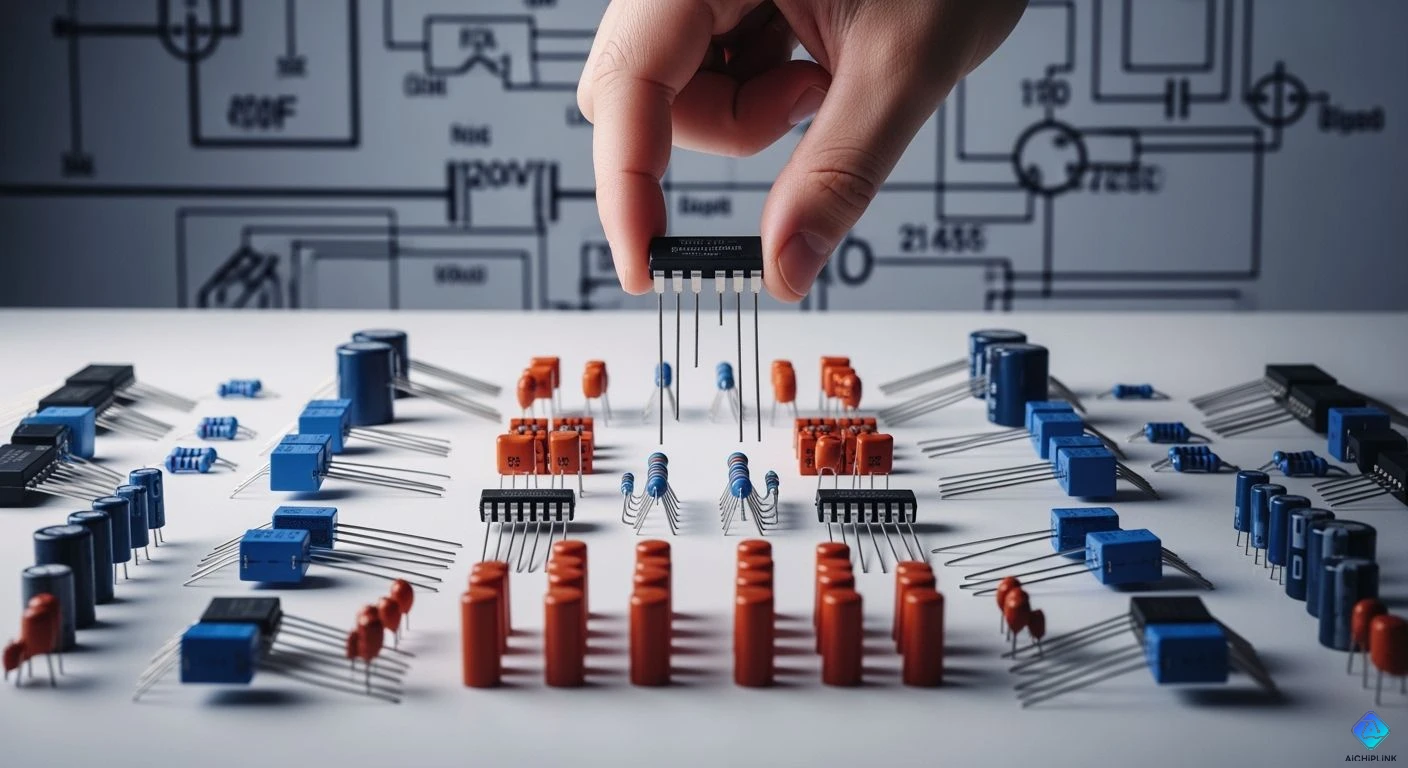
You should know how precise you need to be before picking a low offset operational amplifier for your diy project. Offset voltage can change your output even if you think it should be zero. This happens because of tiny differences inside the amplifier. This small mistake can change how accurate your results are, especially if you need high precision. Always look at each detail in the datasheet and see if it matches what your project needs. Go step by step to make sure you pick the right one for your project.
Key Takeaways
-
Learn about offset voltage and drift. These things change how correct your circuit is. Always look for these numbers in the datasheet.
-
Pick an operational amplifier that fits your project. Think about what kind of signal you have. Also, think about how exact you need your project to be.
-
Look at what power the amplifier needs. Make sure it works with your voltage. Check if it can handle the amount of work in your circuit.
-
Find important details like CMRR and noise. High CMRR helps block signals you do not want. Low noise is important for small signals.
-
Use help from the company that makes the amplifier. Datasheets and tech support can help you pick the best amplifier for your project.
Low Offset Operational Amplifier Basics
Offset Voltage and Drift
A low offset operational amplifier helps your circuits work better. Offset voltage is a small mistake at the output. This happens even if both inputs get the same voltage. The error comes from tiny parts inside the amplifier. If you want your circuit to be very exact, you must watch this value closely.
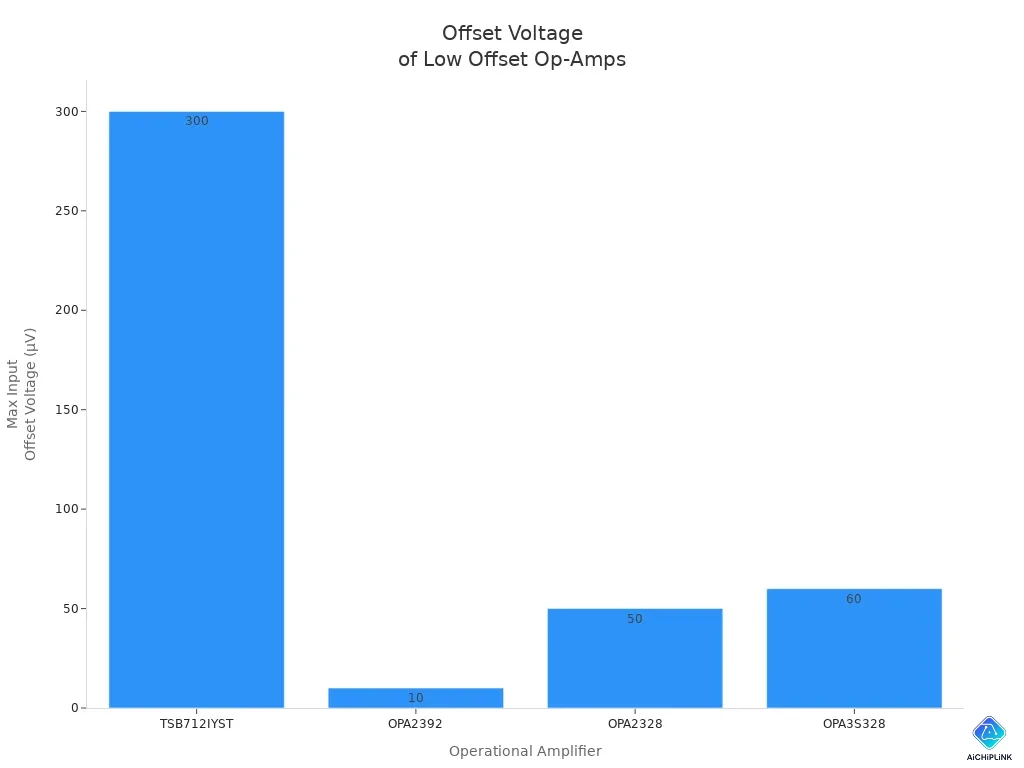
You can look at the table below to compare different amplifiers:
| Operational Amplifier | Maximum Input Offset Voltage |
|---|---|
| TSB712IYST | 300 µV |
| OPA2392 | 10 µV |
| OPA2328 | 50 µV |
| OPA3S328 | 60 µV |
| ≤10 µV | Precision category |
| 10 to 25 µV | Precision category |
| 25 to 150 µV | Precision category |
| >150 µV | Precision category |
Offset voltage drift is also important. Drift means the offset can change over time. This happens if temperature or humidity changes. Drift can make your measurements less correct. For example, in measurement systems, drift can cause errors that add up. This makes your data less trustworthy. Temperature changes are a big reason for drift. You should think about where your project will be used.
Why Offset Matters
Offset is important because it changes how your circuit works. High offset can make big mistakes in the output. It can also make it hard to measure some signals. This is bad if you use sensors that need to be very exact. Sometimes, it is hard to fix these mistakes, especially in tricky circuits.
Tip: Always look at the offset and drift numbers in the datasheet when you pick a low offset operational amplifier. This helps your project stay correct and work well.
Project Requirements
Signal and Precision Needs
First, think about what kind of signal your project uses. Some projects use small signals from sensors. Others use bigger signals. The sensor you pick will help you choose the right operational amplifier. Here is a table that shows different sensor types and where they are used:
| Sensor Type | What It Does | Applications |
|---|---|---|
| Position sensor | Detects position or orientation of an object | Robotics, automotive systems |
| Pressure sensor | Measures force from a liquid or gas | HVAC, industrial processes, braking systems |
| Temperature sensor | Monitors heat levels | Climate control, electronics, manufacturing |
| Humidity sensor | Measures moisture in air | Environmental control, farming, weather |
| Force sensor | Detects mechanical force | Scales, machines, touch-sensitive devices |
| Vibration sensor | Measures oscillations in machinery | Maintenance, fault diagnosis |
| Motion sensor | Detects movement or presence | Security, lighting, touch-free interfaces |
| Flow sensor | Measures fluid movement rate | Water management, chemical processing |
| Level sensor | Determines material height in a container | Inventory, safety, process control |
Next, decide how accurate your project needs to be. Some sensors need to be very exact. This is important in medical or industrial projects. Think about the output signal and how fast you need it. Also, think about the range you want to measure. If your project must follow safety or quality rules, check if the amplifier meets those rules. These rules help keep your project safe and reliable.
Tip: Make sure the amplifier’s precision matches your sensor’s needs. This helps your project work its best.
Power Supply and Load Handling
You also need to check your power supply. See how much load your amplifier will drive. The amplifier must work with your voltage. If you use batteries, pick an amplifier that works at low voltage. The load is what the amplifier powers, like a speaker or another circuit. Here is a table to help you check important power and load points:
| Specification | Importance | Verification |
|---|---|---|
| Supply-voltage range | Must match your available power | Check datasheet for recommended range |
| Output swing | Shows how much the output can move | Compare with your load and supply voltage |
| Load current | Tells how much current the amplifier can provide | Calculate using I_LOAD ≈ V_OUT / R_LOAD |
-
Output swing and load current depend on:
-
Load resistance
-
Supply voltage
-
Output current needed
-
Temperature
-
Required accuracy
-
Always check these things before picking an amplifier. This helps your project work well and stay reliable.
Key Specifications for Operational Amplifiers
When you pick a low offset operational amplifier, you should check some important numbers. These numbers help your circuit stay correct, lower noise, and make sure your project works right. You can find these numbers in the datasheet for each operational amplifier.
Input Offset Voltage and Drift
Input offset voltage is a small voltage that shows up at the output even when both inputs are the same. This number can change your results, especially if you need your circuit to be very exact. Drift tells you how much the offset voltage changes with temperature or over time. If you want your project to stay correct, you need to check both offset voltage and drift.
-
You can test the offset voltage in your prototype with a simple circuit called a false summing junction. This lets you see if the amplifier matches the datasheet.
-
If your sensors or ADC give weird readings, the offset voltage might be too high.
-
Always look at the offset voltage and drift numbers in the datasheet before you choose.
Tip: Lower offset voltage and drift help your measurements stay correct.
CMRR and Noise
CMRR means common-mode rejection ratio. This number tells you how well the operational amplifier can ignore noise that is on both inputs at the same time. High CMRR is very important if there is a lot of electrical noise around. If the CMRR is low, your circuit might pick up signals you do not want, which can cause mistakes.
-
CMRR shows how well the amplifier blocks noise that is the same on both inputs.
-
High CMRR keeps your signal clean and protects your data from outside noise.
-
In noisy places, low CMRR can give you wrong readings and make your circuit work badly.
Noise is another important thing. Every operational amplifier makes some noise. If you use small signals, you want an amplifier with low noise. Look for the noise number in the datasheet, usually shown in nanovolts per root hertz (nV/√Hz).
Note: High CMRR and low noise help you get the best and most steady results.
Gain Bandwidth and Slew Rate
Bandwidth tells you how fast the operational amplifier can react to changes in the input signal. The gain-bandwidth product (GBW) shows the frequency where the amplifier’s gain drops to one. If you need to boost high-frequency signals, you want a high gain-bandwidth.
Slew rate is the fastest speed the output can change. If the slew rate is too low, the output cannot keep up with fast input changes. This can make the signal look strange, especially with big or quick signals.
-
Slew rate shows how fast the output can move from one voltage to another.
-
Gain-bandwidth product tells you the highest frequency the amplifier can handle at a certain gain.
-
High gain-bandwidth lets you work with fast, small signals. If the slew rate is low, big signals may look strange.
-
If you pick a high slew rate but low gain-bandwidth, you may lose gain at higher frequencies.
-
You need to balance both numbers to stop signal problems and keep your circuit working well.
Here is a table to help you compare these key specs:
| Specification | What It Means | Why It Matters |
|---|---|---|
| Input offset voltage | Small error at output with equal inputs | Affects measurement accuracy |
| Drift | Change in offset over time/temperature | Impacts long-term stability |
| CMRR | Ability to reject common noise | Keeps signals clean in noisy environments |
| Noise | Random unwanted signals from the amplifier | Important for small-signal applications |
| Gain-bandwidth | Frequency range for a given gain | Needed for high-speed or wideband signals |
| Slew rate | Maximum speed of output voltage change | Prevents distortion in fast or large signals |
| Input/output impedance | Resistance to current at input/output | Affects signal transfer and loading |
Remember: Always check the datasheet for these numbers. Making sure they fit your project helps you avoid problems and get the best results.
Matching Amplifier Types to Applications
Precision Sensing
You need the right operational amplifier for precision sensing jobs. These jobs are common in medical devices and industrial sensors. You want your measurements to be correct and steady. Two amplifier types are best for this:
-
Instrumentation amplifiers give you accurate gain and high input impedance. They also have great common-mode rejection ratio (CMRR). Use them when you need to measure small signals in noisy places, like biomedical sensors.
-
Low-noise amplifiers help you catch weak signals without much extra noise. These amplifiers are used in many precision systems. About 85% of medical imaging devices use low-noise amplifiers.
Tip: Pick an amplifier with low offset voltage and drift for the best results in precision sensing.
Audio and Signal Conditioning
Audio circuits need amplifiers that keep sound clear and real. You want to stop noise and distortion. The table below shows the most important specs for audio signal conditioning:
| Specification | Description |
|---|---|
| Supply Voltage Range | Keeps the amplifier safe with audio signals. |
| Input Common Mode Voltage Range | Sets the input voltage range for good operation. |
| Input Impedance | High input impedance stops signal loss, especially with high-impedance sources. |
| Equivalent Input Noise | Low noise keeps audio quality high. |
| Typical Harmonic Distortion | Low distortion keeps the audio signal clean. |
| Supply Current | Important for battery-powered devices; affects energy use and noise. |
| Output Impedance | Low output impedance stops voltage drops when driving loads like headphones. |
Note: Always check these specs in the datasheet to keep your audio clear and strong.
Filters and Analog Processing
You use operational amplifiers in filters and analog processing to shape signals or remove unwanted parts. Automotive electronics often need amplifiers with special features. The table below shows what you should look for:
| Feature | Description |
|---|---|
| Low Power Consumption | 210 µA at 5V |
| Speed-to-Power Consumption Ratio | Excellent |
| Gain Bandwidth Product | 1.6 MHz |
| Input Bias Current | Ultra-low |
| Application | Ideal for high-accuracy sensor interfaces |
You should match the amplifier’s features to your project’s needs. This helps your circuit stay reliable and efficient.
Datasheet Comparison and Selection Tips
Comparing Key Parameters
When you pick a low offset operational amplifier, start by checking the datasheet. The datasheet gives you important facts. Look for the main parameters that affect your project. These are supply voltage, noise, current consumption, input offset voltage, power supply rejection ratio (PSRR), and common-mode rejection ratio (CMRR).
Here is a table to help you compare these key parameters:
| Parameter | Importance |
|---|---|
| Supply Voltage | Makes sure the op amp works with your power supply. |
| Noise Performance | Needed for projects that need high amplification and less signal distortion. |
| Current Consumption | Important for battery-powered projects to save energy. |
| Input Offset Voltage | Changes how accurate DC signals are; lower values are better. |
| Power Supply Rejection Ratio | Shows how well the op amp keeps working when supply voltage changes. |
| Common-Mode Rejection Ratio | Measures how sensitive the op amp is to common-mode signals; higher values are better. |
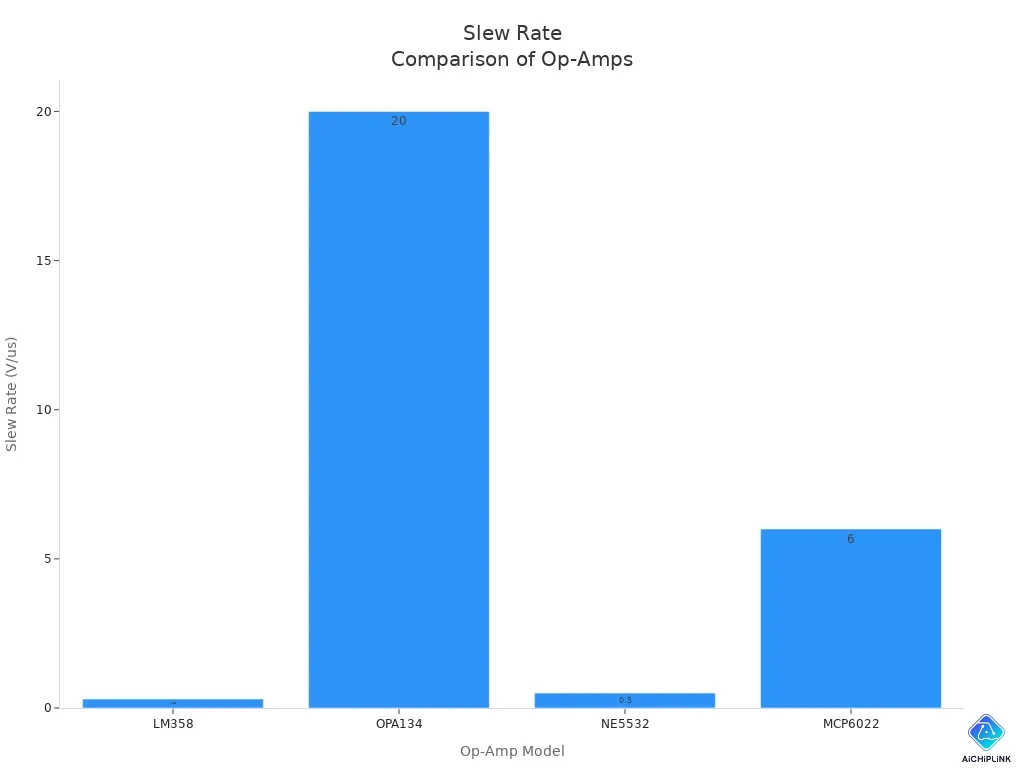
You can also look at real examples to see how different amplifiers work. The table below shows four popular op amps:
| Parameter | LM358 | OPA134 | NE5532 | MCP6022 |
|---|---|---|---|---|
| Slew Rate | 0.3 V/us | 20 V/us | 0.5 V/us | 6 V/us |
| Input Offset Voltage | 1.4 mV | 70 uV | 3 mV | N/A |
| Noise | High | Low | Moderate | N/A |
| Frequency Response | Limited | High | Moderate | N/A |
Tip: Always check the datasheet for each amplifier. Compare the numbers to see which one fits your project.
Manufacturer Recommendations
Manufacturers give you lots of resources to help you pick the right amplifier. You can find datasheets, application notes, and online comparison tools. These resources show how each amplifier works in different situations. Use these tools to check if the amplifier meets your needs for offset, supply voltage, and PSRR.
Here is a table with trusted sources for datasheet information and comparison tools:
| Source Type | Description |
|---|---|
| Historical Databook | Linear Databook 1 (1988, 1262 pages) by National Semiconductor |
| Historical Databook | Linear and Interface Databook (1990, 1658 pages) by Motorola |
| Historical Databook | Linear Databook (1986, 568 pages) by RCA |
| Current Datasheet | LM301, Single BJT OpAmp by Texas Instruments |
| Current Datasheet | LM324, Quad BJT OpAmp by Texas Instruments |
| Current Datasheet | LM741, Single BJT OpAmp by Texas Instruments |
| Current Datasheet | NE5532, Dual BJT OpAmp by Texas Instruments |
| Current Datasheet | TL072, Dual JFET OpAmp by Texas Instruments |
| Educational Resource | Operational Amplifiers - All About Circuits |
| Educational Resource | Loop Gain and its Effects on Analog Circuit Performance - Linear |
| Educational Resource | Simple Op Amp Measurements - Analog Dialogue |
You can also ask manufacturer technical support for help. They can answer questions about datasheet specifications. They help you find the best amplifier for your project. Many experts say input offset voltage should be under 5mV for most uses. This helps you avoid errors in your signal.
Note: Manufacturer support teams can help you understand tricky datasheet details and suggest the best amplifier for your needs.
Trade-Offs and Reliability
When you compare amplifiers, you will see trade-offs between features. For example, an amplifier with very low offset might use more power. A device with low noise might cost more. You need to decide which features matter most for your project.
Here are some tips to help you balance trade-offs and reliability:
-
List your top priorities: Decide if you care more about low offset, low noise, or low power use.
-
Check datasheet specifications: Make sure the amplifier meets your minimum needs for each key parameter.
-
Test in your circuit: Build a prototype and see how the amplifier works in real life.
-
Ask for help: Use manufacturer resources if you have questions about reliability or performance.
| Evidence Description | Importance in Selection Process |
|---|---|
| Low input offset voltage is desired for general-purpose amplifiers. | Ensures minimal error in signal processing, crucial for applications requiring precision. |
| Input offset voltage should be kept under 5mV for broad application suitability. | Helps in selecting amplifiers that meet the performance criteria for a wide range of applications. |
| Key power supply parameters include supply voltage range and PSRR. | Understanding these parameters aids in selecting amplifiers that will perform reliably in specific circuit designs. |
Callout: Always use the datasheet to check for trade-offs. Careful review helps you avoid surprises and keeps your project reliable.
If you follow these steps, you can use datasheet information to make the best choice for your low offset operational amplifier. Careful comparison and smart trade-offs will help your project work well and last a long time.
You can choose the best low offset operational amplifier if you follow some easy steps. First, look at the offset voltage and drift. Next, compare datasheets to see important specs. Then, make sure the amplifier fits what your project needs.
Tip: Always check datasheets and ask the manufacturer for help. This makes your circuits work well and stay accurate.

Written by Jack Elliott from AIChipLink.
AIChipLink, one of the fastest-growing global independent electronic components distributors in the world, offers millions of products from thousands of manufacturers, and many of our in-stock parts is available to ship same day.
We mainly source and distribute integrated circuit (IC) products of brands such as Broadcom, Microchip, Texas Instruments, Infineon, NXP, Analog Devices, Qualcomm, Intel, etc., which are widely used in communication & network, telecom, industrial control, new energy and automotive electronics.
Empowered by AI, Linked to the Future. Get started on AIChipLink and submit your RFQ online today!
Frequently Asked Questions
What is the main benefit of a low offset operational amplifier?
You get more accurate results in your circuits. Low offset means the amplifier adds less error to your signal. This is very important for measuring small signals.
How do you test the offset voltage in your project?
You can use a simple test circuit. Apply the same voltage to both inputs. Measure the output. The output shows the offset voltage.
Can you use a low offset op amp for audio projects?
Yes! Low offset op amps help reduce unwanted noise and distortion in audio circuits. Your music or sound signals stay clear and true.
Do low offset op amps use more power?
Some low offset op amps use more power. You should check the datasheet for current consumption. If you need low power, look for amplifiers made for battery use.