Schmitt trigger vs comparator what sets them apart in electronics
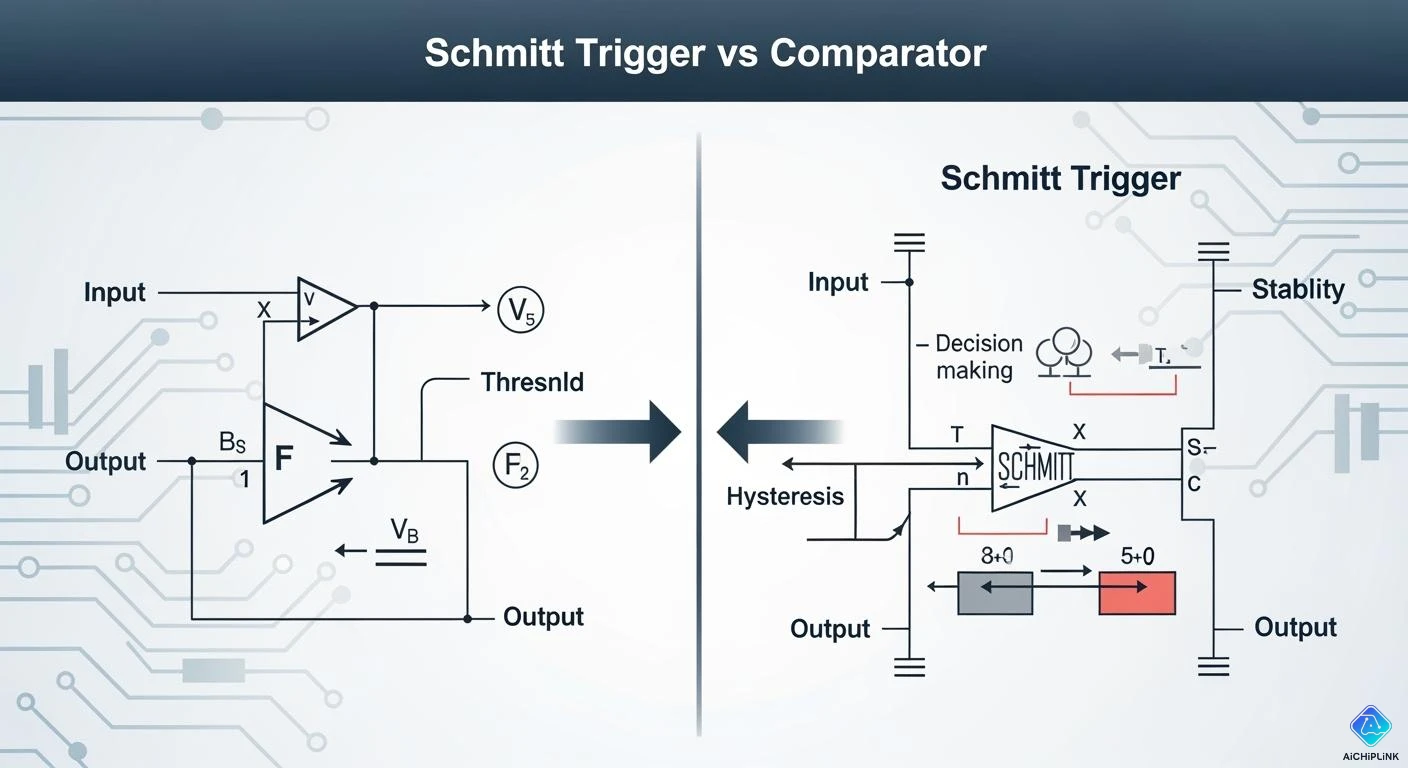
You will see the main technical difference in how a Schmitt Trigger vs Comparator works. A Schmitt Trigger uses positive feedback, which creates strong hysteresis. In contrast, a comparator has little or no feedback, affecting how you design electronic circuits.
It is important to know these differences because:
Schmitt Triggers help block noise with hysteresis, making them ideal for noisy environments.
Comparators provide high accuracy for identifying exact thresholds.
Understanding these uses helps you balance the performance of your system and its limitations.
Key Takeaways
-
Schmitt triggers use positive feedback to make two voltage points. This helps block noise and gives a steady output.
-
Comparators work with one threshold. They are good for finding exact voltages. But they can be more sensitive to noise.
-
Pick a Schmitt trigger if your signals are noisy or slow. This will help you get a clean digital output.
-
Use a comparator if you need fast and exact switching at one voltage.
-
Knowing these differences helps you make better electronic circuits for what you need.
Schmitt trigger vs comparator: core functionality
Signal Processing Differences
When you look at a schmitt trigger and a comparator, you notice they handle signals in different ways. A schmitt trigger is good for changing a noisy or slow analog signal into a clear digital output. It uses positive feedback. This feedback makes two voltage points for switching. One point is for when the signal goes up. The other is for when the signal goes down. This is called hysteresis.
A comparator does not work the same way. You use a comparator to see if a signal goes past one set point. The comparator changes its output right when the input crosses this point. It does not have hysteresis. So, the comparator can react to tiny changes or noise near the set point. The output might switch back and forth fast if the input is noisy.
Here is a list of the main differences:
-
Schmitt triggers have two voltage points. One is for rising signals, and one is for falling signals. This helps stop noise.
-
Comparators use only one set point. They can be more open to noise.
-
Schmitt triggers need extra parts for hysteresis. This makes the circuit harder.
-
Comparators have a simple design. You can make one with just a differential amplifier.
Intended Roles in Circuits
You pick a schmitt trigger or a comparator based on what your circuit needs. If you want to clean up a noisy signal, you should use a schmitt trigger. The schmitt trigger gives a steady digital output even if the input is not steady. This is important in circuits where noise is a problem.
If you need to find an exact voltage level, you use a comparator. The comparator tells you right when the input goes past the set point. This is helpful in circuits where you need high accuracy.
Choosing a schmitt trigger or comparator changes how your circuit works. The schmitt trigger helps block noise. The comparator gives sharp switching at one point. You need to think about your signal and what you want to do before you choose.
Tip: If your circuit has slow or noisy signals, a schmitt trigger will give you a clean output. If you need to check exact voltage levels, a comparator is the best choice.
Circuit design and feedback
Positive Feedback in Schmitt Triggers
A schmitt trigger uses positive feedback to change how it works with signals. This feedback makes two voltage points for switching the output. One point is for when the input goes up. The other is for when the input goes down. The space between these two points is called the hysteresis window. Positive feedback helps the schmitt trigger ignore small changes or noise in the input. This means you get a clean and steady output, even if the input is slow or noisy. In some circuits, the hysteresis window can be very big. For example, it can be as high as 8.25kV. This depends on the resistance network and the supply voltage. Strong hysteresis stops the output from switching too fast.
Here is a table that shows the main differences inside a schmitt trigger and a comparator:
| Feature | Comparator | Schmitt Trigger |
|---|---|---|
| Hysteresis | Lacks hysteresis | Includes hysteresis |
| Feedback Type | Typically negative feedback | Positive feedback |
| Output Behavior | Can produce multiple transitions due to noise | Provides a single clean transition |
Thresholds in Comparators
A comparator does not work like a schmitt trigger. You use a comparator to see if an input voltage goes past one threshold. The output changes right at this point. The threshold is important because it tells the device how to react to changes in the input. If the input voltage gets close to the threshold, the output can switch fast. Sometimes, designers add hysteresis to a comparator to make it more stable. This stops the output from switching back and forth when the input is noisy. By picking the right threshold, you make sure the comparator works well in your circuit.
Input-output behavior
Hysteresis in Schmitt Triggers
When you use a schmitt trigger with noisy or slow signals, you notice a big difference. Hysteresis gives the schmitt trigger two voltage points for switching. One point turns the output on. The other point turns it off. The space between these points stops the output from changing too much. This keeps the output steady, even if the input is not steady. Regular gates might switch a lot from small noise spikes. The schmitt trigger blocks these spikes. Hysteresis helps the schmitt trigger work well in noisy places. You need a bigger change in the input before the output switches again. This makes your circuit steady and reliable.
-
Hysteresis makes two switching points.
-
The output stays steady with small input changes.
-
You stop fast switching in noisy or slow signals.
Switching in Comparators
A comparator works in a different way. It checks if the input signal goes past one threshold. The output changes right at this point. If the input is noisy, the comparator can switch back and forth quickly. You might see the output flicker if the input stays near the threshold. Some comparators add hysteresis to help, but most do not. Comparators switch fast and give sharp changes. You can use them in circuits that need high speed. The table below shows how fast different comparators can switch:
| Component Type | Typical Switching Speed |
|---|---|
| High-speed Comparators | 100-200 kHz |
| Ultra-fast Comparators | Sub-10 ns delays |
| General-purpose Op-Amps | 5-20 kHz |
Noise Immunity Comparison
You want your circuit to work well in noisy places. The schmitt trigger gives better noise immunity than a standard comparator. The two thresholds in the schmitt trigger make it less likely to switch from small noise spikes. You get a steady output and strong noise blocking. The table below compares noise immunity:
| Feature | Schmitt Trigger | Standard Comparator |
|---|---|---|
| Noise Margin | Better because of two thresholds | Not as good because of one threshold |
| Immunity to Noise Fluctuations | Strong because of hysteresis | Can switch too much in noisy places |
Hysteresis in the schmitt trigger keeps the output steady and blocks noise. Comparators can react to noise and change the output when you do not want it. You should use a schmitt trigger if you need strong noise blocking and steady output.
Applications and selection
When to Use a Schmitt Trigger
Pick a schmitt trigger circuit if you need to fix noisy or slow signals. This circuit works in both digital and analog systems when you want a steady output. You can use a schmitt trigger for these things:
-
Noise filtering: It stops small changes in the input and only reacts to real signals.
-
Signal conditioning: It changes messy analog signals into clean digital ones.
-
Oscillators and timers: It helps make square waves with steady timing.
-
Debouncing switches: It makes sure you get one clear signal from a bouncy switch.
A schmitt trigger circuit gives strong noise immunity. You can use it in places with lots of electrical interference, like factories or cars.
Tip: Use a schmitt trigger circuit if your input signal is not steady or you want to stop false triggers.
When to Use a Comparator
Use a comparator if you want to find a certain voltage level. A comparator works best in circuits that need fast and exact switching. You can use it for these jobs:
-
Threshold detection: It tells you right when a signal crosses a set point.
-
Window detection: It helps you check if a signal stays inside a certain range.
-
Zero-crossing detection: It finds the spot where a signal changes from positive to negative.
Comparators work well in high-speed circuits. You can use them in measurement tools, analog-to-digital converters, and protection circuits.
Here is a table to help you choose:
| Criteria | Schmitt Trigger Circuit | Comparator |
|---|---|---|
| Noise Immunity | High | Low to moderate |
| Speed | Moderate | High |
| Best Use | Noisy or slow signals | Precise threshold detection |
Real-World Examples
You can find schmitt trigger circuits in many devices. For example, a solar panel tracking system uses a schmitt trigger to move the panel only when sunlight changes enough. This keeps the motor from moving too much. In temperature control, a schmitt trigger circuit keeps a heater from turning on and off too quickly by setting a range for action.
You will see comparators in battery chargers. They help find when the voltage reaches a safe level. You also see them in alarm systems, where they set off alerts if a sensor signal goes above or below a set value.
Note: Schmitt trigger circuits are used in electronics, cars, and machines. Comparators are important in measurement and safety circuits.
Pros and cons
Schmitt Trigger Advantages and Limitations
Schmitt triggers are very helpful for many signal jobs. They help you get clear digital signals from noisy or slow analog signals. Here are some main advantages:
-
Schmitt triggers use hysteresis. This means they block small changes in the input, so only real changes turn the output on or off.
-
You can use them to change analog signals into digital ones. This gives you sharp changes between logic states and helps block noise.
-
Schmitt triggers are good for debouncing switches. You get a steady output when the switch stops moving, so your circuit works well.
-
They make noise immunity better. You can trust the output to stay steady, even in careful jobs.
-
Schmitt triggers can do many things. You can use them to make exact oscillations or clean up switch signals.
-
You save money and space. Schmitt triggers are cheap and easy to add to your circuits.
-
They take noise out of signals, so you get a noise-free output.
Tip: Schmitt triggers help you get steady signals in noisy places or with slow signals.
But, you should know about their limits:
-
Schmitt triggers can change with how they are made. This means the switching points might not always be the same from batch to batch.
-
If your power supply changes, the trigger points can move. This can cause wrong triggers, especially in battery-powered things.
-
Temperature changes can change how the Schmitt trigger works. The switching points and hysteresis window can move.
-
Circuits with strong hysteresis use more power, sometimes up to 30% more.
-
Switching can slow down your circuit, especially in fast designs.
-
The hysteresis window can change by up to 25% with temperature, which can hurt how well it works.
Comparator Advantages and Limitations
Comparators give you fast and exact signal checks. You can use them in many digital and analog circuits. Here is a table that shows their main benefits:
| Benefit | Description |
|---|---|
| Simple Signal Comparison | You can turn analog voltages into digital outputs for easy processing. |
| High-Speed Response Capability | Comparators switch in nanoseconds, so you can use them in fast circuits. |
| Flexible Threshold Detection | You can set the reference voltage to detect different signal levels. |
| Anti-Noise Design Features | Some comparators use hysteresis to block noise and stop output jitter. |
| Wide Range of Applications | You can use comparators in ADCs, waveform shaping, and power management. |
You also get these good things:
-
You can change analog signals to digital logic easily.
-
You can set the threshold voltage for what you need.
-
Some comparators add hysteresis for better noise blocking.
Note: Comparators work best when you need fast and exact checks of voltage levels.
Still, comparators have some problems:
Comparators can have trouble in noisy circuits. If the input signal stays near the threshold, the output may switch back and forth fast. This is called "chattering." You may see unwanted changes, which can cause problems in circuits that need clear state changes. In noisy places, this can make your circuit not work well unless you add extra noise blocking or hysteresis.
When you look at schmitt trigger vs comparator, you notice they act differently with signals and noise. A schmitt trigger is best if you want steady outputs in places with lots of noise. If you need quick and exact switching, pick a comparator. The table below shows which one is better for each job:
| Criteria | Schmitt Trigger | Comparator |
|---|---|---|
| Noise Immunity | High | Moderate |
| Precision | Moderate | High |
| Speed | Moderate | High |
You can make your circuit work better by using stable resistors, good capacitors, and strong PCB materials. Always remember, feedback and hysteresis change how schmitt trigger and comparator circuits work in real life.

Written by Jack Elliott from AIChipLink.
AIChipLink, one of the fastest-growing global independent electronic components distributors in the world, offers millions of products from thousands of manufacturers, and many of our in-stock parts is available to ship same day.
We mainly source and distribute integrated circuit (IC) products of brands such as Broadcom, Microchip, Texas Instruments, Infineon, NXP, Analog Devices, Qualcomm, Intel, etc., which are widely used in communication & network, telecom, industrial control, new energy and automotive electronics.
Empowered by AI, Linked to the Future. Get started on AIChipLink and submit your RFQ online today!
Frequently Asked Questions
What is the main reason to use a Schmitt trigger?
A Schmitt trigger helps clean up signals that are noisy or slow. It gives you a steady digital output. Hysteresis blocks small changes in the signal. This makes your circuit work better in hard places.
Can you add hysteresis to a comparator?
You can add hysteresis to a comparator. You do this by using resistors for positive feedback. This helps the comparator ignore small noise. The output becomes more steady.
Where do you see comparators in real life?
Comparators are in battery chargers, alarm systems, and tools for measuring. They help find when a voltage goes past a set point. This makes them good for safety and control.
How does hysteresis improve noise immunity?
Hysteresis makes two points for switching. The circuit only reacts to big changes in the input. Small noise spikes do not make the output switch. You get a cleaner and more steady output.