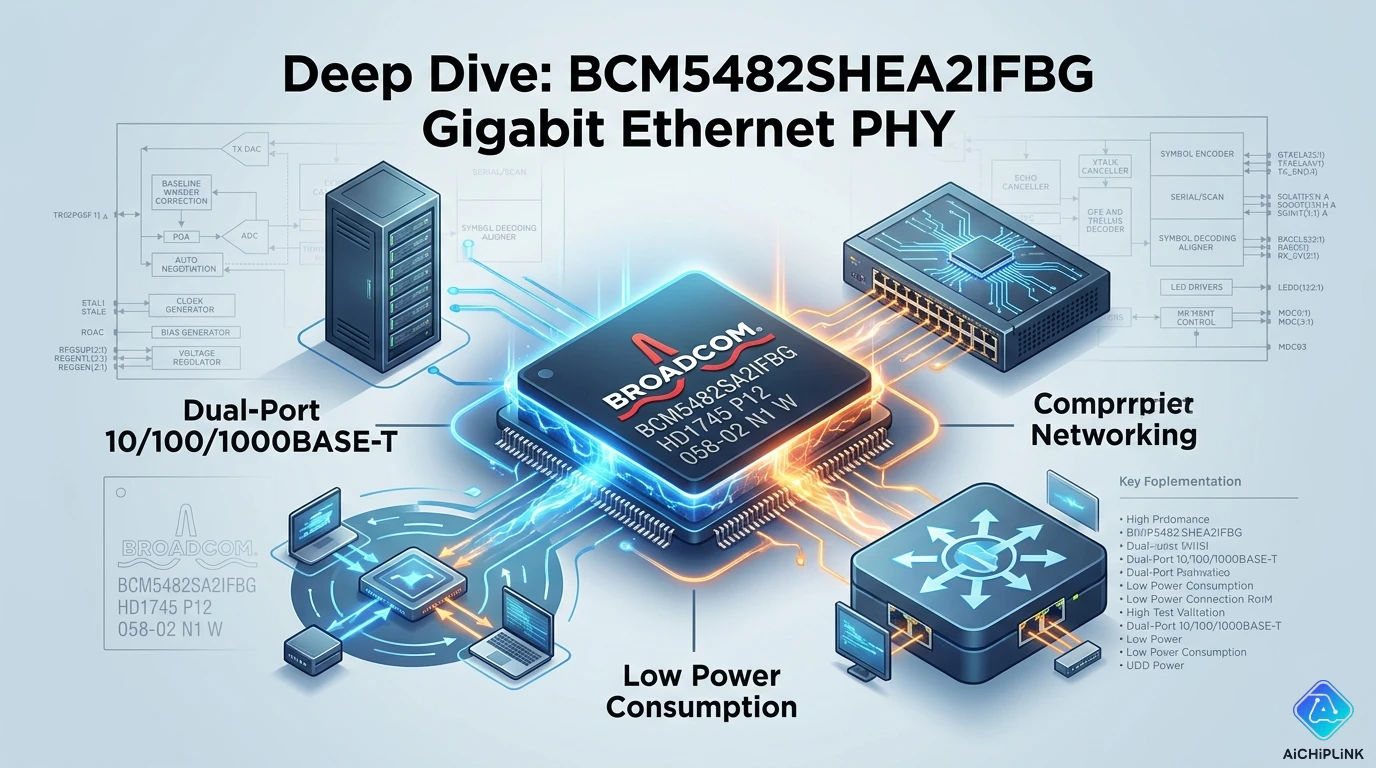
BCM5482SHEA2IFBG: Why a Dual-Port PHY Needs One Critical Design Step That a Single-Port PHY Doesn't
The BCM5482S integrates two complete Gigabit Ethernet PHY transceivers in a single package. Two ports, one chip, smaller footprint than two BCM5221 single-port devices, and a bill-of-materials that lists one part number instead of two. For high-density uplink applications — the design scenario Broadcom explicitly targets with this device — the integration makes sense.
The design step that catches engineers unfamiliar with dual-port PHYs: both ports share one MDIO management bus, but each port must be individually addressable on that bus. The BCM5482S presents two PHY addresses — typically configured via hardware strap pins to adjacent addresses such as 0x00 and 0x01. If those strap pins are not correctly implemented in the PCB layout, both PHY ports may respond to all MDIO transactions simultaneously, causing bus contention that prevents either port from being properly configured or read. A switch or processor that polls PHY status via MDIO will see corrupted link-state data. The link may appear to come up and immediately drop in ways that look like a firmware problem, a switch compatibility problem, or an Ethernet magnetics issue — because an MDIO bus contention failure is not an obvious diagnostic.
This is not a complex problem to avoid. It requires understanding how the PHY address strap pins work on a dual-port device and ensuring they are implemented correctly before PCB fabrication. But it is a concrete, specific risk in dual-port PHY designs that has no equivalent in single-port PHY designs, and it is worth understanding before the first prototype is built.
1.0 Part Number Decoded: BCM5482SHEA2IFBG
Broadcom's GbE PHY ordering part numbers encode the product variant, silicon revision, temperature grade, package, and RoHS status:
BCM — Broadcom Communications product prefix
5482 — Product family identifier. The BCM548x series is Broadcom's third-generation dual-port Gigabit Ethernet PHY family, designed for high-density uplink applications in managed switches, routers, and embedded networking equipment.
S — Feature variant: S = SerDes / fiber capable
- BCM5482 (no S) = copper-only dual-port PHY
- BCM5482S = copper + fiber: adds 1000BASE-X SerDes, 100BASE-FX, and SGMII support for SFP optical modules on each port, alongside the standard copper 10/100/1000BASE-T interface
HE — Package / configuration code:
- H = specific package height/variant within the BCM5482 family
- E = exposed thermal pad (the package has a metal exposed pad on the bottom for thermal dissipation — this pad must be soldered to the PCB ground plane for proper thermal and electrical performance)
A2 — Silicon revision: A = first major revision; 2 = second stepping within the A revision. The current production silicon revision for BCM5482SHEA2IFBG.
I — Temperature grade: I = Industrial, −40°C to +85°C junction temperature
- The non-I variant (BCM5482SHEA2KFBG) is commercial grade: 0°C to +70°C
FBG — Package:
- F = FC (Flip-Chip) die attach
- B = BGA (Ball Grid Array)
- G = specific ball count / body size variant; for BCM5482S this is a 128-ball FC-BGA package
2.0 Specifications at a Glance
From Broadcom's BCM5482S product brief and distributor technical data:
Interface standards (per port, BCM5482S variant):
- Copper: 10BASE-T, 100BASE-TX, 1000BASE-T (IEEE 802.3, Cat5 UTP)
- Fiber / SerDes: 1000BASE-X, 100BASE-FX, SGMII (for SFP optical modules)
- Auto-negotiation: IEEE 802.3 compliant; Auto-MDI/MDI-X
Host MAC interface (per port):
- RGMII (Reduced Gigabit MII) — standard for embedded SoC and switch ASIC connections
- GMII — legacy parallel interface (wider pin count, less common in modern designs)
- Each port has an independent RGMII/GMII interface to the host
Number of ports: 2 (fully independent PHY functions per port, integrated on one die)
Management:
- MDC/MDIO: Single management bus shared by both ports
- PHY addresses: Two distinct addresses (configured via strap pins), enabling independent register access per port
- MDIO: IEEE 802.3 Clause 22 and Clause 45 (extended register access)
Diagnostics:
- CableChecker™ / VCT: Time-domain reflectometry per port for cable fault detection, length estimation, pair diagnostics
Power:
- Supply voltages: 3.3V (I/O, analog), 2.5V (optional core), 1.0V (digital core — may require external regulator depending on variant)
- Typical power (dual port, both at 1GbE active): approximately 1.0–1.4W total
- EEE: IEEE 802.3az Energy Efficient Ethernet — LPI mode for idle links
Physical:
- Package: FC-BGA 128-ball (FBG suffix), body approximately 10 mm × 10 mm
- Exposed thermal pad: Present (HE suffix "E" = exposed pad) — must be soldered to PCB ground plane
- Temperature: −40°C to +85°C junction (I-grade)
- RoHS: Compliant
3.0 How the BCM5482S Works: Dual-Port Integration and Copper+Fiber Architecture
Dual-port integration on one die:
The BCM5482S integrates two physically separate PHY instances on one silicon die. Each port has its own complete set of analog front-end circuits (twisted-pair line drivers, analog-to-digital converters, echo cancellers, digital adaptive equalizers for 1000BASE-T), its own digital processing pipeline, its own clock recovery circuit, its own RGMII interface to the host, and its own set of IEEE 802.3-compliant registers accessible via MDIO.
The two ports share: the die substrate, the package, the power supply input pins, and the MDC/MDIO management bus. Everything else is functionally independent — link state, speed, duplex, and fiber/copper media selection on Port 0 have no effect on Port 1.
Copper + fiber per port (S variant):
Each port in the BCM5482S can connect to either a copper RJ-45 (via external magnetics) or a fiber SFP cage — and in some configurations, both simultaneously with automatic media selection. The fiber interface uses an integrated SerDes that presents a 1.25 Gbps serial electrical interface to the SFP module.
The media selection logic can be configured to:
- Copper priority: prefer copper when available, fall back to fiber if copper link is down
- Fiber priority: prefer fiber, fall back to copper
- Copper only / Fiber only: disable one media type
- Auto-detect: link up on whichever medium first establishes connection
This per-port media flexibility means a single BCM5482S-based port can serve as either a copper uplink or a fiber uplink depending on what is connected, without hardware changes — a useful feature for network equipment that must deploy in both fiber and copper uplink environments.
MDIO shared bus — the critical integration detail:
In a standard dual-port PHY design, both ports appear on the same MDC/MDIO bus as two distinct PHY addresses. The host (switch ASIC, processor, or management CPU) accesses Port 0 by addressing PHY_AD[4:0] = 0x00 and Port 1 by addressing PHY_AD[4:0] = 0x01 (or whatever addresses are strapped). If both ports respond to the same address — because the strap pins were not correctly differentiated — every MDIO read or write simultaneously accesses both PHY register files, with the two PHYs' outputs ORed or ANDed on the shared MDIO data line, producing data corruption.
4.0 ⚠️ Four Pitfalls Specific to BCM5482SHEA2IFBG Designs
Pitfall 1: MDIO PHY address strap pins not differentiated between the two ports
The BCM5482S has hardware strap pins that set the PHY address for each port independently. These strap pins must be connected to different logic levels (typically Port 0 strapped to address N, Port 1 to address N+1 or some other distinct value). If both ports are strapped to the same address — for example, because the strap pins for both ports are connected to the same pull-up/pull-down network, or because only one port's straps were considered in the schematic — both PHYs will respond to every MDIO transaction addressed to that address, causing MDIO bus contention. Symptoms: link status reads appear stuck, configuration writes to one port appear to affect the other, or PHY register reads return unexpected values. Prevention: verify the strap pin assignment for both ports independently in schematic review, and confirm the two addresses are distinct. After PCB bring-up, confirm via MDIO read of the PHY ID register (register 2 and 3) that each address returns a valid, distinct response before proceeding to link testing.
Pitfall 2: Assuming copper and fiber interfaces on the same port can operate simultaneously
The BCM5482S supports automatic media selection — the device can be configured to prefer copper or fiber and switch to the other if the preferred medium goes down. However, both media types on the same port cannot carry traffic simultaneously — the port operates on one medium at a time. A design that routes copper magnetics and an SFP cage to the same BCM5482S port and expects both to carry traffic independently will not function as expected. This is a media selection architecture, not a bonding architecture. Each port handles one active media at a time; the other medium is available as a failover or alternative.
Pitfall 3: Not soldering the exposed thermal pad (E in HEA2 suffix)
The "E" in the HEA2 package code indicates an exposed metal pad on the bottom of the FC-BGA package. This pad serves two functions: it is the primary thermal path from the die to the PCB (without soldering it, junction temperature rises substantially under load), and it provides the electrical ground reference for the internal ground plane. A BCM5482S assembly with the exposed pad left unsoldered (floating) may exhibit higher-than-expected operating temperature, intermittent behavior at elevated temperature, and in some cases degraded signal quality on the twisted-pair interface due to the degraded ground reference. The PCB footprint must include a central thermal pad with thermal via stitching to the ground plane, and the reflow profile must ensure complete solder paste coverage of this pad.
Pitfall 4: Using separate RGMII interfaces for each port without verifying host clock timing
Each of the two BCM5482S ports has an independent RGMII interface to the host MAC. RGMII runs at 125 MHz with data on both clock edges. If the host switch ASIC provides two independent RGMII ports with individual clocking, the timing for each port must be independently verified. A common design shortcut is to route both RGMII clock signals from the host with identical trace lengths, assuming they are identical in timing — but if the host generates the two RGMII clocks from different clock domains or different PLLs, there may be phase differences. Always confirm RGMII signal integrity (eye diagram or timing margin measurement) on both ports during bring-up, not just one.
5.0 Application Design Notes: Power, MDIO, Magnetics, and SerDes
Power supply:
The BCM5482SHEA2IFBG requires 3.3V for I/O and analog blocks and 1.0V for the digital core. Some variants can generate the 1.0V core internally from 3.3V via an internal LDO — verify in the specific silicon revision datasheet (available under NDA from Broadcom) whether the HEA2 revision requires an external 1.0V supply or generates it internally. Decoupling: 100 nF X5R ceramic at every 3.3V and 1.0V supply pin, within 2 mm of the package. Add 10 µF bulk capacitance per supply domain at the PCB level.
PHY address strapping:
Both ports share the package but each has independent strap pins. For a two-port PHY in a design where the host MAC scans PHY addresses 1 and 2:
- Port 0: PHYAD[4:0] strapped to 0b00001 (address 1) via pull-up/pull-down resistors
- Port 1: PHYAD[4:0] strapped to 0b00010 (address 2)
Use distinct 10 kΩ pull-up or pull-down resistors for each port's strap pins, verified against the BCM5482S strap pin table in the datasheet. After PCB assembly, the first bring-up step should be reading IEEE register 2 (PHY Identifier High) at each expected address to confirm both ports enumerate correctly.
Ethernet magnetics (copper):
Each port requires one 10/100/1000BASE-T isolation transformer module between its MDI pins and the RJ-45 connector. Use Bob Smith termination (75 Ω from each center tap to a 1 nF capacitor to chassis ground) for EMC compliance. The magnetics specification must include 1000BASE-T support (broader bandwidth than 100BASE-TX-only transformers). Place magnetics within 15–20 mm of the BCM5482S MDI pins.
SerDes / SFP interface (fiber):
For each port's fiber connection, route the BCM5482S's SerDes TX/RX differential pairs (100 Ω differential impedance, matched length within ±10 mil) to the SFP cage. Include AC coupling capacitors (100 nF C0G) at the SFP cage TX/RX pins. Connect SFP control signals (LOS/signal detect, TX_DISABLE, present pin) to available GPIO or the switch management bus.
6.0 Variant Comparison: BCM5482 Family and When to Use Each
| Variant | Ports | Fiber/SerDes | Temperature | Package | Best for |
|---|---|---|---|---|---|
| BCM5482SHEA2IFBG | 2 | Yes (S) | Industrial −40/+85°C | FC-BGA | High-density copper+fiber, industrial |
| BCM5482SHEA2KFBG | 2 | Yes (S) | Commercial 0/+70°C | FC-BGA | High-density copper+fiber, commercial |
| BCM5482HA2KFBG | 2 | No | Commercial | FC-BGA | Copper-only dual port, lower cost |
| BCM5461SKPBG | 1 | Yes | Commercial | BGA | Single-port copper+fiber |
| BCM5221 | 1 | No | Commercial | Various | Single-port copper, simplest design |
BCM5482SHEA2IFBG vs two BCM5461S (single-port):
Using one BCM5482S instead of two BCM5461S saves PCB area and reduces component count from 2 devices to 1. However, the shared MDIO bus requires attention to PHY address strapping (described above), and a failure in one port of the BCM5482S may affect the ability to manage the other port through MDIO if the failure corrupts the shared bus. Two independent single-port PHYs are more fault-isolated. For applications where individual port failure isolation is a reliability requirement, two single-port PHYs are more robust; for applications where board space is the primary constraint, the dual-port BCM5482S is the appropriate selection.
BCM5482S vs BCM54220 (newer dual-port):
The BCM54220 is a newer Broadcom dual-port GbE PHY with EEE, SyncE, and IEEE 1588v2 support — capabilities not present in the BCM5482S. For new designs requiring timing synchronization features (5G small cell, smart grid, industrial time-sensitive networking), BCM54220 is the more capable modern option. For designs that do not require SyncE or IEEE 1588, BCM5482S remains a cost-effective and field-proven choice.
7.0 Sourcing BCM5482SHEA2IFBG
The BCM5482SHEA2IFBG is an active Broadcom production part available through authorized distribution (Arrow, Avnet, DigiKey for volume; Mouser for lower quantities). Broadcom's Ethernet PHY products are catalogued parts with relatively short lead times compared to FPGA or complex ASIC products.
Counterfeit awareness: BCM5482-series devices are widely copied, particularly in the secondary market for managed switch repair. Common counterfeit approaches include lower-port-count devices (single-port PHYs) remarked with BCM5482 labels. Verify authenticity by reading the PHY ID registers (registers 2 and 3) via MDIO on both PHY addresses — a genuine BCM5482S reports Broadcom's assigned OUI in the PHY ID high register and the BCM5482S device model in PHY ID low. A remarked single-port device will enumerate at only one MDIO address or report a different model code.
For verified authentic Broadcom BCM5482SHEA2IFBG with competitive pricing and traceability, visit aichiplink.com.
8.0 Real Questions from Network Hardware Designers
Q: After bringing up our BCM5482S board, Port 0 links up correctly but Port 1 never links. MDIO reads from both PHY addresses return identical data — the same values for both ports. What is wrong?
A: This is the MDIO PHY address strap collision described in Section 4. Both ports are responding to the same MDIO address, so reading "Port 1's address" is actually reading Port 0 again — and Port 1 has never been independently configured because all configuration writes go to Port 0. Verify the strap pin configuration for Port 1 on the PCB: check which logic levels are applied to Port 1's PHY address strap pins at power-up (use a voltmeter on the strap pins before MDIO traffic begins). The pins for Port 1 should be at a different logic combination than Port 0. If both are at the same combination, the schematic has the strap resistors connected to the same net for both ports — this needs to be corrected in a board revision or worked around by adding a jumper to change one port's straps.
Q: Can both ports of BCM5482SHEA2IFBG be connected to the same Ethernet switch ASIC, or must they go to different MAC interfaces?
A: Each port must connect to a separate MAC interface (separate RGMII port) on the host switch ASIC. The BCM5482S does not include any internal switching fabric — the two ports are completely independent PHYs that each require a MAC to exchange packets. A switch ASIC with two RGMII ports connects Port 0 to RGMII0 and Port 1 to RGMII1, and the switch ASIC handles forwarding between them. The BCM5482S provides the physical-layer connection to the cable and the management interface; all Layer 2 packet forwarding decisions happen in the switch ASIC connected to the two RGMII interfaces.
Q: The BCM5482SHEA2IFBG is in an industrial application at 80°C ambient. The exposed thermal pad is soldered to the PCB ground plane with thermal vias. Is active cooling required?
A: Depends on the operating power and the PCB thermal spreading. At full load (dual 1GbE active with copper links), the BCM5482S dissipates approximately 1.0–1.4W. With the exposed pad soldered to a PCB ground plane with a 4-via thermal array, the effective θJA in still air is approximately 35–45°C/W. At 1.2W and 45°C/W: ΔT = 54°C. At 80°C ambient, Tj = 80 + 54 = 134°C — well above the 85°C maximum junction temperature. Active cooling is required for this combination. With moderate airflow (1 m/s across the PCB), θJA improves to approximately 20–25°C/W: ΔT = 30°C, Tj = 80 + 30 = 110°C — still above the 85°C limit. For 80°C ambient operation at full dual-port load, either a heatsink with direct airflow achieving θJA < 5°C/W is needed, or the application must accept derated performance. Use Broadcom's power calculator to estimate actual power at your specific traffic mix, as idle or light-load power is substantially lower than full-load.
9.0 Quick Reference Card
Part Number Decode:
| Field | Value | Meaning |
|---|---|---|
| BCM5482 | BCM5482 | Broadcom 3rd-gen dual-port GbE PHY |
| S | S | Copper + Fiber SerDes (1000BASE-X, 100BASE-FX, SGMII) |
| H | H | Package height/variant |
| E | E | Exposed thermal pad — must be soldered to GND plane |
| A2 | A2 | Silicon revision A, stepping 2 |
| I | I | Industrial: −40°C to +85°C Tj |
| FBG | FBG | FC-BGA 128-ball package, ~10×10mm |
Key Specifications:
| Parameter | Value |
|---|---|
| Ports | 2 (fully independent) |
| Copper standards | 10BASE-T / 100BASE-TX / 1000BASE-T |
| Fiber (S variant) | 1000BASE-X, 100BASE-FX, SGMII |
| Host interface | RGMII (one per port) |
| Management | Shared MDC/MDIO, 2 distinct PHY addresses |
| Diagnostics | CableChecker™ TDR per port |
| EEE | IEEE 802.3az |
| Supply | 3.3V + 1.0V core |
| Temperature | −40°C to +85°C (I-grade) |
| Package | 128-ball FC-BGA, exposed pad |
The Dual-Port MDIO Rule — Always Verify:
Both ports share MDC/MDIO → each port needs a distinct PHY address via strap pins
| Port | Strap pins | MDIO address | Outcome if same |
|---|---|---|---|
| Port 0 | PHY_AD → 0x01 | Address 1 | ✅ |
| Port 1 | PHY_AD → 0x02 | Address 2 | ✅ |
| Port 1 (wrong) | PHY_AD → 0x01 | Address 1 | ❌ Bus contention |
BCM5482S vs BCM54220 — When to Upgrade:
| BCM5482S | BCM54220 | |
|---|---|---|
| Dual port | ✅ | ✅ |
| Fiber/SerDes | ✅ | ✅ |
| SyncE | ❌ | ✅ |
| IEEE 1588v2 | ❌ | ✅ |
| Use when | Cost-optimized copper+fiber | Timing-critical applications |
For sourcing Broadcom BCM5482SHEA2IFBG with verified authenticity and competitive pricing, visit aichiplink.com.

Written by Jack Elliott from AIChipLink.
AIChipLink, one of the fastest-growing global independent electronic components distributors in the world, offers millions of products from thousands of manufacturers, and many of our in-stock parts is available to ship same day.
We mainly source and distribute integrated circuit (IC) products of brands such as Broadcom, Microchip, Texas Instruments, Infineon, NXP, Analog Devices, Qualcomm, Intel, etc., which are widely used in communication & network, telecom, industrial control, new energy and automotive electronics.
Empowered by AI, Linked to the Future. Get started on AIChipLink and submit your RFQ online today!
Frequently Asked Questions
What is BCM5482SHEA2IFBG used for?
BCM5482SHEA2IFBG is a dual-port Gigabit Ethernet PHY transceiver used in industrial Ethernet switches, routers, embedded Linux systems, security appliances, and networking equipment that require both copper RJ-45 and fiber/SFP connectivity. It supports 10/100/1000BASE-T copper Ethernet plus 1000BASE-X, 100BASE-FX, and SGMII fiber interfaces, making it suitable for flexible uplink designs in industrial and managed networking hardware.
Why does BCM5482S require different MDIO addresses for each port?
Both PHY ports share one MDC/MDIO management bus, so each port must have a unique PHY address configured through hardware strap pins. If both ports are assigned the same MDIO address, they respond simultaneously to management transactions, causing corrupted register reads, failed configuration writes, unstable link detection, or complete MDIO bus contention during bring-up.
Can BCM5482SHEA2IFBG use copper and fiber at the same time on one port?
No — each BCM5482S port supports both copper and fiber interfaces, but only one medium can be active at a time. The PHY can automatically switch between RJ-45 copper Ethernet and SFP fiber depending on configuration and link availability, enabling failover or media-selection applications, but it does not support simultaneous traffic over both interfaces on the same port.
Does BCM5482SHEA2IFBG require external cooling?
In high-temperature industrial environments, thermal management is important because the dual-port PHY can dissipate more than 1W under full Gigabit traffic load. The exposed thermal pad must be soldered to the PCB ground plane with thermal vias, and designs operating at elevated ambient temperatures may require airflow or additional heatsinking to maintain safe junction temperatures and reliable Ethernet operation.
Does BCM5482SHEA2IFBG need firmware or Linux drivers?
The PHY itself does not run application firmware, but the host processor or switch ASIC must configure it through MDIO during system initialization. Linux systems typically use Broadcom PHY drivers through the kernel phylib framework, while embedded switches and networking SoCs initialize the PHY registers using SDK-based MDIO drivers to configure RGMII timing, auto-negotiation, fiber mode, and link management.