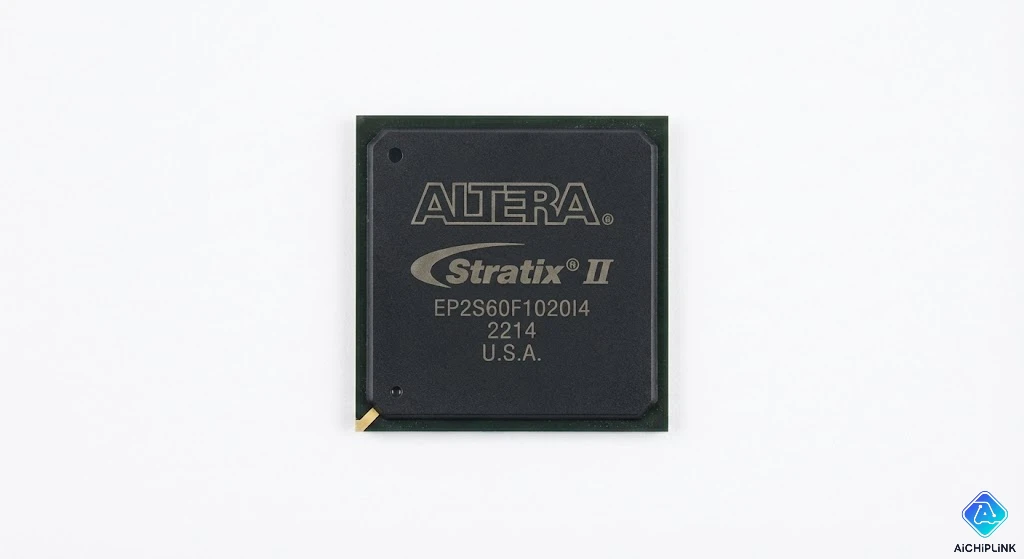
In the hierarchy of FPGAs, the Stratix® series has always represented the "High-End." While modern Stratix 10 chips grab the headlines, the legacy Stratix II family continues to power critical infrastructure deployed years ago—specifically in telecom base stations, medical imaging, and military radar.
The EP2S60F1020I4 is a prime example of this enduring utility.
It combines high logic density (~60k LEs) with an Industrial Temperature rating and a massive I/O count, making it the brain of systems that have to survive outdoors or in unconditioned environments.
Since this part is Obsolete (EOL), finding accurate technical data and replacement stock can be challenging. This guide breaks down the specs and implementation details you need.
Table of Contents
- Decoding the Part Number
- Technical Architecture: The ALM Revolution
- Software Compatibility: The Quartus II Trap
- Hardware Considerations: The 1020-Pin Beast
- Conclusion
1. Decoding the Part Number
Altera part numbers are dense with information. Here is the translation for EP2S60F1020I4:
| Segment | Code | Meaning |
|---|---|---|
| EP2S | Family | Stratix II. The 90nm high-performance family. |
| 60 | Density | 60,440 Equivalent Logic Elements (LEs). (Actually 24,176 ALMs). |
| F | Package | FineLine BGA (FBGA). |
| 1020 | Pin Count | 1,020 Pins. A massive package allowing for high I/O bandwidth. |
| I | Temp | Industrial ($-40^\circ C$ to $+100^\circ C$ Junction). |
| 4 | Speed | Speed Grade 4. (Faster than -5, slower than -3). |
Why "Industrial" Matters: Many legacy systems using this chip are in telecom cabinets (LTE/3G towers) or factory floors. A standard "C" (Commercial) grade chip ($0^\circ C$ to $85^\circ C$) would fail during a cold winter start-up or a hot summer afternoon.
2. Technical Architecture: The ALM Revolution
The Stratix II was a turning point for Altera because it introduced the Adaptive Logic Module (ALM).
- Before (Stratix I): Used simple 4-input LUTs.
- Stratix II: Uses the ALM, which can be configured as one huge 6-input LUT, or two smaller adaptive LUTs.
- Result: The "60" in the part number claims 60,440 Equivalent LEs, but the chip is actually far more efficient than older 60k architectures.
- DSP Power: It includes 144 DSP blocks (18x18 multipliers), making it excellent for signal filtering and FFT processing in older radios and medical ultrasounds.
3. Software Compatibility: The Quartus II Trap
This is the #1 issue engineers face when maintaining these systems.
Do not install Quartus Prime Pro. Modern Intel FPGA tools dropped support for the Stratix II family years ago.
- Required Software: Altera Quartus II Web/Subscription Edition.
- Version: v9.1 is generally considered the "Golden Version" for Stratix II. Versions up to 13.0sp1 might support it (check device library), but v9.1 is the safest bet for legacy IP cores.
- OS: These old versions were designed for Windows XP/7. You may need a Virtual Machine to run the synthesizer correctly.
4. Hardware Considerations: The 1020-Pin Beast
The F1020 package is a physical challenge.
- PCB Layout: With 1,020 pins packed into a 33x33mm body (1.0mm pitch), you cannot route this on a standard 4-layer board. You typically need 8 to 12 layers with careful BGA breakouts (dog-bone or via-in-pad).
- Moisture Sensitivity (MSL):
- Since these chips are EOL, any stock you find is likely New Old Stock (NOS) sitting on shelves for 10+ years.
- Mandatory Baking: You MUST bake the chips (125°C for 24 hours) before reflow. The large package absorbs moisture, and rapid heating will cause "popcorning" (cracking), destroying the silicon.
- Reflow Profile: Check if the balls are SAC305 (Lead-Free) or SnPb (Leaded). Industrial parts from that era could be either. Do not mix profiles.
5. Conclusion
The Intel Altera EP2S60F1020I4 is a legend of the FPGA world. While no longer suitable for new designs due to cost and tool obsolescence, it remains vital for keeping the world's existing industrial and telecom infrastructure running. By respecting its thermal grade and using the correct legacy software, this 90nm giant can continue to perform for years to come.
Sourcing Obsolete Altera FPGAs Need to replace a failed Stratix II in a critical system? Visit Aichiplink.com to search for verified stock of the EP2S60F1020I4.

Written by Jack Elliott from AIChipLink.
AIChipLink, one of the fastest-growing global independent electronic components distributors in the world, offers millions of products from thousands of manufacturers, and many of our in-stock parts is available to ship same day.
We mainly source and distribute integrated circuit (IC) products of brands such as Broadcom, Microchip, Texas Instruments, Infineon, NXP, Analog Devices, Qualcomm, Intel, etc., which are widely used in communication & network, telecom, industrial control, new energy and automotive electronics.
Empowered by AI, Linked to the Future. Get started on AIChipLink.com and submit your RFQ online today!
Frequently Asked Questions
What is the EP2S60F1020I4 used for?
It is used in telecom, industrial control, medical imaging, and defense systems requiring high logic density and long-term reliability.
Is EP2S60F1020I4 still in production?
No. The EP2S60F1020I4 is End-of-Life (EOL) and available only as legacy or surplus stock.
Which software supports the EP2S60F1020I4?
It requires Altera Quartus II, with version 9.1 being the most stable and commonly recommended.
What does the “I” temperature grade mean?
“I” indicates industrial temperature range (−40°C to +100°C junction), suitable for harsh environments.
What are the main handling concerns for the F1020 package?
The 1020-pin BGA requires multi-layer PCBs, moisture baking before reflow, and careful thermal control.