What is a 18650 Lithium Battery?
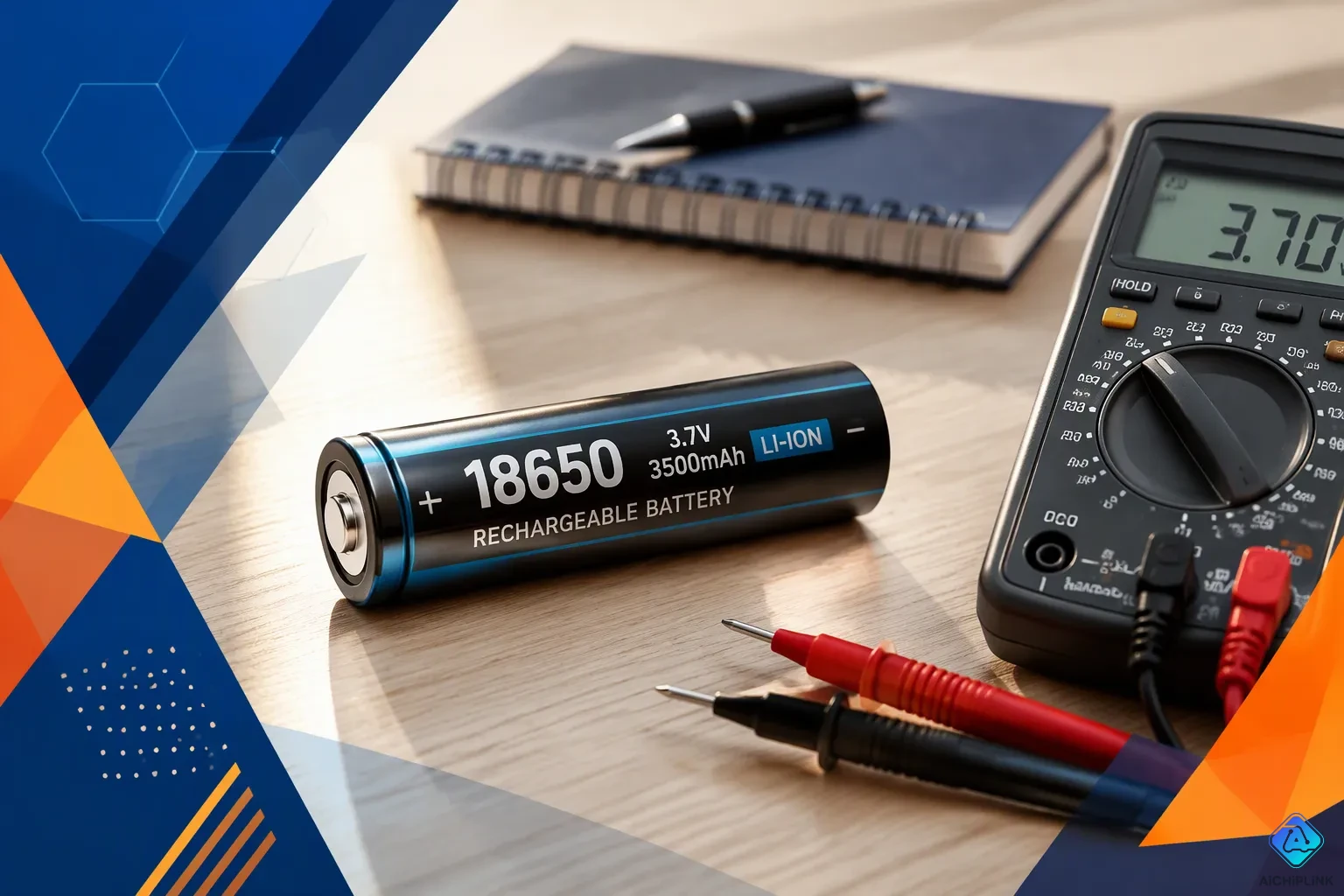
A 18650 lithium battery is a rechargeable, cylindrical lithium-ion cell. Its numbers tell you its size: 18mm wide and 65mm long. That makes it clearly bigger than a AA battery. This 18650 battery cell usually holds about 2600mAh of capacity. That power keeps a flashlight glowing for hours or keeps a laptop working all day. You will find it in portable electronics everywhere, like power banks and e-bike packs. The standard format also means you can swap in a new one without changing the device. You can recharge it hundreds of times before it wears out. That long life lowers your cost over time.
Key Takeaways
-
The name '18650' tells you the size: 18mm wide and 65mm long.
-
Most 18650 batteries hold 1200mAh to 3500mAh and last 300 to 500 charges.
-
Choose the right chemistry: ICR for capacity, IMR for power, INR for balance, IFR for safety.
-
You find 18650 batteries in flashlights, laptops, power tools, and electric cars.
-
Always use a lithium-ion charger and buy from trusted brands for safety.
Decoding the 18650 Name
You might think the name is random. It is not. An 18650 battery carries a code that spells out its shape and dimensions. That code follows a naming rule used across the entire world.
What the Numbers Mean
Under the IEC 61960 standard, a cylindrical lithium-ion cell receives a designation built from letters and digits. The letters identify the chemistry. The digits identify the geometry. For the 18650, you read the numbers in two parts. The first two digits, 18, give the diameter in millimeters. The cell measures 18mm across. The last three digits, 650, give the length in tenths of a millimeter. That equals 65.0mm from top to bottom. The trailing zero also points to a round body. It tells you the unit is round, not flat.
That reading is not guesswork. The naming rule is published, so any maker using the standard produces parts with matching dimensions. The table below uses the cylindrical battery size code to compare two common formats.
| Battery | First two digits | Meaning | Remaining digits | Meaning |
|---|---|---|---|---|
| 18650 | 18 | 18 mm wide | 650 | 65.0 mm long |
| 26650 | 26 | 26 mm wide | 650 | 65.0 mm long |
Notice how the table highlights the pattern. The first pair of digits sets the width. The remaining digits set the height. Once you learn this pattern, you can estimate the physical dimensions of any round unit just by reading its label.
An 18650 is not the same size as a AA battery. It is wider and taller, so it will not fit inside a AA holder. When you hold one, you can feel the difference at once. It looks like a thick, stubby version of a standard AA.
Why the Format Matters
The 18650 format matters because the dimensions are standardized. Every maker builds to the same numbers. The physical dimensions of the cell stay identical whether you buy from a top brand or a budget brand. That consistency makes replacing a battery cell simple. A flashlight, laptop, or power tool built around these numbers accepts a fresh unit with no changes.
This 18650 form factor has become one of the most mature designs in the industry. Decades of refinement and strict manufacturing standards have made these units highly dependable. Many devices run on lithium-ion rechargeable 18650 size cells every day. Laptop battery packs wire several together. High-performance flashlights use a single one. Portable power banks, camcorders, and medical devices rely on this format too. Power tools such as cordless drills, saws, and impact drivers draw power from packs built around the same shape.
Because the numbers never change, you do not need to return to the original manufacturer for a replacement. Any 18650 with the right specifications can take over the job. The shared standard also holds costs down, since factories produce the same unit in massive volumes.
In short, the 18650 designation tells you exactly what you are holding. The numbers describe the geometry, and the standard format guarantees broad compatibility. When you need a replacement, a new cell from a trusted brand drops into place.
Key Specs of a 18650 Battery
Voltage and Capacity
A standard 18650 usually has a nominal voltage of 3.6 or 3.7 volts. This number shows the average voltage the cell gives during normal use. When fully charged, an 18650 reaches 4.2 volts. Most lithium-ion cells follow this same pattern, so the numbers stay the same across brands.
Capacity tells you how much energy the battery can store. Most 18650 cells range from 1200mAh to 3500mAh. A common 18650 is around 2600mAh. Higher-capacity models give you longer runtime. Lower-capacity versions work well for high-discharge jobs. Trusted brands show this range clearly. The Samsung 25R holds 2500mAh. The Sony VTC5A carries 2600mAh. The LG HG2 reaches 3000mAh. The Panasonic NCR18650B stores 3400mAh. The Sanyo NCR18650GA tops the list at 3500mAh.
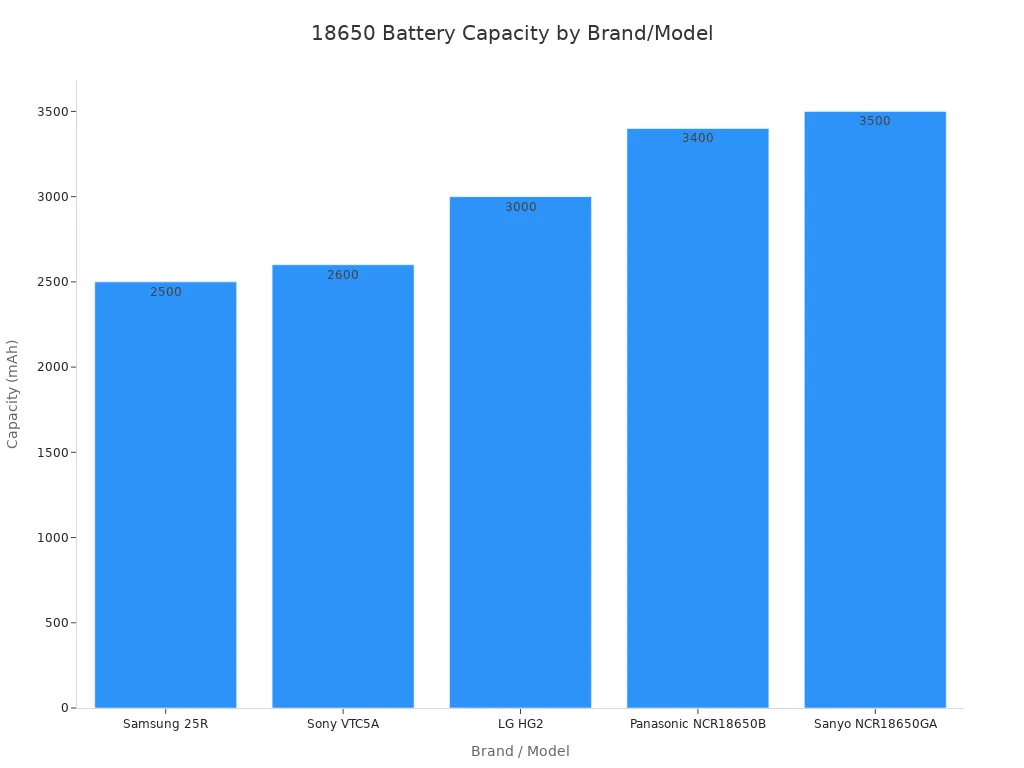
Most 18650 cells range from 1200mAh to 3500mAh, with high-capacity models used for extended runtimes and lower-capacity cells favored in high-discharge applications.
Cycle life is just as important as capacity. A typical 18650 cell lasts 300 to 500 cycles before its capacity drops below 80 percent. High-drain use shortens that span to about 200 cycles. A well-kept quality cell can go beyond 500 cycles. You can make it last longer by avoiding full discharges. The table below shows how depth of discharge affects cycle life for NMC cells.
| Charge / discharge condition | Cycle life | Capacity endpoint |
|---|---|---|
| 4.20V/cell charge | 300–500 cycles | General Li-ion capacity fade |
| 100% DoD, NMC | ~300 cycles | 70% remaining capacity |
| 80% DoD, NMC | ~400 cycles | 70% remaining capacity |
| 60% DoD, NMC | ~600 cycles | 70% remaining capacity |
| 40% DoD, NMC | ~1,000 cycles | 70% remaining capacity |
| 20% DoD, NMC | ~2,000 cycles | 70% remaining capacity |
| 10% DoD, NMC | ~6,000 cycles | 70% remaining capacity |
That cycle life beats many other rechargeable batteries by more than double. You save money over time because you replace the battery cell less often.
Discharge Current
Continuous discharge current tells you how much power a battery can safely give over time. You measure it in amps or milliamps per cell. This rating changes by cell type. A high-drain device pulls a large current. A flashlight at full brightness might draw several amps. A power tool draws even more. If you go over the continuous discharge rating, the 18650 can become unstable. It may overheat or even explode.
A lithium-ion battery rated at 10C can discharge continuously at ten times its capacity. For an 18650 rated at 2,000mAh, that means 20A. Lithium phosphate versions can reach 30A. Engineers do this by lowering internal resistance and improving the surface area of active materials. Low resistance lets current flow with minimal heat. At the maximum allowed discharge current, the cell heats to about 50°C (122°F). The temperature stays limited to 60°C (140°F).
The lithium-ion cell size of 18mm by 65mm sets a fixed volume. Chemistry and internal design determine how much current that volume can handle. Always check the continuous discharge rating before you pair a cell with a high-drain device. A mismatch can damage the battery or the device.
18650 Cell Chemistry and Protection
ICR, IMR, INR, and IFR Cells
The cathode chemistry inside an 18650 lithium battery affects how much energy it holds, how fast it can release power, and how safe it is. There are four common types, and each one does a different job. The table below shows how they compare.
| Type | Cathode | Capacity | Discharge Rate | Safety |
|---|---|---|---|---|
| ICR | LiCoO2 | High | Lower | Lowest |
| IMR | LiMn2O4 | Lower | High | Good |
| INR | NMC | Moderate | Balanced | Improved |
| IFR | LiFePO4 | Lower | Moderate | Highest |
ICR cells hold the most energy, but they have the highest chance of thermal runaway. IMR cells give up some capacity for more power and stay cooler when working hard. INR cells find a middle ground between the two. IFR cells use lithium iron phosphate and have the best heat stability, even though their nominal voltage is lower at 3.2 volts compared to 3.6 to 3.7 volts for the other three.
INR batteries balance capacity and discharge rate well. IMR batteries have less capacity but a higher discharge rate. ICR batteries have high capacity and a low discharge rate. IFR batteries perform steadily and have a low risk of thermal runaway.
Protected vs. Unprotected
A protected 18650 battery cell has a small circuit board on the negative end. This circuit uses a DW01 protection IC and N-channel MOSFET switches. It watches the cell all the time. If voltage hits 4.2V while charging, the IC turns off the MOSFET to stop the charge. If voltage falls to 3.0V during use, the MOSFET opens to stop over-discharge. If current goes above about 5A from a short circuit, the switch cuts off the battery until you clear the fault.
Unprotected cells do not have this circuit. They depend on the device itself to handle charging and discharging safely. Many laptops and power tools have their own protection boards, so they use unprotected 18650 battery cells. Flashlights and vaping devices often need protected cells instead. Always check your device manual before you pick between the two.
Common Uses of the 18650 Battery
Everyday Devices
You likely own something that uses this power source right now. Flashlights, laptops, power banks, and vaping devices all depend on the 18650 lithium battery. A laptop battery pack often holds a series of these cells inside. High-performance LED flashlights usually use one 18650 instead of several AAs. Power banks store energy in the same format to charge your phone while you are out.
Capacity matters for these devices. Older 18650 designs give about 1800mAh. Modern high-capacity versions reach 3500mAh or more. Most 18650 cells fall between 1200mAh and 3500mAh. High-capacity versions give you longer runtimes. Lower-capacity cells work better for high-discharge jobs. You choose the right 18650 battery for your device based on how much power it needs.
Many popular gadgets depend on one or several 18650 cells for power. For example, a laptop battery pack often holds a series of 18650 cells inside, and high-performance LED flashlights usually use one 18650 instead of several AAs.
Larger Applications
The 18650 format powers much bigger machines too. E-bikes, power tools, and electric vehicles use packs built from many cells. Each lithium-ion cell runs at about 3.6 to 3.7 volts nominal. You arrange cells in series to set voltage and in parallel to set capacity and current. A 13S4P pack is a 48V pack with four cells in parallel per series group.
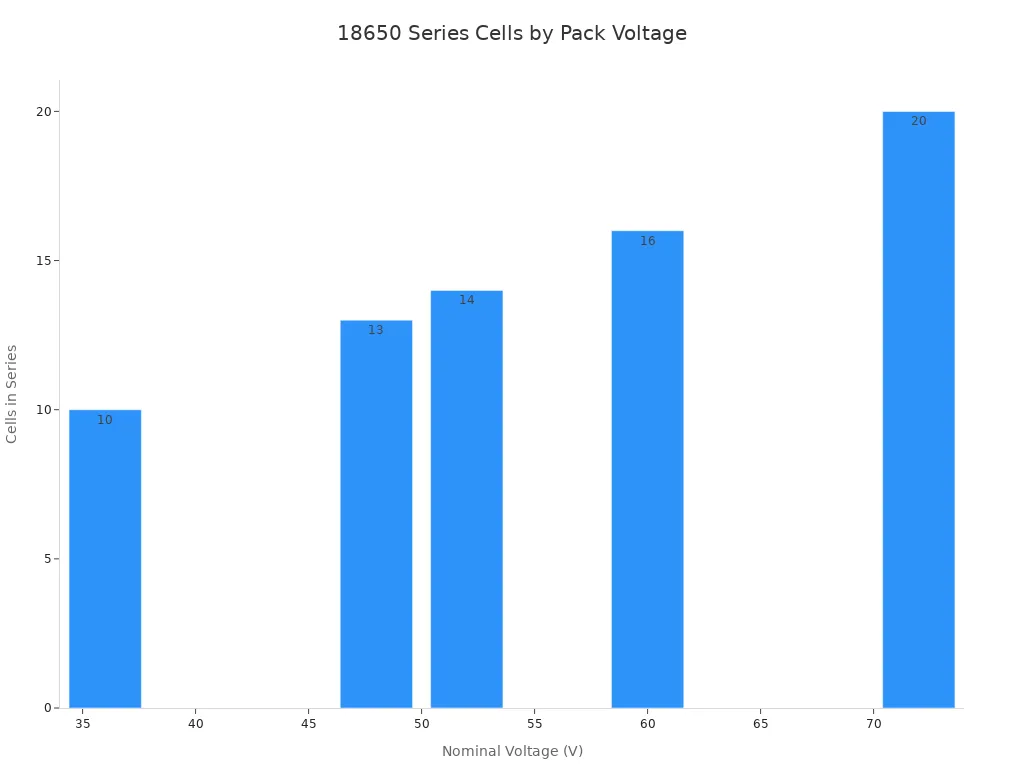
| Nominal Voltage | Cells in Series (S) | Typical Motor Power | Typical Use |
|---|---|---|---|
| 36V | 10S | 250–500W | City/commuter bikes, DIY conversions |
| 48V | 13S | 500–1,500W | Mainstream e-bike and light-EV class |
| 52V | 14S | 500–1,500W | 48V systems tuned for more speed/torque |
| 60V | 16S | 1,000–2,000W | High-power bikes and scooters |
| 72V | 20S | 1,500W+ | Performance bikes, light EVs, cargo bikes |
Tesla battery packs use thousands of 18650 size cells. These lithium-ion batteries offer high energy density and long-lasting performance. That is why they show up in so many products. A single battery cell stores modest energy. Thousands together power a car.
18650 Battery Safety and Selection
Risks and Best Practices
A lithium-ion battery can break down in a few ways. Overcharging occurs when bad charge control or weak battery management lets voltage rise too high. Over-discharge below 2V damages inner parts and may cause a short circuit later. Overheating builds up internal pressure until the electrolyte breaks apart and makes gas. A physical puncture leaks electrolyte, which can short-circuit nearby electronics. Fake cells make every one of these dangers worse.
A 2023 study led by Judy Jeevarajan compared real and fake cells. Real cells had thick plastic insulators and safety tape. Fake cells had thin or missing insulators and no current interrupt device. That device cuts the circuit when pressure goes up. Without it, a fake cell can catch fire while overcharging. Counterfeiters copy label colors and markings closely, so looking alone will not keep you safe.
Follow these tips to stay safe. Use a charger made for lithium-ion cells, never a NiCd or NiMH unit. Never poke or short a cell. Keep spare batteries in a protective case away from anything that can burn. Charge in a fireproof container and never leave charging batteries alone. Stop using any battery that swells, smells, or gets too hot. Buy from trusted brands and look for certifications like UL, CE, or GB 31241.
How to Choose the Right Cell
Matching a battery to your device starts with three numbers. Check the voltage first. Most 18650 cells run at 3.6 to 3.7V nominal. Make sure your device accepts that range. Next, look at capacity. A higher capacity gives longer runtime, but high-drain devices need cells rated for more current. Finally, check the continuous discharge rating. A flashlight at full brightness might pull several amps. A power tool pulls even more.
You must also pick between protected and unprotected cells. A protected 18650 battery cell has a small circuit for overcharge, over-discharge, and short-circuit protection. Unprotected cells depend on the device's own protection board. Pick a protected cell when the device manual calls for it or when the host has no monitoring. Pick an unprotected cell only when the device has a built-in protection design.
Picture a device pulling 2A nonstop with a 5A startup pulse and a slot that fits up to 69.5mm. A protected 18650 rated above both current levels and under the max length may work. A 70.5mm model should be turned down even if its capacity looks good.
Never swap a protected cell for an unprotected one just because it fits more easily.
An 18650 lithium battery is a rechargeable, cylindrical lithium-ion cell. Its size is simple: 18mm by 65mm. Most 18650 cells give 3.6 to 3.7 volts. Their capacity ranges from 1200mAh to 3500mAh. Pick the right chemistry with care. ICR cells hold more energy, IMR cells give high current, INR cells balance both traits, and IFR cells are safest. You can also find this 18650 battery in e-bikes, power tools, and electric cars. Buy from trusted brands. Match each battery to the voltage and current your device needs. A good battery makes your device last longer. Check each battery cell before charging. A little care keeps your power source dependable for years.

Written by Jack Elliott from AIChipLink.
AIChipLink, one of the fastest-growing global independent electronic components distributors in the world, offers millions of products from thousands of manufacturers, and many of our in-stock parts is available to ship same day.
We mainly source and distribute integrated circuit (IC) products of brands such as Broadcom, Microchip, Texas Instruments, Infineon, NXP, Analog Devices, Qualcomm, Intel, etc., which are widely used in communication & network, telecom, industrial control, new energy and automotive electronics.
Empowered by AI, Linked to the Future. Get started on AIChipLink and submit your RFQ online today!
Frequently Asked Questions
Can you replace a AA battery with an 18650?
No. An 18650 lithium battery measures 18mm wide and 65mm long. A AA battery is smaller in both dimensions. The 18650 will not fit inside a AA holder. You need a device designed for the 18650 format.
How long does an 18650 last?
A quality 18650 lasts 300 to 500 charge cycles before capacity drops below 80 percent. Gentle use extends that span. You can reach over 500 cycles by avoiding full discharges. High-drain use shortens life to about 200 cycles.
What voltage does an 18650 produce?
A standard lithium-ion battery runs at 3.6 to 3.7 volts nominal. It reaches 4.2 volts when fully charged. Stop using it below 3.0 volts to prevent damage. Always match the voltage to your device requirements.
Do you need a special charger for an 18650?
Yes. Use a charger made for lithium-ion cells only. Never use a NiCd or NiMH unit. A proper charger controls current and stops at 4.2 volts. This prevents overcharging and keeps your battery cell safe.
What is the difference between protected and unprotected 18650 cells?
A protected 18650 includes a small circuit for overcharge, over-discharge, and short-circuit protection. An unprotected cell relies on the device's own protection board. Check your device manual. Pick the type your device requires for safe operation.