What Is the ATmega328P Microcontroller and Its Key Features
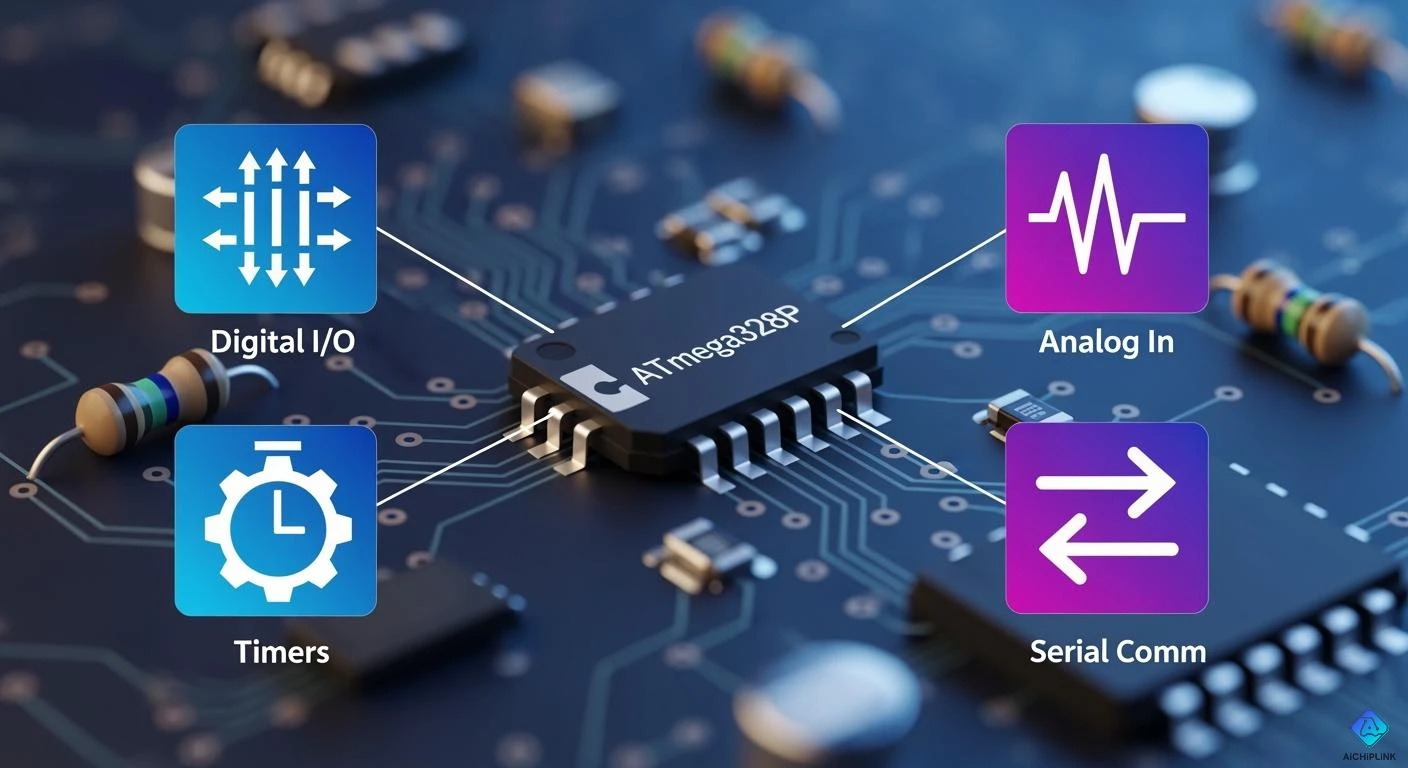
You can use the ATmega328P as a small but strong microcontroller for many electronics projects. This chip gives good performance and saves power. It helps you build simple or hard devices. You will see the ATmega328P in testing and home electronics. Microcontrollers like the ATmega328P make up more than a third of the Arduino-compatible market. Home electronics have a 28.4% market share. If you are new, you will see the ATmega328P in popular arduino boards.
Key Takeaways
-
The ATmega328P is a flexible microcontroller. It is good for both new and skilled users. It is used in many Arduino boards. This makes starting electronics projects simple.
-
This chip has 32 KB of flash memory. It can run at speeds up to 20 MHz. This lets it work fast and do tasks well in many uses.
-
The ATmega328P has 23 general-purpose I/O pins. It can connect to sensors, motors, and other devices. This makes it great for smart home ideas and fun projects.
-
The ATmega328P saves energy and uses little power. This is helpful for devices that use batteries. You can change the clock speed to save even more power.
-
The chip works with many communication protocols like UART, SPI, and I2C. This helps you connect it easily with other parts and devices in your projects.
ATmega328P Overview
Definition and Core Architecture
The ATmega328P is a smart chip. It helps you control electronic devices. This chip uses an 8-bit AVR processor. It works with data in small, fast steps. The ATmega328P uses a modified Harvard architecture. This design lets the chip get program memory and data memory at the same time. The chip works faster because it does not wait for instructions or data. Most instructions finish in one cycle. You get quick and clear results. This makes the ATmega328P good for real-time projects.
Here is a table that shows the main features of the ATmega328P compared to other chips in the same family:
| Parameter | Value |
|---|---|
| CPU type | 8-bit AVR |
| Maximum CPU speed | 20 MHz |
| Performance | 20 MIPS at 20 MHz |
| Flash memory | 32 KB |
| SRAM | 2 KB |
| EEPROM | 1 KB |
| Package pin count | 28 or 32 |
| Capacitive touch channels | 16 |
| Maximum I/O pins | 23 |
| External interrupts | 3 |
| USB interface | No |
You can also see how the ATmega328P stands out in this chart:
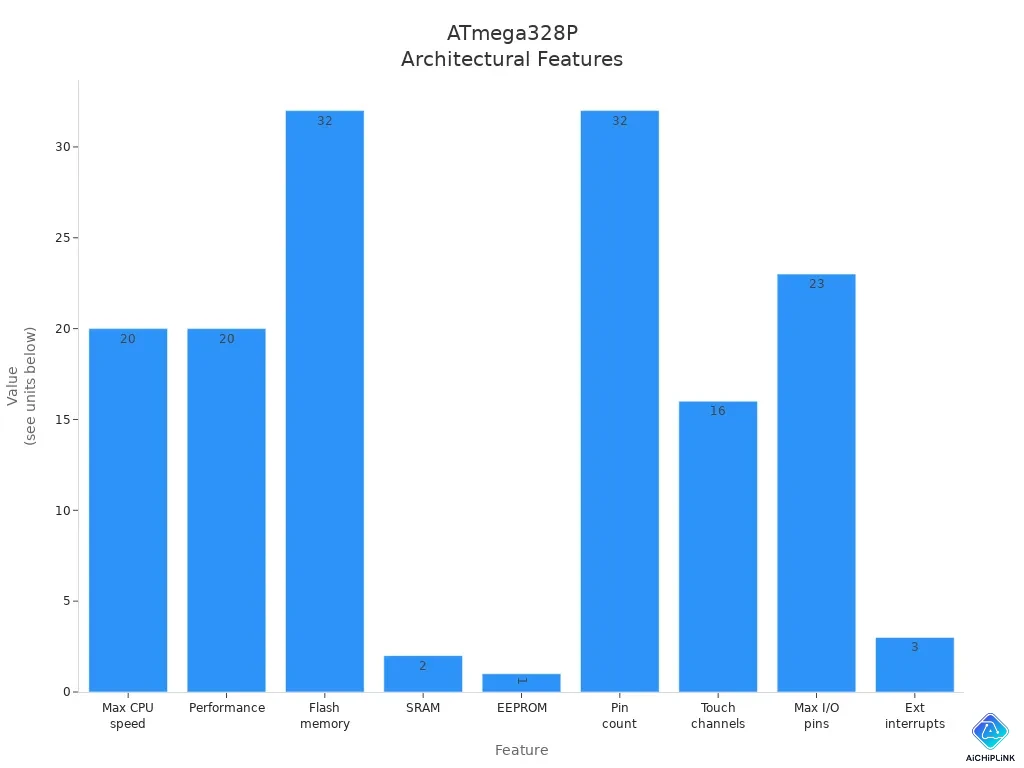
The ATmega328P is part of the AVR family. There are other chips like the ATmega328 and ATmega328PB. The ATmega328P is the most popular for learning and building.
General Purpose and Role
You can use the ATmega328P in many ways. In schools, teachers use this chip to teach electronics and programming. You get to work with real circuits. If you want to build something new, the ATmega328P makes testing ideas easy. You can quickly see how your ideas work. In factories, the ATmega328P controls machines and reads sensor data. It helps keep things working well. At home, you might find the ATmega328 in coffee makers or smart gadgets. It handles jobs like timing and temperature. The ATmega328P also works in power systems to check and control energy use.
People use the ATmega328P because it is simple and reliable. It does not use much power. The AVR core gives enough speed for small projects. You can trust this chip for learning and real tasks.
ATmega328P Features
Memory and Processing
The atmega328p has strong memory and works fast. It gives you 32 KB of flash memory for your programs. You also get 2 KB of RAM and 1 KB of EEPROM. These help you save code, data, and settings. The atmega328p uses an avr processor with 32 working registers. You can set the clock speed from 32kHz to 20MHz. This lets you pick more speed or save power. The chip can reach 16MIPS at 16MHz. It can finish tasks quickly.
| Feature | Specification |
|---|---|
| Flash | 32 KB |
| RAM | 2 KB |
| EEPROM | 1 KB |
| Processing Speed | Up to 16MIPS at 16MHz |
| Working Registers | 32 × 8 general-purpose |
Tip: You can change the clock speed. This helps you save power or make your project faster.
Input/Output and Peripherals
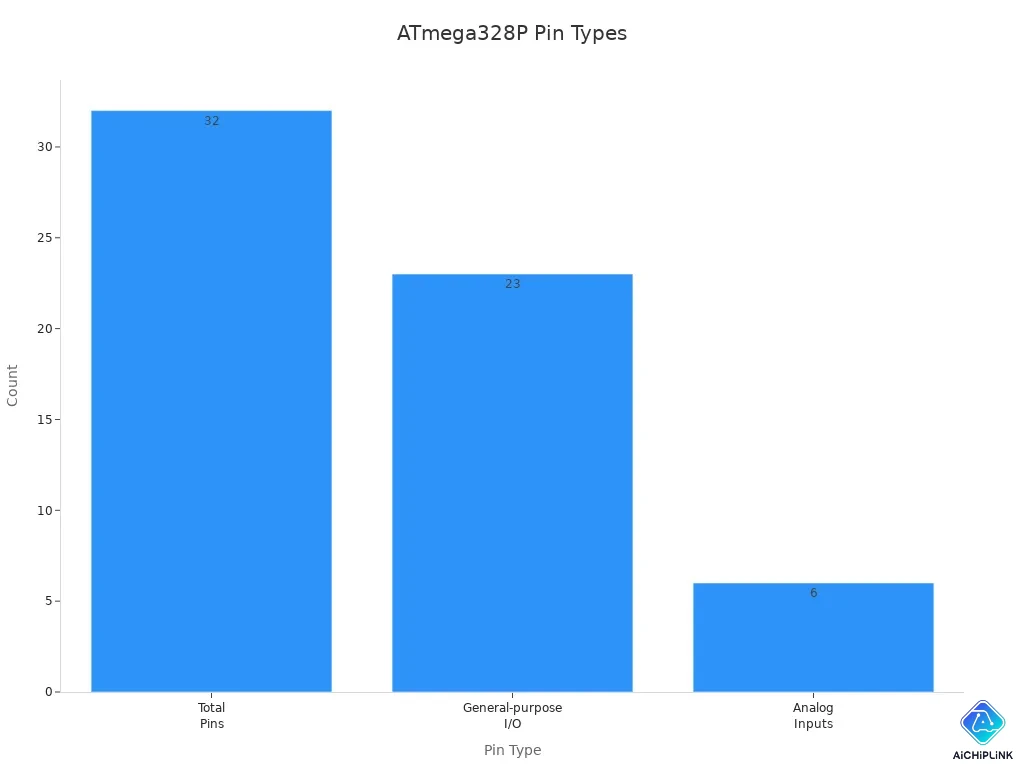
The atmega328p gives you many i/o pins. It has up to 32 pins and 23 general-purpose i/o pins. You can use 14 digital i/o pins, 6 PWM pins, and 6 analog inputs. These pins let you connect sensors, motors, LEDs, buttons, Wi-Fi modules, and displays. The atmega328p works with many peripherals and supports different communication protocols.
| Pin Type | Count |
|---|---|
| Total Pins | 32 |
| General-purpose I/O | 23 |
| Digital I/O Pins | 14 |
| PWM Pins | 6 |
| Analog Inputs | 6 |
-
You can connect many devices.
-
You can control motors and read sensors.
-
You can use the chip for smart home projects.
Power and Voltage Range
The atmega328p works with many power supplies. You can use voltages from 1.8V to 5.5V. This helps you use batteries or adapters. The chip uses very little power. At 5V, it uses about 1mA, which is 5mW. At 2.5V, it uses 0.4mA, so power is about 1mW. If you run it at full speed (20MHz/5V), it uses 20mA, which is 100mW. You can lower the settings to save energy.
| Parameter | Value |
|---|---|
| Operating Voltage | 1.8V to 5.5V |
| Power Consumption | 1mW to 100mW |
| Adaptability | Suitable for various power supply configurations |
Note: You can make your project last longer. Use lower voltage and clock settings.
Communication Interfaces
You can use the atmega328p to talk to other devices. The chip supports UART, SPI, and I2C. These help you connect sensors, displays, and memory modules. UART is good for serial communication. I2C lets you connect many devices on one bus. SPI gives you fast, two-way communication.
| Interface | Description | Characteristics |
|---|---|---|
| UART | Universal Asynchronous Receiver-Transmitter | Serial communication, used for short-distance applications. |
| I2C | Inter-Integrated Circuit | Synchronous master/slave protocol, supports multiple devices on the same bus. |
| SPI | Serial Peripheral Interface | Full-duplex communication, allows multiple clients to connect to one server. |
| Communication Protocols | Description |
|---|---|
| SPI | Lets you send data fast to other parts. |
| USART | Helps you send data between sensors and displays. |
| I²C | Lets you talk to memory modules and other parts. |
You can build projects that share data and work with many devices using these communication interfaces.
The atmega328p is efficient and reliable. You can trust this avr chip for many uses. It works for simple gadgets and advanced systems. The features make it great for learning and building.
ATmega328P Applications
Arduino Integration
You will see the atmega328p microcontroller in many arduino boards. The arduino platform uses this chip in boards like the arduino uno, arduino nano, and Pro Mini. Each board is made for different uses. The arduino uno is simple to use and good for new users. It has a clear layout and lots of input and output pins. The arduino nano is tiny and fits in small places. It still has the same features as the uno. The Pro Mini is basic and works well in small systems. You can use it when you need a small board with fewer parts. The atmega328 chip gives you the same main functions on all these boards. You can make projects easily and learn fast.
Tip: If you are just starting with arduino, pick the uno. There is lots of help and many guides online.
Common Use Cases
You can use the atmega328 for many things. The chip helps you make smart gadgets and control machines. Here are some ways people use it:
-
Simple IoT devices: You can build Bluetooth or Wi-Fi sensors for your house. These sensors check things like temperature or humidity. The chip does not use much power, so your device works longer.
-
Sensor nodes: You can make weather stations or soil testers. The atmega328 reads data from sensors and runs simple code.
-
Hobbyist projects: You can make LED signs, motor drivers, pet feeders, and night lights. The chip has six PWM channels for easy control.
-
Educational tools: You can build Morse code makers or robots that follow lines. Teachers use the chip to teach students about electronics.
-
Motor control systems: You can control motors with smooth signals. The chip works in drones and robots where movement is important.
-
Industrial control: You can use the atmega328 in PLCs and temperature systems. The chip helps machines work safely.
Note: You can use the arduino micro for projects that need a small board and USB support.
You can count on the atmega328 for many electronics and smart devices. The chip gives you steady performance in lots of projects.
Pros, Cons, and Alternatives
Advantages
You can count on the atmega328p for many things. This microcontroller is simple to use. You do not have to worry about tricky hardware. You can spend more time on your project. You get results fast. The chip is good for control jobs. It works in many arduino projects because it can do a lot. The atmega328p does not use much power. This helps your battery devices last longer. PicoPower technology saves energy in IoT projects. You can trust this chip to work well.
| Specification | Details |
|---|---|
| Memory size | 32 KB |
| RAM size | 2 KB |
| Flash memory | 32 KB |
| Clock speed | 16 MHz |
| Power consumption | Low |
| Voltage requirement | 5V |
| Current requirement | 50 mA |
| Low power current | 1.8 mA |
| High power current | 40 mA |
You should use the atmega328p when you want to save energy. It is great for battery-powered devices.
Limitations
There are some things the atmega328p cannot do. The chip is not made for big or hard tasks. It does not have USB support or very fast speed. If you need more memory or speed, you might need a different chip. Some chips, like the STM8S103F3P6, have more features and faster clocks. But they can use more power and drain batteries faster.
Alternative Microcontrollers
You can pick other microcontrollers if you need more features or speed. Here are some good choices:
-
STM32 has strong hardware and is easy to use.
-
PIC microcontrollers are steady and work for many jobs.
-
ESP8266 is good for wireless and IoT projects.
Pick a different chip if you need more memory, speed, or things like Wi-Fi.
You can use the ATmega328P microcontroller easily. It is strong and not hard to learn. The price is low, so you do not spend much. Programming it is simple for most people. The Arduino community gives lots of help. You do not need to know a lot about hardware to begin.
-
The ATmega328P does not cost much and is good for new users.
-
You can make test projects, smart home things, and robots.
-
Many people use it, so you get answers fast.
Try making things like weather stations or cars you control from far away. You can also build easy LED signs. You will pick up new skills and have fun using this microcontroller.

Written by Jack Elliott from AIChipLink.
AIChipLink, one of the fastest-growing global independent electronic components distributors in the world, offers millions of products from thousands of manufacturers, and many of our in-stock parts is available to ship same day.
We mainly source and distribute integrated circuit (IC) products of brands such as Broadcom, Microchip, Texas Instruments, Infineon, NXP, Analog Devices, Qualcomm, Intel, etc., which are widely used in communication & network, telecom, industrial control, new energy and automotive electronics.
Empowered by AI, Linked to the Future. Get started on AIChipLink and submit your RFQ online today!
Frequently Asked Questions
What makes the ATmega328P good for beginners?
The ATmega328P is easy for new users. You can program it without trouble. There are many guides and examples online. The Arduino community helps you if you get stuck. The chip works well for simple projects.
Can you use the ATmega328P for battery-powered devices?
Yes, you can use it with batteries. The ATmega328P uses very little power. You can make it use even less by lowering the clock speed. This helps your battery-powered projects last longer.
How do you program the ATmega328P?
You can use the Arduino IDE to program the ATmega328P. Connect your board to your computer. Write your code and upload it. Most people find this process easy.
What types of sensors can you connect?
You can connect many kinds of sensors. These include temperature, light, motion, and humidity sensors. The chip works with both analog and digital sensors. You can use the I/O pins to connect them easily.
Does the ATmega328P support wireless communication?
You can add wireless features with Bluetooth or Wi-Fi modules. The ATmega328P does not have wireless built in. You can connect external modules using its communication pins.