STM32U5 Microcontroller: Features and Specifications
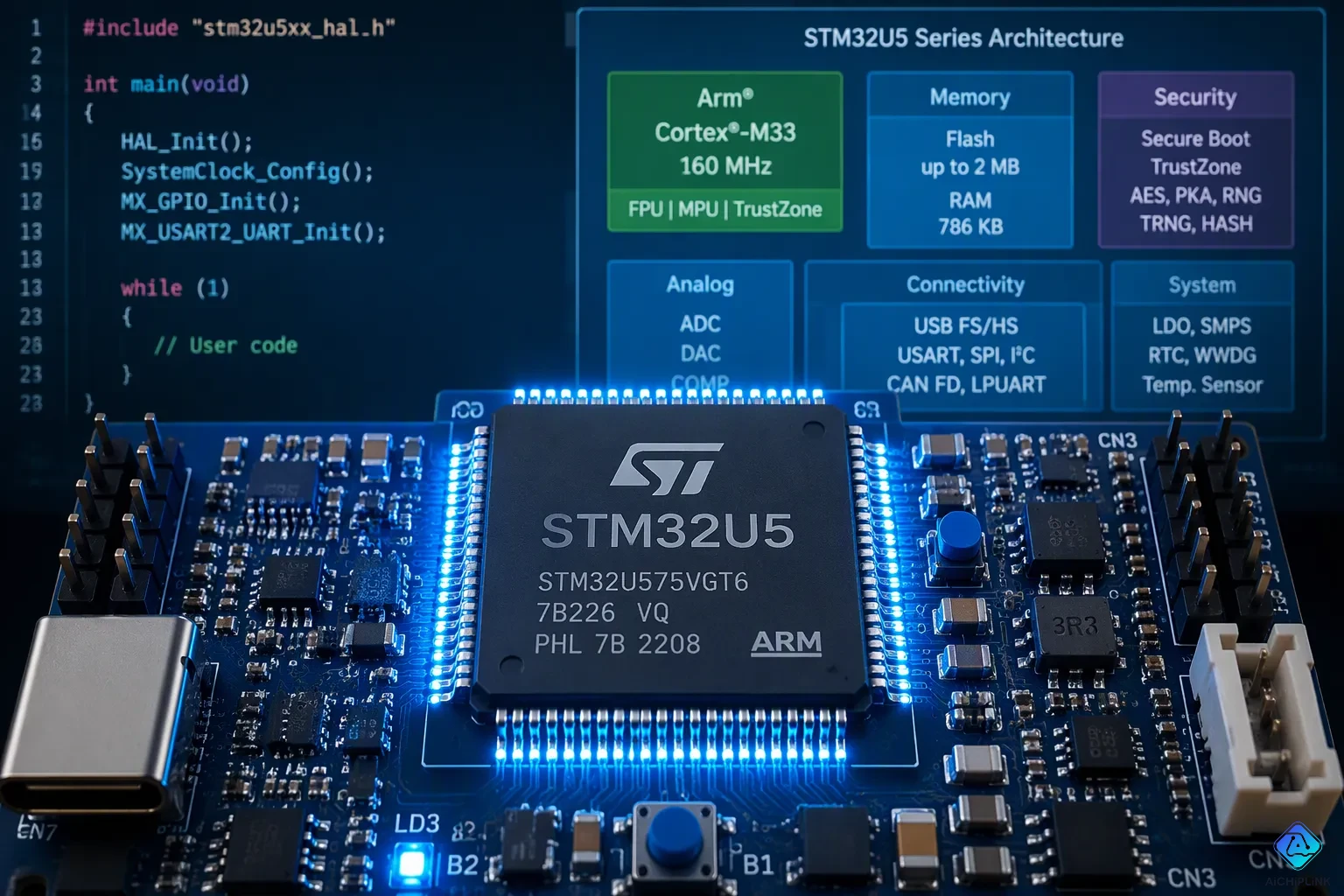
The stm32u5 is a microcontroller that uses very little power. It is built on the Arm Cortex-M33 core. It is made for secure edge devices that run on batteries. This stm32u5 chip runs at 160 MHz and gives 240 DMIPS. Engineers pick this ultra-low-power microcontroller for fast processing and long battery life.
The stm32u5 family has low-power modes like LPBAM. It offers memory that can grow up to 2 Mbytes of flash and 786 Kbytes of SRAM. It also has built-in security with TrustZone. The stm32u5 gives you many peripheral choices too. This microcontroller works well in many embedded designs.
Readers often ask what the stm32u5 is and which specs matter. They also ask how it works in real products and how to pick a version. The stm32u5 answers these questions as an ultra low power microcontroller and mcu in the ultra-low-power microcontroller family. Designers like its low-power use and security features. Many microcontrollers exist, but this low-power chip stands out.
Key Takeaways
-
The STM32U5 microcontroller uses little power and runs at 160 MHz to work fast.
-
It has many low-power modes, including LPBAM, which keeps peripherals working while the CPU sleeps.
-
Security features, such as TrustZone and secure boot, keep your data safe from attacks.
-
You can pick from different memory sizes and packages to match your design needs.
-
The STM32U5 is a great choice for devices that run on batteries, including wearables and smart meters.
STM32U5: A Low-Power MCU with Arm Cortex-M33 Core
Core Performance and Energy Efficiency
The stm32u5 uses an Arm Cortex-M33 core. This core gives you both speed and good energy use. The table below shows the main performance numbers for the stm32u5.
| Specification | Value |
|---|---|
| Maximum CPU clock frequency | 160 MHz |
| CoreMark score | 651 |
| DMIPS rating (Arm Cortex-M33 core) | 1.5 DMIPS/MHz |
The arm cortex-m33 core gives 1.5 DMIPS per MHz. At 160 MHz, the stm32u5 hits 240 DMIPS. The CoreMark score of 651 proves this processing power. Engineers get fast math and control loops without using up the battery. The stm32u5 also handles math-heavy jobs efficiently. This helps with sensor fusion and motor control tasks.
Energy efficiency comes from more than just raw speed. The stm32u5 finishes tasks fast and goes back to a low-power state. This pattern lowers average power use in real products. A wearable device, for example, wakes up, processes data, and sleeps again. The stm32u5 handles this cycle with very low power use. That is why designers see it as a true low-power mcu.
Low-Power Design and Security Purpose
The stm32u5 supports up to six low-power modes. These modes include Sleep mode, Low-power Run mode, Low-power Sleep mode, Stop 0/1/2/3 modes, Standby mode, and Shutdown mode. Each mode trades wake-up speed for lower power use. Stop 0, Stop 1, and Stop 2 fully support LPBAM. Stop 3 does not support it. Standby mode draws about 0.5 to 1 microamp. ST suggests Stop 2 for LPBAM operation.
LPBAM stands for Low-Power Background Autonomous Mode. It keeps DMA and other peripherals running while the CPU sleeps. This design lowers power use without losing data. A smart meter can sample a sensor in Stop 2 and wake the CPU only when needed. The stm32u5 handles this on its own. Engineers value this behavior in battery-powered products.
Security is the other purpose behind the design. The stm32u5 builds on TrustZone for Armv8-M. It is the first general-purpose MCU to earn both PSA Certified Level 3 and SESIP Level 3.
The STM32U5 just became ST's first microcontroller to receive PSA Certified and SESIP Level 3 certifications, a critical step in answering the need for greater guarantees in security. These certifications cover hardware and software implementations on the STM32U5 that protect code and users from remote and physical attacks.
The stm32u5 also includes cryptographic accelerators, secure data storage, secure boot, and secure firmware update. A hardware unique key stores secrets safely. Anti-tampering systems block side-channel attacks and physical intrusions. Internal monitoring erases secret data when it detects a perturbation attack. These features make the stm32u5 a secure general-purpose mcu. Designers choose it for payment terminals, medical sensors, and wearables. The stm32u5 combines low-power operation with strong security in one family. This balance explains its growing use in edge devices.
Low Power MCU Memory, Packages, and Peripherals
Flash, SRAM, and Package Options
The stm32u5 gives you memory on the chip that can grow for tough embedded jobs. The table below lists the main memory specs.
| Memory Type | Capacity | Key Features |
|---|---|---|
| On-chip Flash | 2 Mbytes | ECC support; 2 banks with read-while-write; 512 Kbytes rated for 100 kcycles |
| SRAM | 786 Kbytes (ECC OFF) / 722 Kbytes (ECC ON) | Up to 322 Kbytes SRAM with ECC ON |
Designers can get up to 2 Mbytes of flash memory with two banks. This flash memory allows read-while-write, so the stm32u5 can update firmware while code is running. The 512 Kbytes sector rated for 100 kcycles works well for frequent data logging. The stm32u5 also gives you 786 Kbytes of SRAM with ECC off. This low power mcu handles complex buffers and stacks without needing extra memory chips.
Package choices include LQFP, UFQFPN/VFQFPN, UFBGA, and WLCSP types. The stm32u5 supports high ambient-temperature operation. A 48-LQFP package with 33 I/O pins fits designs with little space. This low-power microcontroller balances pin count and board area. WLCSP gives the smallest size for wearables. LQFP is still easier to rework and troubleshoot. Engineers choose the package based on board space and assembly skills.
Interfaces and Analog Peripherals
The stm32u5 packs in many communication interfaces for IoT and embedded uses. Five USART/UART/LPUART blocks support SPI, ISO 7816, LIN, IrDA, and modem control. Three SPI ports plus one OCTOSPI and two USART-based SPI paths give you flexible serial choices. Four I2C FM+ interfaces run at 1 Mbit/s with SMBus and PMBus support. One CAN FD controller handles automotive and industrial networks. A USB full-speed host or device controller and one SDMMC interface complete the connectivity.
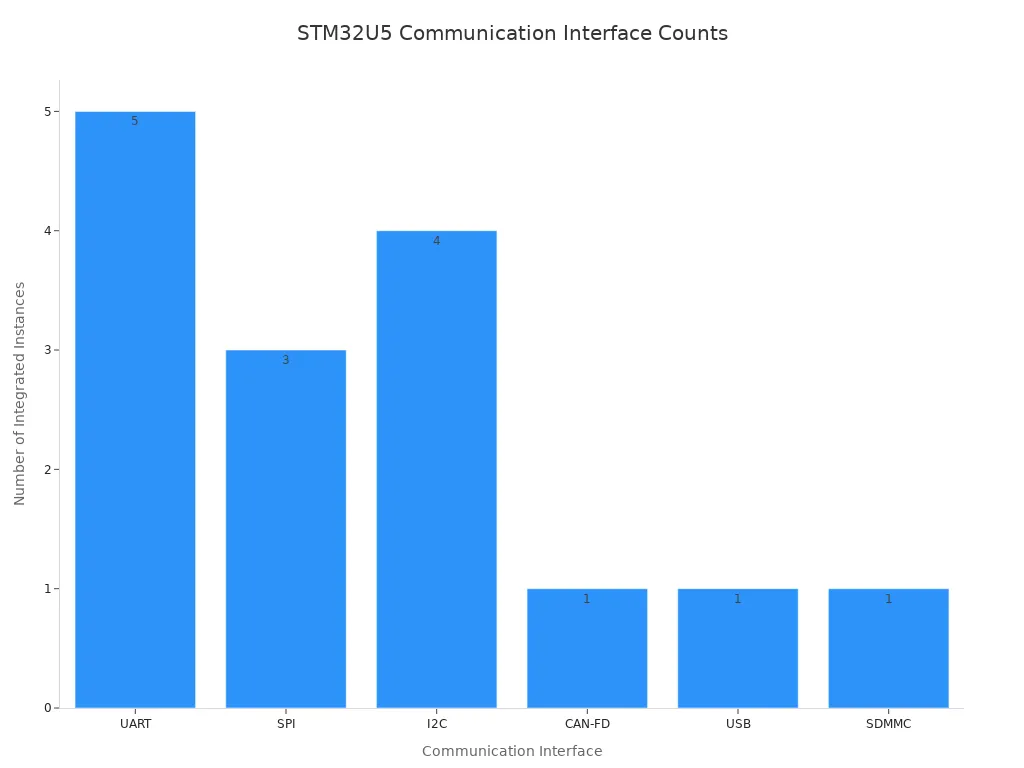
Additional peripherals include a serial-audio interface, a multi-function digital filter, and an audio digital filter with sound-activity detection. Together with the communication interfaces, these peripherals let the mcu handle sensor data and audio without extra chips. A low power mcu with these features cuts board size and cost. The stm32u5 serves smart meters, wearables, and industrial sensors. The stm32u5 delivers low-power operation with strong peripheral coverage.
STM32U5 MCU Low-Power Modes and Security Features
Run, Sleep, Stop, and Standby Modes
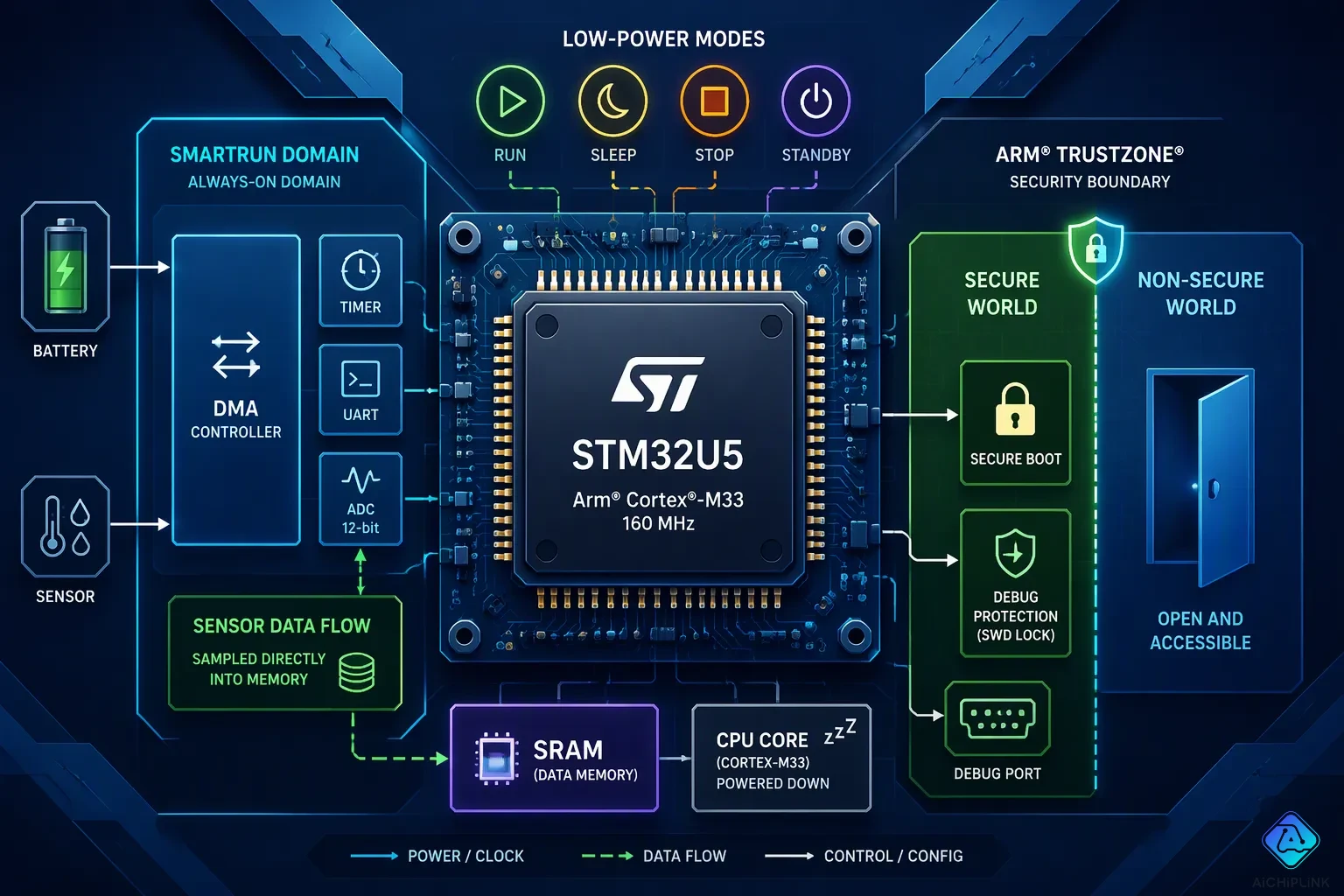
The stm32u5 has several low-power modes that help designers balance speed and power use. Run mode gives full processing power. Sleep mode stops the CPU but keeps peripherals active. Stop modes cut power use even more by gating clocks to most of the chip. Standby mode draws very little current and keeps only essential functions.
Low-Power Background Autonomous Mode (LPBAM) stands out as a key feature. LPBAM keeps DMA and peripherals running on their own in Stop 2 mode without any software running. A 16 kB SRAM buffer supports LPBAM, letting I2C, SPI, serial, and ADC data transfer via LPDMA while the CPU sleeps. This setup can reduce CPU wake-ups to 1/10. Peripheral setups and data transfers happen without waking the CPU, and the CPU only wakes when real work is needed.
The table below summarizes LPBAM support and typical current consumption by low-power mode.
| Mode | LPBAM Support | Typical Current Consumption |
|---|---|---|
| Stop 0 | Fully supported (all LPBAM peripherals available) | Not specified with LPBAM |
| Stop 1 | Fully supported | Not specified with LPBAM |
| Stop 2 | Fully supported (ST-recommended for LPBAM) | Not specified with LPBAM |
| Stop 3 | Not supported | N/A |
| Standby | Not specified | 0.5–1 µA (without LPBAM figure) |
This design gives low power use without losing data. A smart meter can sample a sensor in Stop 2 and wake the CPU only when needed. The stm32u5 does this on its own, which cuts power use in battery-powered products.
TrustZone, Secure Boot, and Debug Protection
Security features in the stm32u5 build on Arm TrustZone for Armv8-M. TrustZone makes secure and non-secure parts for code, data, and peripherals. The stm32u5 also provides a Hardware Unique Key mechanism that can help generate and store keys securely. Cryptographic accelerators are hardened against side-channel analysis, and anti-tampering systems prevent side-channel attacks or other physical intrusions.
The device passed tests for logical, board, and basic physical resistance, confirming substantial cyber protection. It is compliant with Arm Trusted Base System Architecture (TBSA) requirements.
Secure boot and secure firmware update protect the device from unauthorized code. The stm32u5 supports hardware-based security through cryptographic accelerators and secure storage. A hardware unique key stores secrets safely. Anti-tampering systems block side-channel attacks and physical intrusions. Internal monitoring erases secret data when it detects a perturbation attack.
Together, these measures protect the device from remote and physical attacks during development and deployment. The stm32u5 is the first general-purpose mcu to earn both PSA Certified Level 3 and SESIP Level 3. These certifications cover hardware and software implementations that protect code and users from remote and physical attacks. Designers choose this ultra-low-power mcu for payment terminals, medical sensors, and wearables because it combines low-power operation with strong security in one family.
Applications and Selection for the STM32U5 MCU
Battery-Powered IoT, Wearables, and Industrial Sensors
Industrial smart flow meters need a battery powered mcu that can last for years. Health and fitness wearables track heart rate all day long. Medical monitoring devices keep an eye on vital signs. POS terminals depend on built-in security. Smart thermostats help cut heating costs. Access control systems open doors using encrypted codes. Smart lighting adjusts brightness without wasting energy. Environmental sensors report air quality in faraway places.
The stm32u5 also powers asset tracking and indoor localization. IoT tags and outdoor real-time monitoring stations can run for extended periods on small batteries. Smart glasses and sport watches need small boards with efficient chips. These products depend on low-power modes to sleep between readings. The mcu wakes up, samples a sensor, and then sleeps again. This cycle keeps power consumption low. The low power mcu handles these jobs without a big battery.
ST prototyping boards help speed up development. The B-U585I-IOT02A Discovery kit demonstrates the STM32U585AI MCU with smart peripheral resources. It provides a platform for IoT node prototypes.
Variant Selection, Package Compatibility, and Sourcing
Selecting a stm32u5 variant starts with memory. Flash sizes range from 128 kB to 4 MB. Total SRAM is 786 kB with ECC. A separate 16 kB SRAM region supports LPBAM. Larger flash fits complex firmware or data logging. The STM32U585 variant targets payment terminals. It adds AES and TrustZone for secure transactions. Other variants offer different hardware encryption options.
The stm32u5 family includes 24 models with different storage, encryption, and form factors. These low-power mcus share the same Arm Cortex-M33 core and TrustZone security across the family. A WLCSP package suits tiny wearable boards. An LQFP package with more pins works for industrial sensors. Designers must check the official datasheet for temperature grades.
Sourcing the stm32u5 requires authorized distributors. Engineers verify lifecycle status and part availability. Fake chips can lack features that protect deployed products. Engineers confirm part numbers before final designs.
The stm32u5 puts one arm cortex-m33 core, ultra-low-power operation, scalable flash memory, and strong security into a single family. This ultra low power microcontroller works well for battery-powered edge devices. It mixes processing speed with low-power run modes and low-power sleep modes. The stm32u5 family includes 24 models with different storage, encryption, and package form factors. Designers pick a stm32u5 by memory, power modes, security needs, package, and availability. Each low power mcu supports flexible wearable and industrial designs. Bigger product lines can reuse firmware across microcontrollers. Before you finalize, check part numbers, lifecycle status, and supply-chain authenticity through authorized sources. This step protects deployed systems. A proven sourcing path lowers risk and keeps batteries running in the field.

Written by Jack Elliott from AIChipLink.
AIChipLink, one of the fastest-growing global independent electronic components distributors in the world, offers millions of products from thousands of manufacturers, and many of our in-stock parts is available to ship same day.
We mainly source and distribute integrated circuit (IC) products of brands such as Broadcom, Microchip, Texas Instruments, Infineon, NXP, Analog Devices, Qualcomm, Intel, etc., which are widely used in communication & network, telecom, industrial control, new energy and automotive electronics.
Empowered by AI, Linked to the Future. Get started on AIChipLink and submit your RFQ online today!
Frequently Asked Questions
What makes the stm32u5 different from other microcontrollers?
The stm32u5 combines an Arm Cortex-M33 core with very-low-power modes. At 160 MHz, it reaches 240 DMIPS. LPBAM lets peripherals keep running while the CPU sleeps. Strong security comes from TrustZone and PSA/SESIP Level 3 certification. This combo suits battery-powered edge devices.
How does LPBAM reduce power use?
LPBAM means Low-Power Background Autonomous Mode. In Stop 2 mode, DMA and peripherals can run alone. During sensor sampling and data transfers, the CPU stays asleep. A smart meter can collect readings this way. The chip wakes up the CPU only when real work shows up.
Which security features protect code and data?
TrustZone divides secure and non-secure worlds for code, data, and peripherals. Cryptographic accelerators and secure storage guard secrets. Secure boot and secure firmware update block unauthorized code. Anti-tampering systems block side-channel attacks and physical intrusions. Internal monitoring erases secret data during tampering attempts.
Which development boards help engineers start?
ST provides a Discovery kit to help engineers start. The B-U585I-IOT02A Discovery kit demonstrates the STM32U585AI MCU with smart peripheral resources.
How do designers pick the right variant?
When picking, designers compare flash size, SRAM, power modes, security needs, and package type. Flash ranges from 128 kB to 4 MB here. A WLCSP package suits tiny wearables. An LQFP package fits industrial sensors. Buyers should confirm part numbers and lifecycle status with authorized distributors.