Key Heat Exchanger Types and Their Applications
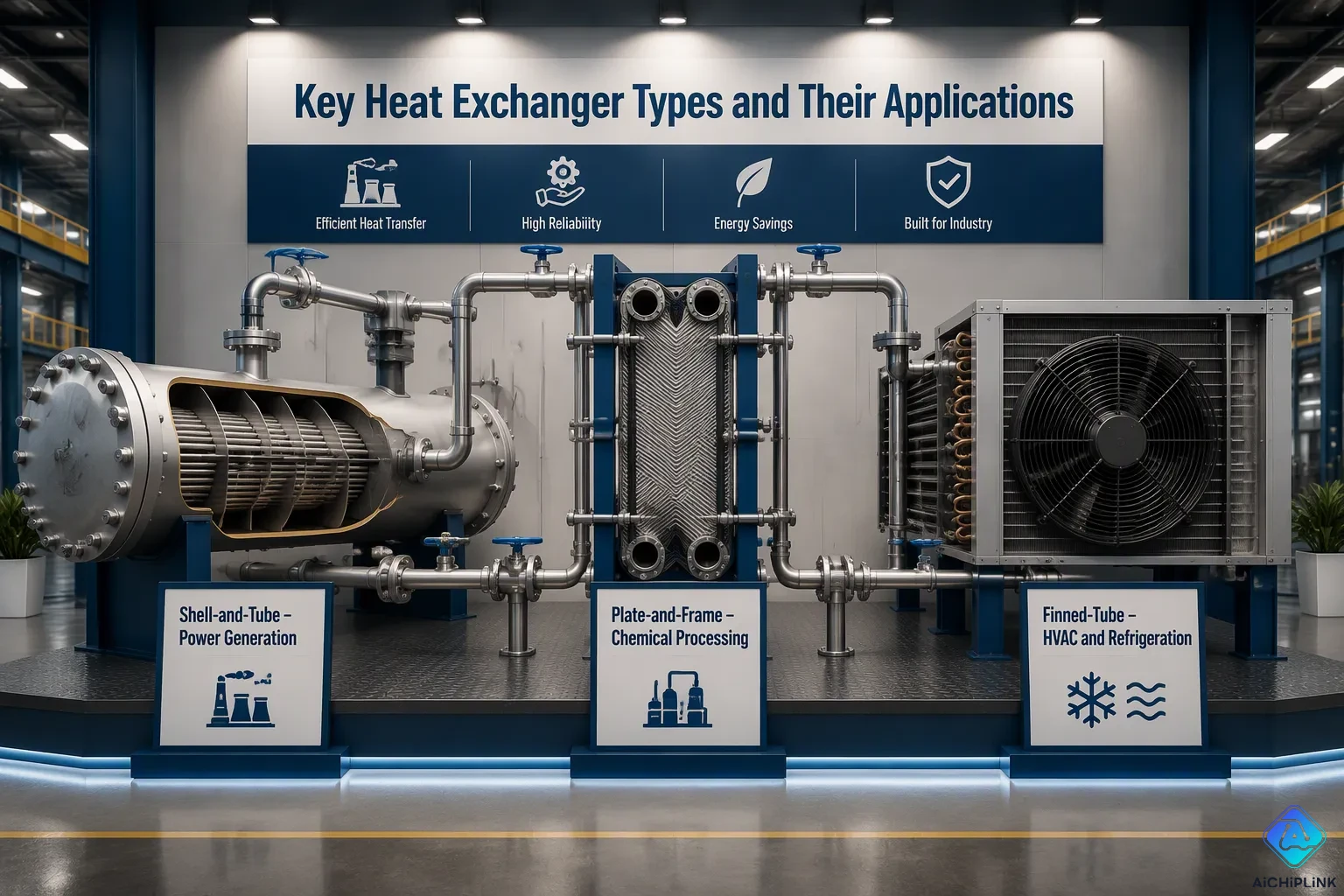
Main designs include shell and tube heat exchangers, plate heat exchangers, double pipe heat exchangers, air-cooled, regenerative, printed circuit, mechanically aided, and direct contact units. Different types of heat exchangers serve heat exchanger applications in HVAC, power generation, chemical processing, and manufacturing.
Heat exchanger types and applications depend on heat transfer. Shell-and-tube heat exchangers lead the USD 19.8 billion heat exchanger market with a 35.5% share. You use double-pipe heat exchangers for smaller heat transfer jobs. Heat exchangers and their applications span oil and gas (18.4%) and food. Air-cooled heat exchangers ease oil, gas, and power plant heat transfer.
Asia Pacific holds 31.7% of revenue; growth runs at a 6.9% CAGR through 2033.
Key Takeaways
-
Shell and tube heat exchangers handle high pressure and temperature. They lead in power and chemical plants.
-
Plate heat exchangers are compact and efficient. They work best in HVAC and food processing.
-
Air-cooled heat exchangers use air to cool fluids. They suit dry areas with little water.
-
Double-pipe heat exchangers are simple and small. They fit tight spaces and low heat loads.
-
Regenerative heat exchangers store and release heat. They recover waste heat in steel and glass plants.
Classifying Heat Exchanger Types
Heat Transfer Flow Arrangements
You can sort heat exchangers by how their fluids move. Parallel flow sends both fluids the same way. Counter flow heat exchangers send fluids from opposite ends toward each other. Cross flow heat exchangers push fluids at right angles to each other.
Each arrangement changes how well heat moves. Counterflow keeps a steady temperature difference across the whole unit, so it gives the biggest temperature change. Parallel flow loses its push quickly because the largest gap is at the inlet. A crossflow heat exchanger works well for gas-liquid duty or condensation, often with baffles to stir turbulence.
| Arrangement | Temperature Profile | Thermal Effectiveness |
|---|---|---|
| Parallel flow | Both fluids exit at similar temperatures | Lower efficiency; cold fluid cannot exceed hot fluid outlet |
| Counterflow | Difference stays high throughout | Best thermal performance |
| Crossflow | Fluids flow perpendicularly | Less efficient than counterflow, but compact |
Medium Phase Classification
You also group heat exchangers by the phase of each medium. Gaseous units handle air, steam, or exhaust gas. Liquid units move water, oil, or chemical streams. The medium matters because gases carry much less heat per unit volume than liquids. A gas-side design therefore needs more surface area to move the same heat transfer load.
This phase split shapes which types of heat exchangers fit a job. Air-cooled and crossflow designs rule gas service. Plate and shell-and-tube units serve liquid duty. Industry standards back up this sorting. TEMA covers shell-and-tube heat exchangers within set limits, including inside diameters up to 100 in and design pressure up to 3000 psi. ASME governs material grades, welding, and hydro testing for the same equipment. Together, these rules help you match a heat exchanger to its medium and duty.
Shell and Tube Heat Exchangers
How Shell and Tube Heat Exchangers Work
A shell and tube heat exchanger has a bundle of tubes inside a round shell. One fluid moves through the tubes, and another moves through the shell. The fluids never mix together. Heat moves through the tube walls. Baffles make the shell-side fluid zigzag across the tube bundle. This redirecting adds turbulence. More turbulence helps heat move better. It also increases pressure loss. You balance these effects with baffle spacing and baffle cut. Closer spacing stops vibration; wider spacing lowers pressure drop. Balanced settings create good crossflow. Window velocity should about match crossflow velocity.
Shell and tube heat exchangers handle high pressure and high temperature. TEMA rules cover shell and tube heat exchangers up to 60 inches wide and 3,000 psi. Builders follow Recommended Good Practice past those limits. Shell and tube heat exchangers fit high-pressure plants best. These heat exchangers move heat between process fluids. Many heat exchangers use the same baffle ideas.
Heat Exchanger Applications in Power and Chemical Plants
Shell and tube heat exchangers make up 35.6 percent of global revenue in heat transfer equipment. Power plants use shell-and-tube heat exchangers as feedwater heaters. Shell-and-tube heat exchangers work as condensers and pre-heaters. Coal plants depend on shell and tube heat exchangers for flue gas recovery. Nuclear stations use shell-and-tube heat exchangers to keep radioactive coolant separate. Chemical plants use shell-and-tube heat exchangers for distillation. Shell-and-tube heat exchangers also handle evaporation jobs. Solvent recovery depends on shell-and-tube heat exchangers. Refineries trust shell-and-tube heat exchangers for hot, corrosive fluids. These shell-and-tube heat exchangers give stable reaction temperatures.
You will find heat exchangers in almost every process plant. Some heat exchangers handle gas jobs. Other heat exchangers manage liquid streams. Such heat exchangers keep processes efficient. These shell and tube heat exchangers show up in acid and polymer lines. Both heat exchangers in a loop share the load. A single heat exchanger can meet both heating and cooling needs. Operators install shell and tube heat exchangers for critical duty. Several heat exchangers run in series in large refineries. Baffle design drives heat transfer performance. Shell and tube heat exchangers stay the leading types for demanding service.
Plate Heat Exchangers
How Plate Heat Exchangers Work
Thin metal plates in a frame form a plate heat exchanger. Rubber gaskets seal edges and route two fluids into alternating channels. The frame and pressure plate squeeze the plate pack. Hot fluid goes through one set of channels, and cold fluid through the next set in reverse. Counter-current flow holds the temperature difference and lets the fluids finish close in temperature.
Each plate is pressed in a herringbone pattern. Opposing patterns create helix-like turbulence. You can vary pressing depth, chevron angle, and corrugation shape to tune performance. Corrugations add stiffness and surface area. They break the laminar boundary layer and improve the convective heat transfer coefficient. A gasketed model lets you add or remove plates when duty changes. Brazed models seal plates together for compact, high-pressure jobs. Both designs give strong heat transfer in a small footprint.
| Aspect | How It Works |
|---|---|
| Counterflow channels | Gaskets seal edges and route fluids into alternating channels; fluids run opposite ways |
| Corrugation patterns | Herringbone pressing creates helix-like turbulence and improves heat transfer |
Applications in HVAC and Food Processing
Plate heat exchangers hit 85–95% thermal efficiency; tubular systems hit 70–85%. They cut heating and cooling energy by up to 30% for the same job. Their high U values and compact size fit tight mechanical rooms in HVAC and refrigeration. The plate pack is easy to expand or modify. Low temperature difference and moderate duty make plate units the best pick.
Food processing needs exact heating and cooling rates. Corrugated plates suit dairy pasteurization, juice processing, and beverage production. They transfer heat 15–20% better than tubular units in typical food use. Sanitary designs drain fully and allow cleaning-in-place. Welded or gasket-free designs remove contamination spots. Smooth surfaces exceed 32 Ra food-contact roughness standards. Gasket-sealed plates come apart for full cleaning and inspection. These features meet FDA rules for sanitization without disassembly and cover HACCP critical control points. Plate-and-frame units remain the top choice for pasteurization and sterilization.
Air-Cooled Heat Exchangers
How Air-Cooled Heat Exchangers Work
An air-cooled heat exchanger takes heat from a hot process fluid and sends it to the open air. A hot fluid, such as water or lube oil, flows through many tubes with fins on the outside. One or more fans push or pull air over those tubes. The fins increase the surface area that touches the air, so heat transfer is as high as possible. This design works well where cooling water is limited or expensive.
You can pick between two fan setups. In a forced draft design, the fan sits before the finned tubes and pushes air through the bundle. This keeps the fan and belt away from hot exhaust air, helps parts last longer, and often uses less energy. In an induced draft design, the fan sits after the tube sections and pulls air through the bundle. This gives steadier airflow and lowers the risk of hot exhaust air being pulled back in.
In a forced draft unit, fans sit below or beside the air cooler bundle and push air upward or across the tubes. This setup makes maintenance easier and brings in cooler air, so cooling is efficient, but recirculation can happen.
Applications in Oil, Gas, and Power Plants
These units are found across heavy industry. Oil refineries use them as overhead condensers on atmospheric and vacuum distillation columns. They also cool refined petroleum products. Variable-frequency drives on the fans give precise temperature control. Gas processing plants use them to cool compressed gas between stages in multi-stage compressors. They also cool lean amine in gas sweetening units. They handle pumped liquids and separator overheads in natural gas liquids recovery.
| Industry | Specific applications |
|---|---|
| Oil refineries | Overhead condensers on atmospheric and vacuum distillation columns; product coolers for refined petroleum streams |
| Gas processing plants | Interstage cooling of compressed gas in multi-stage compressors; lean-amine coolers in gas sweetening units; cooling of pumped liquids and separator overheads in natural gas liquids recovery |
| Power stations | Air-cooled condensers (ACCs) for steam-turbine plants where water is limited or discharge rules prevent wet cooling towers or once-through cooling; A-frame forced-draft design is standard |
Power stations use air-cooled condensers to condense steam-turbine exhaust steam with outside air. This lowers the plant's water use and removes thermal pollution. These units run on air alone, unlike air-cooled and water-cooled heat exchangers that need a wet supply. This freedom is important at remote compression stations. It also matters where discharge rules block once-through cooling. Among all heat exchanger types, this one works best in dry, water-scarce places.
Double-Pipe Heat Exchangers
How Double-Pipe Heat Exchangers Work
A double pipe heat exchanger has two pipes, one inside the other. One fluid moves through the inner pipe. The other fluid moves through the ring-shaped gap between the two pipes. Heat travels through the inner pipe wall, and the fluids never mix. This simple design makes these units easy to build, clean, and maintain.
You can set up flow in two ways. Counterflow sends hot and cold fluids from opposite ends toward each other. Parallel flow sends both fluids in the same direction. Counterflow gives the highest thermal efficiency because it keeps a bigger temperature difference across the whole exchanger.
| Flow Direction | Description |
|---|---|
| Counterflow | Fluids flow in opposite directions through the concentric tubes |
| Parallel flow | Fluids flow in the same direction through the concentric tubes |
Heat moves in three steps. Convection carries heat from the inner fluid to the tube wall. Conduction moves heat through the metal wall. Convection passes heat from the outer wall to the annular fluid. Each step adds resistance. Total resistance sets your overall heat transfer coefficient.
Counterflow gives the highest thermal efficiency because it keeps a bigger temperature difference between the two fluids along the whole length of the exchanger.
These units work with a smaller surface area than shell and tube designs. That limit gives a lower heat transfer rate and weaker performance. Double-pipe units fit low heat loads and tight spaces. Shell-and-tube heat exchangers handle higher pressures, temperatures, and larger surface areas for factory needs.
Applications in Small-Scale HVAC and Manufacturing
Double pipe heat exchangers work well in compact HVAC systems. They fit tight mechanical rooms where larger units cannot. You can change them quickly when your needs change. Add-on sections let you grow from pilot to production easily.
| HVAC Function | Description | Example Fluids |
|---|---|---|
| Chilled Water Cooling | Takes heat out of air or process systems | Water/Glycol–Water |
| Condenser Heat Rejection | Cools refrigerant gas into liquid | Refrigerant–Water |
| Heat Recovery | Moves waste heat from one loop to another | Hot Water–Return Air Loop |
| Oil Cooling in Compressors | Keeps lubrication at the right temperature | Oil–Water |
| De-superheating | Cuts refrigerant superheat before expansion | Refrigerant–Water |
Factories use these units for exact temperature control. They cool compressor oil, treat air-handler coils, and capture waste heat between process loops. Their simple design keeps repair costs low while working reliably.
| Application | Process Description | Benefit |
|---|---|---|
| Chilled Water Loop | Moves heat between process water and chilled water | Energy-efficient cooling |
| Condenser Water Cooling | Cools refrigerant gas into liquid | Increases chiller COP |
| Heat Recovery Unit | Moves waste heat from return air to fresh air | Reduces energy loss |
| AHU Coil Preconditioning | Keeps air inlet temperature steady | Improves indoor air comfort |
| Compressor Oil Cooling | Keeps lubricant at a safe temperature | Protects compressor life |
You will find double-pipe heat exchangers in medicine and biotech work. Their clean stainless steel design and smooth, gap-free surfaces support germ-free operation. Clean-in-place and sterilize-in-place options stop contamination. These features matter for vaccine production, buffer preparation, and fermentation temperature control. For small jobs, pilot plants, and places where cleaning counts, this heat exchanger type stays a reliable choice among the main types.
Regenerative Heat Exchangers
How Regenerative Heat Exchangers Work
A regenerative heat exchanger holds heat in a solid matrix, then gives it off to a cooler fluid. This design is not like most heat exchangers, which move heat through a wall between two fluids at the same time. There are two main designs: the rotary wheel regenerator and the fixed-bed regenerator.
A rotary regenerator uses a spinning matrix that moves nonstop through two separate gas streams flowing in opposite directions. Here is how the cycle works:
-
Hot gas flows through one part of the matrix, heating the matrix material and storing thermal energy.
-
As the matrix spins, the heated part moves into the cold-gas stream, where the cold gas takes in the stored heat.
-
Over a full spin, each matrix part is exposed to both streams in turn, so heat is taken in and given off again and again.
-
Seals keep the streams mostly apart; because the spin is perpendicular to the temperature gradient and flow direction, each matrix part stays nearly isothermal, and the counter-current flow pattern supports high heat-recovery effectiveness.
A fixed-bed regenerator works in cycles instead. Hot gas passes through a stationary matrix until the bed heats up. Then you switch the flow so cold gas passes through and picks up the stored heat. These heat exchangers suit high-temperature waste heat recovery because the matrix handles extreme conditions.
| Heat exchanger type | Thermal efficiency / energy recovery | Relevance to high-temperature waste heat recovery |
|---|---|---|
| Rotary wheel regenerator | 80–90% energy recovery | Suitable for flue gas heat recovery and industrial process air heating; uses stainless steel, aluminum, or specialty alloy matrices. |
| Fixed matrix (fixed-bed) regenerator | 70–90% thermal energy recovery | Extremely robust for high-temperature applications; used in furnace air preheating, flue gas heat recovery, industrial kilns, and chemical reactors. |
Applications in Steel and Glass Manufacturing
Steel plants depend on these heat exchangers to capture heat from furnace exhaust. A fixed-bed regenerator preheats combustion air before it enters the furnace. This step cuts fuel use and raises flame temperature. Rotary units handle flue gas heat recovery across continuous processes.
Glass furnaces run at extreme temperatures for long periods. Regenerative heat exchangers recover heat from exhaust gas and return it to the incoming combustion air. This heat recovery and heat exchangers pairing lowers energy costs and reduces emissions. You will also see these types in chemical reactors and industrial kilns, where durability matters more than compact size.
Printed Circuit Heat Exchangers
How Printed Circuit Heat Exchangers Work
A printed circuit heat exchanger begins with flat metal sheets. Photochemical etching cuts tiny channels, ports, and manifolds into each plate. You stack the etched plates into a block. Diffusion bonding joins the plates without melting them. The bond line matches the parent material. The core acts like a solid block. Pressure capability depends on the thickness of flow-channel ligaments and side walls.
The etching step makes open flow patterns. Diffusion bonding turns the stacked plates into a sealed core. Printed circuit heat exchangers follow a clear build order:
-
Etch a complex flow pattern onto flat sheets.
-
Stack individual plates into a block.
-
Diffusion bond the block in a furnace at high temperature and pressure.
-
Weld multiple blocks together for the required heat transfer area.
-
Weld inlet/outlet manifolds and customer connections onto the core.
-
This design reaches 1,250 bar (18,125 psi) in 304/316 stainless steel.
Diffusion bonding goes through four stages. Surface micro-contact starts the join. Grain boundary migration comes next. Volume diffusion removes pores. Full metallurgical bonding finishes the weld. This process creates strong heat transfer between streams.
A high-quality diffusion bonded PCHE can withstand very high pressures of hundreds of bars and extreme temperatures beyond 800°C. As a result, PCHEs are well suited for a wide range of demanding applications, including oil and gas, hydrogen vehicle fueling stations, and aerospace. — Dr. Udo Broich
Applications in Offshore and Cryogenic Systems
Offshore platforms need heat exchangers that resist corrosion. These heat exchangers handle wet natural gas cooling. Their compact design cuts installation space by up to 80% versus shell-and-tube units.
Cryogenic systems need extreme tolerance. These heat exchangers work from -253°C to above 1000°C. LNG ships use these heat exchangers for boil-off gas reliquefaction. Very large ethane carriers also depend on these heat exchangers. Fifteen ultra-large 98,000 m³ VLECs use PCHEs in reliquefaction systems. These heat exchangers give steady heat transfer at cryogenic temperatures. Receiving stations use these heat exchangers to cut gas losses.
These heat exchanger types handle high pressure and cryogenic duty. The core handles both streams at peak design pressure and temperature. Every core delivers efficient heat transfer.
Mechanically Aided Heat Exchangers
How Mechanically Aided Heat Exchangers Work
Mechanically aided heat exchangers use moving parts to stir the fluid or scrape the heat transfer surface. This movement fixes a common problem. Thick fluids stick to surfaces and form a layer that blocks heat transfer. A spinning blade or scraper keeps removing that buildup. The surface stays clean, so heat moves freely.
You will find several designs in this family. Each one uses a different mechanical action.
| Heat Exchanger Type | Mechanical Agitation Mechanism | Intended Fluid/Product Type | Key Features |
|---|---|---|---|
| Single-wall scraped surface heat exchanger | Rotating scraping blades | Medium- to high-viscosity products | Handles viscous, sticky, crystallizing, heat-sensitive products; vertical or horizontal installation; gentle low-shear handling |
| Double-wall scraped surface heat exchanger | Rotating scraping blades | Demanding, high-viscosity applications requiring higher capacity | Boosts capacity while maintaining gentle, hygienic product treatment; handles extremely high product pressures |
| Scraped surface heat exchangers (general) | Rotating blades that continuously remove buildup from heat transfer surfaces | Viscous, sticky, crystallizing, particulate-rich, or heat-sensitive materials | Prevents fouling; maintains thermal efficiency; CIP-suitable; hygienic stainless-steel design |
The scraping action does more than clean the wall. It also creates turbulent flow that disrupts boundary layers on the fluid surface. This turbulence produces higher heat transfer coefficients and improves overall efficiency.
Unlike traditional models that risk fouling and thermal inefficiency with viscous or crystallizing materials, scraped surface heat exchangers use rotating blades to remove buildup from heat transfer surfaces continuously.
Applications in Viscous Fluid Processing
These heat exchangers work great in food processing. Minced meat, sauces, and dairy products stick to surfaces during heating. A standard heat exchanger would lose efficiency fast. The scraper design solves this problem and reduces product losses.
Normally, when processing dense, viscous or sticky products such as minced meat, a certain amount will adhere to surfaces. This greatly reduces heat transfer, meaning that longer exposure is required to compensate. With its clever scraper design the R Series overcomes this problem, and also reduces product losses which can soon add up.
Chemical and pharmaceutical plants also depend on these units. They handle crystallizing materials and heat-sensitive compounds that would foul other types of heat exchangers. The rotating scraper keeps the surface clean, so the unit maintains heat transfer performance for longer periods without frequent cleaning. This reduces downtime and operating costs. You get a more energy-efficient system than conventional heat exchangers can offer.
Direct Contact Heat Exchangers
How Direct Contact Heat Exchangers Work
A direct contact heat exchanger puts two fluid streams together in one place. Nothing solid stands between them. The fluids share mass and energy right away. This contact makes heat move quickly between the streams. Indirect heat exchangers use a metal barrier to keep their streams apart. That barrier slows down heat transfer and lowers efficiency.
A heat exchanger is like two water pipes side by side with a thin copper wall between them. A mixing chamber is like a Y-junction in plumbing: the streams join and leave as one flow.
Direct steam injection (DSI) heaters show this idea clearly. Steam goes into the liquid stream and turns to liquid, giving off hidden heat at once. Nothing blocks the process, so thermal efficiency gets close to 100%. DSI moves almost all the heat because steam touches the product directly. The mass flow going in equals the mass flow going out in a mixing chamber. Both heat exchangers and mixing chambers run at steady state.
| Feature | Direct Steam Injection | Indirect Heat Exchanger |
|---|---|---|
| Heating Speed | Instantaneous | Moderate to slow |
| Thermal Efficiency | ~100% | Lower |
| Steam Contact | Yes | No |
| Product Dilution | Yes | None |
| Maintenance | Lower | Higher |
Applications in Cooling Towers and Desalination
Cooling towers use direct contact heat exchangers every day. Hot exhaust air meets a cold water stream; the air takes in heat, and the cooled water comes back for reuse. In another design, hot process water sprays into the air, and nearby air picks up heat as the water drops. These heat exchangers move large thermal loads with simple equipment.
Thermal desalination plants count on direct contact heat exchangers for the same job. In multi-effect distillation systems, hot brine mixes with cooling water in direct contact heat exchangers. The direct mixing boosts heat transfer during evaporation and condensation. This process takes out salt and makes fresh water. These heat exchangers handle high salinity without clogging a barrier surface.
Direct contact heat exchangers fit jobs where mixing is okay. These types work best when the two fluids can join safely. If contamination or purity is a concern, pick an indirect design. The right choice depends on your process goals.
Heat Exchanger Applications by Industry
HVAC and Refrigeration
You will find brazed plate units in small chillers, heat pumps, and refrigeration skids. These units act as evaporators and condensers in water-cooled systems. Semi-welded plate heat exchangers handle ammonia evaporators in industrial refrigeration and cold stores. Full welded plate units serve high-pressure jobs where gaskets fail. Spiral heat exchangers manage fouling-prone fluids in wastewater and sludge. Shell and tube heat exchangers stay common in larger flooded chillers and marine systems. Each type matches the refrigerant, pressure, and space you have.
Your choice depends on flow arrangement, medium, and duty. A brazed plate unit saves space but cannot be serviced. A shell-and-tube unit costs more but handles high pressure. Double pipe heat exchangers fit small HVAC rooms where larger units cannot go. Double-pipe heat exchangers also cool compressor oil and recover waste heat. These types of heat exchangers keep heat transfer efficiency high in tight spaces.
Power Generation and Manufacturing
Power plants depend on shell and tube heat exchangers for steam cycle processes. Condensers turn steam back into water for reuse. Boilers and evaporators form steam for the cycle. Gasketed plate heat exchangers improve steam cycles and cool lube oil across turbines, transformers, and generators. Welded block heat exchangers give a durable, low-maintenance option for petrochemicals. Shell and plate heat exchangers deliver high pressure and thermal efficiency in a smaller footprint.
Manufacturing plants use plate heat exchangers for process heating and cooling. Cooling jackets use chilled water as a heat sink. Heating jackets use steam as a heat source. Condensers reject heat in distillation columns and air conditioning. Evaporative coolers serve oil refineries and chemical plants. Shell-and-tube heat exchangers cool exhaust gases and refractory walls in steel and glass production. This heat recovery and heat exchangers pairing lowers energy costs. The applications of heat exchangers by industry show one clear rule: match the unit to your flow, medium, and pressure needs.
Different heat exchanger types solve different heat transfer problems. Shell-and-tube heat exchangers handle high pressure in power plants. Plate heat exchangers serve HVAC and food lines. Air-cooled heat exchangers suit water-scarce oil and gas sites. Double-pipe heat exchangers fit compact loops. Regenerative heat exchangers recover furnace waste heat. Printed circuit heat exchangers manage cryogenic offshore duty. Mechanically aided heat exchangers process viscous fluids. Direct contact units drive cooling towers. You can choose a design by flow arrangement, medium, and pressure to achieve efficient heat transfer and stable operation. That practical map of heat exchangers and their applications clarifies heat exchanger applications across industries.

Written by Jack Elliott from AIChipLink.
AIChipLink, one of the fastest-growing global independent electronic components distributors in the world, offers millions of products from thousands of manufacturers, and many of our in-stock parts is available to ship same day.
We mainly source and distribute integrated circuit (IC) products of brands such as Broadcom, Microchip, Texas Instruments, Infineon, NXP, Analog Devices, Qualcomm, Intel, etc., which are widely used in communication & network, telecom, industrial control, new energy and automotive electronics.
Empowered by AI, Linked to the Future. Get started on AIChipLink and submit your RFQ online today!
Frequently Asked Questions
Which heat exchanger works best for high-pressure jobs?
Shell and tube units handle the toughest pressure. TEMA rules cover them up to 3,000 psi. Printed circuit heat exchangers reach even higher limits. They withstand 1,250 bar in stainless steel. Both types keep fluids separate under extreme conditions.
Why do food plants prefer plate heat exchangers?
Plate units reach 85–95% thermal efficiency. In food use, they move heat 15–20% better than tubular units. Their smooth surfaces meet food-contact roughness rules. You can open gasketed models to clean them fully. These features help with pasteurization and sterilization.
When should you pick an air-cooled heat exchanger?
Pick air-cooled units where cooling water is scarce or costly. Power stations use air-cooled condensers to cut water use. Oil refineries run them as overhead condensers. Gas plants cool compressed gas between stages. These heat exchangers work well in dry, remote locations.
What makes regenerative heat exchangers different?
Regenerative units store heat in a solid matrix. Later, they release that heat to a cooler fluid. Rotary wheels recover 80–90% of energy. Fixed-bed regenerators handle 70–90%. Steel and glass plants use them to preheat combustion air and cut fuel costs.
Can one heat exchanger type serve every industry?
No. Each type fits specific duties. Shell and tube units lead power and chemical plants. Plate units serve HVAC and food lines. Air-cooled units suit water-scarce sites. Your choice depends on flow arrangement, medium, and pressure needs.